
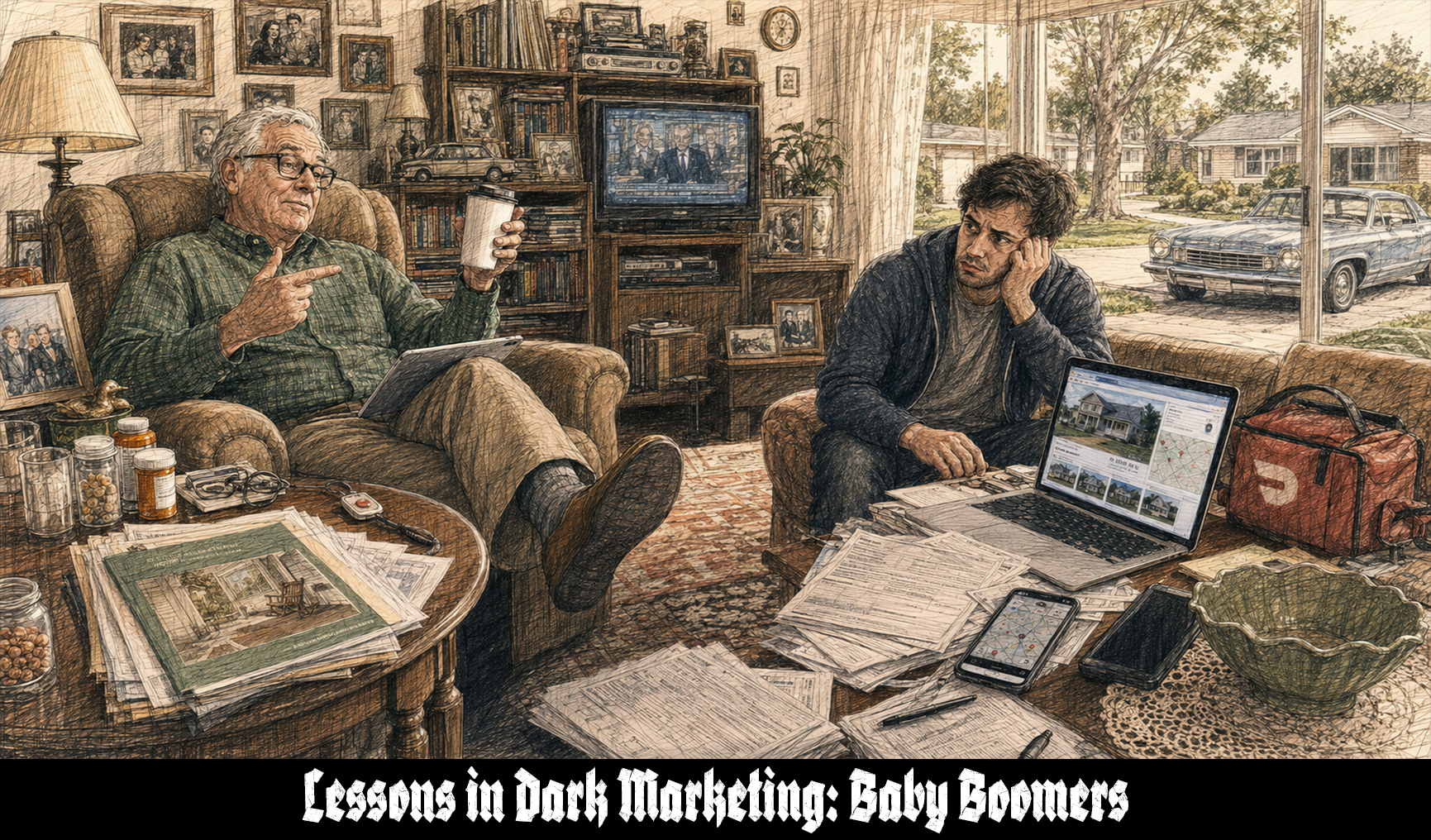
There is a particular American room that tells you almost everything you need to know about the Baby Boomer argument. The house was purchased decades ago. The mortgage may already be gone. Property taxes are a recurring complaint, although Zillow keeps insisting the place is worth an amount that would have sounded like lottery winnings when the keys first changed hands. Somewhere nearby sits a pension statement, a Social Security notice, a Medicare card, or an investment account that has spent years riding American asset markets upward. Cable news murmurs from the television. Facebook is open on an iPad. The refrigerator has pictures of grandchildren who are postponing children of their own because daycare now costs roughly one kidney and the deed to a small Caribbean island.
Then somebody in this comfortable little command center explains that young people can’t buy houses because they order too much DoorDash. Welcome to the Baby Boomers. Born from 1946 through 1964, the Baby Boomers were never going to pass quietly through American history. There were too many of them. The U.S. Census Bureau describes the postwar Baby Boom as one of the largest generational surges in American history, a demographic bulge big enough to remain visible as it moved through the population decade after decade.
Schools expanded around them. Universities expanded around them. Suburbs expanded around them. Consumer industries chased them. Politicians courted them. Employers planned around them. Eventually retirement, pharmaceutical, healthcare and financial companies started preparing for the exact same human wave, except this time it arrived with grayer hair and considerably better credit.
Boomers didn’t invent demographic marketing, but they gave American capitalism one hell of a demonstration of what happens when a massive generation moves through roughly the same life stages together. The babies needed diapers. The children needed cereal and toys. The teenagers wanted records, clothing and cars. The young adults wanted apartments, houses, furniture and appliances. Parents needed insurance, mortgages, family vehicles and ways to feed everybody after work. Middle age brought investments, exercise equipment and increasingly expensive ways to pretend middle age wasn’t happening. Retirement brought cruises, financial planning, pharmaceuticals, medical-alert products, reverse mortgages and an entire industry built around the terrifying realization that the people who once thought thirty was ancient were now receiving Medicare mailers.
The customer aged. The sales pitch aged with them. That is where the Baby Boomer story becomes a Lessons in Dark Marketing story.
The Generation That Arrived With a Tailwind
Baby Boomers were born into an America enjoying circumstances that were historically unusual. The United States emerged from World War II with immense industrial capacity, comparatively little physical destruction at home, expanding suburban development, major infrastructure investment, strong organized labor, growing access to higher education and an economy increasingly capable of turning factory production into middle-class consumption.
None of that prosperity was distributed equally. A Black family navigating segregation, redlining and housing discrimination did not inherit the same postwar America as a white family buying into a newly developed suburb. Women faced professional restrictions that would look astonishing today. Poverty remained widespread. Rural communities lived differently from prosperous metropolitan ones. Plenty of Boomers grew up with little money, and plenty remained financially insecure throughout their lives.
That complexity matters because generational averages aren’t individual biographies. The seventy-year-old still working a cash register because Social Security doesn’t cover rent doesn’t need somebody explaining how easy her generation supposedly had it. Historical advantage wasn’t a magic coupon handed to every American born during a nineteen-year period.
The larger economic environment still matters. For a substantial portion of the American middle class, the basic milestones of adulthood were materially more attainable than they later became for many of the generations following them. College was dramatically cheaper. Traditional defined-benefit pensions were more common. Union membership was far higher. Stable long-term employment was more culturally normal. Housing could still function primarily as somewhere to live before decades of appreciation turned it into one of the largest financial assets owned by American households.
A middle-class family could plausibly imagine that working, saving and waiting would eventually produce a house, children and retirement. That became the Boomer promise: follow the instructions and the system should work. The remarkable thing is that, for millions of them, it did.
The American Dream Came With Assembly Instructions
The Boomers inherited one of the clearest versions of the American Dream ever marketed. Finish school, find a job, get married, buy a house, raise children, accumulate equity, stay employed, retire and leave the next generation better off than you were. It wasn’t universally available and it certainly wasn’t effortless, but it was coherent enough to become a national expectation.
That coherence matters because people naturally build explanations around outcomes they personally experienced. If you worked hard and the expected milestones appeared, it’s easy to conclude that the milestones appeared because you worked hard. The overtime was real. The sacrifices were real. The miserable boss was real. The years of carefully paying the mortgage were real. Nobody likes being told that timing also played a role because timing feels like an insult to effort. It isn’t. Hard work and structural advantage can exist in the same biography without canceling each other out.
Higher education illustrates the problem. National Center for Education Statistics data show that average tuition and required fees at public four-year institutions were dramatically lower, even after adjusting for inflation, during the decades when Boomers were entering adulthood than they became later. In 1963–64, public four-year tuition and required fees averaged the equivalent of roughly $2,400 in 2023–24 dollars. By 2023–24, the figure for tuition was several times higher.
College could still require sacrifice without requiring the kind of debt burden that later became normalized for Millennials. The educational ladder existed, and access remained deeply unequal, but the price of stepping onto it was different.
Housing followed a similar trajectory. Boomers did not buy homes for three nickels and a carton of Lucky Strikes, despite how generational arguments sometimes sound. Inflation mattered. Wages mattered. Mortgage rates mattered. Anyone buying during the brutal interest-rate environment around the late 1970s and early 1980s could tell you exactly how unpleasant borrowing money became.
Yet homeownership also became one of the great engines of Boomer wealth. Once a household successfully entered the housing market, decades of appreciation could transform an ordinary family home into an asset worth several times what the owners originally paid. The work used to buy the house was real. The appreciation wasn’t generated because somebody mowed the lawn with exceptional moral character.
Television Raised America’s First Great Mass-Market Generation
Boomers were the first enormous American generation raised alongside television as an ordinary household medium. Advertisers suddenly possessed something earlier marketers could only fantasize about: a glowing salesman sitting directly inside the family living room.
Television didn’t just show products. It demonstrated entire lifestyles. The smiling family used the right detergent. Dad drove the correct car. Mom had the proper appliance. The children ate the approved cereal. The right mouthwash could rescue your social life. The right deodorant could prevent humiliation. The right kitchen cleaner demonstrated that somebody was properly performing motherhood.
The product stopped being just an object. It became evidence that you were operating your life correctly. That distinction is fundamental to dark marketing. Selling somebody a washing machine earns money once. Convincing somebody that the state of her laundry says something about her competence as a wife and mother creates an emotional vulnerability capable of supporting an industry.
My released case studies on Jell-O Molds, Tang, TV Dinners and Tupperware Parties all live inside this same cultural machinery. Cheap gelatin became domestic creativity. Powdered orange sugar borrowed the glow of the space program. Frozen dinners turned convenience into modern living. Plastic storage bowls became friendship, domestic competence and suburban sales theater.
The products were different, but the larger lesson was the same. Modern life could be purchased one box, tray, bowl, appliance and branded ritual at a time.
Boomers didn’t invent keeping up with the Joneses. Television introduced the Joneses to the entire country at once.
The Generation That Questioned Authority Eventually Became the Authority
This is where any cheap caricature of the Baby Boomers falls apart. Their generation participated in extraordinary cultural upheaval. Boomers came of age amid the civil rights movement, antiwar activism, second-wave feminism, environmental activism, new forms of journalism, dramatic changes in popular music, changing attitudes toward sexuality and a widespread suspicion of inherited authority.
Young Boomers weren’t famous for quietly accepting whatever their elders told them. They challenged institutions, parents, politicians, corporations, universities and social conventions that previous generations had treated as permanent. Sometimes they were courageous. Sometimes they were reckless. Sometimes they were simply twenty-two years old and having an excellent time while claiming the revolution would begin immediately after the concert.
The cultural effect was still enormous. Boomers helped make American life more open in important ways. They participated in expanding civil rights, environmental protections, women’s professional opportunities and personal freedoms. They produced transformative music, films, technology, journalism, literature and entrepreneurship. They helped move environmental contamination, consumer safety and government abuse from things respectable people quietly tolerated into subjects Americans were increasingly willing to confront.
Marketing, of course, noticed the rebellion almost immediately. The tobacco industry offered one of the cleanest examples. Virginia Slims demonstrated how quickly a legitimate movement for women’s independence could be repackaged into product positioning. Liberation became a sales hook. Rebellion became branding. A cigarette could wear feminism like an accessory while continuing to sell addiction underneath it.
That wasn’t an accidental side effect of the era. It was a preview of what American marketing would get much better at doing later: wait for consumers to develop an identity, then sell them products that appear to validate it.
Then something deeply funny happened to the Boomers themselves. They got older. The protesters became professors. The anti-establishment kids became executives. The longhairs joined corporate boards. The generation famous for questioning authority gradually became the authority, and “Don’t trust anyone over thirty” suddenly seemed to lose some of its charm once everybody saying it had crossed seventy.
That transformation gives us one of the central contradictions of the Baby Boomer story. They understood perfectly well that institutions could become self-serving when controlled by older generations. Too many somehow became considerably less interested in that insight once their own generation occupied the offices. Funny how complicated radical philosophy gets once your name is on the deed.
What Baby Boomers Got Right
Boomers deserve considerable credit before the knives come out. They participated in extraordinary technological, social and cultural changes and proved remarkably adaptable across their lifetimes. They moved from rotary phones to smartphones, paper ledgers to online banking, three television networks to streaming services, typewriters to cloud computing and handwritten checks to tapping a watch against a cash register.
That doesn’t happen automatically. They also created and supported enormous advances in medicine, computing, entertainment, entrepreneurship and professional life. Millions spent decades working difficult, dangerous, physical or monotonous jobs. They raised families through inflation, recessions, layoffs, plant closings and social upheaval. Many watched industries disappear around them. Many lost pensions or savings. Many were devastated by the financial crisis. Plenty reached retirement with nowhere near the security the stereotype assumes.
A generational profile becomes worthless if praise is withheld because it complicates the prosecution. Boomers accomplished extraordinary things. They also developed a remarkable talent for forgetting how much the playing field changed after they crossed it.
When Good Timing Becomes a Personality Trait
This is where Boomer self-mythology starts doing expensive work. People remember effort more vividly than structural conditions because effort has a face. You remember getting up at five in the morning. You remember overtime. You remember skipping vacations. You remember the mortgage payment that made you nervous. You don’t personally remember the zoning restriction that didn’t exist yet, the tuition increase that hadn’t happened yet, the pension benefit somebody negotiated decades before you arrived or the housing appreciation that wouldn’t become obvious until twenty years later.
Structural advantage becomes background scenery while personal effort becomes the plot. Over time, the story can turn moralistic. Homeownership demonstrates responsibility. Retirement savings demonstrate discipline. A stable career demonstrates loyalty. Paying off a mortgage demonstrates sacrifice. Those qualities absolutely matter, but once they become the entire explanation for success, anyone lacking the outcome starts looking like they must have lacked the virtue.
That is how complicated economic changes get reduced to coffee, avocado toast, delivery apps and whatever tiny consumer purchase older commentators decide caused the housing crisis this week. The criticism usually sounds reassuringly simple. Young people spend too much. They change jobs too often. They don’t know how to sacrifice. They want everything immediately. They need to stop buying stupid things and learn the value of hard work. At some point the economic analysis has quietly transformed into an old man yelling at a cloud.
The Ladder Was Real. So Was What Happened to It.
This is the section Boomers tend to hear as an accusation against every human being born between 1946 and 1964. It isn’t. No serious analysis can stamp “PROPERTY OF BABY BOOMERS” across every economic problem in modern America. De-industrialization, outsourcing, work visa body-shops, globalization, financialization, changing technology, public policy, corporate decisions, suburban development, tax policy, declining union membership and changing retirement systems involved multiple generations, political parties, institutions and decades of decisions.
Boomers didn’t personally hold a secret meeting in 1987 and decide Millennials should someday need three jobs and a roommate to afford a two-bedroom apartment. That doesn’t mean nobody was in charge while the country changed.
During the decades when Boomers became America’s dominant managerial, professional, homeowner and political-age cohort, many institutions that had supported portions of the postwar middle class weakened or transformed. Bureau of Labor Statistics data show union membership among wage and salary workers falling from 20.1 percent in 1983, the first year with comparable data, to 10 percent in 2025. Retirement systems also shifted increasingly from defined-benefit pensions toward defined-contribution plans such as 401(k)s, transferring more investment responsibility and risk to individual workers, a change documented for decades by the Government Accountability Office.
Higher education became more expensive. Housing became an increasingly valuable financial asset. Employment relationships became less secure in many sectors. Boomers didn’t cause every one of those transformations, and plenty of individual Boomers fought them. They also spent decades occupying an enormous share of the electorate while gradually taking leadership positions throughout government, business, education, media and local institutions.
At some point, “We personally caused everything” and “We had nothing to do with anything” become equally ridiculous. The stronger indictment sits between them.
Many of the economic arrangements that helped significant portions of the Baby Boomer generation build security weakened during the same long period in which that generation accumulated extraordinary cultural, political, professional and financial influence. Acknowledging that isn’t generational hatred. It’s remembering who was old enough to be in the room.
The House Became an Investment, and the Door Got More Expensive
Housing may be the cleanest example of the entire generational contradiction because an American house performs two jobs that eventually start fighting with each other. It is somewhere to live, and it is an appreciating asset. Those functions get along beautifully when you already own one. They become considerably less friendly when your adult child is trying to buy one.
For millions of Boomers, home equity became a major source of household wealth. That created a perfectly rational incentive for homeowners to care about preserving property values. The trouble begins when millions of individually rational preferences combine into collective scarcity.
Everybody likes affordable housing in theory. Then somebody proposes apartments nearby and suddenly there are concerns about traffic. Higher density raises questions about neighborhood character. Smaller lots threaten the feel of the community. Accessory dwelling units create parking concerns. New housing near transit might affect property values.
Nobody needs to stand on the sidewalk twirling a mustache and announcing that younger people shall never own property. Everybody simply protects what they already own. The market handles the rest.
This is how the ladder gets pulled upward without anyone physically grabbing the ladder. The American Dream became an appreciating investment vehicle, and appreciating investment vehicles work especially well when the next customer has to pay more than the previous one. That is wonderful when you’re selling. It’s considerably less charming when the buyer shares your last name.
The Old Price Story Usually Leaves Out Half the Math
Every generational housing argument eventually produces somebody who remembers paying an amount for a house that now sounds like the price of an meagerly optioned salvage title Ford Probe. That anecdote is usually followed by somebody younger losing their mind. Both sides skip important parts.
Historical home prices have to be considered alongside wages, inflation, mortgage rates, location, housing supply, household composition, taxes and lending conditions. Some Boomers bought during periods of extraordinarily high interest rates. Pretending everyone in 1981 wandered into a bank and received a 3 percent mortgage on a suburban palace is just reverse nostalgia.
The important difference is what happened after purchase. A household that successfully bought property decades ago could benefit from long-term appreciation while paying down a fixed mortgage. The monthly cost could become more manageable relative to income while the underlying asset became substantially more valuable.
That doesn’t mean the owner didn’t earn the money used to make the payments. It means the house participated in the wealth building. There is no shame in that. The bullshit arrives when accumulated appreciation gets rewritten as proof that younger people simply don’t know how to work.
From Pension to Portfolio: Congratulations, You’re the Benefits Department Now
The transformation of retirement offers another window into how much the economic environment changed. Earlier generations of workers were more likely to encounter retirement systems combining Social Security, employer pensions and personal savings. Over time, employer-sponsored retirement increasingly shifted toward defined-contribution accounts such as 401(k)s, placing more responsibility for investment decisions, market risk and long-term planning on individual workers.
Boomers straddled both systems. Some received traditional pensions. Many participated in 401(k)s. Some received both. Others received neither. Corporations and small businesses discovered another profitable truth along the way: retirement itself could become a massive consumer category.
Financial advisers, mutual funds, brokerages, annuities, life insurance, reverse mortgages, Medicare products, retirement communities, cruises, pharmaceuticals, long-term-care products and estate planning all became parts of an aging demographic marketplace.
The same people who had once been sold breakfast cereal now needed completely different emotional triggers. Childhood marketing could run on desire. Adulthood ran heavily on status and security. Retirement offered something even stronger: preservation.
Are you saving enough? Will your money last? What happens if you get sick? What happens if you fall? What happens if you become a burden to your children? The customer hadn’t changed nearly as much as the fear being placed in front of them. That is lifetime demographic marketing at its purest.
The Youth Generation Discovers That Youth Has an Expiration Date
There was something almost inevitable about what happened when the generation associated with modern youth culture started aging. American marketing immediately offered assistance. Hair restoration, hair color, diet programs, home fitness equipment, cosmetic procedures, anti-aging creams, sexual-performance medication, luxury vehicles, motorcycles, active-adult communities, adventure travel and an endless parade of products promising that whatever number was printed on your driver’s license didn’t reflect the age you actually felt.
Fifty became the new forty. Sixty became the new fifty. Eventually everybody was allegedly twenty years younger than they actually were, which raises the question of where the real old people went. Wanting to remain healthy, attractive, active and sexually alive isn’t ridiculous. Those are perfectly human desires.
That’s exactly why they’re profitable. Beauty marketing had already spent decades teaching women that social acceptance could be found inside a bottle, compact or catalog. Avon Calling showed how beauty anxiety could be delivered directly through the front door by someone who looked less like a corporate salesperson and more like a neighbor. As Boomers aged, that same commercial logic didn’t disappear. The anxieties changed from fitting in and looking fashionable to looking younger, remaining desirable and proving that aging hadn’t somehow removed you from the market.
A generation that partly defined itself through youth culture presented marketers with an emotional vulnerability that could be followed for decades. Old was what happened to somebody else’s parents. You were simply experiencing an unexpected shortage of collagen.
When Aspiration Runs Out, Sell Fear
Marketing changes when the customer acquires something to lose. A young adult can be sold possibility. An older consumer can be sold preservation. Protect the house. Protect the savings. Protect the health. Protect independence. Protect yourself from crime. Protect yourself from fraud. Protect yourself from falling. Protect your family from funeral expenses. Protect your retirement against the terrifying possibility that retirement lasts longer than expected.
Many of the products serving these needs are genuinely valuable. Medical-alert devices can save lives. Insurance can prevent catastrophe. Financial planning can protect families. Home-security systems can provide real safety. That legitimate value is what makes the darker marketing surrounding these categories so effective.
The Life Alert case study sits directly inside this world. “I’ve fallen, and I can’t get up” became culturally immortal because it touched something deeper than slapstick. Aging threatens independence, and independence sits near the center of the Baby Boomer identity. The product addressed a real danger while the sales machine enlarged that danger into fear, guilt and recurring subscription logic. The marketing machine didn’t invent mortality. It learned how to invoice it.
Then the Internet Handed Everybody a Printing Press
Boomers entered the digital information environment with habits built during a completely different media age. For most of their lives, professionally distributed information arrived through recognizable gatekeepers. Newspapers looked like newspapers. Television news looked like television news. Advertisements usually looked like advertisements. Producing convincing mass media required resources.
Even something like Reader’s Digest existed inside a recognizable publishing hierarchy. It could compress information, amplify fear, reinforce middle-class morality and turn complicated subjects into reassuringly digestible narratives, but readers still understood that a publication had produced the material.
The internet flattened those signals. A conspiracy blog could visually imitate a news organization. A meme could circulate without a source. A stranger with basic graphics software could manufacture an image, attach quotation marks to something nobody ever said, add the logo of a legitimate institution and have the whole thing circulating through Facebook before dinner.
A generation trained to evaluate twentieth-century signals of credibility suddenly entered an environment where those signals could be copied by anyone. That didn’t make Boomers uniquely gullible. It made them valuable targets.
The FBI reported more than 201,000 internet-crime complaints from victims over sixty in 2025, with reported losses exceeding $7.7 billion. Older Americans frequently possess exactly what scammers want: accumulated savings, home equity, retirement accounts and enough financial history for fear to have something concrete to threaten.
The emotional mechanics of the scam remain astonishingly old-fashioned. Fear, urgency, authority and familiarity still work. The technology just makes finding victims cheaper.
Some digital marketing jagoff eventually figured out that a familiar corporate logo, a frightening message and a countdown clock could do a remarkable amount of psychological work. The medium changed. The manipulation barely had to.
Facebook: Where the Mass-Media Generation Met Personalized Reality
There is a peculiar irony in watching a generation raised on national television enter the world of personalized algorithmic feeds. Television had to show millions of people roughly the same thing. Social media can learn what keeps one particular person clicking.
That represents an enormous evolution in persuasion. Facebook didn’t invent confirmation bias, tribalism, nostalgia or outrage. It gave those tendencies industrial-scale distribution. Content telling people their generation was smarter, tougher, more independent and less sensitive than everyone afterward had an obvious emotional advantage because flattery has always been one of marketing’s cheapest ingredients.
The same mechanism works with fear. Crime is worse. Children are weaker. The country is collapsing. Nobody wants to work. Everything familiar is disappearing. The feed always has another piece of content ready to explain why.
Boomers didn’t create algorithmic persuasion by themselves. They became one of its valuable audiences, and the system learned from their clicks just as it learned from everybody else’s. Television once told an entire generation what to want. The feed eventually learned what each person already wanted to believe.
Nostalgia Becomes a Retirement Community for the Mind
Every generation eventually becomes nostalgic, but Boomers became one of the first enormous cohorts whose nostalgia could be monetized across nearly every imaginable consumer category. Classic rock, muscle cars, vinyl records, reunion tours, Route 66, old television, retro diners, cruises, collectibles and endless cultural revivals turned memory into an economy.
Nostalgia works because it remembers emotion more accurately than circumstance. The music really was great. Your knees really didn’t hurt. Your parents were alive. Your friends lived nearby. Summer felt endless because you hadn’t yet discovered quarterly tax estimates. The past becomes warmer because memory edits aggressively.
Marketing doesn’t need to correct the edit. It monetizes it. Buy the record. Take the cruise. See the reunion tour. Restore the car. Watch the reboot. Move to the community that promises the lifestyle you remember.
Nostalgia can even sell an entire worldview because “things were better then” doesn’t require the past to have objectively been better. It requires the customer to remember feeling better. That’s a far easier product to manufacture.
The Self-Mythology Machine
Every generation eventually writes a flattering autobiography. Boomers had enough cultural influence to get theirs syndicated. They worked harder. They were tougher. Children respected adults. People had manners. Nobody needed therapy. Nobody stared at phones. Everybody played outside. Families ate dinner together. Products lasted forever. Music was better. People knew how to fix things.
Some of those observations reflect genuine cultural differences. Some reflect remembering childhood before you understood what was happening around you. The same allegedly perfect past contained segregation, domestic violence that stayed hidden, untreated mental illness, alcoholism and prescription drug abuse nobody discussed, workplace harassment regarded as normal, industrial pollution, lead exposure and enormous restrictions on who could openly live certain kinds of lives.
Children remember bicycles. Adults eventually learn about zoning boards. That’s normal. It becomes commercially useful when nostalgia transforms into identity. Once your personal history becomes proof that the world used to function correctly, criticism of that history begins to feel like criticism of you.
Tell somebody economic conditions changed and they hear that their work didn’t matter. Tell them public policy helped them and they hear that they didn’t earn anything. Tell them younger people face different conditions and they hear an excuse. The mythology protects itself. Marketing loves mythology because mythology is essentially brand loyalty applied to your own biography.
Where Boomers Became Full of Shit
Now we get to the generational contradiction that makes the whole profile worth writing. The anti-authority generation became remarkably interested in younger people respecting authority. The generation that challenged cultural conformity can become surprisingly irritated when younger people reject its own conventions. The generation whose youth helped redefine sex, music, drugs, clothing, family life and protest periodically behaves as though social disruption was invented three months ago by somebody with blue hair.
The generation that benefited from enormous public infrastructure and institutional investment can complain bitterly about government spending. The generation that purchased homes before those homes became incredibly expensive financial assets can point at later buyers and suggest patience. The generation that spent decades warning children that television would rot their brains discovered Facebook and began sharing pictures of eagles containing quotations never spoken by Thomas Jefferson.
The deepest contradiction is still the simplest. Boomers spent part of their youth insisting that their parents couldn’t possibly understand the world they were inheriting. Too many reached old age with astonishing confidence that they completely understand the economic and cultural world inherited by their children and grandchildren. Apparently generational context expires precisely when you stop needing it.
What Boomers Get Blamed for Unfairly
None of this means Baby Boomers should be turned into the cartoon villain of modern America. They didn’t invent every policy that later caused problems. They didn’t all receive cheap houses, pensions or prosperous careers. They didn’t vote identically. They didn’t experience the same America. Race, gender, geography, class, education, immigration status and family wealth created radically different lives inside the same birth cohort.
Late Boomers also encountered an economic environment quite different from those born immediately after World War II. Somebody born in 1946 was entering adulthood while somebody born in 1964 was still learning multiplication. Treating their experiences as interchangeable is sloppy.
Millions of Boomers suffered through layoffs, plant closures, divorce, addiction, financial crises, healthcare expenses, disappearing pensions and bad investments. Many remain financially vulnerable today.
Generational averages become poisonous when people start treating them like individual verdicts. The argument isn’t that every Boomer was handed prosperity.
The argument is that a significant portion of the generation benefited from economic institutions and asset conditions that became less favorable for many people behind them, while the generation as a whole eventually accumulated immense institutional influence. Those are different claims. Only one is worth defending.
The Part About Younger Generations That Boomers Don’t Want to Hear
Millennials didn’t design the housing market they entered. Generation Z didn’t set college tuition. Generation X didn’t schedule the decline of traditional pensions. Children don’t establish the economic conditions of their own childhoods.
Older generations naturally possess more institutional influence because they’ve had more time to accumulate money, property, professional authority and political power. That doesn’t create automatic guilt. It creates responsibility proportional to influence.
You cannot spend decades becoming the adults in the room and then point at the condition of the room as though twenty-four-year-olds broke in overnight and moved the furniture.
That is the central problem with a lot of Boomer generational commentary. Personal responsibility is demanded most aggressively from the people with the least historical responsibility for establishing the conditions under which they began. Structural explanation becomes “making excuses.” Convenient arrangement.
What Baby Boomers Handed Down
The Baby Boomer inheritance is enormous and contradictory. They helped hand younger Americans astonishing technological progress, broader civil rights, greater personal freedom, longer lives, better medicine, extraordinary entertainment, environmental awareness and a consumer economy capable of producing conveniences their grandparents would have considered science fiction.
They also handed forward an America in which several foundational middle-class milestones became more expensive, individualized or precarious. Housing became an increasingly powerful wealth engine for existing owners while becoming harder for many new buyers to enter. Higher education became substantially more expensive. Traditional pensions declined. Union density fell. Retirement became more dependent on individual investment decisions. Healthcare became an enormous household concern. Media fragmented. Consumer marketing grew increasingly sophisticated.
Most importantly for this series, Boomers helped demonstrate that the consumer didn’t need to be acquired again every decade. The consumer could simply be followed. Childhood desire could become adolescent identity. Adolescent identity could become adult status. Adult status could become middle-aged insecurity. Middle-aged insecurity could become retirement anxiety.
The product changes. The psychological relationship survives. Perhaps the most dangerous thing handed down was the idea that if the system worked for you, the system must still work. That belief is where generational memory becomes generational blindness.
Demographic Profile Breakdown
- Primary Demographic Vulnerability: Prosperity became intertwined with identity, allowing marketers to attach products to adulthood, success, family competence and social status instead of selling functionality alone.
- Secondary Vulnerability: As Boomers accumulated homes, investments, careers and retirement savings, marketing increasingly shifted from selling acquisition to selling protection against losing what had already been gained.
- Formative Marketing Environment: Television, national brands and postwar consumer expansion created a shared visual vocabulary for what successful American life was supposed to look like.
- Greatest Generational Strength: Boomers combined extraordinary cultural influence with significant adaptability and participated in major advances in civil rights, technology, medicine, environmental awareness, popular culture and personal freedom.
- Most Expensive Blind Spot: Structural advantages too easily disappeared from the generation’s autobiography, allowing favorable timing and policy conditions to be remembered primarily as personal virtue.
- Most Profitable Emotional Trigger: Nostalgia became a commercial bridge back to the period when life felt younger, more familiar and more predictable.
- Late-Life Marketing Trigger: Fear surrounding health, safety, independence, fraud, retirement security and mortality created powerful new consumer categories.
- Marketing Legacy: American business learned that one large demographic could remain commercially valuable across an entire lifetime if the emotional pitch changed with the customer.
- Inheritance Left Behind: Extraordinary technological and cultural progress arrived alongside more expensive housing and education, weaker traditional retirement arrangements, lower union density and a marketing system increasingly capable of turning insecurity into recurring revenue.
- Dark Marketing Verdict: Boomers didn’t invent modern consumer manipulation, but their size, wealth and longevity helped prove just how profitable lifetime demographic targeting could become.
Dark Marketing Principle No. 1: Sell the Generation Its Prosperity as Personality
A house is useful. A house that proves you’re successful is far more profitable. A car provides transportation. A car that demonstrates you’ve arrived creates a reason to replace it long before it stops moving. A kitchen prepares food. A kitchen that proves your family is doing well sells appliances, counters, floors and whatever finish everybody is suddenly pretending is timeless.
Boomers came of age inside a consumer culture increasingly capable of attaching possessions to personal achievement. What you owned became evidence of who you were. Once possessions become proof that you’re a responsible person, questioning the economic system that helped produce them begins feeling suspiciously like questioning your character.
Dark Marketing Principle No. 2: Convince Good Timing That It Was Good Character
People remember the work they personally performed. They don’t remember the alternative version of history where tuition cost more, the factory closed ten years earlier, the pension disappeared before they arrived or the house appreciated before they could afford one.
This makes structural advantage psychologically invisible. The person sees the ladder because they climbed it. They don’t necessarily notice somebody later moved the first rung.
Hard work deserves credit. It doesn’t deserve sole authorship of a success story with demographics, public policy, labor institutions and forty years of asset appreciation buried in the acknowledgments.
Dark Marketing Principle No. 3: Follow the Customer Through Every Stage of Life
The Baby Boom became an extraordinary demonstration that marketers didn’t need to replace their audience as it aged. They could replace the anxiety.
The child wants the cereal. The teenager wants identity. The adult wants status. The parent wants security. The middle-aged customer wants youth. The retiree wants freedom. The elderly customer wants protection.
One demographic can support multiple industries if marketers continue changing the emotional trigger. The cereal mascot grew up too. Eventually he became a financial adviser asking whether you’ve considered long-term-care insurance.
Dark Marketing Principle No. 4: Turn Nostalgia Into Evidence That the Past Was Better
Nostalgia remembers how something felt far more reliably than it remembers how society actually functioned. That makes it commercially perfect.
The old music really can be wonderful while the old economic system still contained terrible inequalities. The neighborhood can be a cherished memory while people were being excluded from living there. Both can be true.
Marketing has no reason to complicate the memory. It sells the feeling. “Things were better then” may be one of the easiest sentences in the English language to print on a product, package into entertainment or quietly smuggle into a sales pitch.
Dark Marketing Principle No. 5: When Aspiration Stops Working, Sell Fear of Losing What They’ve Accumulated
Young consumers are profitable because they want things. Older consumers can become even more profitable because they have things.
Homes, savings, health, independence, family security and time all become assets that can theoretically disappear. That creates legitimate needs and equally legitimate opportunities for manipulation.
The marketing machine spends decades helping consumers acquire a version of the good life, then discovers another revenue stream in protecting them from losing it. Spend forty years selling somebody the dream, then spend the next twenty charging them to protect it.
Final Diagnosis
- The good: Baby Boomers helped reshape American culture, expanded important personal freedoms, participated in extraordinary technological advancement and adapted across enormous changes in work, media and everyday life.
- The bad: Too much Boomer self-mythology treats historically favorable conditions as evidence of superior character while interpreting younger generations’ different outcomes as personal weakness.
- The ugly: Several economic arrangements that helped portions of the generation build security weakened during the long period when Boomers were simultaneously accumulating institutional, political and financial influence.
- The marketing lesson: Their immense demographic size demonstrated that a generation could remain a profitable customer base across an entire lifetime if the sales machine kept adapting the emotional pitch.
- The generational crime: Pulling up the ladder doesn’t require deliberately kicking somebody off it. Sometimes it happens by protecting the house price, protecting the tax treatment, protecting the retirement account, protecting the neighborhood and protecting the institution while insisting the people behind you are still climbing the same structure.
Baby Boomers inherited one of the strongest economic launching pads in modern American history. They didn’t build all of it. Their parents and grandparents constructed much of the infrastructure, institutions and postwar order they inherited.
Boomers were born into the house, and they renovated it. They tore down some ugly walls that badly needed tearing down. They opened doors that had been unjustly closed. They added extraordinary technology. They made parts of the place freer, louder, stranger and considerably more interesting.
They also spent decades building equity in the property. Somewhere along the way, too many began acting as though everybody behind them had received the same keys. They didn’t.
Baby Boomers aren’t responsible for every modern American problem. History rarely provides the convenience of one villain. What they do represent is something more useful to examine: a massive generation that benefited substantially from a particular economic and institutional moment, accumulated extraordinary influence as it aged and too often allowed its own success story to erase the conditions that helped make that success possible.
The ladder didn’t disappear. Some rungs became farther apart. Others became more expensive. Some were removed. Some were privatized. Some now require a graduate degree before you’re allowed to touch them. The people who climbed earlier keep looking down and wondering why everybody else is taking so damn long.
Leave a Reply