
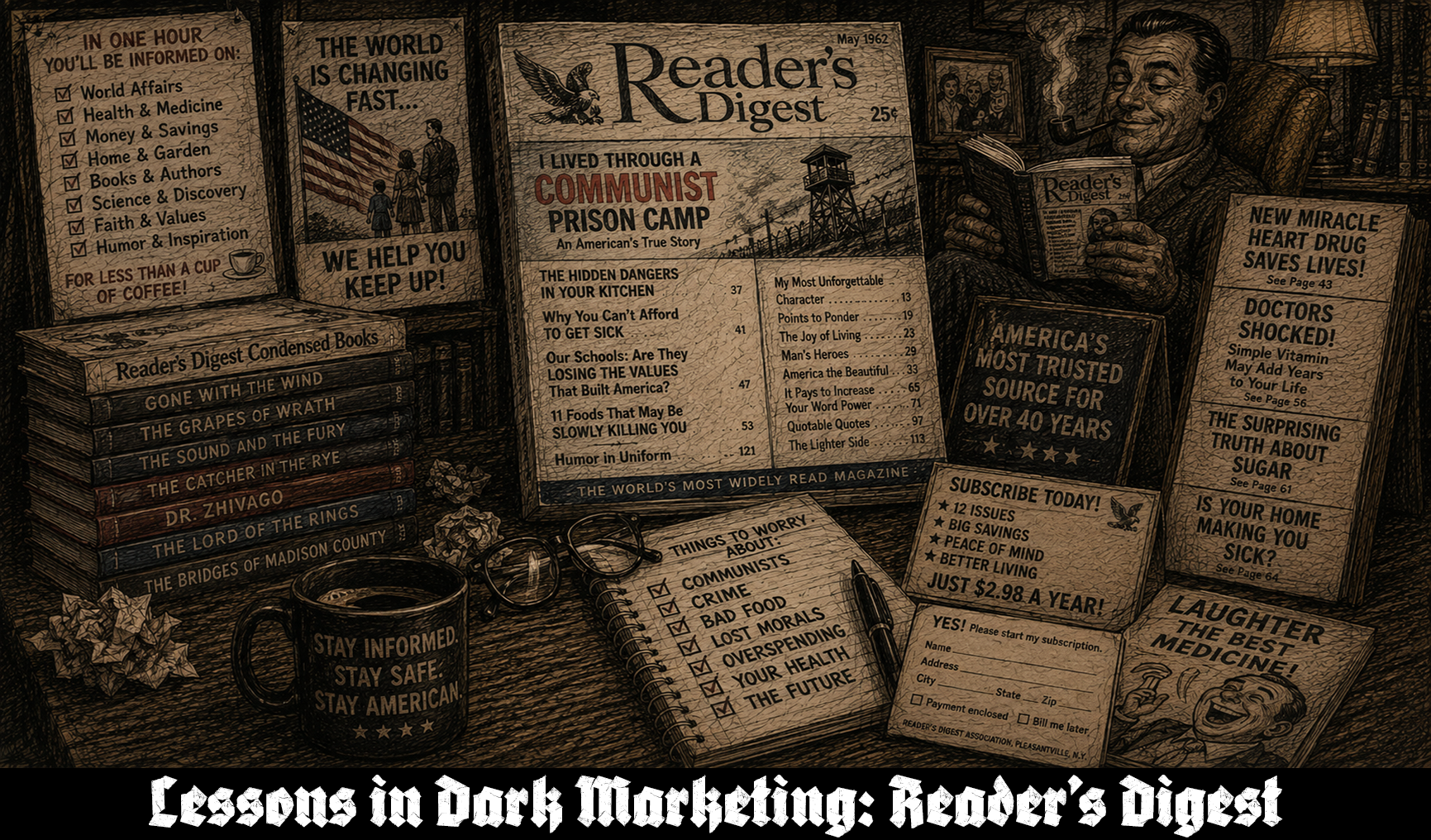
Reader’s Digest was the magazine for people who wanted to feel informed without suffering the burden of actually being curious. That sounds mean until you remember what the product was.
A little magazine. Little articles. Little summaries. Little jokes. Little medical scares. Little patriotic fables. Little inspirational stories. Little moral lessons. Little warnings about the world. Little chunks of reality cut down to a size that could be consumed between a cup of coffee, a waiting room appointment, and a bathroom visit.
That was the genius. Reader’s Digest did not simply sell reading. It sold the feeling of having read. That is much more powerful.
A real book asks something of you. A serious essay asks for attention. A complicated political argument asks you to sit inside uncertainty for more than eight seconds without reaching for a slogan like a baby reaching for a pacifier. Reader’s Digest solved that problem.
It gave the middle class a curated buffet of simplified reality. A little health advice. A little patriotism. A little danger. A little uplift. A little vocabulary improvement. A little joke column. A little heroic American story. A little warning about communism, crime, disease, moral decline, or whatever shadow was currently being sold as the thing coming for your family.
We’re looking at pre-internet algorithmic thinking in magazine form, not harmless waiting room reading. The magazine trained people to expect the world in excerpts.
- Condensed books.
- Condensed politics.
- Condensed danger.
- Condensed morality.
- Condensed intelligence.
That is the machine.
The Product Was Compression Disguised as Wisdom
Reader’s Digest understood the oldest insecurity in middle-class culture. People want to be seen as informed. They do not always want to do the work required to become informed. That gap is where the money lives.
The core promise was not complicated. Reader’s Digest would find the important stuff, shrink it, clean it, package it, and hand it to you in a form that felt respectable. The reader could move through culture without getting stuck in the mud of actual complexity. That is a seductive offer.
Nobody wants to feel ignorant. Nobody wants to feel behind. Nobody wants to admit that a full-length book is too long, a serious magazine is too dense, a political debate is too complicated, or the real world is too messy to fit inside a living room after dinner.
Reader’s Digest took that shame and monetized it gently. The magazine did not say, “You are too lazy to read deeply.” It said, “We respect your time.” That is the polite version of the pitch. The darker version is simple: we will do the thinking posture for you.
You can become the kind of person who knows a little about everything, just enough to feel prepared, just enough to make conversation, just enough to nod seriously when the country club uncle starts talking about what is happening to America.
This is dark marketing principle number one: Sell intellectual convenience as self-improvement and the customer gets to feel smarter while doing less.
- The reader saves time.
- The reader avoids complexity.
- The reader keeps the status of being informed.
That is the opening trick. Reader’s Digest did not sell ignorance. It sold a curated substitute for knowledge that felt clean, moral, and efficient enough to pass as wisdom.
The Digest Format Was a Pre-Internet Feed
Before phones trained people to graze information like bored cattle, Reader’s Digest had already built the grazing model.
- Short item.
- Quick lesson.
- Small joke.
- Digestible warning.
- Inspirational story.
- Health scare.
- Moral anecdote.
- Vocabulary quiz.
- Heroic profile.
- Condensed book excerpt.
- Move on.
That rhythm matters. It made the magazine feel varied, lively, useful, and never too demanding. The reader did not have to live inside one subject long enough to be challenged by it. The magazine kept moving. That is exactly what the modern feed does.
The feed does not ask you to understand the world. It asks you to keep scrolling through a sequence of emotional pellets. Outrage pellet. Joke pellet. Fear pellet. Advice pellet. Memory pellet. Identity pellet. Threat pellet. Soft little story about a dog pellet.
Reader’s Digest did that in print. It gave readers a rhythm of controlled mental stimulation without the chaos of the open world. It was not random. It was curated. That made it feel safe. The reader was not wandering through dangerous information territory. The reader was sitting in the fenced yard of acceptable middle-class reality.
That is why the format worked. It was a feed with manners. It let readers feel active while keeping them passive. It let them consume variety without confronting contradiction. It gave them a sequence of tiny conclusions instead of forcing them through the hard work of argument.
This is dark marketing principle number two: Give people variety without depth and they will mistake motion for learning.
- The format keeps moving.
- The reader keeps consuming.
- The mind keeps feeling busy.
That is the pre-internet feed in its Sunday pants. Reader’s Digest made attention hop from item to item long before apps turned that habit into a global nervous disorder.
Condensed Books Sold Culture Without the Weight
Reader’s Digest Condensed Books may be one of the most perfect middlebrow products ever created.
- They had the physical dignity of books.
- They had the convenience of summaries.
- They had the household respectability of literature.
- They had the emotional safety of editorial pre-selection.
You could put them on a shelf and feel like culture lived in your house. That is a brilliant product category.
A full book can be intimidating. It can be strange, slow, politically inconvenient, morally ambiguous, sexually weird, structurally difficult, or just long enough to expose the reader’s actual habits.
A condensed book removes the danger. The rough edges get sanded down. The bulk gets reduced. The commitment gets lowered. The customer receives the glow of reading without the full labor of reading. That is not just publishing. That is social laundering.
The product turns partial consumption into respectable identity. It lets the buyer say, in effect, “I am the kind of person who reads,” while outsourcing the deepest part of that identity to editors with scissors, and again, that is not stupid from a business standpoint.
It is genius. Reader’s Digest understood that millions of people wanted literature as a life signal more than they wanted literature as an experience. There is a difference. The experience might disturb you. The signal just sits on the shelf and makes the living room look serious.
This is dark marketing principle number three: Reduce the work, preserve the status, and the customer will thank you for removing the substance.
- The book becomes shorter.
- The shelf still looks educated.
- The reader still feels cultured.
- The danger is removed with the pages.
That is the condensed book machine. The customer did not merely buy stories. The customer bought relief from the guilt of not reading the longer versions.
Middlebrow Respectability Was the Real Subscription
Reader’s Digest was not selling rebellion. It was selling respectability. That is a much bigger market. The magazine belonged in respectable homes. It belonged on coffee tables, nightstands, office waiting rooms, dentist offices, church-adjacent households, suburban kitchens, and grandparents’ bathrooms where a whole generation learned that reading material could stare back at you from a wicker basket next to the toilet.
Respectability was the atmosphere. The magazine did not feel dirty. It did not feel fringe. It did not feel weird. It felt acceptable, safe, wholesome, practical, decent, and adult. That made it powerful. A reader could trust it because it looked like something trustworthy people already trusted.
That is circular logic, but consumer culture runs on circular logic all the time. Things are respectable because respectable people own them. Respectable people own them because they are respectable. Reader’s Digest sat perfectly inside that loop.
The magazine became a badge of middle-class seriousness. You were not reading trash. You were not reading radical material. You were not reading some thick academic journal written by people who use the word “discourse” because they have forgotten how normal humans speak. You were reading the Digest and therefor you were:
- Informed, but not weird.
- Curious, but not threatening.
- Patriotic, but not crude.
- Moral, but not mystical.
- Practical, but not lowbrow.
This is dark marketing principle number four: Make the product socially respectable and the customer will use it to decorate their identity.
- The magazine sits in the house.
- The house absorbs the signal.
- The reader borrows the authority.
That is the subscription beneath the subscription. People paid for the magazine, but they renewed the feeling that they belonged to the competent, decent, informed middle of America.
Fear Was Packaged as Helpful Information
Reader’s Digest had a gift for fear. Not screaming fear. Not tabloid fear. Not blood-soaked supermarket checkout fear with a celebrity divorce and a miracle baby on the same cover. Reader’s Digest specialized in respectable fear.
- Health fear.
- Crime fear.
- Safety fear.
- Foreign enemy fear.
- Moral decline fear.
- Your child is in danger fear.
- Your food is suspicious fear.
- Your body may be betraying you fear.
- Your life is changing fear.
Your neighbor may know something you do not fear. This kind of fear works because it does not feel like panic. It feels like preparation. That is the trick.
The reader is not being scared. The reader is being warned. The reader is not consuming anxiety. The reader is becoming responsible. The reader is not turning the page for another little electric shock of dread. The reader is gathering useful information for the family.
That is dark marketing with a necktie on. Fear sells better when it arrives with concern in its voice. A screaming headline makes people feel manipulated. A helpful article makes them feel prudent.
Reader’s Digest understood that distinction. It could introduce danger into the home while keeping the tone calm enough for the reader to feel mature instead of hysterical.
This is dark marketing principle number five: Fear sells best when it lets the customer feel responsible for being afraid.
- The danger feels practical.
- The anxiety feels useful.
- The warning feels like wisdom.
That is how fear becomes a service. Reader’s Digest did not just scare readers. It gave them a moral costume for their fear and called it being informed.
Patriotism Became Editorial Glue
Reader’s Digest did not need to hang a flag on every page to be patriotic. The patriotism was baked into the worldview.
- America was good.
- Common sense was good.
- Hard work was good.
- Faith was good.
- Family was good.
- Decency was good.
- The ordinary citizen was good.
- The outside threat was real.
- The elite could be suspicious.
- The radical was dangerous.
The country was always at risk of losing itself if decent people stopped paying attention. That editorial atmosphere did a lot of work.
It gave unrelated articles a shared moral temperature. A health warning, a war story, a human-interest profile, an anti-communist argument, a joke column, and a story about a brave child could all feel like they belonged to the same universe.
That universe had rules. Good people were plainspoken. Bad ideas were sneaky. The world was complicated, but the conclusion did not need to be.
Reader’s Digest became powerful because it gave readers a simplified moral map. That map was comforting. It made the reader feel oriented. It gave political and cultural anxiety a familiar shape.
This is dark marketing principle number six: Patriotism is strongest as a filter, not a slogan.
- The reader does not need to be told what side they are on every paragraph.
- The magazine builds the world so the side feels obvious.
- The enemies become legible.
- The virtues become repetitive.
That is how editorial identity hardens into worldview. Reader’s Digest did not merely inform its readers about America. It offered them a version of America they could carry around in portable, condensed form.
Anti-Complexity Became the Brand Promise
The world is complicated. That is the problem. The Reader’s Digest solution was to make complexity feel like a failure of packaging.
- If something mattered, it could be shortened.
- If something was long, someone could extract the point.
- If something was confusing, someone could turn it into an anecdote.
- If something was politically messy, someone could turn it into a moral contrast.
- If something was frightening, someone could turn it into advice.
This is a wildly attractive proposition. It tells the reader that the problem is not reality. The problem is that reality has not been edited properly yet.
That is the same sickness that dominates modern media. Explain the war in ninety seconds. Summarize the court case in five bullets. Tell me what to think about the election before I finish my coffee. Give me the conclusion before the evidence. Give me the moral before the facts. Give me the answer before I have to feel uncertain.
Reader’s Digest normalized the emotional desire beneath all of that. The desire is not just for brevity. The desire is for certainty. A condensed world feels safer because the edges have been removed. Complexity makes people feel small. Simplification makes them feel back in control.
This is dark marketing principle number seven: When people feel overwhelmed by reality, sell them a version with the uncertainty edited out.
- The world gets shorter.
- The argument gets cleaner.
- The reader gets calmer.
That is the anti-complexity promise. Reader’s Digest made the reader feel protected from the chaos of knowing too much.
The Magazine Turned Common Sense Into a Product
“Common sense” is one of the most successful marketing phrases in human history because it lets people confuse familiarity with truth. Reader’s Digest lived in that territory.
The magazine’s voice often felt practical, plain, decent, and reasonable. That was the charm. It did not sound like a professor, a revolutionary, a theorist, or a lunatic with a newsletter printed in a basement. It sounded like a neighbor who owned tools, paid bills, loved the country, distrusted nonsense, and knew which foods would probably kill you.
That tone is powerful. It makes the reader feel grounded. It makes the magazine feel like it is above ideology even when it is absolutely swimming in ideology.
That is the great trick of “common sense.” It presents itself as neutral while smuggling in assumptions about family, nation, morality, work, health, gender, crime, authority, and who gets to be considered normal.
Reader’s Digest sold a worldview that felt like it had not been sold. That is the strongest worldview of all. The kind people think they came up with themselves.
This is dark marketing principle number eight: Package ideology as common sense and the customer will defend it as personal wisdom.
- The claim feels obvious.
- The tone feels reasonable.
- The reader feels independent.
- The brand becomes invisible.
That is the power of common-sense marketing. The customer does not feel persuaded. The customer feels confirmed.
Health Anxiety Was a Reliable Content Engine
Health content is one of the easiest ways to keep people reading because everybody has a body and every body is eventually going to betray its owner. Reader’s Digest understood that. A health article does not need to be sensational to be sticky. It only needs to whisper the right possibility.
- This symptom could matter.
- This habit could hurt you.
- This food could be dangerous.
- This simple test could save your life.
- This doctor knows what your family does not.
- This mistake could be happening in your own home.
Health anxiety is perfect content because it disguises self-interest as responsibility. You are not reading because you are nervous. You are reading because you care about your spouse, your kids, your parents, your future, your cholesterol, your heart, your memory, your medicine cabinet, and the strange pain you have been pretending is probably nothing.
Reader’s Digest turned that into a recurring editorial well. It made health fear feel respectable. It made medical curiosity feel domestic. It gave people little packets of bodily dread they could consume without feeling foolish.
The internet did not invent symptom spiraling. The internet scaled it. Before the search bar convinced everyone they had seven diseases by lunch, print media was already teaching readers that the body was a mystery full of hidden warnings.
This is dark marketing principle number nine: Health fear becomes addictive when every warning feels like an act of care.
- The reader worries.
- The reader keeps reading.
- The reader calls it prevention.
That is the content loop. Reader’s Digest did not need to create mortality anxiety. It only had to keep reminding the reader that the body was always one article away from revealing terrible news.
The Joke Columns Softened the Medicine
Reader’s Digest was not all fear, patriotism, and moral compression. It also had jokes. That mattered. Humor made the medicine go down. A magazine that only warned people about disease, communism, crime, moral decline, and national erosion would become exhausting. So the Digest gave readers little breaks.
- A joke.
- A funny anecdote.
- A harmless laugh.
- A cute mistake.
- A family moment.
- A workplace quip.
- A small bit of human ridiculousness.
That created emotional rhythm. Fear, relief, fear, uplift, worry, joke, moral lesson, vocabulary quiz, heroic story, joke again. This is exactly how modern feeds work. They do not keep you in one emotion. They rotate you. The rotation keeps you from leaving. You are never angry long enough to quit, never amused long enough to relax, never afraid long enough to close the app. You are moved from one emotional compartment to another. Reader’s Digest did that in print.
The joke columns made the magazine feel human. They made the whole package less severe. They gave the reader permission to enjoy the issue while still receiving the warnings and moral cues.
This is dark marketing principle number ten: Rotate fear with comfort and the customer will stay longer inside the system.
- The laugh resets the reader.
- The comfort softens the fear.
- The variety keeps the habit alive.
That is emotional pacing. Reader’s Digest did not merely choose content. It arranged feelings.
Vocabulary Became Class Performance
The vocabulary features were another perfect Reader’s Digest move.
- Learn a word.
- Test yourself.
- Feel sharper.
- Feel educated.
- Feel like the kind of person who still improves their mind.
That is a tiny product, but a powerful one. Vocabulary is class performance disguised as self-improvement. Words are social weapons. People know this. They may not say it directly, but they know it. A better vocabulary suggests intelligence, discipline, education, authority, and refinement.
Reader’s Digest packaged that aspiration in safe little exercises.
- No classroom humiliation.
- No professor.
- No thick textbook.
- No real intellectual risk.
Just a little quiz that lets the reader feel upgraded. That fit the larger brand perfectly. The magazine offered manageable self-improvement. Nothing too radical. Nothing that might destabilize your life. Just enough polish to feel better than yesterday.
This is dark marketing principle number eleven: Sell small symbols of intelligence and the customer can feel improved without being transformed.
- The word is new.
- The identity feels sharper.
- The effort stays tiny.
That is the appeal. Reader’s Digest did not ask readers to become different people. It let them feel like slightly better versions of the same people.
The Subscription Model Sold Habit, Not News
Reader’s Digest did not need to win every month like a newsstand brawl. The subscription model changed the psychology. Once the magazine entered the home regularly, it became part of the household rhythm. It arrived. It sat. It waited. It became familiar. It became a small domestic constant. That is a very different relationship from impulse buying.
A subscription turns media into furniture. It becomes part of the environment. The reader does not have to decide each time whether the magazine deserves attention. The attention decision has already been automated by the renewal. That is why subscriptions are powerful. They turn choice into inertia.
Reader’s Digest did not merely sell issues. It sold continuity. The customer bought a relationship with a voice that would keep returning, keep simplifying, keep warning, keep reassuring, keep confirming the reader’s place in the moral order of middle-class America. The magazine came back like a neighbor with a key.
This is dark marketing principle number twelve: Recurring delivery turns content into household authority.
- The product arrives before desire has to form.
- The habit replaces the decision.
- The brand becomes familiar enough to feel true.
That is subscription psychology. Reader’s Digest did not have to seduce the reader from scratch every month. It only had to remain useful enough, comforting enough, and familiar enough not to be canceled.
Waiting Rooms Made the Brand Feel Universal
Reader’s Digest lived everywhere. That was part of its power. It was not only in private homes. It was in waiting rooms, offices, reception areas, lobbies, clinics, barbershops, relatives’ houses, and every place where humans were expected to sit quietly under bad lighting and pretend they were not annoyed. That kind of distribution matters.
A magazine in a waiting room feels culturally validated. Somebody chose it. Somebody assumed it was safe for everybody. Somebody believed no one would be offended enough to complain. That is a powerful signal. Reader’s Digest became default reading.
Default products are not always loved. They are simply everywhere, which is often better. A default product does not need passion. It needs presence.
- You may not seek it out.
- You will still encounter it.
- You may not subscribe.
You will still flip through it while waiting for a dentist to tell you your gums are disappointing.
This is dark marketing principle number thirteen: Ubiquity can imitate trust.
- The magazine is everywhere.
- The reader assumes it belongs there.
- The brand absorbs institutional respectability.
That is how default media becomes cultural wallpaper. Reader’s Digest did not need everyone to be a fan. It only needed to appear wherever respectable boredom needed something safe to hold.
The Magazine Sold Certainty to People Afraid of Losing the Country
Reader’s Digest thrived in an America that was always being told it might lose itself.
- Lose itself to communism.
- Lose itself to crime.
- Lose itself to permissiveness.
- Lose itself to bad health.
- Lose itself to elites.
- Lose itself to laziness.
- Lose itself to moral confusion.
- Lose itself to people who did not share the same values, accents, habits, manners, politics, prayers, or recipes.
The magazine turned that anxiety into a manageable reading experience. Every issue could offer the reader a little reorientation. Here are the heroes. Here are the threats. Here are the values. Here is the joke that proves ordinary people are still funny. Here is the medical advice that proves your vigilance matters. Here is the patriotic story that proves the country still has a soul.
That’s not just information. That’s emotional maintenance. Reader’s Digest helped readers feel like they still understood the world, even as the world kept changing in ways they did not like or could not process.
This is dark marketing principle number fourteen: Sell certainty to people who experience change as decline.
- The country feels unstable.
- The culture feels confusing.
- The magazine makes the old map feel usable again.
That is why simplified reality sells. It gives anxious readers the pleasure of recognition in a world that keeps refusing to stay recognizable.
The Case Study Breakdown
Here is the Reader’s Digest machine in plain English.
- The magazine compressed information into emotionally manageable pieces.
- The format created a pre-internet feed.
- The condensed books sold culture without the work of full reading.
- The subscription model turned the brand into a household habit.
- The voice made ideology feel like common sense.
- The patriotism gave the content moral glue.
- The health articles turned fear into responsibility.
- The jokes softened the anxiety.
- The vocabulary quizzes turned class aspiration into a game.
- The waiting room presence made the brand feel universal.
The whole product helped readers feel informed without forcing them to wrestle with the full difficulty of being informed. That is why Reader’s Digest worked. It did not need to be the deepest source. It needed to be the most comfortable one. It needed to make the reader feel equipped. Decent. Sensible. Alert. Patriotic. Cultured. Safe. Smarter than the people who did not know what was really going on, but not so smart that life became complicated.
This is dark marketing principle number fifteen: The most durable media brands do not only tell people what happened. They tell people who they are for consuming it.
- The reader is practical.
- The reader is decent.
- The reader is informed.
- The reader is on the right side of common sense.
That is the identity loop. Reader’s Digest did not merely digest the world. It digested the reader’s self-image and fed it back in a form that felt wholesome.
What Marketers Should Learn From Reader’s Digest
The first lesson is that convenience can become identity.
Reader’s Digest sold time-saving, but the deeper product was intellectual self-respect. People were not only buying shorter articles. They were buying permission to feel informed through shortcuts.
The second lesson is that curation can become authority.
When a brand chooses what matters, shortens it, frames it, and repeats that process for years, customers begin trusting the filter as much as the content. Sometimes more.
The third lesson is that fear performs best when it is wrapped in usefulness.
Health scares, safety warnings, cultural threats, and political anxieties all travel farther when the reader can call the fear practical information.
The fourth lesson is that middlebrow products win when they flatter the customer’s self-image.
Reader’s Digest never had to make readers feel elite. It made them feel decent, informed, reasonable, and prepared. That is a bigger audience than elite culture will ever have.
The fifth lesson is that pre-internet media already understood algorithmic emotion.
Reader’s Digest rotated fear, humor, advice, patriotism, uplift, status, and simplification long before social platforms turned emotional sequencing into a surveillance business.
This is dark marketing principle number sixteen: The platform changes, but the emotional menu stays the same.
- Fear.
- Relief.
- Pride.
- Status.
- Certainty.
- Amusement.
- Repeat.
That is the Reader’s Digest formula. The modern feed did not invent it. The modern feed inherited it, stripped away the manners, and injected it straight into the bloodstream.
Final Diagnosis
Reader’s Digest was brilliant because it understood the middle-class hunger for simplified seriousness.
- It gave people a way to feel educated without becoming difficult.
- It gave people a way to feel patriotic without thinking too hard about power.
- It gave people a way to feel medically alert without admitting they were afraid.
- It gave people a way to feel cultured without reading the whole book.
- It gave people a way to feel morally oriented in a country that kept changing.
That is the darkness. Reader’s Digest did not merely shorten articles. It shortened the emotional distance between ignorance and confidence.
- It made partial knowledge feel respectable.
- It made fear feel responsible.
- It made ideology feel like common sense.
- It made subscription feel like wisdom arriving by mail.
It made a whole generation comfortable with the idea that reality should come pre-chewed, morally labeled, and trimmed down to fit inside a small magazine on the coffee table.
That is why it belongs in the Dark Marketing museum. Somewhere between Tupperware, Chia Pets, TV dinners, Life Alert, and every modern app promising to summarize the world before your attention span collapses completely.
Reader’s Digest did not create brain rot. Give it some credit. It gave brain rot a blazer, a flag pin, a vocabulary quiz, and a subscription card. Then it mailed it to your house.
Leave a Reply