
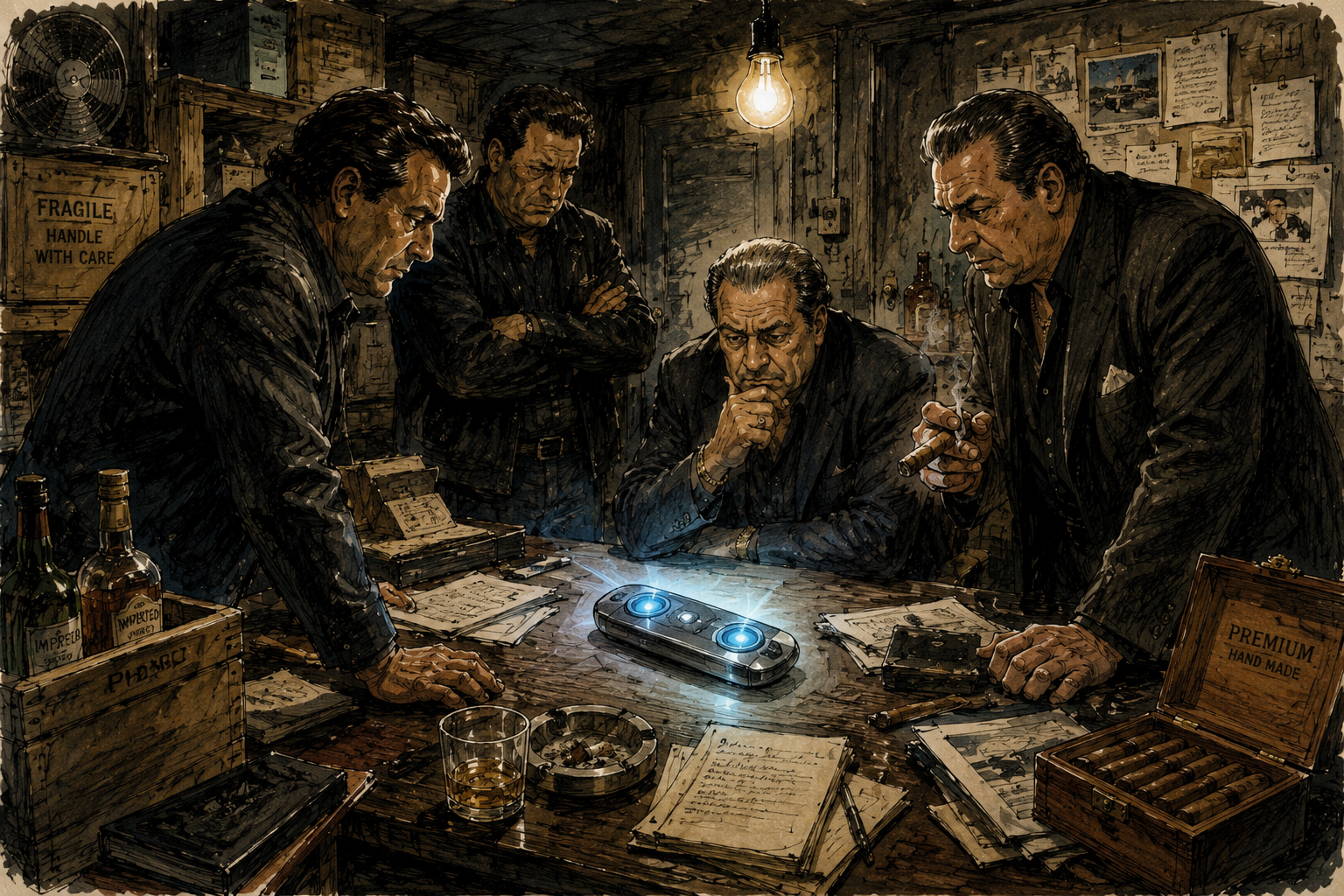

The Sopranos: “Time to Kill” is the longest and most dramatically developed of the three samples. It takes the shared premise and lets it become something heavier, uglier, and more morally complicated.
The script begins in the Bada Bing back office with crates of contraband, liquor, cigars, and a strange glowing device that nobody understands but everyone immediately tries to interpret through criminal opportunity. That is exactly the right entry point for this world. The device is not introduced as wonder. It is introduced as potential profit, potential trouble, and potential leverage.
Tony brings it home. Carmela rejects it. Tony brings it back to the Bing. Christopher touches what he should not touch. The room flashes, and suddenly the crew is thrown into a situation none of them can control. From that point forward, the script becomes a pressure narrative: Tony, Paulie, Christopher, and Silvio moving from confusion to survival mode to calculation.
The Sopranos version understands that these characters would not become clean heroes in a crisis. They would lie, posture, improvise, threaten, hide fear under attitude, and look for the angle. Tony’s authority becomes the stabilizing force, but it is also the thing that makes the final moral movement possible. He does not need a speech. He needs a room, a weapon, a moment, and a version of events that the world will accept.
The script also uses the ensemble well. Paulie’s anxiety gives the story its superstitious comic pressure. Christopher’s curiosity and incompetence keep creating danger. Silvio reads rooms and adjusts. Tony calculates. Carmela’s later scenes bring the story back into domestic reality, where the impossible has to be buried under a normal lie. The “speaker blew” cover story is especially strong because it feels exactly like the kind of stupid, practical lie that would survive in that world.
The ending on the Stugots gives the script its final Sopranos note. The crew tries to dispose of the device, but the object refuses to behave like ordinary evidence. Tony wants the problem gone. Paulie senses something spiritually wrong. Christopher still sees value. Silvio sees liability. The device does something it should not do, leaving the men with the one thing The Sopranos always understood: the past is never fully buried, and the things men refuse to discuss often keep humming somewhere offscreen.
As a writing sample, “Time to Kill” shows Tony’s ability to write dramatic tension, subtext, character pressure, crime-family dynamics, dark humor, moral evasion, and scenes where power moves through dialogue before it moves through action. It shows a strong grasp of how The Sopranos can move from absurdity to dread without breaking its own reality.
This script is useful as a sample for prestige drama, crime writing, ensemble drama, morally complex characters, psychological tension, dark comedy, and grounded genre-bending.
You must be logged in to post a comment.