
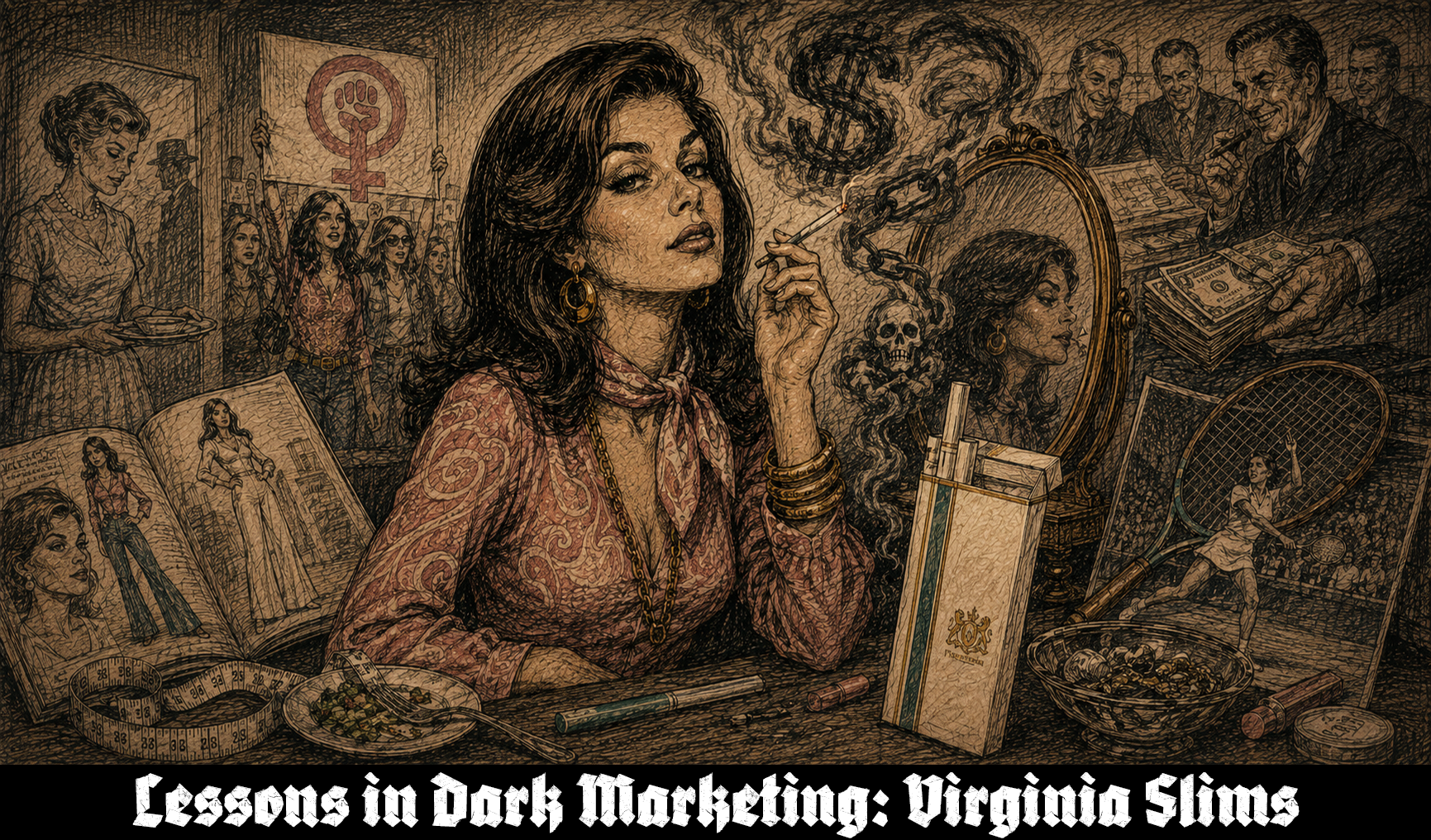
Virginia Slims sold female liberation with a cigarette between its fingers.
That’s the whole crime scene.
A cigarette is already one of the dirtiest marketing objects in American history. It’s addiction, image, ritual, danger, denial, and death wrapped in paper. But Virginia Slims added a special little corporate flourish. It looked at women’s liberation, saw a massive cultural shift, and asked the most American question possible: how do we turn this into a product line?
The answer was simple, ugly, and brilliant.
Make the cigarette slimmer. Make the branding feminine. Make the woman in the ad stylish, modern, independent, and sexually confident. Then place her next to the old image of female restriction and sell the cigarette as proof that she had escaped.
That is dark marketing at an olympic level.
Virginia Slims didn’t just sell smoking to women. It sold the idea that smoking was evidence of progress. It took the language of freedom, rebellion, self-possession, style, confidence, and equality, then welded it to a product that was slowly harming the customer.
We’re looking at liberation turned into a sales hook, not simple cigarette advertising.
The product was tobacco. The machine was identity theft.
Virginia Slims stole the emotional energy of women’s progress and redirected it into the cigarette aisle. It understood that if a company can attach a harmful product to a person’s idea of freedom, the customer may defend the product as part of herself.
That is the case study.
The Slogan Turned Progress Into Permission
“You’ve come a long way, baby” is one of the most disgusting advertising lines ever written, which is exactly why it worked.
The line was short, memorable, condescending, flattering, and strategically loaded. It acknowledged that women had been restricted, mocked, controlled, and excluded. Then it offered a cigarette as the reward. Congratulations, sweetheart. You can vote, work, dress differently, move through public life, claim some independence, and now you have your own special cigarette.
No shit, Einstein. That’s progress now?
That was the trick. The line didn’t sell the product as a cigarette first. It sold the product as proof that the customer had arrived somewhere. The ad invited women to see the cigarette as a marker of social movement. The smoke became symbolic. The purchase became participation. The brand turned a dangerous habit into a little trophy of modern womanhood.
This is dark marketing principle number one: When people are fighting for recognition, sell them a product that pretends to recognize them.
Virginia Slims didn’t create women’s liberation. It positioned itself near the movement and acted like the cigarette was part of the victory parade. That’s the corporate move. Stand next to real social progress, borrow the emotional glow, and sell the customer a product that has nothing to do with actual freedom.
The Brand Sold Harm as Independence
Virginia Slims used one of the oldest manipulations in identity marketing: confuse choice with liberation.
The ads did not need to say smoking was healthy. They needed to make smoking feel chosen. That is a very important difference. Once a product can be framed as a personal choice, criticism of the product can start to feel like criticism of the person choosing it. That is how the brand protects itself inside the customer’s ego.
A woman smoking a Virginia Slim wasn’t just consuming tobacco in the brand’s fantasy. She was choosing for herself. She was refusing old rules. She was stylish, sexy, independent, modern, and unwilling to be told what to do. The cigarette became a prop in the theater of self-possession. That is where the darkness sits.
A company sold a product that created dependency by branding it as independence. The customer could feel free while building a habit that was anything but free. That’s not marketing. That’s a straight-faced con job with better typography.
This is dark marketing principle number two: If a product creates dependency, frame the first purchase as freedom.
Virginia Slims understood that people don’t want to think of themselves as being trained by a product. They want to think they are making an empowered choice. The brand gave women the language of choice while selling them a product designed to make choice harder over time.
Feminism Became Packaging
The ugliest part of the Virginia Slims machine is how neatly it converted feminism into packaging.
The brand did not need to support women’s freedom in any meaningful structural sense. It only needed to borrow the visuals, tone, and emotional charge of liberation. The ads could show modern women, contrast them with older restrictions, imply progress, and let the product sit there like the cigarette had marched in the streets itself.
This is what corporations do when a social movement becomes culturally powerful. They don’t necessarily fight it. Sometimes they domesticate it. They strip it of danger, remove the political substance, and sell back the emotional residue in a form that can be purchased, displayed, and repeated.
Virginia Slims turned liberation into a brand position.
The woman in the ad was free because she looked free. She was modern because the styling said modern. She was independent because the copy said independent. The cigarette became the costume piece that completed the character.
This is dark marketing principle number three: When a movement becomes culturally valuable, brands will try to sell the symbol while avoiding the substance.
Virginia Slims didn’t have to deliver liberation. It only had to let customers perform liberation through consumption. That is the difference between a political gain and a marketing costume. One changes power. The other changes the prop in your hand.
The Slim Cigarette Turned Body Anxiety Into Product Design
The word “Slims” was not accidental. Come on now. Think for a second.
This was a cigarette brand aimed at women in a culture already obsessed with making women smaller. Smaller bodies. Smaller appetites. Smaller voices. Smaller anger. Smaller ambition, unless that ambition could be made attractive, stylish, and non-threatening enough to sell something.
The product name did a lot of work. “Slim” suggested elegance, fashion, delicacy, thinness, sex appeal, control, and feminine refinement. The cigarette itself became part of the body-image fantasy. It wasn’t just a cigarette. It was a thinner cigarette for a woman who had been taught that thinness was discipline, beauty, class, and self-command. That is vile, but it’s also precise.
The brand fused smoking with fashion and body anxiety. The product was designed to feel physically and socially gendered. A regular cigarette could be rough, masculine, blunt, or ordinary. A slim cigarette could feel tailored. It could feel like an accessory. It could sit next to lipstick, perfume, nails, handbags, sunglasses, and a narrow waisted dress inside the same visual universe.
This is dark marketing principle number four: Build the insecurity into the product form and the object starts selling before the ad speaks.
Virginia Slims did not have to give a lecture on body image. The name and shape already did the whispering. The cigarette looked like it belonged to a woman trained to understand that smaller is often marketed as better.
Fashion Made Poison Look Polished
Virginia Slims was not selling cigarettes in a vacuum. It was selling a look. That matters.
The ads leaned into style because style is one of the easiest ways to make danger look desirable. A fashionable woman smoking a cigarette does not read visually as a medical warning. She reads as attitude, taste, confidence, sexuality, money, independence, and control. The smoke becomes atmosphere. The hand pose becomes character. The product becomes an accessory.
This is why cigarette advertising was so powerful for so long. Smoking photographs well. That is the truth, if you don’t like it then I’m sorry I’m not sorry. A cigarette can be used to create mood instantly. It gives the subject something to hold, something to do, something to exhale, something to suggest boredom, rebellion, glamour, sex appeal, or contempt. It’s a little cancer stick with stage direction built in.
Virginia Slims understood this perfectly.
The cigarette became part of the fashion system. It didn’t need to be discussed as tobacco. It could be shown as style. That shift made the harm easier to ignore because the viewer wasn’t being asked to think about lungs. She was being asked to think about the woman she might become.
This is dark marketing principle number five: Aestheticize the harm and the customer will focus on the image instead of the consequence.
Virginia Slims made smoking look polished, feminine, and modern. The more stylish the scene became, the less the product looked like damage. That is the danger of good art direction in the service of a bad product.
Rebellion Was Made Purchasable
Virginia Slims did not invent female rebellion, but it did something corporations love doing with rebellion. It put rebellion on a shelf.
That is a huge move. Real rebellion is risky. It can cost relationships, jobs, reputation, safety, social approval, and comfort. Product rebellion is easier. You buy the object, adopt the look, and feel like you have crossed a line without necessarily changing anything larger.
The cigarette became an affordable symbol of defiance.
A woman could smoke Virginia Slims and feel like she was rejecting old expectations. The product let her perform independence in public. It gave her a gesture. It let her say, with smoke, posture, and brand choice, that she was no longer the woman locked into the old script.
The problem is that the rebellion had been prepackaged by a tobacco company. That’s the scam. Corporate rebellion is rebellion with a barcode and a loyalty program. The customer gets the emotional rush of defiance, while the company gets the revenue, the habit, and the cultural association.
This is dark marketing principle number six: Sell rebellion as a purchasable gesture and the customer can feel radical while staying inside the market.
Virginia Slims made rebellion convenient. It didn’t ask women to overthrow anything. It asked them to buy a slimmer cigarette and feel like the purchase had historical meaning. Beautiful little trick, if you’re a ghoul.
The Ads Used the Past as a Punching Bag
One of the campaign’s smartest moves was contrasting modern women with old restrictions. The ads often played with the idea that women used to be controlled, scolded, punished, or denied certain freedoms. Then the modern Virginia Slims woman appeared as the opposite: stylish, sexy, liberated, confident, and allowed to smoke openly.
That structure worked because the past really was restrictive. The campaign didn’t have to invent the history of women being controlled. That history was real. The marketing simply used that reality as a launchpad for selling cigarettes.
That is what makes the campaign especially slippery.
It starts from a truth. Women had been boxed in. Women had been told how to behave. Women had been denied public freedom. Women had been treated like children by men, institutions, and social codes. Then the ad makes the leap from that real history to a product solution.
That leap is the con.
A cigarette does not repair the past. It does not give women equal pay, bodily autonomy, safety, respect, political power, legal protection, or cultural freedom. But in the ad, the cigarette becomes the symbol that says the old days are over.
This is dark marketing principle number seven: Start with a real grievance, then redirect the emotional force toward a product.
Virginia Slims used the past as evidence and the cigarette as the punchline. It let women feel the insult of old restrictions, then offered tobacco as the proof that they had moved beyond them. We’re not looking at liberation. We’re looking at emotional rerouting.
The Brand Made the Customer Feel Personally Addressed
Virginia Slims worked because it made women feel seen by the category.
That is important.
For decades, many cigarette brands had been built around masculine images, general adult sophistication, or broad lifestyle appeals. Virginia Slims walked in and said, this one is for you. That direct address is powerful, especially when aimed at a group that had often been ignored, mocked, or treated as secondary.
The cigarette was framed as a woman’s cigarette. The copy, the name, the styling, the slogans, and the visual world all told the customer that the brand understood her. That feeling can override a lot of rational resistance. People like products that appear to recognize them, especially when the marketplace has made them feel like an afterthought.
That recognition was the bait.
The brand wasn’t simply selling tobacco. It was selling the emotional pleasure of being targeted. That sounds strange until you realize how much modern marketing runs on the same mechanism. People enjoy seeing themselves reflected in a product category, even when the product itself is garbage.
This is dark marketing principle number eight: Targeted recognition can make exploitation feel like inclusion.
Virginia Slims made women feel like the cigarette market had finally made room for them. The brand offered inclusion, but the thing women were being included in was addiction, disease, and corporate profit. That is a hell of a welcome package.
The Cigarette Became an Accessory to the New Woman
The “new woman” was a perfect marketing character. She could be stylish, modern, mobile, social, flirtatious, ambitious, independent, and still beautiful enough to be commercially safe. She could push against old norms without becoming too politically inconvenient. She could be liberated in a way that still photographed well.
Virginia Slims gave that character a cigarette.
The product became part of her costume. It belonged with the clothes, hair, makeup, posture, and facial expression. It said she was current. It said she was not trapped in the old world. It said she had a certain attitude toward authority, men, tradition, and herself.
That kind of character marketing is powerful because customers do not only buy products. They buy roles. They buy moods. They buy versions of themselves they want to rehearse. Virginia Slims gave women a script: you are modern, you are stylish, you are free, and this is your cigarette.
This is dark marketing principle number nine: Sell the customer a character to perform and the product becomes part of the costume.
Virginia Slims did not need every woman to consciously think through the politics of the ad. It only needed the image to feel desirable. Once the customer wanted the character, the cigarette could come along as the accessory.
Health Consequences Were Pushed Out of Frame
The darkest tobacco advertising trick is always what gets left outside the frame.
Virginia Slims showed style, confidence, liberation, and feminine identity. It did not show the coughing. It did not show the addiction. It did not show the lung disease, cancer wards, oxygen tanks, heart disease, grief, medical bills, or the slow humiliation of a body damaged by a product sold as personal freedom.
That absence was not accidental.
Good cigarette advertising had to create a sealed fantasy world where smoking meant image and never consequence. The frame had to protect the viewer from the real product. Smoke had to look glamorous, not pathological. The cigarette had to look like identity, not dependency. The model had to look free, not trapped.
This is where the campaign becomes especially grotesque.
It sold freedom while hiding the future cost of the supposed freedom. That is one of the dirtiest moves in harmful-product marketing. Make the present emotionally rich and the future invisible.
This is dark marketing principle number ten: If the product carries long-term harm, sell the immediate identity and push the consequence out of the frame.
Virginia Slims made the first image beautiful and the later reality absent. The customer saw confidence now. The damage was somebody else’s problem later. That delay is exactly where harmful industries make their money.
Thinness, Control, and Smoking Fed the Same Fantasy
Smoking has often been sold around appetite, control, and self-command, especially to women. Virginia Slims fit that universe very well.
The name suggested slimness. The imagery suggested fashion. The cigarette itself suggested controlled desire. A woman could smoke instead of eat, smoke while socializing, smoke while posing, smoke while signaling that she was composed, modern, and in command of herself. The brand did not need to spell out every body-image implication. The culture already had those wires exposed.
That is how dark marketing works when the culture is already sick. You do not need to create the wound. You just need to press on the one that already exists in a way that looks like style.
Women had been taught to manage appetite, appearance, desirability, and self-presentation constantly. A slim cigarette could slide right into that discipline system. It could look like pleasure while also carrying the emotional scent of control.
This is dark marketing principle number eleven: When a culture trains people to shrink themselves, a product named for slimness arrives preloaded with meaning.
Virginia Slims did not have to explain the body fantasy. It lived inside the name, the shape, the model, the pose, and the entire visual world. The cigarette was not only smoked. It was worn.
The Campaign Let the Company Sound Modern Without Being Moral
Virginia Slims sounded modern. That did not make it moral.
This is one of the traps of social-change advertising. A brand can use the language of the moment, speak in the tone of progress, show the right kind of person, and still be selling something rotten. Modernity is not virtue. Relevance is not ethics. A good slogan does not clean the product.
Virginia Slims knew how to sound current. It knew how to speak to women in a changing society. It knew how to make the old order look foolish and the new consumer look stylish. That gave the brand cultural freshness.
But the product remained the product.
That is the point. Dark marketing often wins by separating the emotional wrapper from the material reality. The wrapper says independence. The product says tobacco. The wrapper says progress. The product says addiction. The wrapper says modern womanhood. The product says disease with a filter.
This is dark marketing principle number twelve: A brand can sound progressive while selling a product that moves the customer backward.
Virginia Slims proved that modern messaging can be used for ugly ends. A company does not become ethical because it knows which cultural wave to surf. Sometimes it just becomes more dangerous.
Sponsorship Turned the Brand Into a Women’s Culture Platform
Virginia Slims did not stop at print and television-style identity advertising.
The brand also moved into women’s culture through sponsorship, especially women’s tennis. That was a very smart extension. Sponsorship allowed the brand to attach itself to active, visible, ambitious women in a socially respectable setting. The cigarette brand could stand near athletic achievement and borrow a little of that energy too.
That’s some weird wild stuff when you think about it.
A tobacco brand associating itself with women’s sports is a little like a Jeffrey Dahmer sponsoring a home cooking expo. But as marketing, the logic was clear. Women’s tennis gave the brand a platform that felt modern, competitive, glamorous, and female-centered. It helped Virginia Slims stay attached to the idea of women advancing in public life.
Again, the brand didn’t need to be part of the progress. It needed to stand close enough to the progress to be photographed near it.
This is dark marketing principle number thirteen: Sponsor the arena where your target audience’s identity is being celebrated and your product can borrow the celebration.
Virginia Slims used women’s advancement as atmosphere. The game, the athletes, the visibility, and the cultural energy all helped the cigarette brand look like it belonged to the world of modern women. That is how sponsorship turns proximity into image.
The Brand Evolved With the Language of Empowerment
Virginia Slims did not only use one campaign and disappear.
The brand kept adapting its empowerment language as the culture changed. Later slogans and campaigns moved from the original liberation framing into newer versions of female identity, individuality, and self-expression. That matters because it shows the system was not a one-time accident. It was a strategy.
The company understood that the language of womanhood changes over time. In one era, the pitch is liberation from old restrictions. In another, it becomes personal identity. In another, it becomes finding your voice. The vocabulary changes, but the machine remains familiar: attach the cigarette to whatever version of female self-image is culturally useful at the moment.
That is why this case is bigger than one slogan.
The dark marketing move is not only “You’ve come a long way, baby.” The deeper move is watching a harmful product repeatedly dress itself in the newest acceptable language of empowerment.
This is dark marketing principle number fourteen: When the product cannot become healthier, keep updating the identity costume around it.
Virginia Slims could not make the cigarette good for women. It could keep changing the story around the cigarette. That is how harmful brands survive cultural change. They don’t become better. They become fluent.
The Case Study Breakdown
Here is the Virginia Slims machine in plain English:
- The brand turned women’s liberation into a cigarette slogan.
- It sold tobacco as a symbol of progress, independence, and modern womanhood.
- The word “Slims” fused smoking with body anxiety, thinness, and feminine style.
- The ads used real historical restrictions on women as emotional fuel for a product pitch.
- The campaign re-framed smoking as choice, then confused choice with liberation.
- Fashion imagery made harm look polished, glamorous, and socially desirable.
- The cigarette became an accessory to the “new woman” character.
- Targeted recognition made exploitation feel like inclusion.
- The product’s long-term health consequences were pushed out of the advertising frame.
- The brand borrowed credibility from women’s progress without delivering actual power.
- Sponsorships helped the cigarette brand stand near women’s public achievement.
- Later campaigns kept updating the language of empowerment while the product stayed harmful.
- The customer was sold a version of herself that looked free while the product created dependency.
That is why Virginia Slims worked.
It did not need to make cigarettes safe. It needed to make them meaningful. It needed to make the customer feel that smoking this cigarette said something about who she was and where women were going. The brand succeeded because it understood that identity can overpower product reality when the emotional timing is right.
This is dark marketing principle number fifteen: The most dangerous identity marketing makes the customer defend the product as part of herself.
Virginia Slims attached the cigarette to freedom, style, womanhood, and progress. Once that attachment formed, criticism of the product could feel like criticism of the image the customer had been sold. That is how a harmful object gets emotional bodyguards.
What Marketers Should Learn From Virginia Slims
The first lesson is that borrowed social meaning can completely change a product’s position.
Virginia Slims did not sell tobacco as tobacco. It sold tobacco as a sign of women’s progress.
The second lesson is that the best harmful-product marketing hides the harm behind identity.
If the customer is focused on who the product lets her become, she may spend less time thinking about what the product does to her.
The third lesson is that targeted inclusion can be a trap.
A brand can make a group feel recognized while selling that group something damaging. Recognition alone is not respect.
The fourth lesson is that slogans are dangerous when they compress a social movement into a purchase.
“You’ve come a long way, baby” took the emotional force of women’s liberation and redirected it toward cigarettes.
The fifth lesson is that cultural fluency does not equal moral seriousness.
Virginia Slims knew how to speak the language of empowerment. That only made the campaign more effective, not more ethical.
This is dark marketing principle number sixteen: When a brand uses the language of justice to sell harm, the language becomes camouflage.
Virginia Slims did not need to oppose women’s progress. It did something more profitable. It used women’s progress as a costume for addiction. That is the dark lesson every modern brand should be judged against.
Final Diagnosis
Virginia Slims is one of the ugliest Lessons in Dark Marketing because it shows how easily liberation can be turned into packaging when the market smells money.
The final diagnosis is fashionable, poisonous, and smiling through smoke:
- Virginia Slims turned feminism into a cigarette campaign.
- It made smoking look like independence.
- It converted women’s progress into product positioning.
- It used the past oppression of women as setup for a tobacco punchline.
- It fused thinness, style, control, and femininity into the product name.
- It made poison look polished through fashion imagery.
- It sold rebellion as a purchasable gesture.
- It made targeted advertising feel like recognition.
- It used empowerment language to hide dependency.
- It placed the cigarette inside the costume of the modern woman.
- It pushed health consequences out of frame.
- It borrowed the glow of women’s sports and public achievement.
- It kept updating the language of self-expression while the product stayed rotten.
- It proved that a harmful product can become more dangerous when it learns to speak the language of freedom.
That is why Virginia Slims belongs in the Dark Marketing museum, somewhere between Life Alert, Avon, Tupperware, Tang, TV dinners, Reader’s Digest, and every modern brand that borrows the language of liberation to sell people something that makes them weaker, poorer, sicker, or easier to manipulate.
Virginia Slims wasn’t just a cigarette. It was a corporate ventriloquist act. The tobacco company threw its voice into feminism and made poison sound like progress.
A slim cigarette. A sharp outfit. A little smoke. A little swagger. A little insult dressed as a compliment. A little movement language stripped of its power and sold back in a pack.
You’ve come a long way, baby. And the brand was waiting for you at the checkout.
Leave a Reply