
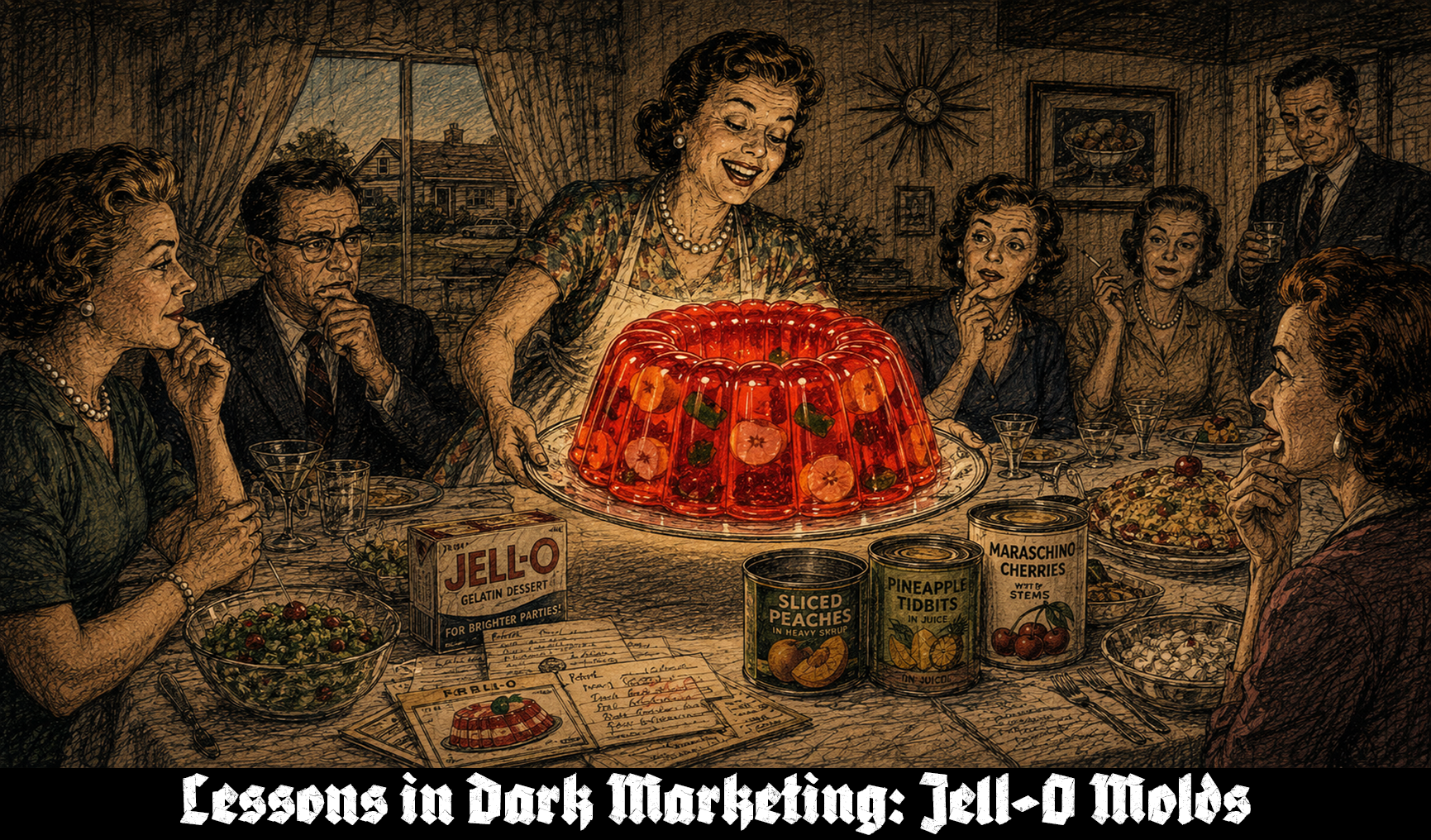
A ring of gelatin with canned fruit suspended inside it should have been treated as a warning from the gods. Instead, people put it in the center of the table. That is how you know the marketing worked.
The Jell-O mold was not just dessert. It was a wobbling status object. A translucent suburban monument. A bright red, green, orange, and/or yellow shrine to processed food, domestic performance, artificial color, and the terrifying belief that canned pineapple trapped inside gelatin somehow meant the hostess had taste.
A bowl of Jell-O is one thing. A Jell-O mold is something else. A bowl says the children wanted dessert. A mold says someone made decisions. Someone bought a ring mold. Someone opened cans. Someone arranged fruit. Someone waited for the refrigerator to do the final act. Someone turned processed powder and pantry leftovers into a centerpiece and expected applause. That is the machine.
We’re looking at domestic spectacle, not simple dessert.
Jell-O molds turned cheap ingredients into visual theater. They let ordinary households perform creativity without requiring real culinary skill. They made artificial color feel festive. They made convenience look like effort. They made the party table into a stage where the homemaker could prove she was modern, clever, prepared, and socially acceptable.
The product was gelatin. The machine was approval. That is the case study.
The Mold Turned Cheap Dessert Into a Centerpiece
Jell-O by itself is humble. Powder, hot water, cold water, refrigerator, wait. That is not a culinary achievement. That is a science project for people who own a spoon.
The mold changed the meaning.
Once Jell-O left the bowl and entered the mold, the product became architectural. It had shape. It had height. It had shine. It had wobble. It could sit in the center of a table and demand to be noticed. That matters because visibility is one of the oldest tricks in food marketing. The food that gets seen gets talked about. The food that gets talked about becomes social currency.
The Jell-O mold understood the party table as a battlefield.
A hostess did not just need to serve something edible. She needed something that looked like effort. Something that suggested care. Something that could survive the scrutiny of relatives, neighbors, church ladies, bridge club women, and every quietly judgmental guest pretending not to inspect the spread.
A molded gelatin ring gave her that.
It looked like a dish. It looked planned. It looked like a special occasion had happened. It gave a cheap powdered product the posture of ceremony.
This is dark marketing principle number one: When the product is cheap, give it a shape that makes it look important.
The mold did not improve the substance. It elevated the presentation. That was enough. Jell-O did not need to become better food. It needed to look like it had crossed the line from snack into centerpiece. The mold gave the product visual authority, and visual authority can do a lot of work when the table is full of people pretending to have standards.
Artificial Color Became Domestic Spectacle
Jell-O did not look like nature. That was part of the appeal.
The colors were too bright, too clean, too clear, too theatrical. Red that looked like a stoplight dissolved in sugar. Green that looked like a lawn chemical pretending to be lime. Orange that looked like Tang’s cousin got promoted to dessert. Yellow that looked cheerful in the way only processed food can look cheerful before it starts feeling suspicious.
That artificial brightness was the point.
Jell-O molds arrived in a world where color could signal modernity, fun, abundance, and celebration. A table with a glowing gelatin ring looked more festive than a table with a plain bowl of fruit. The product took artificiality and made it decorative. It turned chemical color into domestic joy.
That is an important distinction.
A natural dessert has to rely on taste, texture, ingredients, and skill. A Jell-O mold could rely on color and shape before anyone even took a bite. It worked visually first. The eye made the sale before the mouth had a chance to object.
That is why Jell-O molds were pre-internet visual bait. They were built to be seen. They were built to stop the room. They were built to make someone say, “Oh, look at that,” even when “that” looked like a traffic signal died in a bundt pan.
This is dark marketing principle number two: Artificial color can beat real quality when the product’s first job is to attract attention.
Jell-O molds did not need to look natural. They needed to look noticeable. The brightness became the hook. The color told the room that something festive was happening, even when the actual dish was just flavored gelatin holding canned fruit hostage.
Convenience Was Dressed Up as Effort
The genius of the Jell-O mold was that it sat in the perfect middle zone between laziness and labor.
It was easy enough for mass adoption, but involved enough to feel like effort. That is a powerful place for a product to live. If something is too easy, the person serving it gets no credit. If something is too hard, many people avoid making it. Jell-O molds solved that problem beautifully.
The process gave the homemaker just enough performance.
Dissolve the powder. Add the fruit. Pour it into a mold. Refrigerate it. Un-mold it. Garnish it. Carry it to the table like a trophy from a very strange war.
The labor was manageable, but the result looked like an event. That is the trick. The brand did not merely sell a convenience product. It sold a convenience product with a built-in ritual, and that ritual allowed the person serving it to claim creativity.
This is where many processed food brands became powerful. They did not remove the consumer from the process completely. They left a little space for participation so the buyer could feel responsible for the final result.
Jell-O gave people the illusion of authorship.
The company supplied the powder. The refrigerator supplied the structure. The mold supplied the shape. The consumer supplied the arrangement and then accepted the compliment.
This is dark marketing principle number three: The best convenience products leave just enough labor for the consumer to feel creative.
Jell-O did not ask the homemaker to master pastry. It asked her to participate in a small act of assembly and then enjoy the social credit of having “made” something. That is a very efficient emotional bargain. The brand did most of the work before the box ever entered the kitchen, but the consumer got to feel like the artist.
Cheap Ingredients Were Disguised as Abundance
Jell-O molds made cheapness look generous. That is one of the darkest parts of the machine.
Gelatin powder was inexpensive. Canned fruit was accessible. Whipped topping, marshmallows, cottage cheese, shredded carrots, nuts, celery, canned pineapple, fruit cocktail, and whatever else mid-century recipe writers decided to bury in the wobble could all be presented as abundance when suspended inside a colorful molded form.
The mold hid the economics.
A few inexpensive ingredients could be stretched into a dish that looked larger than the sum of its parts. The transparency helped. You could see the fruit. You could see the pieces. You could see the embedded evidence of effort. The mold made scraps look curated.
That is very powerful for households managing budgets while still wanting to perform hospitality. Hosting is expensive. Feeding people is expensive. Looking generous is expensive. Jell-O molds offered a way to stage plenty without actually providing much of it.
- A little fruit became a visible feature.
- A little whipped topping became a garnish.
- A little canned filling became a centerpiece.
This is dark marketing principle number four: Make inexpensive ingredients look abundant and the customer can perform generosity on a budget.
The product did not simply feed people. It helped the host avoid the shame of looking like she had served too little. Jell-O gave cheap ingredients height, color, structure, and social presence. We’re not looking at just a recipe, we’re seeing economic anxiety wearing a ring mold.
Brand Recipes Turned Consumers Into Product Demonstrators
Jell-O molds did not spread only because people independently woke up possessed by the desire to trap fruit in gelatin. The recipes mattered.
Branded recipe culture is one of the great dark marketing engines in American food history. A company sells a product, then teaches consumers how to build meals, desserts, parties, rituals, and identities around that product. The recipe is presented as help, but it also functions as instruction, dependency, and demand creation.
That is what happened with Jell-O.
The brand did not simply say, “Here is gelatin.” It said, “Here is what you can become with gelatin.” Creative. Modern. Clever. Festive. Prepared. A woman with ideas. A woman with a dish people notice.
Recipes turned the product into a system.
Each new recipe gave the consumer another reason to buy the box. Each new mold idea expanded the product’s social territory. Dessert, salad, holiday dish, party centerpiece, children’s treat, luncheon item, church potluck contribution. The brand did not have to wait for consumers to invent use cases. It manufactured the use cases and handed them out as inspiration.
This is dark marketing principle number five: A recipe can be advertising disguised as domestic advice.
The consumer thinks she is receiving help. The brand is building habits. The recipe does not merely describe what to do with the product. It creates new occasions for the product to appear, new excuses to buy it, and new ways for the consumer to demonstrate the brand to other people.
The Homemaker Became the Stylist
The Jell-O mold turned the homemaker into a food stylist before most people had any reason to use that phrase.
That was central to the appeal.
The dish was visual. The fruit placement mattered. The mold shape mattered. The garnish mattered. The serving plate mattered. The moment of un-molding mattered. A Jell-O mold could succeed or fail before anyone tasted it because the presentation was the performance.
This created a new kind of domestic pressure.
The homemaker was no longer just feeding people. She was staging the food. She had to make the table look attractive. She had to make processed ingredients appear elegant. She had to turn a cheap box of powder into something that looked intentional enough to deserve a comment.
That pressure was useful to the brand.
The more food became presentation, the more consumers needed products that helped them present. Jell-O was perfect because it created instant visual drama. It gave the host something bright, shiny, and structured to place on the table.
This is dark marketing principle number six: When presentation becomes social judgment, products that create instant visual impact become emotional tools.
Jell-O molds helped the homemaker manage the fear of being seen as plain, lazy, cheap, or un-creative. The product gave her an object that performed effort on her behalf. The wobble became part of the show. The shine became evidence. The color became personality.
Party Food Became a Test of Social Competence
A party table is never just a party table. It is a report card.
People judge what is served, how it looks, how much there is, whether the host tried, whether the food is modern or boring, whether the spread is generous or sad, whether the hostess understands the occasion, and whether the family seems respectable enough to keep inviting.
Jell-O molds fit into that judgment system perfectly.
They were party-safe. They were bright. They were easy to slice or scoop. They could be made ahead. They could sit on the table like an object. They gave the host something to point to. They also carried enough novelty to create conversation without requiring much risk.
That made them valuable.
A Jell-O mold was not only food. It was proof that the host understood the social game. The dish said she had planned something. She had not simply put out the bare minimum. She had created a moment, even if that moment looked like canned peaches trapped in a red aquarium.
This is dark marketing principle number seven: Sell a product that helps people pass social inspection and they will call the purchase preparation.
Jell-O molds helped hosts survive the gaze of other people. The product gave them a visible marker of effort, creativity, and occasion awareness. That is a stronger sales pitch than taste alone. Taste is private. Social inspection is public.
The Weirdness Became the Conversation
Some Jell-O molds were normal enough. Fruit, gelatin, whipped cream, bright colors, fine.
Then things got weird.
Savory gelatin molds. Vegetable molds. Seafood molds. Meat-adjacent molds. Cottage cheese suspended in green gelatin like a cryogenic experiment in a school cafeteria. Shredded carrots. Celery. Olives. Tuna. Mayonnaise. The kind of food that makes you wonder whether mid-century recipe developers were being paid by the ingredient or blackmailed by the mold industry.
But even the weirdness served the machine.
A strange dish gets noticed. A strange dish gets discussed. A strange dish becomes memorable. The consumer may be confused, but confusion is still attention. The host may be praised or quietly judged, but the dish has done something ordinary food often fails to do. It has occupied the room.
That is why novelty is dangerous. It can survive bad taste if it creates enough reaction.
The Jell-O mold could be admired, mocked, feared, remembered, and repeated. All of those reactions kept the format alive. Once a food becomes a conversation piece, it gains social value beyond flavor.
This is dark marketing principle number eight: Weirdness can become distribution when the product is built to be talked about.
A normal dessert disappears after it is eaten. A strange mold lives in memory. The brand does not care whether every reaction is praise. The brand benefits when the product becomes the thing people mention later.
The Mold Gave Control Over Chaos
There is something psychologically revealing about suspended food.
Fruit that would normally roll, bruise, drip, spoil, or collapse gets frozen in place. Everything is visible. Everything is held. Everything is controlled. The gelatin turns disorder into design.
That is part of the appeal.
The homemaker could take a messy world of ingredients and lock them inside a smooth, shining shape. The refrigerator became a machine of order. The mold turned loose pieces into a unified object. That is a powerful metaphor for domestic life, whether people realized it or not.
The mid-century household was full of expectations. Keep the house clean. Keep the children fed. Keep the marriage respectable. Keep the guests impressed. Keep the family looking functional. Keep chaos from showing. A Jell-O mold offered a tiny edible version of that fantasy.
- Everything in its place.
- Everything held together.
- Everything bright enough to distract from how strange the whole thing was.
This is dark marketing principle number nine: Products that symbolize control can sell comfort even when the control is mostly theatrical.
Jell-O did not actually control the household. It controlled the fruit. It controlled the presentation. It controlled the little wobbling sculpture on the plate. But that small visual order could still feel emotionally satisfying inside a culture obsessed with domestic performance.
The Product Made Artificial Food Feel Sophisticated
One of the strangest achievements of the Jell-O mold was that it made processed food feel fancy.
The mold did that.
A bowl of gelatin feels childish. A molded gelatin ring feels like someone is hosting a luncheon and using the word “luncheon” without irony. Shape created sophistication. Presentation upgraded the product. The same basic substance could become more adult, more social, and more respectable when it was un-molded onto a platter.
That is a brilliant transformation.
The brand took a product associated with children, sickness, softness, and simplicity, then taught households how to turn it into a decorative dish. The mold gave the product manners. It dressed the powder up for company.
That is how processed food became socially mobile.
It could move from the children’s bowl to the adult table. It could appear at parties. It could take on the costume of refinement. It could become a “salad” if people were willing to abuse language badly enough.
This is dark marketing principle number ten: Presentation can launder low-status food into high-status performance.
Jell-O molds let processed food climb the social ladder. The ingredients were humble, but the form suggested effort and occasion. That was enough. In consumer culture, looking elevated often matters more than being elevated.
The Mold Was Pre-Instagram Food Culture
Jell-O molds were built for the gaze long before social media turned every meal into a public audition. They were food designed to be looked at. The shine, color, shape, and suspended ingredients all created visual impact. The dish announced itself. It did not sit quietly. It performed.
That makes the Jell-O mold an ancestor of modern viral food culture.
The modern internet loves food that looks wild, excessive, colorful, strange, oversized, nostalgic, or technically unnecessary. Milkshakes covered in candy. Giant cheese pulls. Rainbow bagels. Butter boards. Unicorn drinks. Charcuterie houses. Foods built less for hunger than for the camera.
Jell-O molds belonged to that family before the camera was always in the room.
The party guest was the platform. The dining room was the feed. The recipe card was the content strategy. The hostess was the creator. The dish was the post.
This is dark marketing principle number eleven: When food is designed for visibility, attention can become more important than appetite.
Jell-O molds did not need to be the best-tasting dish at the party. They needed to be the most noticeable. That is the same logic that drives modern visual food trends. The mouth comes second. The eye gets targeted first.
The Brand Made Repetition Feel Like Tradition
A product becomes much more powerful once repetition starts feeling like tradition.
That is what happened with Jell-O molds. They appeared at holidays, family gatherings, potlucks, luncheons, church events, and community tables often enough to become part of the emotional scenery. Once that happens, people stop asking whether the dish is good. They start asking whether it belongs.
That is a different kind of attachment.
Tradition protects products from rational evaluation. A holiday dish can survive bad taste because the memory does the work. A family recipe can be objectively strange and still emotionally untouchable because it carries names, faces, years, jokes, and dead relatives with better timing than judgment.
Jell-O benefited from that.
The brand did not need every mold to be excellent. It needed the format to keep showing up. Repetition turned the product from novelty into ritual. The more it appeared, the more it felt like it had always been there.
This is dark marketing principle number twelve: Repeat a branded product inside family rituals long enough and the brand starts wearing the costume of tradition.
Jell-O did not have to be ancient. It had to be present. Presence becomes memory. Memory becomes tradition. Tradition becomes defense. That is how a box of processed gelatin can end up protected by nostalgia like it came down from the ancestors on stone tablets.
The Product Sold Women a Safe Form of Creativity
Jell-O molds offered creativity inside a very controlled box. That is important.
The homemaker could experiment, but within limits. New fruits. New colors. New molds. New layers. New garnishes. New combinations. The brand encouraged variation, but the system remained safe. The product still set the boundaries. The recipe still held the hand. The result still belonged to a recognizable domestic category.
This is how many consumer brands sell creativity.
They do not actually want chaos. They want controlled personalization. They want the consumer to feel expressive without leaving the product system. Jell-O was perfect for this because the base formula stayed the same while the surface could change endlessly.
The homemaker could feel inventive without risking too much.
That mattered inside a culture that often expected women to be creative, but not too creative. Interesting, but not threatening. Skillful, but still domestic. Clever, but still acceptable. Jell-O molds gave women a sanctioned arena for small acts of aesthetic control.
This is dark marketing principle number thirteen: Sell controlled creativity to people whose self-expression has been confined to approved roles.
Jell-O did not free the homemaker from domestic expectation. It gave her a more colorful way to perform it. That is the darker edge. The product offered expression while keeping that expression safely inside the kitchen.
The Product Turned the Refrigerator Into a Factory Worker
The refrigerator was a silent partner in the Jell-O mold machine.
Without refrigeration, the mold is nothing. With refrigeration, the homemaker could pour a liquid mess into a container and let the machine produce structure. That mattered because it made the kitchen feel modern. The appliance became part of the magic. The cold did the work.
This tied Jell-O molds to the larger story of modern domestic technology.
The refrigerator was not just storage. It was control over time, texture, spoilage, and preparation. Jell-O used that appliance power beautifully. The product transformed because the modern kitchen could transform it. That made the dish feel like part of a new era of household convenience and food science.
The old kitchen required constant labor. The modern kitchen could outsource certain transformations to appliances and packaged products. Jell-O molds turned that into entertainment.
This is dark marketing principle number fourteen: When a product depends on household technology, it can make the consumer feel modern for using both.
The powder, the mold, and the refrigerator created a little production system. The homemaker appeared to make the dish, but the brand and the appliance did most of the structural work. That is the modern convenience bargain in miniature.
The Case Study Breakdown
Here is the Jell-O mold machine in plain English:
- The product turned cheap powdered gelatin into a visible centerpiece.
- The mold gave the dessert shape, height, and social authority.
- Artificial color became a substitute for quality because the dish was designed to attract attention first.
- Convenience was dressed up as effort, allowing the homemaker to feel creative without doing difficult cooking.
- Cheap ingredients were disguised as abundance through suspension, shine, and presentation.
- Brand recipes created new reasons to buy the product and taught consumers how to demonstrate it to others.
- The party table turned the dish into a test of social competence.
- Weirdness helped the product become memorable, even when the flavor or ingredients were questionable.
- The mold symbolized control by holding messy ingredients inside a smooth, bright shape.
- Presentation laundered processed food into something that felt sophisticated.
- The dish became pre-Instagram food culture because it was designed for the gaze before it was designed for the appetite.
- Repetition at family gatherings and holidays helped the branded product feel like tradition.
- The product sold women a safe form of creativity inside the approved boundaries of domestic life.
- The refrigerator, the mold, and the powder worked together as a modern kitchen production system.
That is why Jell-O molds worked.
They did not need to be great food. They needed to be visible, affordable, repeatable, and socially useful. They gave hosts a way to turn inexpensive processed ingredients into table theater. They gave homemakers a way to perform creativity, order, modernity, and hospitality without requiring expensive ingredients or advanced skill.
This is dark marketing principle number fifteen: A product becomes powerful when it helps the consumer perform a social role.
Jell-O molds helped the hostess appear prepared, creative, generous, festive, modern, and respectable. The dish was edible branding. Every molded ring on a party table was an advertisement pretending to be hospitality.
What Marketers Should Learn From Jell-O Molds
The first lesson is that presentation can completely change a product’s status.
A bowl of gelatin is a simple dessert. A molded gelatin centerpiece becomes an event. The substance barely changes, but the social meaning changes dramatically.
The second lesson is that recipes are one of the strongest forms of product marketing.
They do not just tell people how to use the product. They create occasions, rituals, dependencies, and reasons to keep buying.
The third lesson is that visual impact can compensate for weak substance.
Jell-O molds worked because they were bright, strange, shiny, and noticeable. That kind of visibility is a marketing asset, especially in social settings.
The fourth lesson is that convenience sells better when consumers can still claim effort.
Jell-O allowed people to feel like they made something, even when the product system did most of the heavy lifting.
The fifth lesson is that nostalgia can protect a product from judgment.
Once Jell-O molds became part of family gatherings, church tables, holiday spreads, and childhood memory, the brand gained emotional protection that taste alone could never provide.
This is dark marketing principle number sixteen: A product that enters family memory can survive long after the original sales logic becomes ridiculous.
People may laugh at Jell-O molds now, but the laughter still proves the point. The format stuck. The colors stuck. The wobble stuck. The weird old recipes stuck. The brand became part of the cultural memory of American domestic life, which is exactly what every packaged food company wants.
Final Diagnosis
Jell-O molds are one of the strangest and clearest Lessons in Dark Marketing because they prove that processed food can become social theater when the presentation is strong enough.
The final diagnosis is wobbly and horrifying:
- Jell-O molds turned cheap powder into a centerpiece.
- They made artificial color feel festive instead of fake.
- They disguised inexpensive ingredients as abundance.
- They sold convenience while still letting the homemaker claim effort.
- They turned recipes into advertising.
- They made party food into a test of social competence.
- They used weirdness as a conversation engine.
- They made processed food feel sophisticated through shape and presentation.
- They sold women a safe, approved form of creativity inside domestic expectations.
- They turned the refrigerator into part of the product experience.
- They trained households to treat branded processed food as tradition.
- They became pre-internet visual bait, built for attention before appetite.
- They proved that a dish can be remembered even when people are not sure they wanted to eat it.
That is why Jell-O molds belong in the Dark Marketing museum.
Somewhere between Tang, TV dinners, Tupperware, Chia Pets, Reader’s Digest, and every modern viral food trend built to be seen, shared, mocked, and remembered before anyone asks whether it is actually good.
A little powder. A little water. A little canned fruit. A little refrigeration. A little social pressure. A little artificial color. A little domestic desperation dressed up as creativity.
Then the mold comes out. It wobbles. The room notices. The brand wins.
Leave a Reply