
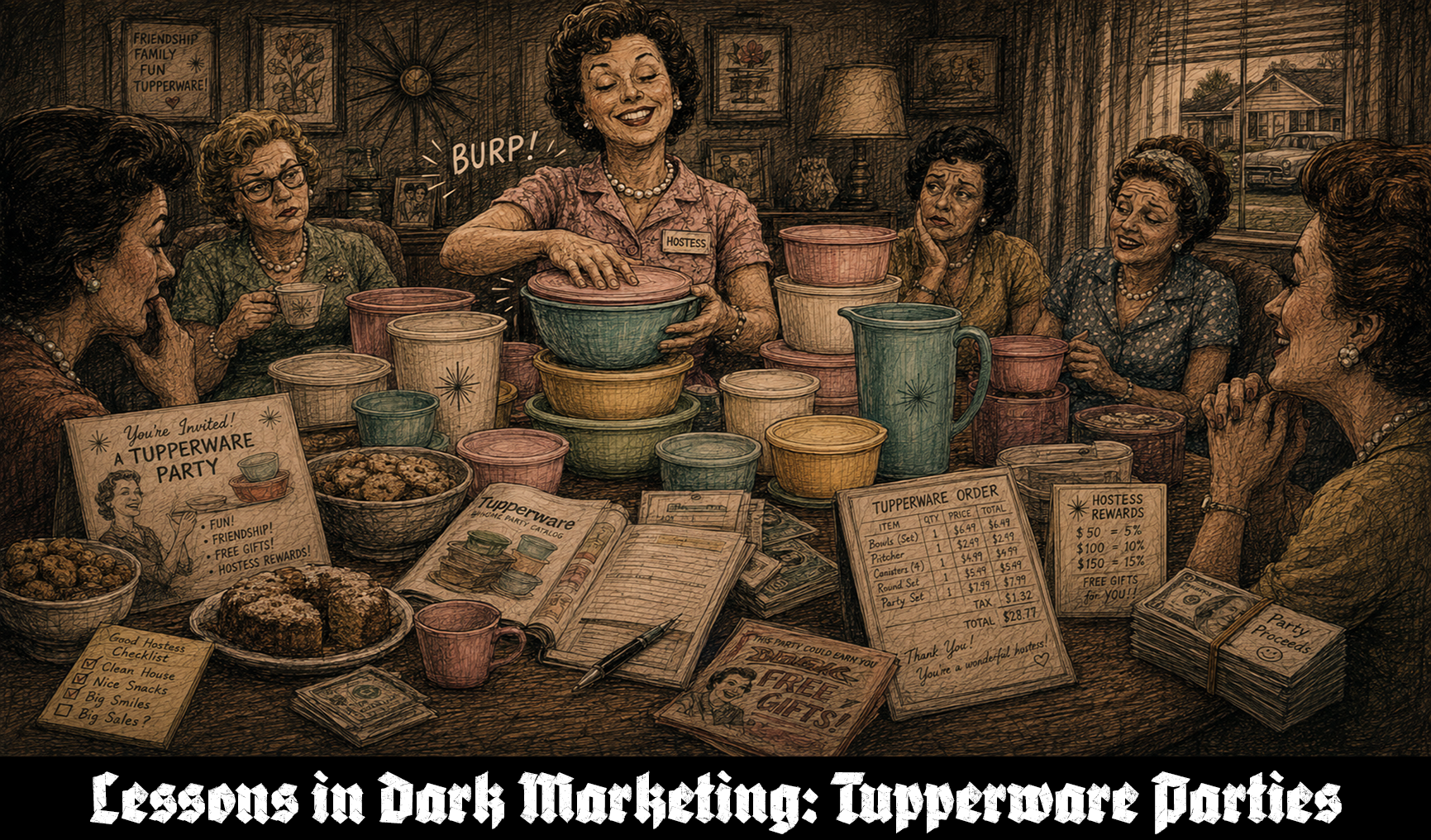
A plastic bowl with a burping lid should not have become a social movement.That sentence sounds insane until you remember consumerism and status exist.
Tupperware was not just a container. It was a ritual. It was a living room sales trap. It was suburban theater with refreshments. It was a plastic promise whispered into the ears of women who had been told their entire domestic worth could be measured by how clean, prepared, organized, modern, feminine, efficient, and respectable their kitchens looked.
A bowl went into the room. A sales system came out. That is why Tupperware belongs in the Dark Marketing museum.
We’re looking at domestic capitalism dressed as friendship, not simple food storage. Tupperware did something most brands dream about. It turned the customer’s house into the showroom, her friendships into the audience, her kitchen anxiety into the pitch, and her social obligations into the closing mechanism.
That was the machine. Not plastic. Not leftovers. Not freshness. Pressure. The product held food. The business model held women in place and made them sell to one another under the soft lighting of politeness.
That is where the case study begins.
The Product Was Boring Until the Demonstration Made It Feel Like Magic
On a store shelf, Tupperware was just plastic. That was the original problem. Plastic did not yet have the emotional glow it would later inherit from postwar convenience culture. A consumer could walk past a plastic bowl without understanding why it mattered. It looked plain. It looked strange. It lacked the obvious weight and dignity of glass, ceramic, metal, or the old containers people already understood.
Then came the demonstration.
- The lid sealed.
- The air pushed out.
- The bowl “burped.”
That little sound was everything. Suddenly the product had theater. It had proof. It had a trick. It had a moment that could be performed in front of a room full of women who were already trained to care about food waste, freshness, kitchen order, and household competence.
A regular container became a magic act. That matters because many products are dead until someone shows people how to desire them. Tupperware was not self-explanatory in the way a candy bar, cigarette, or bottle of soda was self-explanatory. It needed a stage. The home party gave it one.
This is dark marketing principle number one: When a product is boring on the shelf, turn the demonstration into the product.
- The bowl was not enough.
- The lid was not enough.
- The plastic was not enough.
The performance made it feel alive.
That is the first Tupperware trick. The company did not simply sell containers. It sold the little gasp of recognition when the lid sealed and the room understood the pitch at the same time. The product needed witnesses, so the sales model manufactured them.
The Store Failed, So the Living Room Became the Trap
Tupperware did not become powerful because shoppers suddenly developed a religious hunger for plastic food storage.
The product needed context. Stores were too cold. Shelves were too passive. A department store could display the bowl, but it could not create the social charge around it. A shopper could pick it up, look at it, shrug, and move on.
The living room solved that problem. Inside the home, the product became warmer. More intimate. More believable. More socially loaded.
This was not a stranger selling you a bowl. This was a woman you knew hosting a party. She had snacks out. She had chairs arranged. She had invited neighbors, relatives, church friends, and women from the block. You were not browsing. You were attending.
That changes everything. Retail gives the customer permission to walk away. A party makes walking away feel like a small betrayal.
That is why the home mattered. It converted a purchase decision into a social event. The guest was no longer just evaluating a product. She was participating in someone else’s evening. The host’s effort became part of the pressure.
You did not want to disappoint the store. You could disappoint a friend. That is a much stronger sales environment.
This is dark marketing principle number two: The best sales room is the one where saying no feels rude.
- The customer is not trapped by force.
- The customer is trapped by manners.
- The customer is trapped by friendship.
The customer is trapped by the plate of cookies and the fact that someone cleaned the house before you arrived. That was the living room advantage. It turned refusal into discomfort. Nobody had to threaten anybody. Politeness did the dirty work.
Friendship Became the Funnel
Tupperware parties were brilliant because they turned friendship into a distribution channel. That sounds ugly because it is ugly.
The host did not need to buy television ads to reach the neighborhood. She already had the list. She knew who to invite. She knew which women were likely to show up. She knew who felt obligated. She knew who would buy something small just to be nice.
That is not a weakness in the model. That is the model. The home party system moved through trust networks long before social media gave marketers dashboards and referral codes. It was analog influencer marketing with better snacks and worse boundaries.
- A woman invited her friends.
- Her friends came because they knew her.
- They bought because they were in her home.
- Then some of them hosted their own parties.
- The sales force expanded through social obligation disguised as opportunity.
This is where Tupperware becomes more than a brand. It becomes a map of how commerce invades private life. The company did not need to own every relationship. It only needed to teach ordinary women how to monetize them.
This is dark marketing principle number three: The most efficient sales funnel is a relationship the brand did not have to build.
- The host supplies the trust.
- The guest supplies the guilt.
- The company supplies the product.
Then everybody pretends the evening was about fun.
That is the genius and the rot of the party model. The brand gets access to a room it could never enter honestly. Friendship opens the door. Commerce walks in behind it carrying plastic bowls.
The Party Was the Product
The Tupperware party was not a side effect of the business. The party was the business. That is what made the model so dangerous and so effective. The company did not simply sell containers at parties. It used the party format to make the containers feel necessary, modern, communal, and socially validated.
A room full of people watching the same demonstration creates a different psychology than one person shopping alone. The laughter matters. The host’s enthusiasm matters. The group reaction matters. The little games matter. The prize drawings matter. The feeling that everyone else understands the product matters.
The party created momentum. One person’s interest made another person curious. One person’s purchase made another person feel safer buying. One person’s hesitation could be softened by the fact that the room was moving in a buying direction. That is group pressure with a casserole dish on the table. This was not merely sales. It was choreography.
- The demonstration came first.
- The laughter came next.
- The hostess got praised.
- The guests got warmed up.
- The buying became casual.
- The order forms came out.
A room that began as a social gathering slowly became a checkout line.
This is dark marketing principle number four: Make the purchase feel like participation and the customer stops feeling sold to.
- The guest is not just buying a bowl.
- She is joining the moment.
- She is supporting the host.
- She is playing along.
- She is proving she belongs in the room.
That is how the party softened the transaction. Money moved through the evening without feeling like the center of the evening. That is the trick. The sale was everywhere, which made it easier to pretend it was nowhere.
Domestic Anxiety Was the Emotional Trigger
Tupperware understood the postwar kitchen better than most politicians understood the postwar family. The kitchen was not just a room. It was a performance space.
A woman’s refrigerator, pantry, leftovers, lunches, cabinets, and serving dishes could all be treated as evidence of her competence. Was she organized? Was she wasteful? Was she modern? Was she prepared? Was she feeding her family correctly? Was she the kind of woman who had everything under control? Tupperware walked directly into that anxiety with a plastic smile.
- It promised order.
- It promised freshness.
- It promised less waste.
- It promised a cleaner refrigerator.
- It promised a better pantry.
- It promised the fantasy that the chaos of family life could be snapped shut under a flexible plastic lid.
That is a powerful promise. Because the product was never only about storing food. It was about storing the feeling that your household was not falling apart. This is where domestic products become psychologically loaded. A bowl becomes a symbol. A cabinet becomes a report card. A refrigerator becomes a moral document.
Tupperware did not create domestic pressure, but it knew how to package it.
This is dark marketing principle number five: Sell control to people who have been made responsible for chaos.
- The mother handles the leftovers.
- The wife manages the kitchen.
- The hostess protects the appearance of order.
- The brand sells her containers and calls it empowerment.
That is the emotional lock. Tupperware did not need to tell women they were anxious about domestic judgment. The culture had already done that. The product simply showed up with a lid.
Plastic Was Sold as Progress
There was a time when plastic looked like the future.
That is hard to remember now because plastic has become the symbol of cheapness, waste, pollution, and every sad cabinet full of mismatched lids. But in the Tupperware era, plastic carried a different emotional charge.
- It was modern.
- It was light.
- It was colorful.
- It was new.
- It was the opposite of grandma’s heavy kitchen.
Tupperware sold plastic as progress you could hold in your hands. It made the postwar kitchen feel updated, efficient, scientific, and clean. The material itself became part of the fantasy. This was not just a bowl. This was proof that the household had entered the future.
That is why the colors mattered. That is why the flexible seal mattered. That is why the parties mattered. Tupperware made plastic feel aspirational before plastic became embarrassing.
The brand turned synthetic material into domestic status.
This is dark marketing principle number six: When the culture worships the future, sell the cheapest symbol of modernity as progress.
- Plastic was not glamorous by nature.
- The brand made it feel glamorous.
- Plastic was not emotionally rich.
- The party made it feel like the new standard.
- Plastic was not family love.
The marketing placed it inside the rituals of feeding, storing, serving, and hosting. That is how a material becomes a movement. You do not sell what the object is. You sell what era the object makes the buyer feel like she belongs to.
The Hostess Was Both Customer and Sales Infrastructure
The hostess was the most important person in the room because she was doing three jobs at once.
- She was a customer.
- She was a salesperson.
- She was the bait.
That is the dark beauty of the model. The company did not need to rent the room. The hostess had one. The company did not need to build the audience. The hostess invited one. The company did not need to create the trust. The hostess already had it. The company did not need to fully compensate the emotional labor. The culture had trained women to provide it for free or cheap. The hostess cleaned. Invited. Smiled. Served. Demonstrated. Followed up. Managed the room. Absorbed the awkwardness. Converted relationships into orders.
Then the brand got the revenue. That is a brutally efficient arrangement. It gives women a taste of entrepreneurship while keeping the real structure safely above them. The host can feel active, useful, ambitious, and socially rewarded, but the system still depends on her personal network being turned into inventory.
This is dark marketing principle number seven: The best sales infrastructure is labor the company can frame as opportunity.
- The hostess provides the home.
- The hostess provides the friends.
- The hostess provides the warmth.
- The brand provides the script and collects the upside.
That is the old party model in plain English. It made the seller feel chosen while using her social life as the distribution system.
Empowerment Became the Packaging
Tupperware did offer something real to some women. That is part of what makes the case darker, not lighter. For women with limited access to traditional careers, Tupperware selling could provide income, recognition, travel, status, prizes, leadership, and a world outside the narrow domestic cage. Some women built serious sales careers through the system. Some found confidence. Some found community. Some found a stage.
That matters. But dark marketing loves a half-truth. The pitch could be real enough to be believable and limited enough to remain exploitable. The system could give women opportunity while also profiting from the same social restrictions that made that opportunity feel rare.
- That is the uncomfortable tension. Tupperware did not simply oppress women. It also recruited them into a sales structure built on the world that had already boxed them in.
- The brand could say, “You can earn.”
- The culture had already said, “But do it from home.”
- The brand could say, “You can lead.”
- The culture had already said, “But keep it feminine.”
- The brand could say, “You can build something.”
The culture had already said, “But build it through your friends.” That is how empowerment becomes packaging.
This is dark marketing principle number eight: The most profitable empowerment pitch sells freedom inside the boundaries that created the hunger for freedom.
- The seller gets recognition.
- The seller gets possibility.
- The seller gets applause.
The company gets a motivated sales force built from women who were hungry for options. That is not clean villainy. It is more useful than that. It is a system that offers just enough truth to make the trap feel like a door.
The Kitchen Became a Status Battlefield
Tupperware did not just organize kitchens. It ranked them. A woman with the right containers looked prepared. A woman with the full set looked modern. A woman with matching lids and colors and neat stacks looked like she had mastered the invisible labor everyone expected from her. That is the status game.
People think status products are watches, cars, jewelry, suits, and handbags. Those are obvious. Domestic status is quieter and meaner. It hides inside cabinets. It hides inside refrigerators. It hides inside the moment another woman opens your pantry and silently judges whether you have your life together.
Tupperware thrived in that little psychological wound.
- It made organization visible.
- It made storage collectible.
- It made food management aesthetic.
- It made leftovers look like discipline.
That is a savage little achievement, because once a product becomes part of how people judge themselves, it no longer needs to be merely useful. It becomes part of identity maintenance.
This is dark marketing principle number nine: Turn private organization into social status and the customer will police herself.
- The cabinet becomes a mirror.
- The refrigerator becomes a performance.
- The pantry becomes proof.
- The container becomes evidence.
Tupperware did not need to shame every buyer directly. It only needed to sit inside a culture where women were already being judged for the condition of the home. The product became a tool for passing inspection.
The Container Promised Safety From Waste
Food waste is one of the quietest forms of household guilt. Throwing away leftovers feels small, but it carries judgment. You bought too much. Cooked too much. Planned badly. Forgot something. Failed to stretch the family budget. Failed to preserve the work you already did. Tupperware put itself directly into that guilt cycle.
- Save the leftovers.
- Keep food fresh.
- Protect the meal.
- Stretch the dollar.
- Respect the work.
The seal became more than a feature. It became moral relief. This is one of the reasons the product was so durable. It attached itself to a permanent household anxiety. Food goes bad. Families waste money. Mothers and wives get blamed for disorder. Containers promise control.
A container cannot fix a household, but it can make the household feel more managed for a little while. That feeling sells.
This is dark marketing principle number ten: Attach the product to guilt the customer already feels and the purchase starts to look like responsibility.
- Buying becomes prevention.
- Buying becomes discipline.
- Buying becomes proof that you are trying.
That is how a plastic bowl escapes the category of “kitchen item” and becomes a moral object. The customer is not splurging. She is being responsible. That is a much easier sale to defend.
The Brand Made Collecting Feel Practical
Tupperware had another advantage. One piece was never enough. You needed different sizes. Different lids. Different colors. Different sets. Different uses. Refrigerator containers. Freezer containers. Serving containers. Pitchers. Bowls. Canisters. The system could expand forever because the household always had one more organizing problem.
That is how practical products become collectible. A collectible spoon looks like sentimentality. A collectible plastic container looks like planning. That distinction matters. When consumption can disguise itself as utility, the buyer feels less guilty. Tupperware allowed people to buy more while telling themselves they were becoming more organized.
The brand did not need the consumer to say, “I want more plastic.” The consumer could say, “I need the right container.” That is a cleaner psychological path to repeat purchases.
This is dark marketing principle number eleven: The best collectible products pretend they are systems.
- One bowl is helpful.
- Three bowls are organized.
- Ten bowls are a lifestyle.
A cabinet full of them is no longer clutter because the brand taught the customer to call it preparedness. That is the trick. The collection hides behind function. The buyer keeps buying because every new piece feels like it completes a problem the last piece revealed.
Tupperware Was Analog Social Media
Before Facebook groups, Instagram stories, TikTok lives, affiliate links, and influencer codes, Tupperware had the same basic mechanics.
- A trusted person gathered an audience.
- The product was demonstrated.
- The audience reacted in real time.
- The seller used personality as conversion fuel.
- The buyer’s social relationship softened skepticism.
- The event could reproduce itself through new hosts.
- That is social commerce.
- The platform was the living room.
- The algorithm was gossip.
- The engagement metric was who showed up and who bought.
The referral mechanism was shame, friendship, aspiration, and the promise of earning a little money without leaving the world women were expected to maintain.
Modern marketers like to pretend social selling is new because the dashboard is new. The behavior is ancient. Tupperware had the funnel running before anyone knew what a funnel was.
This is dark marketing principle number twelve: Social commerce begins when trust becomes monetizable.
- The follower was once a neighbor.
- The creator was once a hostess.
- The livestream was once a living room.
- The checkout link was once an order form.
Same pressure. Different furniture. That is why Tupperware still matters as a case study. It shows that social selling did not begin with the internet. The internet just removed the folding chairs.
The Collapse Was Built Into the Victory
Tupperware became iconic because it matched the culture around it. That was also the problem. The model depended on a world where women were more available for daytime or evening home parties, where suburban networks were dense, where domestic labor was treated as a central female identity, where plastic still felt futuristic, and where retail options were limited enough for a party demonstration to feel special.
Then the world changed.
- Women entered and reshaped the workforce.
- Retail exploded.
- Cheap competitors copied the function.
- Plastic lost its shine.
- The internet replaced the living room as the attention marketplace.
Social media made every person a seller, which made the old party model feel slower, heavier, and less necessary. The same system that once looked intimate began to look dated. That is the irony. Tupperware helped create a form of social selling that modern platforms would later devour. The brand pioneered the behavior, then got trapped inside the older version of it.
This is dark marketing principle number thirteen: The sales machine that makes a brand famous can become the cage that makes it obsolete.
- The party built the empire.
- The party defined the brand.
- The party made the product culturally immortal.
- Then the party became a burden.
That is the danger of owning a model too completely. When the culture moves, the brand has to move faster than its own nostalgia. Tupperware had a powerful story, but the story belonged to another room, another economy, another version of American womanhood.
The Case Study Breakdown
Here is the Tupperware machine in plain English.
- The product was visually boring until demonstration made it theatrical.
- The seal became a magic trick.
- The home replaced the store.
- The hostess replaced the salesperson.
- Friendship replaced advertising.
- Politeness replaced pressure.
- Domestic anxiety replaced desire.
- Plastic became progress.
- Organization became status.
- Leftovers became guilt.
- The party became the funnel.
- The seller became both customer and infrastructure.
- Empowerment became the wrapper around unpaid emotional labor.
That is why Tupperware worked. Not because America needed another bowl. Because America had a perfectly prepared emotional marketplace for it. Women were expected to manage the home, preserve the food, organize the kitchen, entertain politely, support their friends, and seek socially acceptable ways to earn money without appearing to abandon domestic expectations.
Tupperware walked into that pressure and snapped the lid shut.
This is dark marketing principle number fourteen: The strongest products do not create pressure from nothing. They find existing pressure and give it a container.
- The culture created the anxiety.
- The home created the stage.
- The friendship created the trust.
- The product created the excuse.
That is the entire case. Tupperware did not have to invent the domestic cage. It only had to make the cage look colorful, stackable, and airtight.
What Marketers Should Learn From Tupperware
The first lesson is that context can make a plain product feel powerful.
On a shelf, Tupperware was plastic. In a living room, with a host, a demonstration, and a group of watching guests, it became proof, theater, and social currency.
The second lesson is that distribution can be emotional.
Tupperware did not simply move through sales channels. It moved through relationships. That made it powerful and dangerous. When the seller is known, the product inherits trust it did not earn on its own.
The third lesson is that a demonstration can outperform advertising.
The famous seal needed to be experienced. Once people saw it, heard it, and understood it together, the product became easier to buy and easier to explain to the next person.
The fourth lesson is that empowerment language is most persuasive when it contains a real benefit.
The darker version of empowerment marketing does not lie completely. It offers something real, then uses that real thing to make the larger system harder to criticize.
The fifth lesson is that nostalgia can preserve a brand’s fame long after the business model weakens.
People remember the parties. The colors. The cabinets. The mothers and grandmothers. The burping lids. The leftovers. The ritual. But memory is not a turnaround strategy. A brand can be culturally loved and commercially exhausted at the same time.
This is dark marketing principle number fifteen: nostalgia keeps the story alive, but it does not guarantee the machine still works.
- The memory can be warm.
- The economics can be dead.
- The brand can be famous.
The customer can still move on. That is the final warning inside Tupperware. A brand can become a household name and still lose the household.
Final Diagnosis
Tupperware is one of the greatest dark marketing case studies in American consumer history because it made plastic feel intimate. That is not easy.
Plastic is cold. Synthetic. Manufactured. Cheap. Replaceable. But Tupperware wrapped it in friendship, domestic duty, women’s ambition, kitchen pride, party games, neighborly obligation, and the fantasy of control. Then it sold the whole thing from the living room. The genius was never just the container. The genius was the room.
- The room made the product warmer.
- The room made the pitch softer.
- The room made refusal awkward.
- The room made the hostess valuable.
- The room made the guest vulnerable.
- The room turned storage into status and friendship into sales infrastructure.
That is the Tupperware crime scene. A plastic bowl became a symbol of modern domestic order because the marketing understood exactly where the pressure lived. It did not shout from a billboard. It sat next to the coffee cake and waited for women to sell the system to each other.
The product held leftovers. The business model held social obligation. That is why it worked. That is why it lasted.
That is why the Tupperware party deserves to be studied next to every influencer storefront, MLM pitch, affiliate link, livestream sale, and “community-based brand” pretending it invented human trust last Tuesday. Before the internet turned everyone into a storefront, Tupperware did it with folding chairs, polite laughter, and a bowl that burped. That was not just marketing. That was domestic theater with a purchase order at the end.
Leave a Reply