
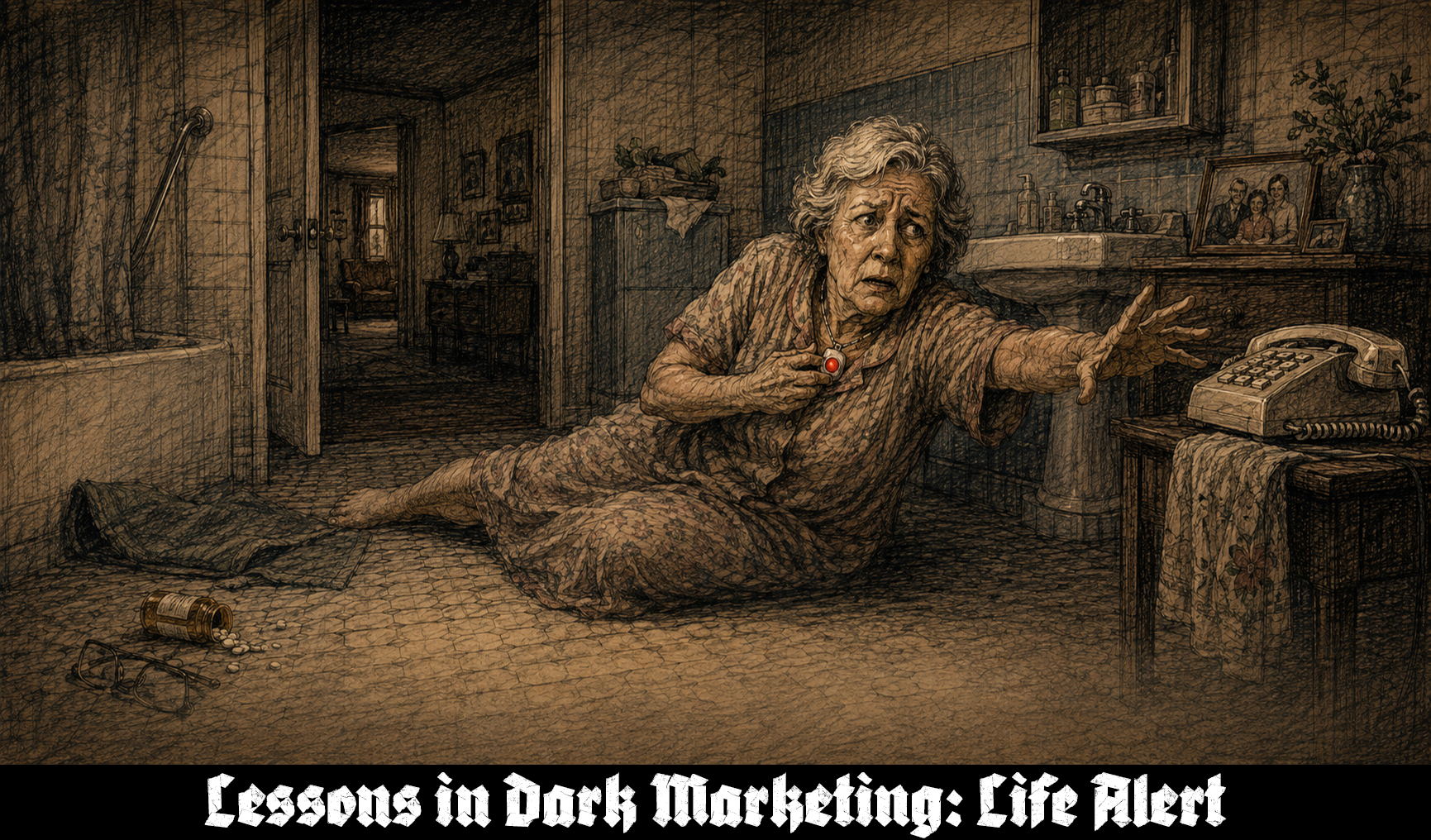
Life Alert understood one of the darkest rooms in American marketing. The bathroom floor. That’s the whole case study.
A person falls. They can’t get up. The phone is too far away. The family isn’t there. The house is quiet. The body that used to work without negotiation has betrayed its owner. Independence, dignity, privacy, and control all collapse in one humiliating moment on tile, carpet, stairs, or linoleum.
Then the commercial arrives.
“Help, I’ve fallen and I can’t get up.”
That line is brutal because it’s funny until it isn’t. People joked about it for decades because the delivery was memorable, the scenario was uncomfortable, and America has always used jokes to avoid looking directly at aging, helplessness, and death. But underneath the catchphrase was one of the cleanest fear-based direct response machines ever built.
We’re looking at panic converted into subscription logic, not simple safety equipment.
Life Alert didn’t just sell a button. Life Alert sold the fear of being alone when the body fails. Life Alert sold the guilt of adult children who couldn’t be there. Life Alert sold the humiliation of dependency, then repackaged the device as independence. Life Alert sold the fantasy that a tiny button could stand in for family, neighbors, community, and a healthcare system that doesn’t have time to hold anyone’s hand.
The product was emergency response. The machine was fear with a phone number. That is the case study.
The Catchphrase Was the Whole Funnel
The genius of Life Alert was compression.
“Help! I’ve fallen, and I can’t get up” told the entire story in one sentence. There was no need for a complicated explainer, a long technical demonstration, or some executive in a golf shirt mumbling about innovation. The phrase created the scene instantly. You heard it, and the image appeared in your head.
That’s strong marketing.
The line had a problem, a victim, a setting, a consequence, and a reason to buy. It was memorable enough to become a cultural joke and serious enough to remain emotionally useful. That’s rare. Most catchphrases either entertain or sell. This one did both. It became part of popular culture while continuing to point back to the product category every time someone repeated it.
That is the beauty and ugliness of the phrase. It didn’t need dignity. It needed recall. The fact that people made fun of it helped it spread. Mockery didn’t kill the brand. It kept the scenario alive inside the public imagination.
This is dark marketing principle number one: The strongest fear pitch is the one that compresses the nightmare into a sentence people can’t forget.
Life Alert didn’t need consumers to remember every feature. It needed them to remember the emergency. The phrase did that job perfectly. It turned a private crisis into a public soundbite, then made the soundbite point back to the product.
The Product Sold Independence by Showing Dependency
Life Alert’s emotional trick is that it sells independence through images of helplessness. That sounds backwards until you understand the target.
Older people often fear losing independence. Adult children often fear their parents losing independence. Families want loved ones to stay home, but they also know the home can become dangerous once the body starts losing strength, balance, speed, and predictability. That tension is the marketplace.
Life Alert walks right into it. The pitch says, in effect, you can keep living alone because help is one button away. The product doesn’t remove vulnerability. It makes vulnerability manageable enough for everyone to continue the arrangement.
That’s powerful because nobody wants to say the harsher thing out loud. Maybe Mom shouldn’t be alone. Maybe Dad isn’t as safe as he says he is. Maybe the house has become a maze of risk. Maybe independence has already started turning into denial.
The device lets the family postpone that conversation.
This is dark marketing principle number two: Sell independence by dramatizing the exact dependency the customer is trying to avoid.
Life Alert doesn’t have to shame aging directly. The fear is already there. The product only needs to position itself as the thing that lets everyone keep using the word independence a little longer.
Family Guilt Was the Hidden Buyer
Life Alert may be worn by the older person, but the emotional buyer is often the family member. That matters.
The adult child sees the commercial and feels the punch. What if something happens? What if she falls? What if he’s alone? What if nobody checks in? What if the phone is out of reach? What if the one time the family isn’t there becomes the one time they can’t forgive themselves?
That’s the hidden conversion path.
The product doesn’t only sell to the person at risk. It sells to the person imagining the guilt after the risk becomes real. That is a much stronger pressure point than ordinary concern. Concern can be ignored. Guilt has teeth.
This is why the pitch works so well. It puts the family member in a morally uncomfortable position. Once you’ve seen the scenario, doing nothing starts to feel like neglect. The device becomes less like a product and more like a defense against future blame.
That is a very effective business model.
This is dark marketing principle number three: The best safety products sell to the person who fears being blamed after the disaster.
Life Alert doesn’t only promise help for the user. It offers emotional insurance to the family. The adult child isn’t just buying a button. They’re buying a little protection against the sentence, “We should have done something.”
The Elderly Body Became the Sales Trigger
Aging is a brutal sales environment because the body becomes the problem. It’s going to happen to all of us, and for some of you it already is. That’s not comfortable, but it’s true.
Falls, heart trouble, dizziness, weakness, strokes, confusion, slipping in the shower, trouble getting up, trouble reaching the phone, confusing your grandson for your brother that passed away before that grandson was born, trouble explaining what happened and when it happened. These are real fears, and they happen. They are also perfect direct response triggers because they are specific, visual, immediate, and emotionally loaded.
Life Alert’s advertising understood this.
The elderly body in distress becomes the sales argument. The person on the floor is not an abstract symbol. They are the future the audience is trying to avoid. For older viewers, the scene says, this could be you. For family members, it says, this could be someone you love.
That’s why the floor matters so much. A fall is physically small and emotionally enormous. One second you’re a person moving through your own home. The next second you’re trapped in the place that was supposed to protect you.
This is dark marketing principle number four: Turn the body’s most humiliating failure into the moment of purchase clarity.
Life Alert’s pitch works because it does not need to invent an exotic danger. It uses the ordinary terror of the body failing in a familiar room. The more mundane the setting, the stronger the fear. The home becomes the danger zone.
The Home Was Re-framed as a Risk Environment
Home is supposed to mean safety. Life Alert complicates that.
The commercial logic quietly rewrites the house. The bathroom becomes a fall hazard. The stairs become a threat. The hallway becomes a place where no one may hear you. The bedroom becomes a site of possible medical emergency. The living room becomes too far from the phone. The home stays familiar, but the pitch teaches the viewer to see danger inside the familiar.
That’s a powerful shift.
Most products sell the home as comfort. Life Alert sells the home as comfort with emergency conditions attached. It doesn’t destroy the emotional value of the home. It protects that value by making fear part of the maintenance plan.
The message is simple: you can keep the home, but you need the button.
That is where the subscription logic begins to feel reasonable. If every room contains potential danger, the device becomes a constant companion. It is no longer something you buy for one situation. It becomes the answer to the general condition of being old, alone, and physically uncertain.
This is dark marketing principle number five: Re-frame a trusted environment as a threat and the product becomes permission to stay there.
Life Alert doesn’t have to convince people that home is bad. It only has to convince them that home is unsafe without the service. That distinction is the whole sale.
Panic Was Made Operational
Panic is messy. Life Alert made panic operational.
That is the entire direct response brilliance. In a crisis, people don’t want philosophy. They want one action. Press the button. That’s it. The product reduces the emergency to a simple command. No dialing. No searching. No crawling. No hoping someone hears. No complicated interface. Press the button and the system activates.
That simplicity is important because fear destroys complexity.
A person in distress can’t be expected to navigate a complicated solution. The device’s appeal is that it turns chaos into procedure. The fall happens, the button is pressed, help is contacted. The pitch is clean because the action is clean.
Marketing loves that kind of clarity.
The more frightening the scenario, the more valuable the simple action becomes. That’s why the button is the perfect symbol. It’s small, obvious, and emotionally loaded. It stands for control when control has disappeared.
This is dark marketing principle number six: The more terrifying the problem, the simpler the product action must appear.
Life Alert turned panic into a button press. That is the conversion engine. The customer isn’t buying technology in the abstract. They’re buying the fantasy that the worst moment can be reduced to one manageable motion.
The Button Became a Substitute for Presence
The darkest thing about Life Alert is what the button represents. It represents someone being there when no one is there. That is the emotional core.
Families are scattered. Adult children work. Neighbors don’t always know each other. Healthcare is impersonal. Older people stay home alone because the alternatives are expensive, unwanted, humiliating, or unavailable. Into that absence comes a button.
The button is sold as connection. That’s both useful and sad.
The product can absolutely provide real emergency access, and that real utility is part of why the marketing works. But symbolically, it is also a substitute for a deeper social failure. Instead of a community close enough to notice, there is a device. Instead of someone in the next room, there is a call center. Instead of human presence, there is monitored response.
That isn’t a joke. That’s the world we live in.
This is dark marketing principle number seven: When society removes human presence, a brand can sell a device that imitates it.
Life Alert’s value comes from the gap between independence and abandonment. The product lives in that gap. It doesn’t solve the loneliness underneath the emergency, but it gives the loneliness an emergency protocol.
Vulnerability Was Packaged as Control
Vulnerability is hard to sell directly because nobody wants to feel vulnerable. So Life Alert sells control.
That’s the emotional translation. The person wearing the device can say they are being safe, prepared, responsible, independent, cautious, and proactive. Those are much easier words to live with than frail, scared, alone, weak, declining, or at risk. That language matters.
Safety products often work by helping people rename fear as responsibility. This is the same machine as home security systems, identity theft protection, car alarms, insurance, emergency kits, and every product that says, “You’re not paranoid, you’re prepared.” Life Alert fits that category perfectly.
Life Alert lets the user and the family convert fear into a plan. Once fear becomes a plan, the purchase becomes easier to justify. The monthly cost is no longer a reminder of vulnerability. It becomes proof that everyone did the responsible thing.
This is dark marketing principle number Eight: fear becomes easier to sell when the customer can call it preparation.
Life Alert doesn’t ask people to see themselves as helpless. It asks them to see themselves as smart enough to have help ready. That framing protects dignity while still monetizing fear.
The Commercial Made Aging Visible
Aging is often hidden in everyday life until it becomes impossible to ignore.
Life Alert made it visible in thirty seconds.
That visibility made people uncomfortable, which is why the catchphrase became a joke. People laughed because they didn’t want to sit with what the commercial was really showing. An older person alone on the floor is not funny. It is one of the most frightening images in domestic life.
The ad forced that image into the living room.
That is why it worked. It punctured denial. It didn’t let the viewer keep aging abstract. It showed the moment where independence breaks. It showed the body on the ground. It showed the failure of normal household safety. It showed the terror of needing help and not having it within reach.
That is heavy material for a commercial, but direct response advertising doesn’t need subtlety when the fear is real. In fact, subtlety would weaken the pitch. The ad needed to be blunt enough to stick.
This is dark marketing principle number nine: When the audience is in denial, make the danger impossible to keep abstract.
Life Alert’s commercial power came from showing aging as an event, not a theory. The fall transformed old age from a vague future into a specific scene. Specific scenes sell.
The Catchphrase Became Cultural Camouflage
The catchphrase became so famous that it started functioning as camouflage. People knew the line. People joked about the line. People repeated it in sitcoms, conversations, parody, and casual exaggeration. The phrase entered popular culture, and that made the brand feel less like a medical service and more like a shared reference.
That helped the marketing. A phrase that becomes a joke can travel farther than an ordinary ad. It gets repeated by people who would never intentionally promote the company. It moves through culture without media buying. It becomes easy to quote, easy to mock, easy to remember, and hard to detach from the product category.
That’s the strange advantage.
The joke made the fear easier to carry. Instead of saying, “I am worried my mother could fall and die alone,” people could say the catchphrase. The line became shorthand for a fear no one wanted to describe directly.
This is dark marketing principle number ten: If the public turns your fear pitch into a joke, you may still own the fear underneath the joke.
Life Alert benefited because the phrase never stopped pointing back to the scenario. The public could laugh, but the scene remained intact. The laugh spread the line. The line preserved the nightmare.
The Product Sold to Two Audiences at Once
Life Alert has two emotional audiences. The user and the family.
That dual-audience structure is a major reason the product is so strong. The older person wants independence, dignity, safety, and reassurance. The family wants peace of mind, reduced guilt, and the ability to believe their loved one is protected when they are not physically there.
Those desires overlap, but they are not identical. The user may fear losing autonomy. The family may fear disaster. The user may resist anything that makes them feel old. The family may want the device because the fear is unbearable without a plan. The marketing has to serve both sides without making either side feel accused.
That is why the language around independence and peace of mind matters. It gives each audience what it needs. The older person gets a story about staying safe while continuing to live at home. The family gets a story about protection and responsibility.
This is dark marketing principle number eleven: When a product has two emotional buyers, sell each one a different form of relief.
Life Alert sells the user control and the family absolution. That combination gives the product a wider emotional target than a normal single-buyer device. One person wears it. Several people may feel better because it exists.
Safety Became a Subscription
A one-time safety product is good. A recurring safety product is better. That’s the business lesson.
Life Alert sits in a category where the emotional need doesn’t disappear after purchase. The fear repeats every day. Every shower, staircase, trip to the bathroom, dizzy spell, or unanswered phone call can renew the logic of the service. That makes the monthly model feel rational because the danger is ongoing.
This is where fear and subscription fit together beautifully from a business perspective.
The product doesn’t sell a single moment of protection. It sells the continuing possibility that something might happen. The customer keeps paying because the risk keeps existing. That is the power of unresolved fear. It doesn’t end neatly. It refreshes itself.
The device also becomes harder to cancel than an ordinary subscription. Canceling entertainment is one thing. Canceling a safety service feels morally heavier. Nobody wants to be the person who canceled the button before the fall.
This is dark marketing principle number twelve: Recurring fear is the perfect foundation for recurring revenue.
Life Alert’s subscription logic works because the danger never fully goes away. The product sits inside an open-ended anxiety. As long as aging continues, the emotional argument renews itself.
The Product Turned “What If” Into a Bill
“What if” is one of the most profitable phrases in marketing. What if she falls? What if he can’t reach the phone? What if nobody checks in? What if the shower is slippery? What if the stairs are too much? What if the next call comes too late?
Life Alert sells directly into that mental loop.
The product doesn’t need the bad thing to happen. It needs the buyer to imagine the bad thing happening vividly enough to act. That is the essence of preventive marketing. The customer pays because the future might become unbearable without the product.
That is not unique to Life Alert, but Life Alert’s version is especially emotionally charged because the imagined outcome is so intimate. The disaster happens at home. It happens to someone old, vulnerable, and possibly alone. It happens in a way that makes everyone feel like the warning signs were there.
That is a brutal sales environment.
This is dark marketing principle number thirteen: A vivid enough “what if” can become more persuasive than any actual feature list.
Life Alert’s strongest argument is the imagined emergency. The buyer doesn’t have to understand every technical detail. They have to picture the fall, the silence, the unreachable phone, a dead relative, and the guilt afterward. Once that picture forms, the product has already done most of the selling.
The Device Made Aging Marketable
Aging is a life stage. Marketing turns it into a category. That’s what Life Alert does. It takes a broad human condition and organizes it around a product need. Older adults living alone become a market. Falls become a market. Family worry becomes a market. Emergency response becomes a market. Independence becomes a market. Aging in place becomes a market. Peace of mind becomes a market.
That is how consumer capitalism works. It identifies a real human vulnerability, builds a product around it, and then repeats the vulnerability back to the public until the product feels like common sense.
Life Alert’s category is serious because the need is serious. But seriousness doesn’t remove the marketing machine. It makes the machine stronger. The more real the fear, the less the pitch has to invent.
This is dark marketing principle number fourteen: Real vulnerability is the most profitable foundation because the brand doesn’t have to create the wound.
Life Alert did not invent aging, falls, or family guilt. It organized them into a purchasable solution. That is the dark brilliance. The company found a fear already sitting in millions of homes and gave it a button, a phone number, and a monthly structure.
The Case Study Breakdown
Here is the Life Alert machine in plain English:
- “Help! I’ve fallen and I can’t get up.” compressed the entire nightmare into one unforgettable sentence.
- The product sold independence by showing the exact dependency people feared.
- The fall became the sales trigger.
- The home was re-framed as a risk environment.
- Family guilt became a hidden buying force.
- The elderly body in distress made the danger specific and visible.
- The button turned panic into a simple action.
- The device became a substitute for human presence.
- Vulnerability was repackaged as preparation.
- The phrase became a cultural joke, but the joke kept the fear circulating.
- The product sold different kinds of relief to the user and the family.
- Safety became a subscription because the fear renewed every day.
- The “what if” became more persuasive than a feature list.
- Aging, independence, falls, and family worry were organized into a purchasable category.
That is why Life Alert worked. It didn’t need to be glamorous. It needed to be unforgettable, specific, emotionally loaded, and easy to act on. The company understood that aging fear is not abstract when you put a person on the floor and make the phone unreachable. It understood that family guilt is not abstract when you imagine being the adult child who failed to prepare. It understood that a button can feel bigger than a button when the alternative is helplessness.
This is dark marketing principle number fifteen: The most powerful fear products turn a private nightmare into a simple purchase decision.
Life Alert took aging, falling, loneliness, guilt, and panic, then reduced them to one object and one action. Press the button. Call for help. Keep living alone. Keep the family reassured. Keep the fear managed.
What Marketers Should Learn From Life Alert
The first lesson is that specificity sells fear.
“An emergency could happen” is vague. “Help! I’ve fallen, and I can’t get up” is a scene. Scenes are stronger than warnings because the audience can picture them instantly.
The second lesson is that the best catchphrases do more than sound memorable.
They carry the entire sales argument. Life Alert’s phrase includes the problem, the vulnerability, and the need for intervention in one line. “Help! I’ve fallen, and I can’t get up”
The third lesson is that family guilt is a powerful hidden buyer.
A product used by one person may be purchased emotionally by someone else. Life Alert sells reassurance to the family as much as safety to the user.
The fourth lesson is that subscription products are strongest when the underlying anxiety renews itself.
Aging risk does not expire after the first month. That makes the service feel ongoing rather than optional.
The fifth lesson is that mockery can extend brand memory.
The catchphrase became a joke, but the joke kept the brand alive in public consciousness. When people repeated the line, they repeated the scenario.
This is dark marketing principle number sixteen: If ridicule keeps the fear attached to the brand, ridicule becomes unpaid recall.
Life Alert didn’t need the catchphrase to be treated with reverence. It needed the catchphrase to survive. It did. The public laughed, repeated it, parodied it, and remembered it. The company still owned the panic underneath.
Final Diagnosis
Life Alert is one of the darkest Lessons in Dark Marketing because it proves that a single sentence can turn mortality anxiety into a sales funnel.
The final diagnosis falls on the bathroom floor harder than a 600 pound geriatric:
- Life Alert turned a fall into a national catchphrase.
- It made aging fear specific, visual, and repeatable.
- It sold independence through a scene of helplessness.
- It turned family guilt into purchase pressure.
- It re-framed the home as a risk environment.
- It made the button feel like control when control had already failed.
- It turned panic into a simple procedure.
- It sold peace of mind to people who couldn’t be there.
- It made the elderly body a direct response trigger.
- It turned vulnerability into a subscription.
- It let mockery spread the phrase without weakening the fear.
- It sold a real service through one of the most emotionally loaded scenarios in American advertising.
- It proved that safety marketing is most powerful when the alternative feels morally unbearable.
That is why Life Alert belongs in the Dark Marketing museum somewhere between Avon, Tupperware, TV dinners, Tang, Reader’s Digest, Chia Pets, and every modern subscription selling relief from a fear the customer has no clean way to resolve.
Life Alert wasn’t just a button. It was the fall, the floor, the silence, the unreachable phone, the absent family, the guilty adult child, the frightened parent, the call center, the monthly bill, and the catchphrase that made everyone laugh because the truth behind it was too ugly to sit with.
A little device. A little panic. A little independence. A little guilt. A little monthly payment. A little voice on the commercial saying the thing everyone was afraid would happen.
Help. I’ve fallen. And the brand is already there.
Leave a Reply