
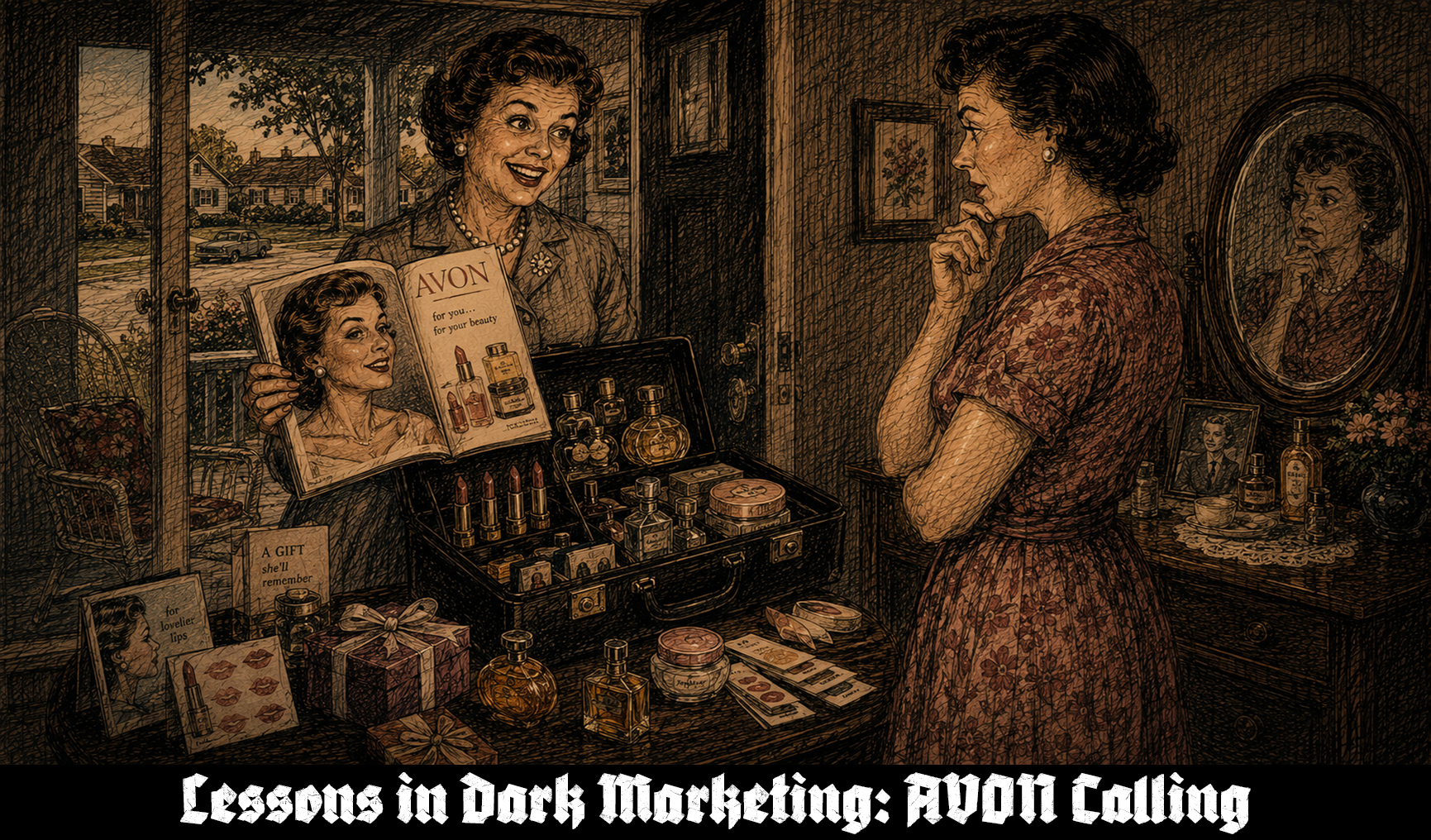
Avon understood the mirror before most brands understood the funnel.
That’s the whole case study.
A lipstick tube, perfume bottle, skin cream jar, or catalog page might look harmless on its own. Pretty colors. Soft names. Little promises. A woman at the door with a smile and a bag full of samples. Nothing threatening. Nothing loud. Nothing that looked like a corporate beauty machine crawling through the neighborhood one living room at a time.
That was the genius.
Avon didn’t need the cold authority of a department store counter. It didn’t need the glossy intimidation of a beauty floor where women were made to feel judged under fluorescent lighting by strangers with perfect eyeliner and the emotional warmth of airport security.
Avon came through the door. The salesperson wasn’t some anonymous clerk. She might’ve been your neighbor, your church friend, a woman from your kids school, the cousin, the coworker, the mother from the block, or the familiar face who already had social permission to stand in your house and talk about lipstick.
We’re looking at beauty anxiety dressed as neighborly service, not simple cosmetics. That’s the machine.
Avon turned personal trust into sales infrastructure. It turned the home into a beauty counter. It turned the catalog into a fantasy mirror. It turned small purchases into identity maintenance. It turned feminine insecurity, politeness, aspiration, and relationship pressure into a door-to-door business model with a friendly face.
The product was beauty. The machine was intimacy. That is the case study.
The Doorbell Was the Opening Hook
“Avon calling” worked because the doorbell was already intimate.
A store asks you to enter its territory. A door-to-door salesperson enters yours. That changes the psychology immediately. The customer isn’t walking into a commercial space with her defenses up. The commercial space comes to her house, softened by a familiar face and the ordinary manners of domestic life.
That’s a very different kind of pressure.
A woman could walk away from a store counter. She could avoid an aisle. She could say she was just looking and disappear into the fluorescent maze. The front door made things stickier. A person at the door creates a social moment. There’s a greeting. There’s eye contact. There’s a small performance of politeness before the pitch even starts.
That was Avon’s first advantage.
The sale began before the catalog opened. It began with access. Once the representative reached the doorway, the brand had already crossed a boundary most companies could only dream about crossing. The pitch wasn’t floating in a magazine ad or shouting from a radio. It was standing in the customer’s personal world.
This is dark marketing principle number one: The closer the sales pitch gets to private life, the softer the pressure feels and the harder it becomes to reject.
Avon’s brilliance was making commerce feel like a visit. The company didn’t have to drag women into a beauty store. It sent beauty to the doorstep, wrapped in conversation, manners, and the familiar rhythm of someone just stopping by.
The Representative Was the Trust Transfer
The Avon representative was the engine.
The catalog mattered. The products mattered. The samples mattered. But the representative carried the trust. That’s the whole trick. Avon didn’t have to build a relationship with every customer from scratch because the representative often brought her own social credibility into the interaction.
That is relationship marketing before everyone started saying “relationship marketing” like they discovered human behavior with a webinar and a ring light.
The representative softened the product because she was human. She could recommend a shade, explain a fragrance, offer a sample, remember a customer’s preferences, flatter just enough, and make the transaction feel personal. That personal layer gave the product warmth it couldn’t create from packaging alone.
The darker side is obvious. When a brand sells through relationships, the customer isn’t only evaluating the product. She’s evaluating the person in front of her. Saying no to a lipstick can feel like saying no to a neighbor. Ignoring a catalog can feel like ignoring a woman trying to earn a little money. Refusing a small purchase can feel unnecessarily cold when the whole interaction has been framed as friendly, feminine, and supportive.
This is dark marketing principle number two: The most valuable salesperson is the one whose relationship does part of the closing.
The representative supplied the warmth. The brand supplied the products. The customer supplied the discomfort of refusal. That triangle made the pitch powerful. Avon didn’t only sell through representatives. It sold through the emotional obligations attached to knowing them.
Beauty Anxiety Was the Emotional Trigger
Avon sold cosmetics, but cosmetics don’t live in a neutral world. They live in the mirror. That’s where the real pressure is.
The mirror is where women are taught to inspect, correct, conceal, brighten, soften, smooth, perfume, improve, and adjust themselves before the world gets a look. Beauty marketing works because it doesn’t have to invent insecurity from nothing. It walks into a culture already full of it and offers a tiny product-sized answer.
Avon’s genius was bringing that answer into the home.
The pitch could be gentle. A new lipstick. A cream. A fragrance. A little color. A little polish. A little something for yourself. The product didn’t have to announce that the customer was inadequate. It only had to suggest she could be a slightly better, fresher, prettier, more put-together version of herself if she bought the right small thing.
That is a very profitable wound that the industry can make sure never fully heals.
Avon’s model made beauty correction feel casual, affordable, and socially acceptable. A woman didn’t need to make a dramatic trip to a beauty counter. She could buy the little promise from someone she knew. The anxiety stayed private. The purchase stayed small. The habit could repeat.
This is dark marketing principle number three: The most reliable beauty pitch doesn’t scream insecurity; it whispers improvement.
Avon didn’t need to insult the customer. The culture had already handled that part. The brand only needed to arrive with a catalog, a sample, and a friendly way to say there was always one more thing that might help.
The Catalog Was a Portable Fantasy Mirror
The Avon catalog was more than a product list, we’re looking at a pocket-sized beauty world.
Page after page, it offered colors, creams, fragrances, names, seasonal collections, little luxuries, gift ideas, and affordable transformations. The catalog let the customer browse a fantasy version of herself without leaving the house. She could imagine a new scent, a new shade, a new routine, a new mood, a new face for work, church, a date, a family event, or whatever social performance was waiting next.
That’s powerful because catalogs are imagination machines. A store shelf shows what exists. A catalog shows what life could feel like if you ordered the right items. Avon understood that difference. The catalog created desire in a slow, private way. The customer could circle things, fold pages, think about gifts, compare shades, and let the product live in her head before the representative came back for the order.
The delay mattered too.
Modern marketers love instant checkout, but slower desire has its own power. A catalog sitting in the house keeps selling after the representative leaves. It waits on the coffee table. It gets picked up again. It lets the customer rehearse the purchase in private until the order starts feeling inevitable.
This is dark marketing principle number Four: a catalog turns desire into homework the customer willingly completes.
Avon didn’t have to keep the representative in the room forever. The catalog stayed behind and kept working. It gave the customer a controlled fantasy space where every page asked the same question in a different shade: what version of yourself are you willing to buy?
Samples Turned the Product Into a Favor
Samples are one of the oldest tricks in the book because they’re never just samples. They’re little obligations.
A free sample feels generous. That’s why it works. The customer receives something before buying anything, and that creates a subtle emotional imbalance. The representative isn’t simply selling anymore. She has given something. She has been helpful. She has let the customer try a scent, a cream, or a color without risk.
That generosity softens resistance.
The sample also does another job. It moves the product from abstract promise to personal experience. A fragrance on paper becomes a smell on skin. A lipstick shade becomes a possibility. A cream becomes texture. Once the customer has touched or worn the product, the sale feels more intimate. The product has crossed from page to body.
That’s the key.
Beauty products become more persuasive once they make contact. Avon’s sample strategy understood that the body is the real showroom. The customer isn’t only imagining the product anymore. She’s trying on the promise.
This is dark marketing principle number five: The best sample feels like a gift while quietly creating a debt.
Avon samples lowered risk, created contact, and made the representative seem helpful before she became transactional. The customer could tell herself she was simply trying something. The brand knew trying is often the first step toward buying.
Small Purchases Built Big Habits
Avon’s products were often emotionally low-risk purchases.
That matters.
A lipstick isn’t a refrigerator. A fragrance isn’t a car. A skin cream isn’t a mortgage. These are smaller buys, which makes the decision easier to repeat. The customer doesn’t have to justify a major financial move. She only has to justify a little treat, a replacement item, a gift, a seasonal color, a new scent, or one more thing from the catalog.
Small purchases are dangerous because they don’t feel like behavior change.
They feel like moments.
One lipstick. One bottle. One cream. One little order. Then another. Then another. Over time, the product category becomes a routine. The representative becomes part of the household rhythm. The catalog becomes expected. The customer develops preferences, repeat orders, and little beauty rituals that keep the brand alive.
This is how habit sneaks in.
Avon didn’t need every order to be dramatic. It needed repeatability. The company understood that beauty is a replenishment market and an aspiration market at the same time. Women run out of things, and they also want new things. That combination is a machine.
This is dark marketing principle number six: Small purchases can build large dependency when the product attaches itself to routine identity maintenance.
Avon’s genius was turning the little order into a repeating ritual. The customer wasn’t only buying products. She was maintaining the version of herself the products helped her perform.
The Friendly Visit Became the Funnel
A friendly visit is a beautiful disguise for a sales funnel. That’s what Avon understood.
The representative could stop by, leave a catalog, check in, mention a new product, collect an order, offer a sample, ask about family, and make the whole thing feel ordinary. The sales process didn’t need to look like a hard sell because the relationship carried the rhythm.
This is where old direct selling starts to look a lot like modern social commerce.
Today, the friendly visit is a DM, a link, a livestream, a creator code, a private group, or some woman from high school pretending she’s just excited to share a product that changed her life. The technology changed. The emotional mechanism stayed the same. People buy more easily from people they know, people they like, people they recognize, or people they feel awkward ignoring.
Avon ran that machine before the internet gave everyone analytics.
The representative knew the customer. She knew who bought fragrance, who liked lipstick, who needed gifts, who had daughters, who loved seasonal items, who needed a little attention, and who might buy just to be nice. That is customer data with a purse and a notepad.
This is dark marketing principle number seven: The oldest targeting system is a person who knows the neighborhood.
Avon didn’t need cookies, pixels, tracking tags, or behavioral dashboards. The representative was the dashboard. She carried social knowledge the brand could never collect honestly on its own, then turned that knowledge into sales.
Empowerment Made the Model Harder to Criticize
Avon’s empowerment story matters because it contained truth. That makes the dark marketing more complicated.
For many women, Avon created real opportunities. Income. Confidence. A flexible way to sell. A chance to leave the house with purpose. A reason to build skills. A little independence in a world that often kept women financially and socially boxed in. That part can’t be brushed aside.
But half-truths are where marketing gets sharp.
Avon could offer women opportunity while also relying on the social limits placed on women. It gave them a way to earn through the same domestic and social networks that culture expected them to maintain. It let women sell, but in a feminine, friendly, socially acceptable format. It offered independence without fully leaving the neighborhood script.
That tension is the meat of the case study.
The brand could say it empowered women, and for many women, it did. The brand also built a sales machine powered by women’s relationships, emotional labor, beauty knowledge, social memory, and the pressure to be pleasant while selling.
This is dark marketing principle number eight: The most durable empowerment pitch contains enough truth to make the larger machine harder to question.
Avon didn’t have to fake the opportunity completely. It only had to frame the opportunity in a way that made the structure feel noble. That’s the power of empowerment marketing. It can be real and still be useful to the company.
The Neighbor Became the Beauty Counter
The department store beauty counter had a problem. It could be intimidating.
A woman might feel judged before she even asked a question. She might feel watched, measured, corrected, or sold to by someone whose job was to look more polished than the customer. That environment creates desire, but it also creates resistance.
Avon softened that. The neighborly representative made beauty feel reachable. She brought the counter into the kitchen, the living room, the porch, or the doorway. She made cosmetics feel less elite, less embarrassing, and less performative. A woman could ask questions without feeling like she had wandered into enemy territory.
That accessibility mattered.
Avon democratized the beauty pitch by making it personal and local. The customer could buy glamour in small pieces without entering a space designed to remind her she was not glamorous enough yet.
This is dark marketing principle number nine: Move aspiration into a familiar setting and the customer lowers her defenses.
Avon made beauty feel less like a judgment and more like a visit. That emotional shift helped the product travel. The brand didn’t remove beauty pressure. It made the pressure more comfortable to accept.
Perfume Sold Identity Without Needing Proof
Perfume is one of the strangest products in marketing because it sells an invisible fantasy.
You can’t see it. You can’t display it on a shelf once you’re wearing it. You can’t prove it the way you prove a dress, a car, or a ring. Perfume lives in suggestion. It promises memory, femininity, romance, cleanliness, elegance, sexuality, softness, confidence, class, mystery, and whatever else the bottle name wants to imply.
That made perfume perfect for Avon.
A fragrance sample could carry an entire identity fantasy in a tiny vial. The customer wasn’t only choosing a smell. She was choosing how she wanted to be perceived. Pretty. Fresh. Mature. Thoughtful. Demure. Romantic. Refined. Playful. Expensive enough, even when the bottle was affordable.
Perfume is dark marketing because it sells the anxiety of being perceived.
It tells the consumer that presence itself can be improved. The body doesn’t just need to look right. It needs to leave the right trace. That’s a deep psychological hook, and Avon brought it straight into the home.
This is dark marketing principle number ten: Products tied to perception don’t have to prove transformation; they only have to suggest the customer will be received differently.
Avon fragrances worked because scent is emotional, intimate, and social at the same time. The product disappeared into the body while the fantasy stayed active in the customer’s mind.
The Brochure Made Aspiration Affordable
Luxury beauty has always had a gatekeeping problem. Avon solved it by selling affordable aspiration.
That’s a massive market. Most people don’t need the most expensive version of glamour. They need a reachable version. They need something that feels like an upgrade without blowing up the household budget. Avon’s catalog gave customers a ladder into beauty culture one small item at a time.
This is why the brochure format mattered so much.
The customer could browse a world of shades, scents, creams, gifts, and seasonal products without the shame of asking prices across a department store counter. She could imagine herself participating in beauty without needing permission from a luxury environment.
Affordable aspiration is one of the strongest engines in consumer culture. It lets people buy the feeling of upward movement in small increments. One product won’t change a life, but it can change a mood. One shade won’t create class mobility, but it can create the feeling of polish. One fragrance won’t make a person elegant, but it can let her borrow elegance for a few hours.
This is dark marketing principle number eleven: When full transformation is too expensive, sell the customer an affordable symbol of it.
Avon made beauty feel reachable by breaking aspiration into small orders. The fantasy didn’t need to be grand. It needed to fit inside the customer’s budget and still feel like a step toward the person she wanted to appear to be.
The Home Became a Sales Territory
Avon’s great geographic insight was that every neighborhood was already organized.
Houses. Blocks. Churches. Schools. Workplaces. Family networks. Social circles. These weren’t abstract markets. They were living maps. Avon representatives could move through them with more precision than any billboard. They knew who lived where, who might buy, who liked gifts, who had daughters, who hosted, who gossiped, who shared catalogs, and who could be counted on for a small order.
That is sales territory built from social life.
The modern internet loves pretending it invented targeting. Please. The neighborhood was always targetable. The representative knew things no platform could learn without becoming openly creepy. She had context. She had memory. She had proximity. She had the difference between Mrs. So-and-so who always bought perfume and the woman down the street who only ordered when there was a deal.
Avon turned the local map into a commercial system.
This is dark marketing principle number twelve: The most valuable market data is often social knowledge disguised as common sense.
The representative didn’t need a dashboard to know who might buy. She had lived knowledge of the community. Avon’s model captured that knowledge and converted it into orders, samples, follow-ups, and repeat business.
Beauty Became a Respectability Routine
Avon didn’t only sell glamour. It sold respectability.
That’s important. Beauty marketing is often framed as fantasy, but everyday beauty is also discipline. Look presentable. Smell nice. Keep your skin decent. Wear the right color. Don’t look tired. Don’t look careless. Don’t let aging show too much. Don’t embarrass yourself. Don’t give people a reason to talk.
Avon products fit directly into that social pressure.
A lipstick could be fun, but it could also be armor. A cream could be indulgence, but it could also be prevention. A fragrance could be pleasure, but it could also be social insurance. The products helped women manage the constant inspection of being seen and percieved.
That is why beauty routines are so sticky.
They’re tied to fear and pleasure at the same time. The customer wants to feel pretty, but she may also fear looking unprepared, older, tired, plain, cheap, or socially careless. Avon gave that anxiety a familiar, affordable, recurring answer.
This is dark marketing principle number thirteen: Products tied to respectability become habits because the customer isn’t just chasing desire; she’s avoiding judgment.
Avon’s beauty machine worked because it sat inside the daily pressure of presentation. The catalog didn’t have to create the fear of being seen. It only had to offer the next small defense against it.
The Gift Market Expanded the Machine
Avon also understood gifts.
Perfume, lotions, soaps, makeup sets, holiday items, small accessories, and themed collections made perfect gifts because they carried emotional meaning without requiring deep intimacy. The giver could say she was being thoughtful, feminine, festive, or practical. The representative could offer seasonal suggestions. The catalog could frame the purchase around birthdays, Mother’s Day, Christmas, teachers, neighbors, coworkers, and all the little social obligations that multiply like mold in American life.
Gifts are powerful because they let a product sell to someone who may never use it.
That’s the loophole.
The buyer needs an object that communicates care. The recipient may or may not want the product. Avon’s catalog helped solve the buyer’s anxiety by offering affordable, pre-packaged signs of thoughtfulness. A fragrance set can stand in for affection. A lotion can stand in for consideration. A holiday item can stand in for effort.
This is dark marketing principle number fourteen: Gift-able products sell emotional symbolism to the buyer before they sell usefulness to the recipient.
Avon’s gift economy expanded the product beyond personal beauty. It turned cosmetics and fragrance into social currency. The buyer wasn’t only purchasing an item. She was purchasing a socially acceptable gesture.
The Brand Sold Self-Care Before Self-Care Got a Hashtag
Avon understood the “treat yourself” mechanism before the phrase became a digital lifestyle chant.
The pitch was simple and effective: you deserve a little something. A lipstick. A fragrance. A cream. A bath product. A small indulgence. Nothing too reckless. Nothing that would destroy the budget. Just a controlled act of personal pleasure wrapped in feminine responsibility. That’s why it worked.
The purchase could feel both indulgent and modest. It gave women permission to spend on themselves without making the act feel selfish. That’s a very important emotional route because many women were trained and socially conditioned to prioritize everyone else first. Avon offered products small enough to bypass guilt and personal enough to feel like care.
The brand gave women a little consumer escape hatch inside the expectations that surrounded them.
This is dark marketing principle number fifteen: Sell indulgence in small enough doses and the customer can call it self-care instead of consumption.
Avon didn’t need every purchase to be dramatic. The smallness helped. A little beauty item could feel like a private reward, a mood fix, a confidence boost, or a harmless pleasure. That emotional permission kept the orders moving.
The Case Study Breakdown
Here is the Avon machine in plain English:
- The doorbell turned a sales pitch into a personal visit.
- The representative carried trust the brand didn’t have to earn directly.
- The customer’s home became the beauty counter.
- The catalog became a portable fantasy mirror.
- Samples made the product feel like a favor before it became a purchase.
- Beauty anxiety created a recurring emotional need.
- Small purchases built repeat habits without feeling financially dramatic.
- Affordable aspiration let customers buy little symbols of polish, glamour, and self-improvement.
- The representative’s local knowledge worked like pre-internet targeting.
- The gift market expanded the catalog beyond personal use.
- Empowerment language made the model harder to criticize because the opportunity could be real while still serving the company.
- The friendly visit softened the pressure of the pitch.
- Respectability made beauty products feel necessary, not merely decorative.
- Self-care language existed before the hashtag because the emotional mechanism was already there.
That is why Avon worked.
It wasn’t only selling lipstick, perfume, skin cream, or bath products. It was selling small, affordable forms of identity maintenance through a trusted person at close range. It moved beauty anxiety out of the department store and into the neighborhood. It made the sales funnel feel like a relationship, the catalog feel like a mirror, and the purchase feel like a little act of control.
This is dark marketing principle number sixteen: A product becomes harder to resist when it reaches the customer through someone she already trusts.
Avon’s real power lived in the relationship between the representative and the customer. The products mattered, but the access mattered more. The brand got inside the house because the person at the door made the pitch feel human.
What Marketers Should Learn From Avon
The first lesson is that trust can be borrowed through distribution.
Avon didn’t rely only on corporate branding. It used representatives who already had social credibility in their communities. That trust made the pitch warmer and more effective than a distant advertisement.
The second lesson is that small purchases can create long-term customer behavior.
Beauty products are perfect for habit formation because they run out, rotate by season, attach to identity, and give the customer a recurring reason to return.
The third lesson is that samples are powerful because they create both experience and obligation.
A sample lets the product touch the body before the customer commits. That physical contact makes the pitch feel personal.
The fourth lesson is that empowerment marketing works best when the benefit is partly real.
Avon’s opportunity for women gave the brand moral force. That same moral force helped protect the sales structure from easy criticism.
The fifth lesson is that a catalog can function like a slow algorithm.
It learns by repetition, preference, seasonal timing, and representative feedback. It keeps selling after the first interaction and lets the customer build desire privately.
This is dark marketing principle number seventeen: The best direct selling systems turn social knowledge into commercial rhythm.
Avon’s model worked because it combined beauty pressure, personal trust, repeatable products, gifting occasions, and local relationships into one ongoing system. The representative wasn’t just selling cosmetics. She was managing a small emotional marketplace.
Final Diagnosis
Avon is one of the clearest Lessons in Dark Marketing because it proves that a soft pitch can still be a hard machine.
The final diagnosis is powdered, perfumed, and sitting politely at the front door:
- Avon turned the doorbell into a sales trigger.
- It turned the neighbor into a beauty counter.
- It turned personal trust into distribution.
- It turned samples into small obligations.
- It turned the catalog into a fantasy mirror.
- It sold beauty anxiety through friendly conversation.
- It made affordable aspiration feel like empowerment.
- It turned local social knowledge into pre-internet targeting.
- It made respectability a recurring beauty routine.
- It sold gifts as emotional shortcuts.
- It offered women real opportunity while using their relationships as sales infrastructure.
- It made the pitch feel personal enough to soften refusal.
- It sold self-care before self-care had a hashtag.
- It proved that intimacy can be one of the most profitable sales environments on earth.
That is why Avon belongs in the Dark Marketing museum.
Somewhere between Tupperware, Jell-O molds, Tang, TV dinners, Reader’s Digest, and every modern creator storefront pretending that commerce becomes pure because the person selling it smiles like a friend.
Avon wasn’t just cosmetics. It was the mirror, the catalog, the neighbor, the sample, the compliment, the insecurity, and the order form all working together in the same living room.
A little lipstick. A little perfume. A little cream. A little praise. A little pressure. A little independence. A little guilt if you didn’t buy. Ding dong. The brand is at the door.
Leave a Reply