
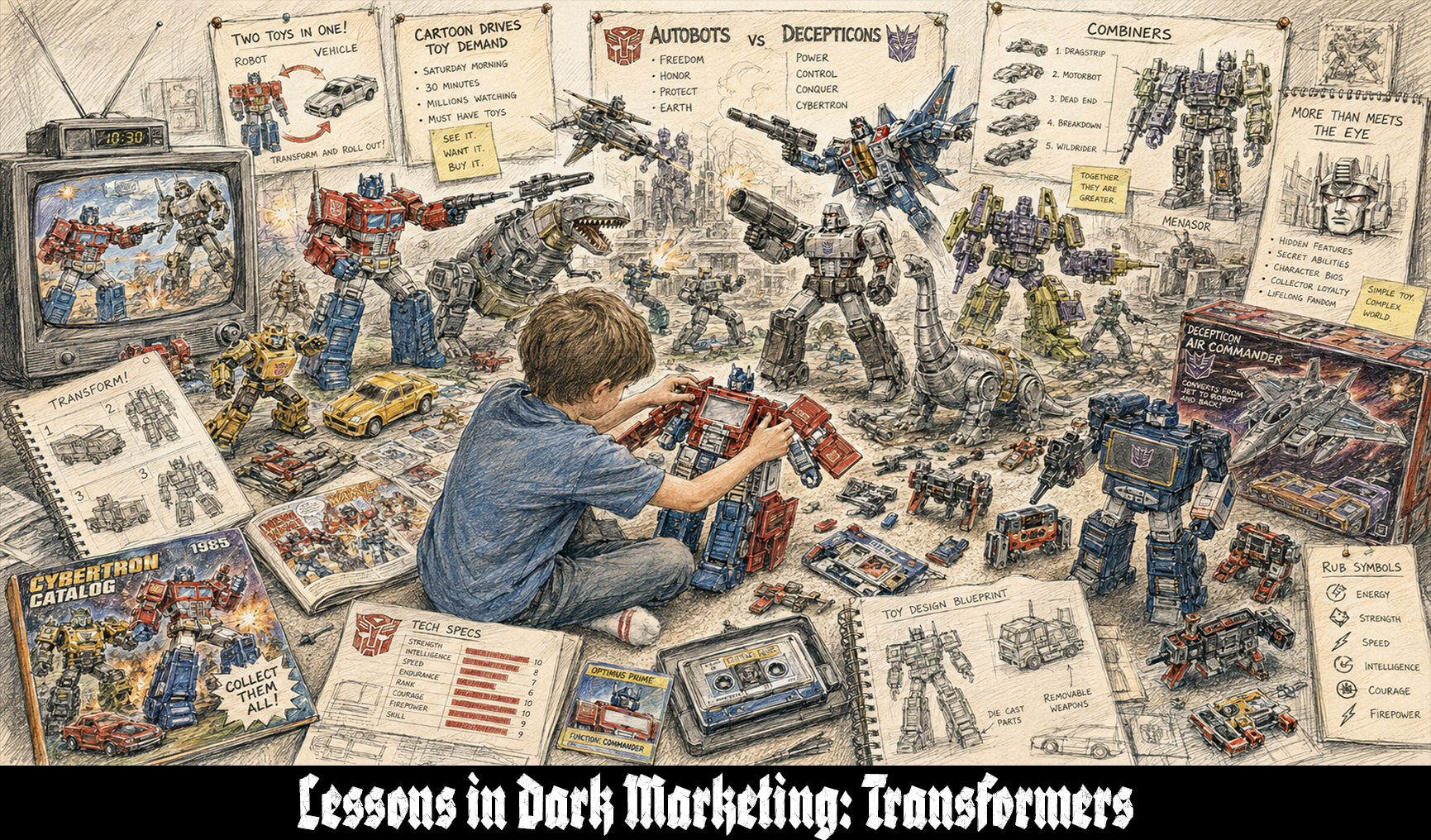
A red tractor-trailer is lying across the living-room carpet in a condition normally associated with highway disasters and mob warnings. The cab has been split open. The wheels are pointing in four directions. Two mechanical arms have emerged from somewhere behind the windshield. A child is holding an instruction sheet in one hand and applying enough rotational pressure with the other to void a warranty, dislocate a robot shoulder, and introduce several new words into the family vocabulary.
Optimus Prime is halfway between truck and robot. He currently resembles an accordion dropped down an escalator.
The child knows the finished form because the box promised a towering mechanical commander with a red chest, blue legs, silver faceplate, and the moral authority of a union foreman delivering the final speech before a dangerous shift. The child also knows that the truck must become that commander through a sequence of folds, turns, extensions, concealed joints, swinging panels, and tiny acts of plastic faith.
That transformation is the whole product demonstration.
A normal action figure stands there waiting for imagination. A Transformer performs evidence. The child can see the machine become the character. The process looks mechanical, intelligent, and impossible until the hands complete it. Then the toy becomes proof that the customer understands something other people might not.
The first American Transformers toys came from Japanese products created by Takara, particularly the Diaclone and Micro Change lines. Hasbro licensed those shape-changing robots, reorganized them under one brand, and asked Marvel Comics to help create the names, factions, personalities, and civil-war mythology that would make an assortment of unrelated vehicles and household objects feel like one coherent universe. Transformers reached American shelves in 1984, supported almost immediately by comics, animation, licensing, and the promise that every ordinary machine might contain a hidden mechanical life. (The Strong National Museum of Play)
Hasbro promoted the launch with the phrase “More Than Meets the Eye,” and contemporary reporting described a product line in which heroic Autobots and villainous Decepticons converted into vehicles, weapons, radios, and other forms. By the end of 1984, Hasbro was predicting approximately $80 million in Transformers sales for the year, placing the line near the center of what the toy industry was calling the year of the robot. (The New Yorker)
The physical product was a mechanical puzzle that changed from one recognizable object into another.
The machine was a permanently expandable war in which every car, jet, cassette, dinosaur, construction vehicle, insect, and household device could become another personality the child had yet to collect.
We’re looking at product variation disguised as secret identity, not a few clever robots that happened to share a cartoon.
The Toy Performed Two Jobs and Charged for Both
Transformers arrived with one of the cleanest value propositions in the toy aisle: two toys in one.
The customer purchased a robot and received a vehicle. Or purchased a vehicle and received a robot. The direction depended on whichever form looked more impressive on the box and whichever argument sounded more fiscally responsible to the adult holding the money.
That phrase protected the price. A Transformer could cost more than a simpler action figure because the product claimed to replace two separate purchases. The child wasn’t asking for one expensive robot. He was requesting a robot, truck, puzzle, character, mechanical demonstration, and small engineering curriculum compressed into one cardboard package.
The arithmetic looked generous even when the customer still received one physical object. This is one of marketing’s favorite forms of price laundering. The company breaks a product into several conceptual benefits, counts each benefit separately, and lets the customer compare the combined promise against the price. The object remains singular. The value proposition multiplies.
Transformers made that multiplication visible. The truck existed. The robot existed. Both forms could be displayed, played with, and demonstrated. The child could change the product back and forth until the plastic joints began filing for workers’ compensation.
The alternate form also widened the customer’s imagination. A child interested in cars could enter through the vehicle. A child interested in robots could enter through the character. A child interested in puzzles could enter through the mechanism. Hasbro didn’t need one desire to carry the entire sale because the product stacked several desires inside the same chassis.
This is dark marketing principle number one: When a product’s price needs justification, divide one object into multiple perceived purchases. Transformers sold one piece of plastic and let both of its personalities testify before the household budget committee.
The Transformation Was the Commercial Everyone Performed at Home
A strong toy demonstration usually requires another person. Somebody rolls the vehicle, launches the missile, activates the feature, or arranges the play-set.
Transformers placed the entire demonstration inside the customer’s hands.
The child folded the hood. Rotated the legs. Released the arms. Raised the head. Turned the machine upright. The process ended with a recognizable vehicle replaced by a recognizable character.
That gave the product a built-in before-and-after sequence, one of the most reliable structures in advertising.
- Before: ordinary truck.
- Action: manipulation.
- After: heroic robot leader.
The transformation didn’t need a narrator once the toy reached the house. The customer became the commercial. Every successful conversion demonstrated the feature to siblings, friends, parents, cousins, classmates, and whatever unfortunate adult had been summoned to repair a panel installed backward.
The product invited the phrase, “Watch this.”
That sentence is valuable because it turns ownership into performance. A private toy becomes a public event. The child receives attention while the product receives another demonstration.
The process could be repeated without inventing a new game. Transforming the figure was already an activity. A child could sit on the floor converting the same robot from one form to another long after the imaginary battle had ended.
This is dark marketing principle number two: Build the demonstration into normal use and customers will advertise the product whenever they play with it.
Optimus Prime didn’t need a traveling sales representative because every kid with functioning thumbs had accepted the position.
Mechanical Difficulty Made the Child Feel Competent
Transformers weren’t equally easy to operate.
Some changed forms through a few obvious movements. Others required instructions, patience, alignment, memory, and the willingness to force a suspicious joint while praying that the cracking sound came from somewhere else in the house.
That difficulty could have been treated as a defect. The marketing and play experience allowed it to become sophistication.
A complicated Transformer felt advanced. More steps suggested more engineering. More hidden parts suggested greater value. A child who mastered a difficult conversion had accomplished something beyond moving an action figure’s arms.
The toy became a competence test. The first successful transformation produced a small victory. The child had read the diagram, understood the sequence, manipulated the parts, and arrived at the promised result. Repetition converted confusion into mastery.
That emotional reward increased attachment. A toy that required learning felt more personal after the customer learned it. The knowledge became part of ownership.
Complexity also created hierarchy among children. One child could transform the figure quickly. Another needed the instructions. Another handed it to the first child after converting Megatron into a shape resembling an injured office stapler. The skilled child became the authority.
This is dark marketing principle number three: A manageable amount of difficulty can make product use feel like achievement, increasing pride and loyalty.
Transformers turned assembly frustration into a mechanical citizenship exam for second graders.
The Toy Made Ordinary Objects Look Secretly Alive
A truck was no longer a truck. It might be Optimus Prime.
A cassette player might be Soundwave. A camera might conceal several robots. A handgun might be Megatron, depending on the version, the market, and whether anyone had considered how that object would look when carried through an airport. Cars, jets, construction equipment, microscopes, insects, dinosaurs, and household electronics all became possible disguises.
The world gained a second layer. This was a powerful childhood fantasy because it attached imagination to ordinary surroundings. The customer didn’t need a distant castle, alien planet, or hidden jungle to activate the premise. The adventure could be concealed inside the parking lot.
Every vehicle became suspicious. The red truck beside the family car might be a commander. The sports car at the stoplight might be an Autobot. The jet overhead might be a Decepticon reconnaissance mission or an airline experiencing delays for less interesting reasons.
The disguise concept expanded the franchise beyond the physical products. Children could continue playing while walking outside, sitting in traffic, visiting stores, or watching machines operate. The brand had colonized perception.
That is stronger than simple recognition. The child wasn’t only noticing vehicles. He was interpreting them through Transformers.
This is dark marketing principle number four: Attach the product fantasy to common objects and the customer’s environment becomes a continuous brand reminder.
Hasbro turned every parking lot into a robot witness-protection program.
“More Than Meets the Eye” Sold Suspicion as Value
“More Than Meets the Eye” was an excellent slogan because it described the product, the story, and the desired customer reaction at the same time. The toy contained a hidden form. The characters concealed their identities. The mythology suggested secret motives and unseen mechanical life. The customer was invited to look more carefully.
That invitation carried a flattering implication. The intelligent customer recognized hidden value. Other people saw a truck. The owner knew it was Optimus Prime. Other people saw a cassette player. The child knew an intelligence officer and several smaller robots were hiding inside it.
The slogan positioned ownership as knowledge. This allowed the product to offer status without relying entirely on price. The customer possessed the secret. The ability to transform the toy confirmed membership among people who understood what they were looking at.
The phrase also prepared the market for endless expansion. Anything could contain more than first appeared. Hasbro could introduce another vehicle, animal, or machine without violating the premise. The slogan had already made surprise part of the category.
This is dark marketing principle number five: A strong slogan should describe the product while teaching customers how to interpret it.
“More Than Meets the Eye” made suspicion sound intelligent and another robot sound inevitable.
Hasbro Bought Engineering and Commissioned Personality
The original Japanese toys supplied the mechanical brilliance. Hasbro still needed a reason American children should care whether one robot turned into a red truck and another turned into a silver weapon.
Marvel helped provide that reason.
The toys were gathered into heroic Autobots and villainous Decepticons, inhabitants of Cybertron whose civil war spread to Earth. Marvel editor and writer Bob Budiansky became central to naming many of the characters and writing the personality profiles and technical biographies that appeared on the packages. Optimus Prime’s name has been credited to editor Denny O’Neil, while Budiansky developed names and profiles for many figures, including Megatron, Starscream, Ratchet, and others. (bwtf.com)
This was the same commercial alchemy Hasbro had used with G.I. Joe.
A physical variation became a personality.
The red truck became noble leadership. The yellow car became courage and approachability. The cassette player became cold surveillance. The fighter jet became ambition and treachery. The silver weapon became authoritarian power.
The mechanical design gave the writer a starting point. The biography converted that starting point into emotional distinction.
Without personality, customers might choose one favorite transformation and stop. With personality, the child could want a figure because of what it became and another because of who it supposedly was.
Hasbro had separated mechanical appeal from character appeal, then sold both inside each product.
This is dark marketing principle number six: When products begin as physical variations, assign each one a distinct emotional role so customers can justify owning several.
Marvel gave the machinery motives, insecurities, grudges, and an excuse to occupy every peg in the aisle.
The Tech Specs Turned Cardboard Into Psychological Intelligence
Transformers packaging included character biographies, mottos, strengths, weaknesses, and numerical ratings for qualities such as intelligence, speed, courage, firepower, and skill.
The package stopped functioning as disposable protection and became a personnel dossier.
Children could compare characters before opening them. A robot with high firepower might lack courage. A fast character might have limited strength. A physically powerful Decepticon might possess the emotional stability of a middle manager who had just discovered somebody else received the promotion.
Those differences supplied more than trivia. They supplied play instructions.
The ratings helped children imagine how battles should work, which characters should lead, and where a supposed weakness might create conflict. The biography told the customer what voice, temperament, and tactical role to assign.
The card also increased the perceived precision of the product. Numbers look official. A rating of eight in intelligence feels researched despite being assigned to a fictional robot by somebody facing a deadline at Marvel.
The customer could cut out and save the profile, extending the life of the packaging. Contemporary accounts from the 1985 toy market described Transformers arriving with personality information and heat-sensitive identity logos, adding documentation and authentication to the play experience. (The New Yorker)
This is dark marketing principle number seven: Quantified personality makes fictional differences feel objective enough to support comparison and collecting.
Hasbro gave imaginary robots performance reviews and children immediately began auditing the workforce.
Autobots and Decepticons Created a Two-Sided Collection
A child could begin with one Autobot. The story immediately exposed the missing enemy.
Without Decepticons, the heroic vehicle could transform, issue a speech, and patrol the carpet for crimes that had yet to be manufactured. Without Autobots, the Decepticons could conquer the bedroom with the strategic difficulty of repossessing an abandoned warehouse.
The factions made opposite-side purchases necessary. The Autobots were generally framed as protectors. The Decepticons pursued control, energy, military advantage, and conquest. The distinction gave parents and children an easy moral map while giving Hasbro two coordinated product families.
Each side created demand for the other. A larger Autobot team made the Decepticons look understaffed. A powerful Decepticon made the Autobots look vulnerable. The child didn’t need to love every character. The conflict could give a less appealing toy a functional reason to exist.
The faction symbols also created tribal branding. A small emblem communicated allegiance across vehicles with wildly different forms. The customer could identify teams, organize shelves, stage battles, and select a preferred side.
This is dark marketing principle number eight: Divide an assortment into opposing systems and every purchase can reveal a weakness in the other system.
Cybertron remained at war because balanced inventory was always one box away.
Optimus Prime Sold Authority Without Selling Fear
Optimus Prime was the emotional anchor. He was powerful without behaving like a bully, authoritative without sounding petty, and serious enough to make a red tractor-trailer feel like the natural guardian of civilization. Peter Cullen’s performance in the animated series gave the character a calm, paternal weight that reached beyond the physical toy.
Optimus represented the adult children hoped would arrive when the situation became dangerous. He was capable, fair, self-controlled, brave, and willing to sacrifice himself. He didn’t need to announce his greatness every thirty seconds because the voice already sounded as though it had signed the mortgage, repaired the furnace, and prepared an evacuation plan.
That personality gave the toy line moral stability. A collection full of violent robots could be defended through its leader. Optimus didn’t fight because destruction was entertaining. He fought to protect others. The machinery received a code.
The truck form strengthened the appeal. A tractor-trailer suggested work, reliability, transportation, and practical strength. Optimus wasn’t disguised as a delicate fantasy object. He became a machine children already associated with scale and power.
The trailer also expanded the product physically and commercially, turning the leader into a larger package with additional play features and enough shelf presence to make smaller Autobots look like members of his organization.
This is dark marketing principle number nine: Give an aggressive product line a principled leader and customers can transfer admiration for the leader onto the entire system.
Optimus Prime made robot warfare feel supervised by the only responsible adult in the galaxy.
Megatron and Starscream Made Corporate Dysfunction Entertaining
The Decepticons needed more than evil. They needed internal drama. Megatron represented command through force. Starscream represented ambition without loyalty. Their relationship allowed the villain faction to remain unstable, theatrical, and endlessly reusable.
Starscream wanted Megatron’s position. Megatron knew it. Starscream repeatedly betrayed him. Megatron repeatedly allowed him to remain close enough to try again. This was less like a military hierarchy and more like a company that had replaced human resources with laser cannons.
The conflict helped individualize two toys that might otherwise have occupied similar villain roles. Megatron was authority. Starscream was treachery. Owning both allowed the child to stage conflict within the Decepticon side before an Autobot entered the room.
That expanded play and purchase logic. Strong franchises create tension across multiple levels. Heroes fight villains. Villains fight one another. Allies disagree. Leaders doubt. Subordinates compete. Every relationship gives another combination of characters something to do.
This is dark marketing principle number ten: Build internal conflict into each side of a product universe and customers gain more reasons to combine characters from the same faction.
The Decepticons could attempt global conquest only after finishing another quarterly leadership dispute.
The Cartoon Became a Daily Mechanical Showroom
The animated series gave the toys movement, voices, personalities, transformations, battles, and emotional stakes. It also showed each product functioning in both forms. A commercial could transform a toy once. An episode could explain why the transformation mattered.
The Autobots drove unnoticed through human environments, converted during danger, fought the Decepticons, and returned to vehicle form. Jets became airborne enemies. Cassettes became spies. Construction vehicles became a giant combined robot. Dinosaurs became mechanical warriors.
Every character entrance carried a demonstration.
Hasbro describes the 1984 launch as a coordinated arrival of robot-to-vehicle figures, comic books, and the original animated series, and the company’s own anniversary history credits that combination with establishing the franchise’s lasting characters and world. (Hasbro Newsroom)
The program had legitimate entertainment value. Writers, animators, performers, and musicians created memorable stories and personalities. Children watched because the series was exciting, funny, dramatic, and visually distinctive.
That creative value strengthened the sales machine. The child could form an attachment to a character before finding the toy. A figure that looked confusing in the package became desirable after the show demonstrated its role. A character already owned could gain fresh importance after receiving an episode.
Television rotated emotional attention through the assortment.
This is dark marketing principle number eleven: Use narrative to demonstrate why each product matters inside a larger system.
The cartoon didn’t interrupt the adventure to show the merchandise because the merchandise had already been hired as the cast.
After-School Repetition Kept the Toy Box Emotionally Active
Transformers emerged during an American children’s television environment increasingly friendly to programs built around toy properties. Deregulation and changing broadcast economics helped toy-supported cartoons spread through the 1980s, while critics argued that shows such as Transformers blurred the boundary between programming and commercial speech. (HISTORY)
The repetition mattered as much as the content. A child saw the transformation sequence again. Heard the names again. Watched the factions assemble again. Learned another voice, ability, weakness, or product form. The brand remained active between shopping trips.
The television could also refresh toys already in the house. A character ignored for several weeks became important after appearing in an episode. The physical product didn’t change. The emotional context did.
This reduced the need for every purchase to create its own long-term excitement. The media system kept returning to the toy and renewing its meaning.
The child then carried the episode onto the floor. The cartoon supplied a fresh conflict. The toys supplied the interactive continuation. The next commercial supplied the missing participant.
This is dark marketing principle number twelve: Repeat the product world often enough and media exposure can continually restore the value of inventory customers already own.
The Autobots went off the air at four-thirty and resumed operations beside the coffee table at four-thirty-one.
The Transformation Sound Became an Audio Logo for Mechanical Power
Transformers had a visual identity and an audio identity. The mechanical transformation sound compressed the entire product promise into a brief electronic sequence. The noise suggested gears, machinery, movement, and controlled reconfiguration even when the animation itself completed changes no physical toy could reproduce without violating several laws of matter.
Children could imitate the sound while transforming the figures. That made the branding participatory. The customer supplied the audio effect that the plastic lacked.
A child didn’t quietly turn a robot into a car like an accountant adjusting office equipment. The hands moved while the mouth performed industrial sound design. The toy gained drama through customer labor.
The sound also created instant recognition across characters. Trucks, jets, radios, and dinosaurs all shared the same mechanical ritual. The noise unified wildly different products under one brand.
This is dark marketing principle number thirteen: An effective audio signature should communicate the product action so clearly that customers reproduce it during use.
Hasbro sold silent plastic and children provided the factory soundtrack free of charge.
Catchphrases Turned Product Use Into Ceremony
“Transform and roll out” provided the Autobots with an instruction, command, rallying cry, and repeatable play cue. The phrase told characters what to do while telling children what to do with the characters.
That fusion is powerful. A child could line up the Autobots, deliver the command, transform the figures, and move them into battle. The language organized the play sequence.
The catchphrase also elevated a mechanical feature into a heroic ritual. Folding a plastic truck no longer looked like fiddling with parts. It became deployment.
Optimus Prime’s authority gave the words emotional force. The customer wasn’t following an instruction sheet. The customer was responding to a commander.
This is dark marketing principle number fourteen: Turn product operation into a ritual phrase and repetition will strengthen both memory and identity.
“Transform and roll out” made cleanup impossible because the toys were apparently responding to military orders.
Rubsigns Turned Faction Identity Into a Magic Trick
Beginning in the line’s early expansion, Transformers used heat-sensitive rubsigns that revealed an Autobot or Decepticon symbol when warmed by a finger. The sticker did little to improve the robot’s mechanical function. It dramatically improved the ownership ritual.
The customer rubbed the symbol. The hidden allegiance appeared. The toy authenticated itself. That small reveal extended the “more than meets the eye” premise into the package and the body of the figure. Even the badge had a disguised form.
The rubsign also suggested counterfeit protection and insider knowledge. A genuine Transformer could prove itself through a secret mark. Children understood the ritual and could demonstrate it to anyone unfamiliar with the feature. The heat-sensitive logo was a method of authenticating the toy “to those in the know,” alongside the personality profiles included with each robot.
The function was inexpensive compared with the emotional effect. A small sticker provided mystery, participation, verification, faction identity, and another reason to touch the product.
This is dark marketing principle number fifteen: Add a low-cost reveal that makes ownership feel exclusive, interactive, and authentic.
The rubsign turned a child’s thumb into Cybertronian security clearance.
The Price Ladder Made Every Robot a Gateway
Transformers came in different sizes, complexities, and price levels. Smaller figures made entry possible. Midrange characters offered greater complexity. Leaders, city-sized robots, large vehicles, combiners, and specialty products created premium targets.
The assortment allowed the brand to occupy allowances, casual rewards, birthdays, and Christmas. A child could begin with a smaller Autobot and still understand that Optimus Prime represented the center of the heroic team. The entry purchase created attachment to a universe containing larger purchases.
That ladder also created social comparison. Children knew who owned the leaders, combiners, rare figures, and large play-sets. The size of the robot could signal the scale of the household commitment.
The 1984 toy market already reflected meaningful price differences between smaller transforming robots and larger, more desirable characters, with contemporary reporting describing premium Transformers at prices well above basic GoBots and smaller robot toys. (The New Yorker)
The range helped Transformers position itself as a deeper, more substantial system. Greater size and complexity could be interpreted as greater seriousness.
This is dark marketing principle number sixteen: Use low-priced products to recruit customers while keeping the most emotionally central characters higher on the ladder.
Hasbro let children enter Cybertron cheaply and charged more for access to management.
Soundwave Put Smaller Purchases Inside a Larger Purchase
Soundwave transformed into a cassette player and could carry smaller cassette characters inside his chest. This was ecosystem marketing with a door.
The larger product physically demonstrated the absence of the smaller products. An empty cassette compartment looked incomplete. The feature could function with one cassette, but the mythology introduced several.
The smaller robots gained value because they belonged inside Soundwave. Soundwave gained value because he could deploy them. Each purchase strengthened the other.
The relationship also created hierarchy. Soundwave served as intelligence officer and communications specialist. The cassettes functioned as spies, scouts, warriors, or agents. The physical nesting matched the fictional organization.
This is an especially effective product design because the collection gap remains visible during play. The customer can look directly at the storage area and imagine what belongs there.
The cassette format also borrowed familiarity from a major piece of Generation X technology. Children recognized the object, understood how cassettes entered it, and enjoyed seeing a household music device converted into a mechanical surveillance operation.
This is dark marketing principle number seventeen: Design one product to hold, deploy, or display other products and empty capacity becomes a sales message.
Soundwave carried an entire accessory department inside his chest and never once offered free storage.
The Dinobots Imported a Second Childhood Obsession
Robots were commercially powerful. Dinosaurs were already childhood royalty. The Dinobots combined both. The franchise didn’t need to persuade children to find Tyrannosaurus-like jaws, horns, plates, and prehistoric scale exciting. It attached mechanical transformation and character mythology to an existing fascination.
This widened the emotional entry point. A child who cared less about cars and jets could want Grimlock because Grimlock became a mechanical dinosaur. The product line absorbed dinosaur play without leaving the Transformers brand.
The Dinobots also offered a different personality style. They were powerful, unruly, direct, and sometimes difficult for the Autobots to manage. Their behavior matched the physical fantasy of barely controlled prehistoric force.
The adjacent category made the universe feel larger while remaining commercially coherent. A robot that became a dinosaur still fulfilled the central transformation promise.
This is dark marketing principle number eighteen: Combine your product system with an established childhood desire and the borrowed fascination can open another route into the brand.
Hasbro looked at robots, looked at dinosaurs, and decided no parent deserved financial peace.
Combiners Turned Completion Into a Physical Requirement
Combiners represented one of the purest collection traps in the franchise. Several individual Transformers could join together to create one much larger robot. The Constructicons formed Devastator. Other teams followed with their own combined forms.
Each component worked independently. The larger promise required the full team. That distinction mattered. The customer could purchase one figure and receive a functional toy, avoiding the appearance of a useless fragment. The package and mythology still made clear that the figure belonged to a greater form.
Partial ownership became visibly partial. Four out of five team members didn’t produce eighty percent of the emotional result. They produced a group of robots standing beside an unfinished giant. The missing component prevented the transformation entirely.
This is collection pressure engineered into the product’s body. The child wasn’t completing a checklist for abstract satisfaction. The child needed every member to activate the advertised feature. Completion unlocked another toy that had been distributed across several packages.
The combined robot also made the individual prices feel like installments. Each figure became progress toward the premium result.
This is dark marketing principle number nineteen: Divide one desired outcome across several independently useful purchases and completion pressure will feel functional rather than decorative.
Devastator was a payment plan with fists.
Catalogs Turned the Existing Collection Into Evidence of Absence
Toy catalogs and package checklists did something the cartoon couldn’t always accomplish: they placed the assortment where the child could see it all at once. The owned figures became a small portion of a much larger visual system.
A child could study the page, identify characters, compare forms, circle desired products, and discover robots that had yet to appear in local stores or television episodes. The catalog didn’t need to insult the current collection. The white spaces did the work.
The full assortment created scale. The brand looked established, organized, and worthy of long-term attention because it contained factions, subgroups, sizes, vehicles, leaders, and specialty products. Abundance suggested cultural importance.
The catalog also turned waiting into an activity. Children could plan, rank, negotiate, and prepare holiday requests. Desire remained active before inventory became available.
Hasbro’s 1984 licensing expansion moved Transformers quickly beyond toys and into school products, sticker books, records, costumes, dinnerware, and other consumer categories, helping the brand surround the child while the core toy assortment continued to grow. (Hasbro Newsroom)
This is dark marketing principle number twenty: Show customers the complete system so owned products begin functioning as reminders of everything still missing.
The catalog was a family budget document disguised as colorful reading material.
GoBots Helped Transformers Look Like the Premium Robot War
Transformers didn’t enter an empty category. Tonka’s GoBots reached the American market during the same robot boom and provided a prominent competing line of vehicles that changed into robots.
Competition helped explain the category to consumers. Parents who had already heard of transforming robots required less education. Children could compare designs, sizes, characters, and complexity. The existence of another line validated the play pattern.
Transformers could then position itself through a larger mythology, more elaborate character profiles, varied product sizes, and deeper mechanical spectacle.
The customer wasn’t deciding whether transforming robots made sense. The customer was deciding which transforming robot universe deserved allegiance.
That is a much easier argument for the category leader. GoBots and Transformers were major competitors during a toy-market robot surge, Transformers generally cost more and arrived with distinct factions, slogans, and personalities. Price could then become part of prestige. Greater expense suggested greater complexity, size, and narrative importance. The product didn’t need to be the cheapest robot. It needed to look like the robot line serious children understood.
This is dark marketing principle number twenty-one: A visible competitor can educate the market while giving the stronger brand an enemy against which to define quality.
The Autobots fought the Decepticons on television while Hasbro fought GoBots beside the cash register.
Breakage Made the Product Feel Valuable Enough to Repair
The transformation mechanism created play value and vulnerability. Small tabs, hinges, doors, accessories, wheels, fists, weapons, stickers, and removable parts could bend, vanish, loosen, or break. A child might complete the transformation hundreds of times, each one placing another little wager against plastic fatigue.
Fragility should reduce attachment. It can also increase perceived seriousness. A broken Transformer looked like damaged machinery. Parents searched for missing parts. Children tried to repair joints. Friends offered mechanical opinions with the confidence of men standing around an open car hood.
The product inspired maintenance. The child learned which parts required care, which pieces came off, and where pressure could safely be applied. That knowledge deepened ownership while making replacement tempting when repair failed.
Lost accessories created another form of incompleteness. The robot still worked, but the missing weapon, fist, missile, or connector left visible evidence that the product had declined from its original state.
This is dark marketing principle number twenty-two: Products requiring care can gain emotional weight because maintenance makes ownership feel like stewardship.
A snapped Transformer turned the kitchen table into an emergency robotics clinic staffed by a father holding glue he knew wouldn’t work.
The 1986 Movie Turned Character Death Into Inventory Transition
The Transformers: The Movie exposed the commercial machinery with a level of bluntness few children expected from a Saturday-morning property. Established characters died. Optimus Prime died. Megatron was rebuilt as Galvatron. New heroes, villains, and larger threats entered the story. The old guard was cleared away for a new product generation.
Screenwriter Ron Friedman later described warning Hasbro that removing Optimus Prime would feel like removing a father figure from the audience’s emotional family. The company still wanted to move forward with new characters and products. The decision produced a backlash that became part of the film’s lasting reputation. (Todd Matthy.com)
This was planned obsolescence written as tragedy. A toy company faced the ordinary commercial need to refresh its assortment. The movie converted that retail transition into death, succession, and destiny.
From a narrow inventory perspective, the logic was understandable. Long-running characters occupied attention that new products needed. A feature film could introduce replacements with more emotional force than a catalog page.
The problem was that the marketing had worked too well. Children didn’t experience Optimus Prime as an inventory unit scheduled for retirement. They experienced him as a trusted leader. The cartoon, voice performance, stories, toys, and repeated rituals had created a relationship strong enough to make his death feel personal.
This is dark marketing principle number twenty-three: When branding turns products into emotional figures, removing the product can feel like betrayal rather than assortment management.
Hasbro tried to retire a truck and discovered it had killed somebody’s robo-truck father figure.
Optimus Prime’s Death Revealed That the Machine Had Created Real Grief
The death scene became culturally infamous because it violated the emotional contract the franchise had built. Children understood that battles ended. Villains retreated. Damaged robots returned. The larger universe remained stable enough for tomorrow’s episode and tomorrow’s play.
Optimus Prime’s death broke that stability. The character’s body faded. The leader disappeared. A new generation was expected to inherit the shelf space.
The audience refused to experience the transition as an ordinary update. Decades later, filmmakers and fans continued describing the scene as traumatic for a generation of viewers, and Hasbro’s own continuing engagement with the 1986 film reflects how deeply the event remained tied to the brand’s legacy. (EW.com)
The backlash demonstrated a limit of dark marketing. Emotional attachment creates durable demand, but the company loses full control over what the attachment means. Customers can forgive a redesign more easily than a perceived betrayal. The brand had taught children that Optimus represented loyalty, protection, and sacrifice. Hasbro couldn’t suddenly ask them to treat him as discontinued inventory.
This is dark marketing principle number twenty-four: The stronger the emotional attachment, the more dangerous it becomes to expose the customer to the commercial logic underneath it.
The audience had accepted robot war, but liquidation disguised as bereavement was a little too honest.
Genuine Mechanical Play Gave the Marketing Respectability
Transformers offered real play value. The toys encouraged spatial reasoning, sequencing, memory, hand-eye coordination, mechanical curiosity, patience, and problem-solving. Children learned how panels aligned, how joints moved, and how one shape could be reorganized into another.
The transformation also supported imaginative play in both forms. The vehicle could race, travel, hide, patrol, or infiltrate. The robot could speak, fight, lead, investigate, or join a team. The customer received open-ended storytelling and a physical puzzle.
The Strong National Museum of Play recognized Transformers for sustained popularity and for their ability to inspire creative play through the imaginative act of turning one object into another. The line entered the National Toy Hall of Fame in 2024. (The Strong National Museum of Play)
Those benefits explain why the product endured. A weak toy supported by a powerful cartoon would eventually become shelf debris. Transformers remained compelling because the central mechanism was satisfying. The change between forms created repeated tactile value independent of the story.
That genuine quality provided moral cover for the collecting machine. Parents could see a puzzle, engineering challenge, and durable play system. The same mechanical value made each additional character easier to justify.
This is dark marketing principle number twenty-five: Real functional depth strengthens commercial expansion because customers can defend every new purchase through the product’s legitimate value.
Transformers exercised the brain while emptying the wallet with admirable coordination.
Licensing Allowed the Robots to Disguise Themselves as Everything Else
The brand spread quickly beyond transforming toys. Early licensed products included school folders, notebooks, sticker books, records, tape sets, dinnerware, TV trays, costumes, kites, and other consumer goods. (Hasbro Newsroom)
This transformed character attachment into household visibility. The child could watch Transformers, play with Transformers, read Transformers, carry Transformers to school, eat near Transformers, wear Transformers, and sleep inside a room containing enough branded machinery to suggest Cybertron had acquired the property.
Practical products reopened demand when the toy collection encountered parental resistance. A child might already own enough robots. He still needed a school folder. The brand converted necessity into another sale.
Licensing also kept the characters visible during periods when no new toy entered the house. A lunchbox or notebook became a daily reminder of the franchise and the social identity attached to it.
This is dark marketing principle number twenty-six: Once a brand owns emotional attention, place it on practical goods so ordinary household spending can maintain the relationship.
The Autobots infiltrated the classroom disguised as school supplies, which was finally an effective use of camouflage.
Annual Reinvention Made Obsolescence Look Like Evolution
Transformers carried change inside the brand promise. That gave Hasbro unusual freedom to redesign characters, introduce new factions, alter forms, add gimmicks, change scales, and rebuild the mythology. Transformation wasn’t limited to the individual toy. The franchise itself could transform.
This protected product turnover. A new generation of toys didn’t have to look like a rejection of the old system. It could be framed as another evolution, war, technology, timeline, planet, or interpretation.
Hundreds of robots have joined the franchise since the 1984 launch, and Hasbro has continued developing the property through new toys, cartoons, comics, games, films, licensed products, and collector programs. (Hasbro Newsroom)
The flexibility is commercially extraordinary. Most brands struggle when their core design changes. Transformers promises change. Reinvention can look like fidelity to the central idea.
The danger arrives when evolution becomes administrative churn. New characters and subgroups can exhaust customers, dilute recognition, and turn a coherent conflict into a census of mechanical strangers. The jagoffs managing the release calendar can always invent another robot. They can’t guarantee that the customer will care.
This is dark marketing principle number twenty-seven: Build adaptation into the brand identity and product turnover can appear like narrative progress.
Cybertron’s greatest natural resource wasn’t energon. It was the ability to justify another assortment.
Nostalgia Turned Childhood Engineering Into Adult Premium Collecting
The original Generation X customer eventually acquired income, display space, and unfinished business. Modern Transformers products can reproduce original designs, improve articulation, increase screen accuracy, add accessories, raise complexity, introduce premium materials, and place familiar characters inside limited or collector-focused packaging.
The stated purchase has changed. The child bought Optimus Prime to lead the Autobots. The adult buys Optimus Prime to recover the feeling of wanting Optimus Prime. Some see it as a sad adult desperately trying to recapture lost or nonexistent childhood, others see it as nostalgia. Hasbro gets paid whatever the reality is.
Hasbro’s 40th-anniversary program celebrated Transformers through dozens of figures, publishing projects, licensed partnerships, music releases, theatrical events, and nostalgia-driven products, demonstrating how the brand continues converting its 1984 foundation into new commercial categories. (Hasbro Newsroom)
Adult collectors may value design history, engineering, preservation, improved construction, and artistic display. Those interests are legitimate. The marketing advantage is that Hasbro doesn’t need to introduce the customer to Optimus Prime, Megatron, Starscream, or Bumblebee. Decades of recognition have already completed the emotional onboarding.
The company can sell improvement, accuracy, scarcity, and memory. Childhood incompleteness also returns. The adult can finally acquire the character, combiner, or leader that remained unavailable when purchasing authority belonged to a parent who kept using words like “enough.”
This is dark marketing principle number twenty-eight: Products tied to childhood competence and identity can return as adult artifacts of memory, completion, and control.
The kid who couldn’t transform the toy without help came back forty years later prepared to finance the entire civil war.
The Case Study Breakdown
- Two-toy value framing: One physical object was positioned as both a robot and an alternate vehicle, animal, weapon, or device.
- Built-in demonstration: The transformation process turned normal play into repeated product advertising.
- Competence marketing: Mechanical complexity allowed mastery to feel like achievement.
- Environmental colonization: Ordinary cars, jets, radios, and machines became possible hidden characters.
- Interpretive branding: “More Than Meets the Eye” taught customers to search for concealed value.
- Imported engineering: Hasbro licensed Japanese toy designs and wrapped them in a unified American story system.
- Character conversion: Marvel-supplied names and personalities turned unrelated mechanisms into emotionally distinct individuals.
- Quantified identity: Tech specs gave fictional personalities numerical authority and comparison value.
- Faction dependency: Autobots and Decepticons made opposite-side collecting functionally necessary.
- Paternal leadership: Optimus Prime gave the violent machinery a principled emotional center.
- Internal villain conflict: Megatron and Starscream made same-faction characters valuable together.
- Program-length demonstration: The cartoon showed products transforming and performing under dramatic pressure.
- After-school repetition: Regular exposure kept characters and toys emotionally active between purchases.
- Audio branding: The transformation sound communicated the entire feature through a repeatable noise.
- Catchphrase ritual: Transformation language organized product use into a heroic ceremony.
- Interactive authentication: Rubsigns made faction identity into a secret reveal.
- Price escalation: Small figures recruited customers while leaders, combiners, and premium products expanded spending.
- Nested ecosystems: Soundwave and the cassette characters made one product physically dependent on smaller companions.
- Adjacent-interest capture: Dinobots combined robot fascination with the established appeal of dinosaurs.
- Engineered completion: Combiners distributed one desired giant robot across several separate purchases.
- Catalog pressure: Assortment images made existing collections look visibly incomplete.
- Competitive positioning: GoBots educated the category while Transformers pursued greater mythology, scale, and prestige.
- Repair-based attachment: Mechanical vulnerability encouraged care, maintenance, and replacement.
- Narrative liquidation: The 1986 film used character death to transition attention toward new products.
- Emotional backlash: Optimus Prime’s death exposed how deeply the marketing had turned merchandise into relationship.
- Legitimate mechanical value: Transformation supported spatial reasoning, sequencing, patience, and imaginative play.
- Household licensing: The brand spread onto school products, clothing, records, costumes, and domestic goods.
- Permanent reinvention: Change within the brand identity allowed each new generation to look like evolution.
- Nostalgia monetization: Adult collectors returned to complete, preserve, and upgrade childhood attachments.
The machine worked because each element strengthened the others. Japanese engineering made the toys compelling. Marvel personalities made the mechanisms lovable. Television made the personalities visible. Factions created conflict. Conflict created collection gaps. Combiners made completion functional. Catalogs made absence visible. Optimus supplied trust. Megatron supplied threat. The movie exposed the inventory calendar. Nostalgia later repaired the relationship at a higher price.
This is dark marketing principle number twenty-nine: The strongest commercial systems make function, character, story, ritual, and collection pressure indistinguishable from one another.
Hasbro didn’t sell a robot that became a truck. It sold a truck that became a personality inside a war that became a shopping habit.
What Marketers Should Learn From Transformers
The first lesson is that a feature becomes more valuable when customers can demonstrate it themselves.
Transformation gave every owner a repeatable before-and-after presentation. Products spread faster when normal use creates a visible moment other people want to watch.
The second lesson is that complexity can improve value when mastery remains achievable.
Transformers required enough thought to feel sophisticated while remaining learnable through instructions and repetition. Marketers should distinguish satisfying complexity from pointless friction. One builds pride. The other builds returns.
The third lesson is that one product can attract several customer motivations.
Transformers combined robots, vehicles, puzzles, characters, stories, collecting, mechanical play, and social performance. A strong offer doesn’t need every buyer to value the same benefit.
The fourth lesson is that names and biographies can transform physical variation into emotional difference.
Hasbro and Marvel gave each mechanism a personality, weakness, allegiance, and role. Customers collect more readily when each variation feels like a person rather than another color.
The fifth lesson is that packaging should continue selling after the purchase.
Tech specs, mottos, faction symbols, catalogs, and rubsigns made the box part of the experience. Packaging can educate, authenticate, deepen mythology, and expose the next product without behaving like disposable wrapping.
The sixth lesson is that opposing factions can organize an enormous assortment.
Autobots and Decepticons gave customers a clear mental system for understanding different shapes, sizes, and product types. A large line needs structure or abundance becomes noise.
The seventh lesson is that supporting products become more powerful when they interact physically.
Soundwave held cassettes. Combiners required teams. Leaders carried smaller units. The ecosystem’s relationships were visible in the design, making cross-selling feel like functionality.
The eighth lesson is that media should restore product value rather than simply announce new inventory.
The cartoon gave older figures fresh episodes, dialogue, and importance. Story can renew products customers already own while creating desire for new ones.
The ninth lesson is that emotional attachment creates responsibility for the brand.
Optimus Prime’s death showed that customers may reject a commercially convenient transition when the company violates the identity it taught them to value. A beloved character can’t be managed like anonymous shelf space.
The tenth lesson is that real utility provides the strongest moral cover.
Transformers supported mechanical reasoning and imaginative play. The product deserved affection. That genuine value made the expansion machine easier to defend and far more durable.
The eleventh lesson is that adjacent interests can widen a franchise without abandoning its core.
Dinosaurs, cassettes, insects, construction equipment, animals, and military machines all entered through transformation. Expansion works when the central promise remains recognizable.
The twelfth lesson is that a flexible brand can survive repeated reinvention. Transformers built change into its name, mechanics, mythology, and customer expectations.
The franchise could evolve across generations without pretending the earlier forms had never existed.
This is dark marketing principle number thirty: The best expandable brands preserve one unmistakable promise while changing almost everything surrounding it.
Transformers kept rebuilding the merchandise because transformation had already been presented as the highest form of loyalty.
Final Diagnosis
Transformers belongs in the Lessons in Dark Marketing museum because it took an assortment of brilliant Japanese mechanical toys and built an American commercial mythology capable of turning every transformation, faction, biography, cartoon episode, package, catalog, and childhood memory into pressure for another purchase.
The case against the Cybertronian retail machine is extensive:
- It framed one object as two separate toys.
- It turned product use into an automatic demonstration.
- It made mechanical difficulty feel like intelligence and achievement.
- It taught children to interpret ordinary machines as hidden branded characters.
- It used “More Than Meets the Eye” to turn suspicion into customer identity.
- It converted unrelated Japanese toy designs into one coherent American product universe.
- It used Marvel-created names and personalities to make mechanical variations emotionally distinct.
- It gave fictional traits numerical authority through tech specs.
- It divided the assortment into factions that made both sides necessary.
- It used Optimus Prime to provide trust, discipline, and paternal moral cover.
- It used Decepticon infighting to create same-side character demand.
- It turned animation into a continuous showroom for transformations and alternate forms.
- It used repetition to keep owned toys emotionally active.
- It turned sound effects and catchphrases into participatory branding.
- It used rubsigns to make authentication feel secret and magical.
- It created a price ladder stretching from entry figures to premium leaders and giant products.
- It placed smaller products physically inside larger ones.
- It absorbed existing childhood obsessions such as dinosaurs.
- It required multiple purchases to unlock combined forms.
- It used catalogs to show customers how incomplete their collections remained.
- It benefited from competition that validated the transforming-robot category.
- It turned mechanical fragility into repair, care, and replacement.
- It killed established characters to redirect attention toward new inventory.
- It underestimated how completely the audience had converted Optimus Prime from product into parent.
- It delivered genuine mechanical and imaginative play value.
- It licensed the brand into school, clothing, music, costume, and household categories.
- It made permanent reinvention look faithful to the franchise.
- It returned decades later to sell Generation X its own childhood at collector prices.
Return to the child on the carpet. Optimus Prime remains halfway transformed. One arm is extended. The legs are folded incorrectly. The trailer is open. The instruction sheet has developed the emotional authority of a disputed map found during a wilderness emergency.
The child could leave the toy as a truck. The child could leave the toy as a robot. The product has trained him to believe that stopping halfway is failure.
That same lesson governs the collection. One Autobot reveals the missing Decepticon. One cassette reveals the empty compartment. One combiner component reveals the unfinished giant. One catalog reveals the wider war. One beloved leader reveals the premium version waiting four decades later.
Transformers promised a world where ordinary objects concealed extraordinary identities. The darker achievement was teaching children that every complete toy might still belong to an incomplete system. More than meets the eye indeed.
Leave a Reply