
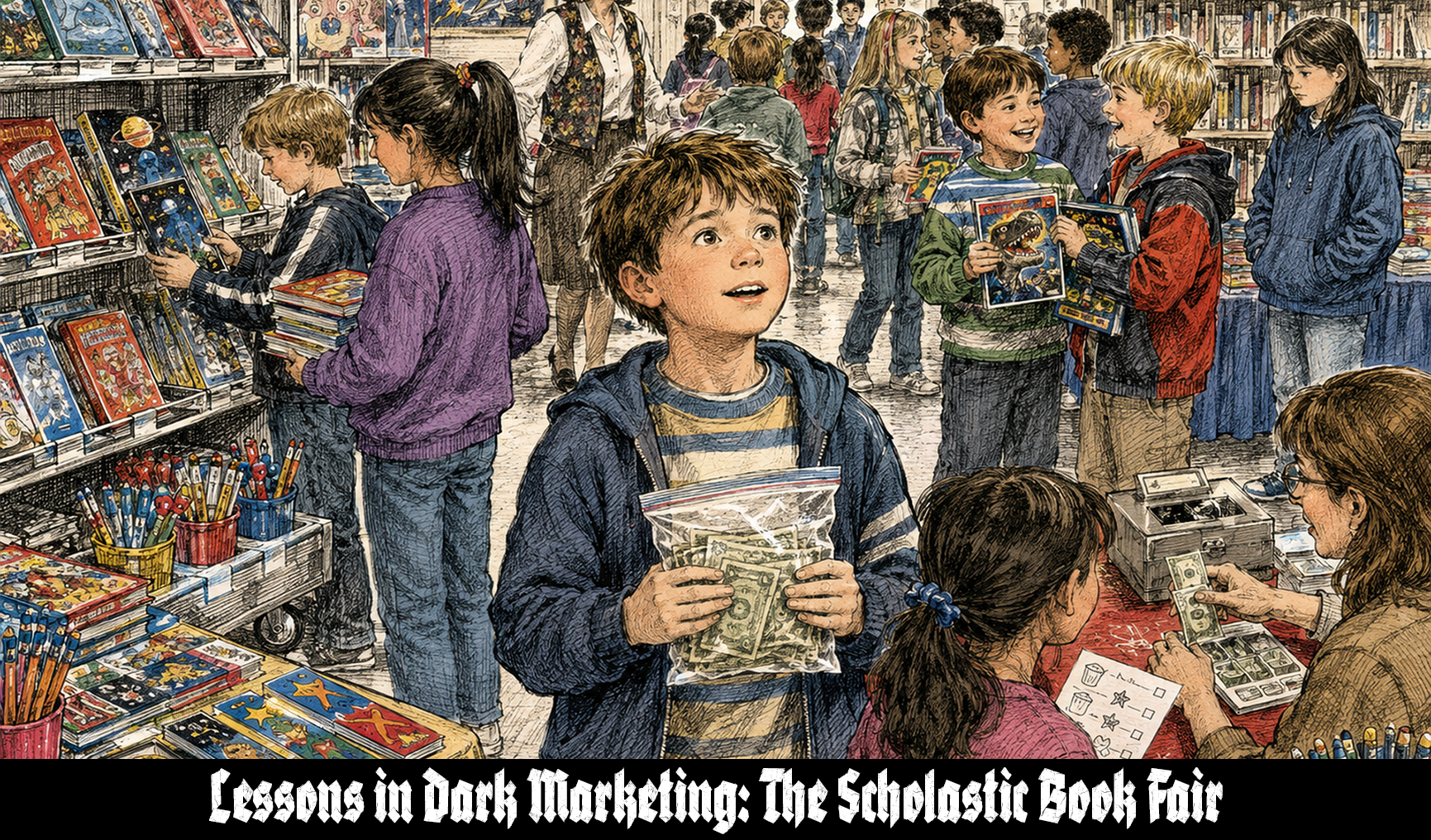
Somewhere in America during the late 1990s, a fourth grader walked into the school library carrying twelve dollars folded into a sandwich bag and discovered that the room had changed professions overnight. The circulation desk was still there. The librarian was still there. Posters about reading still hung from the walls. What had appeared between yesterday afternoon and first period were rolling metal cases packed with Goosebumps, joke books, animal encyclopedias, movie tie-ins, glittery journals, bookmarks, pencils, erasers, posters, activity books, and enough brightly colored merchandise to make the library look as though a bookstore had broken in after hours and received administrative approval.
Every child entered together, and that mattered. The teacher had brought the class during school. The school had announced the event. Flyers had gone home. Books had been previewed. Children had discussed what they planned to buy. Some arrived with twenty-dollar bills. Some had five dollars. Some carried envelopes containing carefully itemized instructions from parents. Some had no money and would spend the next twenty minutes walking through a store they had been required to visit while their classmates shopped.
The books were real, and the literacy benefits were real. The retail environment was also very damn real.
Scholastic entered the school book-fair business in 1981 by purchasing a California operation and expanding the model nationally. The basic arrangement was remarkably efficient: Scholastic supplied books, display cases, promotional materials, logistics, and sales support while school employees, librarians, parent organizations, and volunteers operated the event on school property. The school received a portion of sales in cash, books, supplies, or other educational resources. Scholastic’s corporate history traces that expansion as part of the company’s broader growth into educational publishing and school-based distribution.
More than four decades later, the operation remains enormous. Scholastic says its fairs reach roughly 30 million children annually through tens of thousands of school events. For the 2025–26 school year, the company says Book Fairs put about 60 million books into students’ hands and generated more than $240 million for schools. Scholastic reported $576 million in Book Fair revenue during fiscal 2026. Scholastic Book Fairs presents those numbers as evidence of the program’s educational reach, and they also reveal the scale of the retail machine hiding inside all those gymnasiums and libraries.
That scale exists because the Scholastic Book Fair is genuinely good at getting children excited about books. It is also genuinely good at selling things to children.
The physical event was a temporary bookstore. The psychological sales machine was the school itself: a trusted institution that supplied captive foot traffic, authority figures, peer visibility, fundraising incentives, parental approval, and a moral mission strong enough to make the cash register feel almost incidental. Scholastic placed retail inside an institution children had already been trained to trust, used literacy to give shopping moral legitimacy, turned classmates into social proof, converted a limited-time event into urgency, recruited parents and teachers into promotion, and gave schools a financial reason to want the register busy.
We’re looking at commerce wrapped in educational authority. The book was the respectable product, while the sales floor was hiding between the biographies and the drinking fountain.
The School Building Gave Retail Instant Legitimacy
Children don’t enter school as ordinary consumers. They enter as students, and that changes how they interpret almost everything inside the building. Teachers assign activities. Librarians recommend books. Administrators schedule assemblies. Cafeterias provide lunch. The institution decides where children go, what they do, and which adults deserve authority. When the Book Fair appears inside that same environment, the retail experience inherits some of the legitimacy already attached to the school.
Scholastic’s historical filings describe Book Fairs as weeklong events conducted on school premises and operated by librarians, teachers, parent organizations, and volunteers. Scholastic supplies the merchandise and display infrastructure while the school conducts the event. That arrangement gives the company something ordinary retailers spend fortunes trying to manufacture: trust transferred from place to product.
A bookstore must persuade a family to visit. The Book Fair starts inside the building where millions of children already spend six or seven hours a day. A child doesn’t encounter the merchandise between a shoe store and a food court. The fair appears beside classrooms, homework, library shelves, reading programs, and adults whose authority has already been established.
The transaction absorbs some of that credibility. Buying a book at school feels different from buying candy at a convenience store because the location quietly suggests that the activity belongs there. Somebody responsible approved it. The school opened the doors, the teacher scheduled the visit, the librarian is standing nearby, and the money is being spent on something adults keep insisting is good for you.
Schools host fairs because books matter and funding matters. The darker mechanism begins when institutional trust lowers the normal skepticism applied to a commercial environment. This is dark marketing principle number one: place commerce inside a trusted institution and some of the institution’s credibility transfers to the transaction. Scholastic didn’t have to build a store near the school. It convinced the school to temporarily become one.
The Class Visit Guaranteed Foot Traffic
A normal retailer has to attract customers one person at a time. The Book Fair could receive them by classroom.
Current Scholastic host materials encourage schools to schedule class visits and have students create wish lists during those visits. Schools are also given promotional resources, book trailers, flyers, banners, and other materials designed to build anticipation before and during the event. That is a distribution advantage almost no ordinary retailer possesses.
Twenty-five children can arrive simultaneously because a teacher says it’s time to go. The child who loves books comes. The child who hates reading comes. The child with thirty dollars comes. The child with nothing comes. The child whose parents already said no comes. Everyone walks through the merchandise because the retail visit has been incorporated into the school schedule.
The first visit doesn’t even need to produce a sale. Exposure is enough. A child sees the books, examines the novelty items, notices what classmates want, and creates a mental or written list of things worth requesting at home. In ordinary retail, a failed transaction means the customer left. At the Book Fair, a child can leave without buying and still carry the sales pitch directly into the household.
This is dark marketing principle number two: When you control exposure, the first conversion doesn’t need to happen at the register because it can happen later through memory, desire, and a parent standing in the kitchen.
The class went to the library for twenty minutes and came back carrying thirty-five separate negotiations for dinner.
The Fair Turned Reading Into an Event
A school library is permanent. The Book Fair is temporary, and that difference created excitement.
Rolling cases arrived. Tables appeared. Displays changed. Signs went up. Teachers talked about the event. Students knew the fair would disappear after several days. The ordinary library had books available every week, while the Book Fair had books available right now.
Scholastic still emphasizes the event quality as a central selling point. Its current marketing presents Book Fairs as memorable experiences, promotes seasonal fairs, and encourages schools to host multiple events because each one can offer different titles, exclusives, and releases. The commercial logic is straightforward: temporary retail changes customer psychology.
A child can borrow a library book tomorrow. The fair may be packed into cases on Friday. That deadline creates urgency even when nothing about reading itself is urgent. The books don’t expire. The stories don’t disappear. The temporary storefront disappears.
Scarcity moves from the product to the opportunity, and ordinary inventory inherits the emotional force of a closing window. The child isn’t simply buying a paperback. The child is buying something from Book Fair week, and the memory of the occasion becomes attached to the merchandise.
This is dark marketing principle number three: Make the store temporary and ordinary inventory can inherit the urgency of a disappearing event.
The book would still exist next month, but the rolling metal case had a truck to catch.
The Rolling Cases Made the Transformation Feel Magical
Anyone who experienced a Scholastic Book Fair remembers the cases. They arrived closed and opened into shelves, allowing an ordinary library or multipurpose room to become a compact bookstore almost overnight.
That physical transformation did important emotional work. The cases created visual density, bright covers, categories, display shelves, and enough novelty to overwhelm the normal atmosphere of the room. Scholastic’s business model has long centered on supplying those mobile displays, with warehouses and distribution networks moving books and cases to schools where volunteers and staff perform the final setup.
The cases also gave the fair a repeatable identity. A child in California and a child in Ohio could attend completely different schools and still recognize the same basic ritual. The merchandise arrived inside a branded retail system capable of reproducing itself almost anywhere.
That consistency builds memory. The fair didn’t feel like the librarian had placed a few books on a folding table. It felt like something had arrived. This is dark marketing principle number four: Ritualized physical transformation can make a temporary retail environment feel larger and more important than its footprint.
Yesterday it was the library. Today a truck unloaded capitalism between the encyclopedias.
The Flyer Started Selling Before the Fair Opened
Before many children reached the Book Fair, they had already seen the merchandise. The flyer went home first. Certain covers appeared prominently. Prices were visible. New titles were highlighted. Children could circle items, show parents, compare lists with classmates, and begin allocating money before the cases opened. Scholastic continues using Book Fair flyers, promotional videos, book trailers, social graphics, and school communications as part of its host toolkit.
The flyer transformed the child into a media carrier. Scholastic didn’t need the parent to encounter an advertisement independently because the child carried it home in the backpack.
That gives the advertising unusual emotional power. A flyer arriving through ordinary mail can be discarded. A flyer arriving through a child comes with a spokesperson who has already examined it, developed preferences, and probably circled three books, a pencil, a poster, and something involving sharks that nobody remembers asking Scholastic to classify as literacy. The advertisement reaches the parent attached to a conversation.
This is dark marketing principle number five: When the customer carries the advertisement into the household and explains it personally, marketing becomes harder to ignore because the pitch arrives with a relationship attached.
The flyer cost Scholastic a piece of paper and recruited a nine-year-old account executive for the evening shift.
The Wish List Turned Browsing Into a Formal Request
The wish list was an elegant bridge between school and home. A child could visit the fair without money, identify desired items, record them, and return to the parent with a document. Current Scholastic materials still encourage class visits specifically so students can create wish lists.
That turns desire into paperwork. A child saying, “I want a book,” expresses a feeling. A list containing titles and prices looks like a plan.
The format makes the request more concrete. Parents can review it. Children can prioritize. Families can decide how much money to send. Commercially, the wish list keeps the sale alive after the child leaves the store.
It also gives the child an opportunity to construct an entire basket before any adult has imposed a budget. That sequencing matters because the child first imagines ownership and the parent later performs subtraction. Once desire has been organized, reducing the list feels like taking things away. The retailer has quietly moved the emotional starting point from zero items to six.
This is dark marketing principle number six: let customers mentally own the basket before somebody else has to approve the budget. The wish list didn’t ask whether the family was buying anything. It started negotiations at four books and worked backward.
Book Choice Was the Fair’s Most Powerful Legitimate Benefit
Children choosing their own books is genuinely valuable. Scholastic’s Kids & Family Reading Report found that children strongly prefer books they pick themselves and are more likely to finish books they selected. The Kids & Family Reading Report reflects a simple reality: autonomy can turn reading from an assignment into a personal choice.
Scholastic’s Book Fair gives children unusually direct control over reading. A teacher isn’t assigning the book. A parent isn’t necessarily selecting it. The child can wander, examine covers, read descriptions, follow interests, and discover humor, fantasy, sports, horror, animals, comics, history, or whatever else produces curiosity. That autonomy can turn reluctant readers into buyers and buyers into readers. It is one of the strongest legitimate benefits in the entire system.
The Book Fair really can create excitement around books. It can help children develop ownership over reading. It can help schools acquire materials. It can place stories into homes where children may not regularly visit bookstores. Those benefits are substantial, which makes the surrounding retail system difficult to criticize without sounding like somebody who wants to confiscate Captain Underpants and replace recess with tax preparation. Literacy is exceptionally strong moral cover.
This is dark marketing principle number seven: When the core product creates genuine social value, that value can protect commercial mechanisms operating around it from ordinary scrutiny.
The books were good for children, which gave everything surrounding the cash register a very comfortable chair.
The Child Was Allowed to Become the Buyer
Children usually experience retail through adults. Parents drive to the store, control the money, compare products, set limits, and complete the transaction. The Book Fair gives children a rare opportunity to behave like independent consumers inside their own environment.
A student can hold cash, inspect merchandise, calculate prices, make choices, approach a register, and leave carrying a bag. That autonomy feels enormous because the purchase isn’t only ownership. It is agency.
The child can choose something an adult didn’t select. The book becomes evidence of personal taste. The experience is especially powerful when money is limited because a child with ten dollars has to make decisions. One hardcover or two paperbacks? The joke book or the animal book? A book and a pencil? Spend everything now or save three dollars that suddenly feels psychologically useless because the whole class is standing inside the store? There is educational value in budgeting, arithmetic, and tradeoffs. The commercial result still ends at the register.
This is dark marketing principle number eight: Give young customers controlled purchasing autonomy and the transaction becomes a developmental experience as well as a sale.
The child walked in as a student and emerged as a tiny portfolio manager holding eight dollars of paperback assets.
The Fair Made Spending Public
The Book Fair wasn’t private shopping. Classmates were everywhere. Children could see what other children picked up, discussed, carried, rejected, and purchased. One student might have enough money for a stack. Another might be counting coins beside a paperback. Another might be pretending not to want anything because admitting you couldn’t buy anything is one of childhood’s more efficient forms of public humiliation.
This created social proof automatically. A popular book became more desirable when classmates gathered around it. A poster became valuable because somebody else bought one. A new series gained credibility through the child who already knew it.
The school environment amplified the effect because these weren’t strangers the child would never see again. Purchases returned to class and remained visible after the fair. A book bought Tuesday could be displayed, discussed, traded, borrowed, and envied by Thursday. The merchandise gained a social afterlife.
This is dark marketing principle number nine: Put customers beside their peers and every purchase becomes a demonstration for the people still deciding.
The receipt went into the bag, but the real media placement walked back to homeroom.
The Fair Also Made Inequality Public
The same social environment that creates excitement creates another problem because children don’t arrive with equal spending power.
Some families can send fifty dollars without thinking about it. Some can send five. Some can’t send anything. Scholastic itself acknowledges this gap through programs designed for children who lack money to shop. Its current Share the Fair program and earlier All for Books efforts collect contributions so students who otherwise couldn’t afford purchases can participate.
Those programs are legitimate and useful. Their existence also reveals the structural problem.
The Book Fair takes place inside a shared educational environment where attendance can be culturally universal while purchasing remains financially unequal. A student without money still sees the displays, the classmates shopping, the bags returning to class, and the difference between participation and observation.
That can transform household finances into public childhood status. The child may understand the reason intellectually, but emotion doesn’t care. A school event promising joy around books can accidentally teach another lesson: some children get to leave carrying bags.
This is dark marketing principle number ten: When a commercial experience is socially universal but purchasing power isn’t, inequality becomes part of the customer experience.
Nothing clarifies family economics faster than standing beside a classmate who has moved from books into decorative stationery because twenty dollars remains unspent.
Books Made Pester Power Respectable
Children asking parents for products is one of the oldest sales channels in consumer marketing. Toy companies use it. Breakfast cereal companies use it. Fast-food promotions use it. The Scholastic Book Fair had a tremendous advantage over all of them because the child was asking for books.
That changes the argument. “I want another toy” invites resistance. “I want to read” places the parent in an awkward negotiating position. Books carry developmental, educational, cultural, and moral value. Parents are encouraged to support reading. Schools tell families that reading matters. Teachers reward it. Libraries celebrate it.
The child could request spending while standing on the strongest possible intellectual ground. This doesn’t mean children were consciously manipulating their parents. Most wanted books because the fair had made books exciting. The sales system benefited anyway.
A parent considering whether to send twenty dollars wasn’t simply deciding between consumption and restraint. The parent was deciding whether to financially support the child’s enthusiasm for reading.
This is dark marketing principle number eleven: When children ask for a product associated with a parental virtue, pester power can disguise itself as responsible parenting.
Saying no to the glitter pen was easy. Saying no to reading required a longer opening statement.
Familiar Franchises Removed the Risk From Choosing
Book Fairs have always mixed discovery with familiarity. Popular characters, franchises, graphic novels, recognizable series, and established authors lower the risk of choosing something unknown. Scholastic’s current Book Fair promotion emphasizes familiar series including The Baby-Sitters Club, I Survived, Dog Man, Captain Underpants, Wings of Fire, and Diary of a Wimpy Kid, alongside titles from other publishers.
For children, recognition accelerates desire. A kid who already loves a character doesn’t need to be persuaded that the book deserves attention. The emotional relationship arrived before the fair.
That makes franchises especially useful inside a limited shopping window because the child has little time and familiarity shortens the decision. It also connects the fair to playground culture. When classmates know the same characters, books become easier to discuss and display. Reading becomes social participation rather than private activity. That can be excellent for literacy, and it can turn existing media attachment into a reliable sales shortcut.
This is dark marketing principle number twelve: When customers already love the character, the retailer inherits demand created somewhere else.
The fair didn’t have to introduce the hero. Television, bookstores, previous volumes, and the kid sitting two desks away had already completed orientation.
Exclusives Made School Shopping Feel Special
Scholastic currently markets exclusive books, special paperbacks, markdowns, and fair-specific selections as part of the event’s appeal. Exclusivity changes the emotional question. A child isn’t deciding whether to buy a book available anywhere. The child is deciding whether to buy the version available here.
That gives the school event something an ordinary bookstore may not offer. Limited editions, exclusive formats, bundled products, and fair-specific merchandise create a reason to act during the event rather than postpone.
This is especially effective with children because uniqueness adds a story to ownership. “I got this at the Book Fair” becomes part of the object. The event itself supplies provenance.
This is dark marketing principle number thirteen: Give temporary retail an exclusive object and attendance becomes an acquisition opportunity instead of simple browsing.
The school had temporarily become the only respectable place to conduct urgent paperback diplomacy.
The Non-Book Stuff Increased the Basket
Anyone remembering Scholastic Book Fairs exclusively as rows of literature has granted childhood nostalgia an editorial privilege. There were also things: pencils, erasers, bookmarks, posters, stationery, and small novelty items. Current Scholastic materials still identify pencils, erasers, bookmarks, and classroom supplies as part of the broader fair ecosystem.
These items serve an important commercial function because they capture money that may not fit another book. A child with three dollars remaining might not afford the desired title, but a pencil can absorb part of the balance. An eraser can absorb less. A bookmark can make leaving with something feel better than leaving with change.
Small items also broaden the appeal to children who aren’t enthusiastic readers. The fair can still produce a transaction.
This is standard retail architecture: provide lower-cost impulse products so remaining budget can find a home. Inside a literacy event, those products inherit educational atmosphere even when their primary accomplishment is writing with a slightly more exciting barrel.
This is dark marketing principle number fourteen: Provide products across price points so leftover budget keeps finding something to become.
The book built the moral case, and the pencil-shaped jagoff waited near the register to collect whatever money survived.
The Register Taught Children to Spend to the Limit
Children often arrived at the Book Fair with a fixed amount of money, creating a different shopping psychology from adults using cards or checking accounts. The budget was physically visible. Ten dollars entered. Whatever remained exited.
That encourages optimization. The child wants to maximize what can be purchased because unspent money feels like missed opportunity during a temporary event.
This makes price ladders especially useful. A large item consumes most of the budget. Smaller books fill gaps. Novelty items finish the job. The child can perform arithmetic while the retailer benefits from the answer.
There’s educational value here. Children practice budgeting, addition, subtraction, and tradeoffs. There’s also a commercial truth: a retailer doesn’t dislike teaching subtraction when the equation ends at zero.
This is dark marketing principle number fifteen: When customers arrive with a fixed spending pool, create enough price points that the optimal emotional outcome becomes spending the whole pool.
The math lesson was excellent. Ten dollars minus ten dollars equaled one successful Book Fair.
The School Earned More When Children Spent More
The Book Fair isn’t just retail conducted inside a school. It is fundraising. Schools receive a share of sales or educational resources tied to fair performance. Scholastic’s current program allows schools to earn percentages of sales and choose Scholastic Dollars that can be spent on books, furniture, curriculum materials, subscriptions, and other school resources. Qualifying fairs can receive substantial percentages of sales back in Scholastic Dollars under the current structure.
This aligns the institution with the seller. More sales benefit Scholastic, and more sales can also benefit the school. That doesn’t mean librarians or volunteers are cynically pressuring children. Many are trying to fund chronically under-resourced classrooms and libraries. The incentive still exists.
The school has a reason to promote attendance, send flyers, encourage family participation, hold evening events, remind parents, and celebrate strong sales. The commercial transaction has been connected to educational funding, making spending feel like support for the community.
The child buys a book. The parent supports reading. The school earns resources. Scholastic records revenue. Everybody can point toward a legitimate benefit.
This is dark marketing principle number sixteen: Share revenue with the institution controlling customer access and promotion becomes mutually beneficial.
Scholastic didn’t rent the library. It gave the library a reason to care how busy the register became.
Scholastic Dollars Keep the Revenue Inside the Ecosystem
Schools can receive fair earnings in forms that include Scholastic Dollars, which can then be redeemed through Scholastic for books, classroom products, furniture, digital resources, and other materials. Scholastic markets the system as a way for schools to increase their purchasing power by selecting its internal currency.
That is an elegant closed loop. Families spend money at the fair. The school earns value. The school can increase that value by keeping the reward inside Scholastic. The reward is then spent on Scholastic-controlled inventory.
The original transaction generates another transaction without the value fully leaving the ecosystem. Schools benefit because they can obtain more resources. Scholastic benefits because the reward is redeemed through Scholastic. This is loyalty-program logic operating at an institutional level.
This is dark marketing principle number seventeen: Make rewards more valuable when redeemed inside your own system and customers will voluntarily keep economic activity within the brand.
The school earned money from selling Scholastic products and could stretch the reward by buying more Scholastic products. That circle could teach geometry.
Volunteers Turned Community Labor Into Retail Infrastructure
Scholastic supplies products, cases, logistics, technology, and planning support. Schools supply much of the labor. Company descriptions have long emphasized that fairs are operated by parent volunteers, teachers, librarians, school employees, and parent organizations. That arrangement keeps the fair culturally embedded.
The person at the register may be somebody’s mother. The person helping children locate books may be the librarian. The person organizing the event may be a teacher. These aren’t anonymous retail employees. They’re members of the school community.
That makes the event feel communal rather than corporate, and the labor is economically valuable. Local volunteers unpack cases, organize displays, staff registers, help students, promote the event, and repack merchandise after the fair.
Scholastic has created an operating model where the institution benefiting from sales helps perform the work required to generate them. Schools receive resources and families often enjoy volunteering, while the commercial structure becomes cheaper, scalable, and more trusted because community members are running it.
This is dark marketing principle number eighteen: When customers or partner communities perform part of the operating labor, the business can feel participatory while becoming cheaper and more scalable to run.
The PTA thought it was hosting literacy week and discovered halfway through setup that it had opened a temporary retail branch.
Teacher Participation Made the Event Feel Endorsed
Teachers matter enormously to children’s interpretation of books. A teacher who discusses the fair, previews titles, brings the class, displays a wish list, or helps a child find a book reinforces the event’s educational legitimacy. Scholastic’s host materials encourage teacher preview events, class visits, teacher eWallets, and classroom-library fundraising.
This integration creates another layer of authority because the child doesn’t experience a retailer advertising alone. The fair is woven through adult figures associated with learning.
Teachers may have excellent reasons to support it. Classroom libraries are expensive, and teachers frequently spend their own money on books and supplies. That legitimate need strengthens the machine.
When the teacher wants the fair to succeed because students get books and the classroom gains resources, commercial promotion and educational mission become difficult to separate. The seller has found the ideal advocate: somebody whose recommendation already carries pedagogical weight.
This is dark marketing principle number nineteen: When trusted experts benefit from the product’s success, endorsement can emerge naturally without looking like advertising.
Nobody needed the teacher to deliver a sales pitch. Excitement about books did the work with far better credentials.
The Fundraiser Made Purchasing Feel Generous
A parent spending forty dollars at a bookstore has spent forty dollars on books. A parent spending forty dollars at the school Book Fair can feel that some portion supports the school. That changes the emotional accounting.
The purchase carries a charitable aftertaste. Scholastic prominently markets school earnings as part of the Book Fair proposition and emphasizes the cash and educational resources generated for schools.
This gives families another respectable reason to spend. The child gets books, the school gets resources, and the parent can view the transaction as consumption and contribution at the same time.
That dual purpose reduces guilt around unnecessary purchases because spending isn’t entirely self-directed. The logic resembles charity-linked products, fundraising restaurants, school merchandise, and any system where purchasing becomes support.
This is dark marketing principle number twenty: Attach community benefit to personal consumption and spending can feel virtuous even when the customer would have bought the product anyway.
The receipt said retail transaction. The parent could file it emotionally under civic participation.
eWallet Removed the Crumpled-Cash Brake
The Millennial Book Fair often ran on cash, which meant a child physically watched the budget disappear. The modern Book Fair has removed much of that friction. Scholastic’s eWallet allows families to preload funds digitally so children can shop independently without carrying cash. Relatives and friends can contribute money, additional funds can be added during the fair, and student accounts appear directly in the school’s payment system. Scholastic’s own marketing says eWallet can increase sales. Scholastic eWallet presents the system primarily as convenience and security, which it genuinely provides.
Cash creates friction. A child can lose it. A parent has to decide how much to send. The child can see it leaving. Running out ends the transaction. Digital balances make the experience smoother. That’s convenient for families and safer than sending elementary-school children to campus with cash. It is also better retail engineering.
Extended family can contribute. Parents can add more. Checkout becomes faster. The emotional pain of watching paper money disappear becomes less visible. Scholastic didn’t invent digital payment to corrupt children. It adopted the same friction-reduction logic used across modern commerce, and that logic works.
This is dark marketing principle number twenty-one: Remove payment friction and customers can focus on choosing rather than feeling the physical cost of each choice.
The sandwich bag full of ten dollars disappeared, and childhood retail joined the cashless economy.
Unspent eWallet Money Keeps the Relationship Alive
The modern eWallet contains another clever feature. When the fair ends, unused money can remain as Scholastic credit associated with the adult account, allowing the balance to fund future fair spending or other Scholastic purchases.
That prevents unused purchasing power from disappearing. The fair ends, but the balance remains inside the ecosystem. The customer has already committed the money, so the next question becomes where to spend it rather than whether to spend it.
That is classic stored-value economics. Gift cards work for the same reason. Prepaid funds transform future spending from a new financial decision into completion of an old one. The Book Fair may leave the school on Friday. The commercial relationship can remain in the account long afterward.
This is dark marketing principle number twenty-two: Convert unused event money into stored brand credit and the customer can leave the store without leaving the purchasing system.
The fair packed up. The remaining seven dollars stayed behind electronically, waiting for another paperback to justify its existence.
Online Shopping Removed the Physical End of the Fair
The temporary nature of the Book Fair once created a clean deadline. The cases left and shopping ended. The modern system extends beyond the building. Scholastic gives in-person fairs an online shopping period where families can purchase a much larger selection of products while still contributing toward school-related fair totals. Scholastic’s online fair information positions the service as a way for families to participate even when they can’t attend in person.
That solves several practical problems. Families who can’t attend can participate. Sold-out titles can remain available. Parents can shop without sending cash. It also weakens the natural stopping point.
The child can browse at school. The parent can shop at home. The physical fair can disappear while the school connection and online store remain active. What began as a weeklong fundraiser can become a much longer commercial relationship associated with the school.
This is dark marketing principle number twenty-three: When an event creates valuable customer relationships, extend those relationships beyond the event rather than allowing the closing date to end them.
The rolling cases finally left the library, but somebody forgot to take the checkout page with them.
More Fairs Turn the Event Into a Recurring Institution
The Book Fair doesn’t have to happen once. Scholastic promotes multiple fairs within a school year and offers incentives that can make additional events attractive to participating schools. The logic is straightforward: one successful event creates an experienced host, families already recognize the system, students know what is coming, and the next fair faces less friction.
More events can mean more books and more resources for the school. They also mean more transactions. The literacy mission and revenue model remain aligned, which is why the machine rarely needs aggressive pressure. Everybody involved can identify something genuinely useful produced by another fair.
This is dark marketing principle number twenty-four: Once customers and partners learn the ritual, reward repetition so an occasional event becomes a recurring institution.
The first fair was a fundraiser. The second one arrived with enough familiarity to start looking like a semester.
The School Calendar Became a Sales Calendar
Seasonal events are powerful because anticipation becomes recurring. Students know when the Book Fair is coming. Teachers mention it. Families remember last year. Younger siblings watch older siblings participate and wait for their turn.
The event becomes part of the rhythm of school. That institutional repetition creates brand inheritance. A child can experience Scholastic fairs year after year without consciously deciding to maintain a relationship with Scholastic. The brand returns because the school returns it.
This separates Book Fairs from ordinary childhood fads. A popular toy might disappear. A television show might end. The fair is attached to an institution that receives a fresh population of students every year.
Children graduate. Kindergartners arrive. The customer base replenishes itself.
This is dark marketing principle number twenty-five: Attach the commercial ritual to a repeating institution and new customers enter automatically as the institution renews its population.
Scholastic didn’t need to wait for the next generation to visit the mall. Kindergarten delivered them every September.
Share the Fair Solved a Real Problem the Fair Helped Make Visible
Scholastic’s programs designed to help children without spending money deserve credit. The current Share the Fair program and its predecessor, All for Books, allow schools, families, community members, and businesses to contribute funds so children who otherwise couldn’t afford purchases can still leave with books. Scholastic has also connected these efforts with broader book-giving initiatives.
This is meaningful because a school-based retail event shouldn’t become a public demonstration of which children can participate. Providing funds to close that gap improves the experience and puts books into children’s hands.
The darker marketing lesson comes from how effectively the solution strengthens the overall system. The program addresses inequality without requiring the commercial event to stop. It allows the fair to remain socially inclusive while preserving the retail structure.
Families can donate. Children receive books. Schools benefit. Scholastic sells more product. A structural criticism has been converted into another channel for participation. That doesn’t make the giving program cynical. Helping children acquire books is good. It demonstrates how strong systems absorb criticism by creating a legitimate solution inside themselves.
This is dark marketing principle number twenty-six: When the business model creates an exclusion problem, solving that problem inside the business model can strengthen both the mission and the machine.
The fair created the awkward empty-handed walk back to class and then built a genuinely useful program to make fewer children take it.
Nostalgia Became One of Scholastic’s Most Valuable Assets
Millennials grew up. The Book Fair stayed vivid. People remember the rolling cases, the smell of new paperbacks, the flyers, the pencils, the posters, the wish lists, the money envelopes, and the unusual thrill of being allowed to shop during school.
Scholastic understands how powerful that memory has become. Its modern marketing openly references the nostalgia surrounding Book Fairs and treats the experience as something adults continue to remember decades later.
The company doesn’t have to manufacture nostalgia around an old product because customers already did it. The Book Fair occupied a rare emotional category by combining childhood independence, temporary freedom from normal classroom routine, books, shopping, peer culture, and the excitement of an event that adults approved.
The commercial machinery became inseparable from the memory. Adults don’t usually reminisce warmly about being marketed to. They reminisce about the Book Fair.
This is dark marketing principle number twenty-seven: If the commercial environment becomes part of childhood ritual, nostalgia may preserve the feeling long after customers forget the sales architecture that created it.
Millennials remember the smell of the books, and somehow the cash register gets edited out of the family photo.
The Scale Proves This Was Never a Cute Little Library Fundraiser
The nostalgic memory is small. The business isn’t. Scholastic launched its Book Fair operation in 1981 and now operates tens of thousands of fairs while reaching tens of millions of children. The company’s Book Fair business produces hundreds of millions of dollars in annual revenue.
This is a major retail channel. The school setting can obscure that scale because each individual event feels local. One librarian. One PTA. One set of rolling cases. One week. Multiply that scene across the country and the operation becomes enormous.
The genius of the model is that both views are accurate. It is a local school fundraiser, and it is also a national distribution system operated by one of the largest children’s publishers in the world. The smallness of the individual event makes the enormousness of the business easy to overlook.
This is dark marketing principle number twenty-eight: Decentralize a large commercial system into thousands of intimate local experiences and customers may feel community where the company sees distribution.
One child saw a paperback table. Scholastic’s annual report saw hundreds of millions of dollars.
The Books Really Did Put More Children Into Books
A dark-marketing analysis fails when it pretends the legitimate benefit doesn’t exist. Scholastic Book Fairs have put an extraordinary number of books into children’s hands. The company says tens of millions of books move through the fair system while its reading research shows that children strongly value books they select themselves.
Children who rarely visit bookstores can encounter a large assortment of books. Children can discover genres adults wouldn’t have chosen. Schools can acquire library resources. Teachers can expand classroom collections. Families can connect spending to reading rather than another disposable toy.
A Book Fair can make books socially exciting in a way a permanent shelf sometimes doesn’t. That isn’t a trivial achievement.
The legitimate benefit is exactly why the dark-marketing machinery deserves examination instead of cheap dismissal. Scholastic found a way to make reading compete with toys, television, video games, and whatever else demanded children’s attention.
It did so by borrowing techniques from retail: scarcity, event marketing, peer influence, impulse products, previews, wish lists, franchise recognition, fundraising, stored value, loyalty incentives, and frictionless payments. The reading mission and sales engineering worked together.
This is dark marketing principle number twenty-nine: The most durable commercial systems often succeed because the manipulation and the genuine benefit are both strong enough to reinforce each other.
Scholastic made children want books and made sure somebody was standing nearby with a register when the wanting happened.
The Case Study Breakdown
- The school building transferred institutional trust to retail: Children encountered a commercial event inside a place associated with education and authority.
- Scheduled class visits guaranteed exposure: Entire classrooms could be brought through the merchandise whether individual students planned to shop or not.
- The temporary event created urgency: A weeklong fair made ordinary books feel tied to a disappearing opportunity.
- Rolling cases created theatrical transformation: The school library or multipurpose room became a recognizable temporary bookstore.
- Flyers pre-sold the merchandise at home: Children carried promotional material directly to parents.
- Wish lists converted browsing into planned requests: Students mentally assembled baskets before household budgets entered the conversation.
- Self-selection created genuine literacy value: Children are more likely to enjoy and finish books they choose themselves.
- Independent shopping created emotional agency: Children could behave like consumers inside their own school environment.
- Peer visibility generated social proof: Students watched classmates choose, buy, discuss, and display merchandise.
- Unequal spending power became visible: The same environment highlighted differences between children who could shop and children who couldn’t.
- Books gave pester power moral legitimacy: Asking parents for money could be framed as enthusiasm for reading.
- Popular franchises reduced purchasing risk: Familiar characters and series arrived with demand already established.
- Exclusive products increased event value: Fair-specific selections gave customers a reason to buy during the temporary window.
- Low-cost novelty items captured remaining budgets: Pencils, erasers, bookmarks, and similar products expanded the basket beyond books.
- Fixed child budgets encouraged full spending: Multiple price points helped small balances find merchandise.
- School fundraising aligned incentives: Higher sales could generate more money and educational resources for the host school.
- Scholastic Dollars kept rewards inside the brand ecosystem: Schools could increase value by redeeming earnings through Scholastic.
- Community volunteers supplied retail labor: Parents, teachers, and librarians helped operate the commercial environment.
- Teacher involvement increased legitimacy: Educators could promote reading while naturally supporting fair participation.
- Purchasing could feel charitable: Families knew part of their spending supported school resources.
- eWallet reduced payment friction: Digital balances made independent shopping easier and removed some of the psychological visibility of cash.
- Unused digital balances remained spendable within Scholastic: Money could continue supporting future purchases after the physical fair ended.
- Online shopping extended the fair: Physical closing time no longer ended commercial access.
- Additional fairs encouraged repetition: Schools could turn the event into a recurring part of the academic year.
- School calendars created recurring customer acquisition: New students entered the ritual every year.
- Giving programs addressed financial exclusion: Share the Fair and earlier programs helped students who couldn’t otherwise participate.
- Nostalgia converted retail memory into brand equity: Adults now remember the fair as a defining childhood experience.
- Local presentation concealed national scale: Thousands of intimate events collectively form a major commercial operation.
- Real literacy benefits gave the entire system credibility: Millions of books reached children through a machine designed to make reading exciting enough to purchase.
These mechanisms worked because every commercial mechanism had an educational explanation standing beside it. The temporary store created urgency, but urgency made reading exciting. Peer influence drove demand, but classmates introduced one another to books. The school earned money from sales, but that money could support libraries and classrooms. Children asked parents to spend, but they were asking for reading material. Digital payment reduced friction, but it also made carrying cash safer and easier. Giving programs supported sales while putting books into the hands of children who might otherwise leave empty-handed.
The system was commercially sophisticated because the benefits weren’t fake. They were woven directly into the sales architecture.
This is dark marketing principle number thirty: When every sales mechanism can point toward a legitimate social benefit, commerce becomes difficult to criticize because removing the machine may also remove something customers genuinely value.
Scholastic built a bookstore inside the school and made sure the exit led through literacy.
What Marketers Should Learn From the Scholastic Book Fair
The first lesson is that context changes the perceived meaning of a transaction.
The same paperback sold in a shopping mall is retail inventory. Inside a school library, surrounded by teachers and reading programs, it becomes part of an educational event. Marketers should understand that distribution environments carry psychological authority of their own.
The second lesson is that temporary experiences can make permanent products exciting.
Books don’t usually require urgency, but the Book Fair created it. The disappearing environment supplied a deadline around objects customers could theoretically purchase elsewhere later.
The third lesson is that the best promotional media can become part of customer ritual.
Scholastic flyers weren’t automatically discarded. Children studied them, circled products, and used them to organize requests. Marketing becomes dramatically more powerful when customers voluntarily preserve and revisit it.
The fourth lesson is that self-selection can be both good pedagogy and good commerce.
Children genuinely benefit from choosing books they want to read, and that autonomy creates stronger purchase intent because the desire belongs to the child rather than the adult selecting for them.
The fifth lesson is that social proof becomes especially powerful inside recurring communities.
A stranger carrying a book in a store has limited influence. A classmate bringing a new book back to homeroom can influence the same children for days.
The sixth lesson is that a strong core product can lend legitimacy to weaker peripheral products.
Books created the educational mission. Pencils, bookmarks, posters, and other small items benefited from operating inside the same environment.
The seventh lesson is that partner economics determine how enthusiastically a distribution channel supports you.
Schools benefit when fairs generate funds and resources, giving the institution a real reason to promote participation without Scholastic having to manufacture enthusiasm artificially.
The eighth lesson is that internal currencies can deepen ecosystems.
Scholastic Dollars give schools greater purchasing power when value remains inside Scholastic’s system. Loyalty programs work for consumers and institutions for the same basic reason: value feels larger when the customer agrees not to take it elsewhere.
The ninth lesson is that community labor changes brand perception.
Parent volunteers and librarians make the fair feel local even though the supply system is national. Businesses become more trusted when the people delivering the experience already belong to the customer’s community.
The tenth lesson is that removing payment friction increases conversion.
eWallet makes shopping safer and easier for children and families while making spending smoother. Convenience rarely arrives without a commercial consequence.
The eleventh lesson is that successful events shouldn’t end when the physical infrastructure disappears.
Scholastic now extends fairs online and maintains school-linked purchasing opportunities after the rolling cases have left. The event acquires the customer relationship, and digital commerce keeps it alive.
The twelfth lesson is that solving problems created by your own system can still create authentic value.
Share the Fair addresses a real inequity in school-based shopping. A company doesn’t have to choose between acknowledging a weakness and continuing the business. The stronger move can be building a credible remedy.
The thirteenth lesson is that nostalgia is strongest when people remember the ritual instead of the advertisement.
Adults rarely say they miss Scholastic marketing. They say they miss the Book Fair. That is what happens when branding becomes indistinguishable from experience.
The fourteenth lesson is that a commercial model can be both manipulative and beneficial.
Scholastic Book Fairs encourage reading, increase access to books, raise school resources, create childhood memories, and deploy sophisticated retail psychology at the same time. Serious marketers should be able to hold all of those facts in the same argument.
This is dark marketing principle number thirty-one: The strongest marketing doesn’t always disguise commerce as something else; sometimes it builds commerce so deeply into a valuable experience that customers stop caring where one ends and the other begins.
Scholastic didn’t convince children that shopping was reading. It made shopping one of the ways they experienced reading.
Final Diagnosis
The Scholastic Book Fair belongs in the Lessons in Dark Marketing museum because it achieved something most brands would kill for: it made a generation nostalgic for being sold to during school hours. The books were real, the reading mattered, the school funding mattered, and the joy mattered. Many children discovered favorite authors at those fairs, spent their own money on books for the first time, developed a sense of independence, and carried home stories that became part of their childhood. The commercial machinery mattered too.
The final diagnosis is waiting beside the rolling cases:
- Scholastic placed retail inside a trusted educational institution.
- Entire classes could be scheduled to visit the sales floor.
- The temporary event created urgency around permanent products.
- Rolling cases transformed ordinary school space into a theatrical store.
- Flyers carried advertising from school directly into family homes.
- Wish lists converted browsing into organized purchase requests.
- Children received genuine power to choose what they wanted to read.
- Independent shopping made consumption feel like maturity.
- Classmates supplied constant social proof.
- Unequal household spending power became publicly visible.
- Literacy gave children unusually respectable leverage when asking parents for money.
- Popular characters and franchises lowered resistance to purchase.
- Exclusive products made the event feel commercially special.
- Cheap novelty items helped capture money left after book purchases.
- Fixed child budgets encouraged spending down toward zero.
- School fundraising gave institutions a financial stake in higher sales.
- Scholastic Dollars encouraged schools to keep rewards inside Scholastic’s ecosystem.
- Parents, teachers, librarians, and volunteers performed much of the local retail labor.
- Educator involvement lent the fair additional authority.
- Family spending could be interpreted as support for the school.
- Digital eWallets removed cash friction and expanded who could fund a child’s shopping.
- Unspent digital balances could remain available for future Scholastic purchases.
- Online stores extended shopping beyond the physical fair.
- Additional fairs encouraged schools to repeat the event.
- The school calendar continuously supplied new generations of customers.
- Giving programs helped children excluded by unequal spending power.
- Adult nostalgia converted a childhood sales event into lasting brand affection.
- The local fundraiser disguised the scale of a national retail business generating hundreds of millions of dollars annually.
- Genuine literacy benefits made the entire machine more credible, durable, and culturally protected.
- Scholastic proved that one of the best ways to sell children products is to make the products something responsible adults sincerely want children to have.
Return to the school library and the fourth grader still has twelve dollars while the teacher says the class has twenty minutes. A friend has already grabbed the new book everybody was talking about. Another kid is holding a poster. Somebody has discovered the novelty pencils. A student near the register is counting quarters. Another child is carrying a wish list home because there wasn’t any money in the backpack this morning.
The shelves look brighter than usual, and the books feel more exciting than the books that sit in this same room every other week of the year. The difference isn’t literacy. It is retail theater: a temporary store that has turned reading into an event, classmates into sales demonstrations, teachers into trusted guides, parents into funding sources, volunteers into staff, and school fundraising into an institutional reason for every purchase to feel helpful.
Then the fair ends. The cases close, the truck takes them away, and the library becomes a library again. Years later, the children barely remember what they bought, but they remember the Fair because the commercial machinery became part of the childhood ritual instead of something visibly separate from it.
That may be Scholastic’s greatest marketing achievement of all. The company built a shopping mall inside the school library, sold millions of children something genuinely good for them, and made the cash register disappear from the memory.
Leave a Reply