
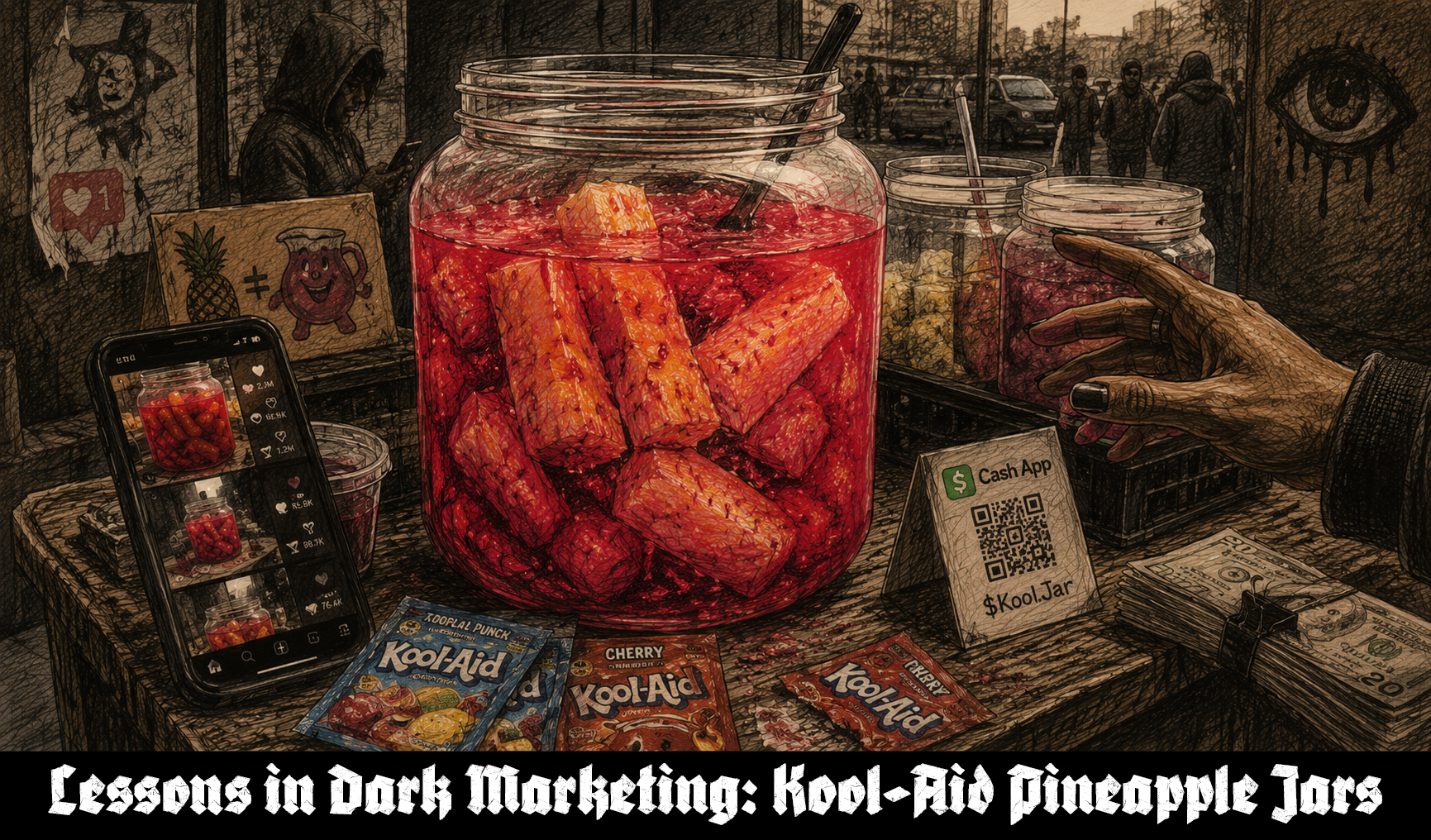
The Kool-Aid pineapple jar is a marketing case study with a screw-on lid, not just a snack trend.
On the surface, the product is stupidly simple: giant clear plastic jars of pre-cut pineapple, soaked in Kool-Aid powder, sugar, and pineapple juice until the whole thing turns neon red, blue, green, purple, or whatever other artificial color can punch a hole through someone’s social media feed. The pineapple floats in tinted syrup like fruit preserved by a madman who lost his food handler’s card and found TikTok.
But that is exactly why it works.
The Kool-Aid pineapple jar is a perfect dark marketing object because it does not need polish. It does not need professionalism. It does not need a traditional ad campaign. It only needs to be loud enough, cheap enough, ugly enough, colorful enough, and nutritionally irresponsible enough to make people stop scrolling.
That is the dark marketing lesson. The product is not selling flavor. It is selling interruption. It is selling spectacle. It is selling permission. It is selling low-class indulgence as a visual identity. And because the machine is now built to reward whatever creates reaction, the jar does not have to be good. It only has to be unavoidable.
Case Study Overview: What Is Actually Being Sold?
A normal person looks at the jar and sees pineapple. A marketer looks at the jar and sees a funnel. That is the first correction. The Kool-Aid pineapple jar is not really a food item. It is a low-cost attention object built from five ingredients:
- Pre-cut fruit.
- Powdered nostalgia.
- Added sugar.
- Clear packaging.
- Neon visual shock.
That is the whole machine. Everything else is distribution.
The genius is not in the recipe. There is no culinary genius here. This is not a chef-driven snack. This is not some delicate street-food tradition. This is pineapple being drowned in powdered drink mix until it looks like it was confiscated from a children’s birthday party at a Superfund site.
The genius is in how well the product performs on camera.
A clear plastic jar gives the product shape. The pineapple gives it texture. The neon juice gives it color. The Kool-Aid name gives it memory. The sugar gives it addiction-adjacent appeal. The absurdity gives it controversy. The controversy gives it reach.
That is the product stack, and it works because every layer is doing a job.
The Packaging Strategy: The Jar Is the Billboard
The clear plastic jar is the most important part of the trend. Not the pineapple. Not the Kool-Aid. The jar.
A bag looks homemade. A bowl looks temporary. A plate looks like something someone already ate half of before remembering they wanted attention. But a giant clear jar looks like inventory. It looks like a product. It looks like something being sold, not just made.
That matters because the jar creates instant legitimacy. It gives the seller the illusion of scale. It makes the product look repeatable. It makes the table look stocked. It turns a kitchen-counter stunt into something that feels like a street-vendor drop.
This is packaging doing the work of branding. The clear plastic lets the neon juice scream at the viewer. There is no label needed. No logo. No design system. No typography. No “brand story.” The product is the ad. The container is the billboard. The color is the headline.
That is why this would not work as well in an opaque container. Hide the color and the trend loses half its power. The point is not just to eat the pineapple. The point is to see the pineapple suspended in a jar of electric syrup like a snack that failed a background check.
This is visual marketing reduced to its dirtiest principle: if it stops the thumb, it has value.
The Scroll-Stopping Mechanism: Neon Beats Taste
Most people still talk about food trends like taste matters most. That is adorable.
Taste matters after the click. Taste matters after the purchase. Taste matters after the video has already done its job. But for viral food, taste is not the opening argument. The opening argument is visual assault.
The Kool-Aid pineapple jar wins because it looks wrong.
Regular pineapple is invisible online. Nobody cares. It is yellow fruit. Fine. Nice. Put it next to watermelon and let somebody’s aunt guard it at the barbecue.
But blue pineapple? Red pineapple? Purple pineapple glowing through a clear plastic jar like it was found in the basement of a condemned Chuck E. Cheese? That stops people.
The neon juice is not flavor. The neon juice is bait. It turns the jar into a thumbnail. It creates instant contrast against the endless feed of faces, dogs, fights, fake business advice, gym mirrors, podcast clips, and car repossessions. The color does not whisper. It screams. And in a platform economy where attention is auctioned in fractions of a second, screaming usually beats substance.
That is dark marketing principle number one of this piece: the product does not have to be better. It has to be more visible.
Audience Targeting: Who Is This Really For?
The target customer is not a foodie. This is not for the person who asks what farm the pineapple came from. This is not for the person reading ingredient labels in silence while blocking the aisle at Erewhon. This is not for the person who says “mouthfeel” without being under court order.
The Kool-Aid pineapple jar is built for the low-class viral snack economy: people who want something sweet, cheap, loud, shareable, and socially validated by the fact that other people are already acting stupid about it online. This is segmentation. not moral panic.
This product understands its audience better than most corporate campaigns do. It knows the customer wants volume. It knows they want color. It knows they want novelty. It knows they want a purchase that doubles as a post. It knows they want the feeling of being part of a moment without needing taste, restraint, or a working relationship with nutrition.
The jar gives them all of it.
- For the buyer, it is a treat.
- For the seller, it is a hustle.
- For the viewer, it is spectacle.
- For the hater, it is a target.
- For the platform, it is engagement.
- For the brand, it is free oxygen.
That is the brilliance. The same object serves different audiences at the same time. Nobody has to agree on what it means. They only have to react.
The Nostalgia Trigger: Kool-Aid as Emotional Contraband
Kool-Aid is not just a flavor powder. Kool-Aid is childhood memory in a packet.
That is why the brand works here. It carries emotional residue. Summer. Cookouts. Grandma’s kitchen. Plastic pitchers. Red-stained mouths. Cheap sweetness. Being eight years old and not knowing what an insurance deductible was. The nostalgia softens the stupidity.
If this were just generic artificial fruit powder, the trend would not hit the same way. Kool-Aid brings a name people recognize, a memory they can access, and a permission structure already loaded into the American brain. It turns a jar of dyed pineapple syrup into something that feels familiar even when it looks like a lab accident.
That is dark marketing principle number two: nostalgia lowers resistance.
People will forgive a lot if the product reminds them of childhood. They will forgive sugar. They will forgive artificial color. They will forgive the fact that the snack looks like something a cartoon villain serves before explaining his plan. Because nostalgia does not ask the adult brain for approval. It goes around it.
The Kool-Aid packet is the emotional key. The jar is the visual lock. The algorithm opens the door.
The Health Halo: Pineapple Launders the Sugar
The pineapple is the alibi. This is one of the oldest tricks in food marketing. Add fruit, and suddenly people behave like the whole thing has been blessed by a nutritionist with student loans.
“It’s pineapple.” Yes, and if you pour syrup and powdered dye on broccoli, that does not make it a salad.
Pineapple already contains natural sugar. The trend then adds Kool-Aid and refined sugar into the juice, turning the jar into a sugar delivery system with nostalgic branding. That health halo is part of why the product can pass through people’s defenses. It looks like fruit, so it feels less guilty than candy. It is in a jar, so it feels more official than something dumped into a cup. It is colorful, so it feels playful instead of predatory. That is how the trick works.
The CDC identifies sugar-sweetened beverages as a leading source of added sugars in the American diet, and it says frequent consumption is associated with weight gain, obesity, type 2 diabetes, heart disease, non-alcoholic liver disease, cavities, tooth decay, and gout. The CDC also warns that consuming too many sugary drinks is associated with type 2 diabetes, high blood pressure, tooth decay, weight gain, and obesity. (CDC) (CDC)
Now, one jar does not magically give someone diabetes. That is not how biology works. But dark marketing is not about one isolated purchase. It is about patterns. It is about normalizing the next bad decision. It is about turning obvious excess into public entertainment.
For someone already prediabetic, insulin resistant, overweight, or living on a diet built around soda, sweet tea, gas station juice, dessert coffee, candy, fried food, and portion sizes designed by a carnival barker, the Kool-Aid pineapple jar is not harmless. It is another cute little milestone on the road to a doctor saying “lifestyle changes” in the tone normally reserved for hostage negotiators.
That is dark marketing principle number three: make the damage look like fun.
The Permission Economy: The Product Sells Absolution
The real product is not pineapple. The real product is permission.
- Permission to overconsume.
- Permission to turn sugar into personality.
- Permission to call a bad health decision “culture.”
- Permission to post it publicly and let the crowd validate it.
- Permission to treat criticism as hate instead of feedback from reality.
This is where the trend gets darker. People do not just buy the jar because they want the taste. They buy the social permission attached to it. They buy the right to participate in a viral moment. They buy a product that says, “Other people are doing this too, so it cannot be that stupid.” That is the emotional transaction.
Shame disappears when the crowd gets big enough. One person eating neon sugar pineapple alone looks sad. A thousand people doing it on TikTok looks like a movement. Same behavior. Different packaging.
Dark marketing thrives in that gap. It takes private self-indulgence and turns it into public identity. Once the behavior becomes part of a trend, people defend it because they are no longer defending the product. They are defending themselves.
That is the key. The jar turns consumption into affiliation. And once consumption becomes affiliation, logic gets jumped in the parking lot.
The Distribution Model: The Comment Section Is the Media Buy
Traditional marketing buys attention. Dark marketing provokes it.
The Kool-Aid pineapple jar does not need a paid media plan because the comment section becomes the media plan. Every reaction helps. Every insult helps. Every defense helps. Every “where can I buy this?” helps. Every “this is why people have diabetes” helps. Every “stop judging poor people” helps. Every disgusted stitch helps. Every joke helps.
The argument is the distribution. That is why the product is so effective. It is not merely shareable. It’s fightable.
People can debate whether it is good, gross, creative, trashy, nostalgic, unhealthy, entrepreneurial, embarrassing, or genius. It does not matter which side they take. The platform only cares that they took a side.
This is dark marketing principle number four: outrage is unpaid reach.
The jar is built to create an immediate opinion. Delicious or disgusting. Hustle or health hazard. Creative or pathetic. Nostalgic or low-class. Every answer feeds the same machine.
And because the product is visually simple, the argument requires no context. You do not need to understand a backstory. You do not need to watch a five-minute explanation. You see the giant clear jar of neon pineapple and the brain immediately has a reaction. That is perfect platform food.
The Vendor Model: Street Hustle as Temporary Demand Capture
There is a small-business angle here, but let’s not put a graduation cap on a walrus.
Selling Kool-Aid pineapple jars is a hustle. It is not automatically a business. There is a difference between building a brand and renting a trend.
A vendor can buy pre-cut pineapple, add Kool-Aid and sugar, jar it, post it, and sell it while the demand is hot. That is not nothing. It is fast execution. It is local arbitrage. It is spotting a wave and paddling before the next idiot notices the water moving.
But the model is fragile because the demand is not owned. It is borrowed from the algorithm.
Today it is Kool-Aid pineapple. Tomorrow it is chamoy pickles. Next week it is frozen candy grape wontons. After that, some aspiring snack criminal will put cereal milk in a medical specimen cup and call it “hood brunch.” The cycle keeps moving because the audience does not want food. The audience wants novelty.
That is dark marketing principle number five: trend sellers are often distributors, not owners.
The vendor takes the operational risk. Food safety. Inventory. Ingredient cost. Storage. Customer complaints. Local delivery. Reputation. The platform gets the engagement. The brand gets the relevance. The customer gets the sugar. The healthcare system gets the bill later.
Everybody participates. Not everybody benefits equally.
Artificial Scarcity: The Drop Model Without the Sneaker
The giant jar format also creates easy scarcity theater. Line up enough jars on a table and suddenly it looks like demand. Add phrases like “limited jars,” “selling out,” “only a few left,” “made fresh,” or “reserve yours,” and now pineapple soaked in Kool-Aid starts acting like a product drop.
This is not complicated. The ingredients are not rare. The process is not advanced. The barrier to entry is low enough for a bored ninth grader with grocery money and a ride home.
But scarcity does not need to be real. It only needs to be believed. The clear jar helps because it makes supply visible. Customers can see the quantity. They can imagine the jars disappearing. They can feel the mild panic of missing out on something everybody else is trying.
That is dark marketing principle number six: visible inventory creates urgency even when the product is easy to reproduce.
It is fake exclusivity wrapped around cheap abundance. It works, because humans are still animals with payment apps.
Brand Benefit Without Brand Responsibility
The cleanest winner is Kool-Aid.
That is not an accusation of direct involvement. It does not need to be. That is the point.
Kool-Aid gets revived relevance without needing to officially sponsor the behavior. The brand name travels through videos, captions, recipes, reactions, comments, vendor posts, and copycat content. People say the name over and over. They buy the packets. They make the jars. They post the results. They argue about the sugar. They spread the visual.
That is the dream outcome for a legacy brand.
- No formal campaign.
- No creative spend.
- No health backlash from an official activation.
- No executive standing in front of a PowerPoint titled “Urban Neon Fruit Penetration Strategy.”
Just the public doing the labor.
This is dark marketing principle number seven: the best user-generated advertising gives the brand upside while outsourcing the mess.
- If the trend is loved, the brand benefits.
- If the trend is mocked, the brand still benefits.
- If the trend is criticized, the brand still circulates.
The public takes the cultural risk. The brand gets the impressions. That is not a mistake. That is the new economy working exactly as designed.
The Case Study Breakdown
Here is the anatomy of the Kool-Aid pineapple jar as a dark marketing object.
The visual hook is the neon juice in a clear jar. It stops the scroll because it looks unnatural, loud, and instantly legible.
The emotional hook is Kool-Aid nostalgia. It reminds people of childhood and cheap sweetness, which lowers the shame barrier.
The permission hook is public participation. Once enough people are doing it, the behavior feels less stupid.
The commerce hook is the vendor hustle. The jar looks like inventory, which makes the trend feel real and buyable.
The scarcity hook is the limited-jar presentation. Visible supply creates fear of missing out, even when the product is easy to copy.
The controversy hook is health and class judgment. People argue about whether it is gross, low-class, creative, dangerous, or fun.
The distribution hook is outrage. Every fight becomes unpaid media.
The brand hook is Kool-Aid getting free relevance from a trend it does not have to officially own.
That is the machine. It’s not just a snack. It’s not just a Trend. It’s a funnel.
What Marketers Should Learn From It
The first lesson is that packaging can create the product. Without the clear jar, this trend is weaker. The packaging turns the snack into a visual object, and visual objects travel faster than explanations.
The second lesson is that ugly can outperform polished. A corporate agency would probably ruin this by making it too clean, too cute, too safe, and too obviously focus-grouped. The power of the jar is that it looks slightly wrong. That wrongness creates attention.
The third lesson is that nostalgia remains one of the most reliable weapons in marketing. Kool-Aid does not need to explain itself. People already have the memory installed.
The fourth lesson is that controversy is not a crisis when the product is built for reaction. In fact, the criticism helps. Mockery is reach. Disgust is reach. Class contempt is reach. Health concern is reach. Every reaction becomes part of the funnel.
The fifth lesson is that low-cost products can create high-value attention if they are visually distinct and socially combustible. The ingredients are cheap. The content value is not.
The sixth lesson is that the modern consumer often buys participation before utility. They do not need the jar because it is the best pineapple. They need it because it is the pineapple everyone is talking about.
The seventh lesson is the darkest one: the platform economy can turn preventable bad habits into scalable entertainment, then call the whole thing culture.
The Final Spear in the Jar
The Kool-Aid pineapple jar is not important because it is good. It is important because it shows how the modern marketing machine really works.
- The clear plastic jar is the billboard.
- The neon juice is the creative.
- The pre-cut pineapple is the convenience play.
- The Kool-Aid is the nostalgia trigger.
- The sugar is the behavioral hook.
- The seller is the street-level distributor.
- The comment section is the media buy.
- The algorithm is the sales manager.
- The consumer is the unpaid actor, customer, critic, and proof of concept.
- That is the full case study.
A cheap product becomes visual bait. Visual bait becomes conversation. Conversation becomes distribution. Distribution becomes commerce. Commerce becomes proof. Proof becomes trend. Trend becomes identity. Identity becomes something people defend even when the original object is a giant jar of pineapple sitting in dyed sugar water like a carnival prize from a county with no dental plan.
This is not about fruit. This is not even about Kool-Aid. This is about how dark marketing no longer needs a boardroom villain. It just needs bad incentives, cheap inputs, loud colors, public overconsumption, and a platform economy that rewards anything stupid enough to start a fight.
The Kool-Aid pineapple jar is America in miniature: clear plastic, neon sugar, fake scarcity, borrowed nostalgia, low-class spectacle, unpaid advertising, and a health consequence everybody will pretend is mysterious later.
Oh yeah.
Leave a Reply