
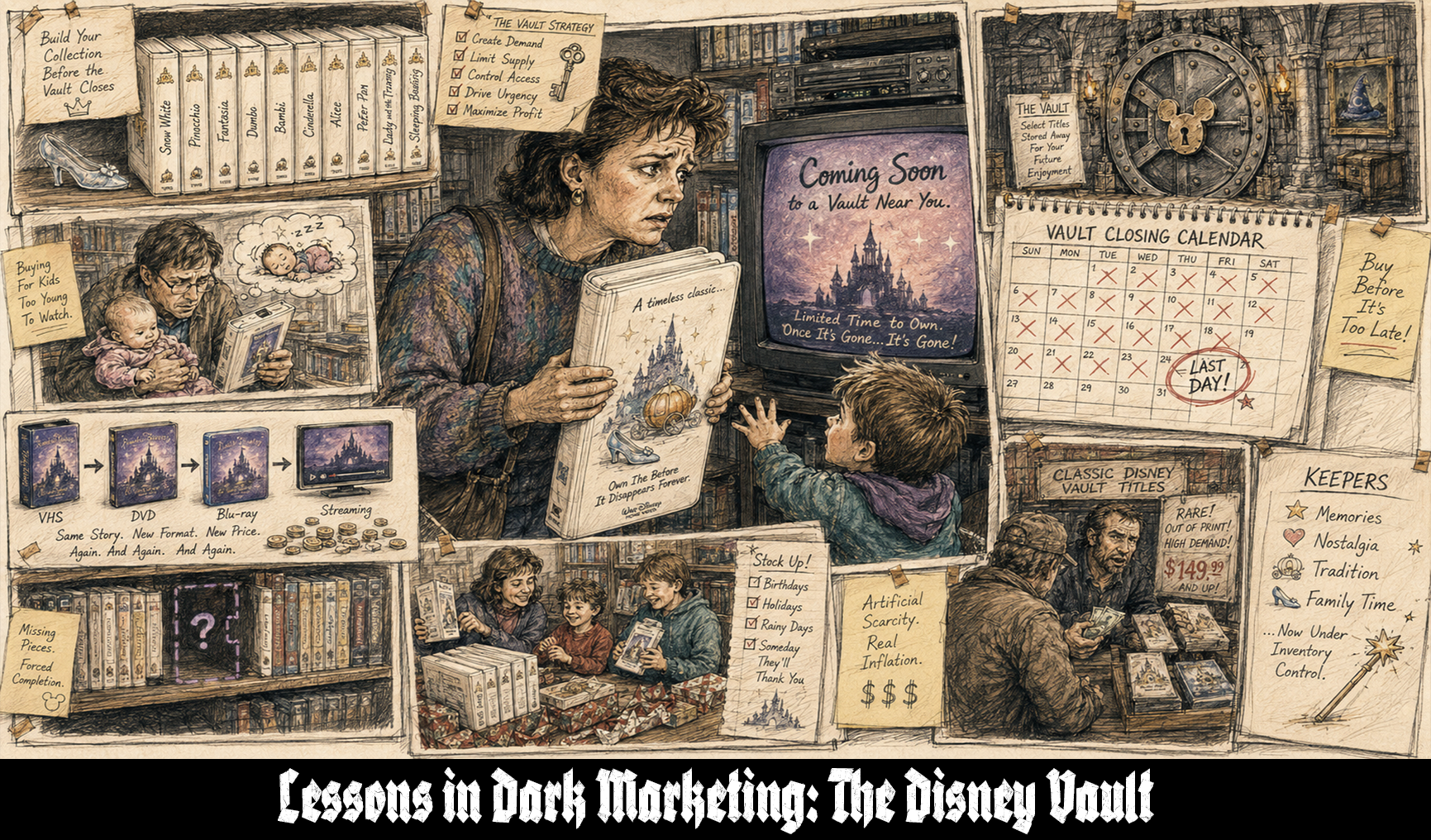
Somewhere in America during March 1991, a parent stood in a video store holding a white plastic clamshell containing The Little Mermaid while a television mounted near the ceiling warned that time was running out.
The child who would watch the movie might have been two years old. She might have been afraid of Ursula, indifferent to musical crabs, or still several months away from sitting through an entire feature without wandering into the kitchen. None of that mattered. Disney had announced that The Little Mermaid and Peter Pan would stop shipping on April 1. Existing copies might remain in stores for a while, but once they disappeared, Disney offered no firm date for their return. A parent waiting for the child to become old enough could discover that Ariel had vanished until elementary school, middle school, or puberty. (Los Angeles Times)
The movie already existed. The tape could be manufactured again. The characters hadn’t retired. The songs hadn’t expired. No animation emergency had forced the mermaid into protective custody. Disney had chosen to stop selling it. That choice became the sales pitch.
The Disney Vault grew from an older theatrical strategy. Disney had reissued Snow White and the Seven Dwarfs in 1944, seven years after its original release, then brought it back again in 1952 and 1958. The studio learned that removing a beloved film and returning it for a new generation could renew attention, ticket sales, and cultural importance. During the home-video era, Disney adapted that cycle into a formal distribution machine. By 1984, the company was placing selected animated classics on sale, withdrawing them, and controlling when families would receive another chance to buy. (Alphaville Journal)
The physical product was a videotape, followed later by a DVD or Blu-ray disc. It contained a movie that had often been completed decades earlier. The machine was the clock.
Disney turned permanent intellectual property into temporary merchandise. It placed familiar stories behind an imaginary door, opened that door for a controlled sales window, and warned parents that failing to purchase immediately could deprive their children of a culturally required childhood experience.
We’re looking at access converted into emergency, not preservation alone. The princess was waiting inside a warehouse. The parent was told the rescue operation had a deadline.
The Vault Gave Inventory Control a Fairy-Tale Name
“Sales moratorium” sounds like distribution policy. “The Disney Vault” sounds like an enchanted chamber beneath a castle where priceless films rest behind a golden door until destiny calls them back into the world.
That naming decision did enormous work. Disney wasn’t discontinuing a product because executives wanted to control supply. The company was returning a classic to the Vault. The language made withdrawal feel ceremonial, protective, and almost inevitable. The movie wasn’t being withheld from customers. It was going home.
The word “vault” also suggested value. Banks use vaults for money. Museums use secured storage for precious objects. Families place important documents in safes. A movie entering a vault must be culturally valuable enough to protect.
That perception allowed scarcity and prestige to strengthen one another. Disney could argue that the film remained special because it wasn’t always available, while the film appeared special because Disney kept removing it.
The metaphor softened the aggression of the strategy. A corporation saying, “We’re deliberately reducing your access so the next release becomes more profitable,” sounds manipulative. A magical narrator announcing that a beloved classic is returning to the Vault sounds like part of the story. The door closed. The orchestral music swelled. The customer received a final opportunity to hand over the money.
This is dark marketing principle number one: Give a restrictive business practice an emotionally flattering name and customers may experience manipulation as tradition.
Disney turned a warehouse schedule into a castle ritual and let Tinker Bell handle public relations.
Theatrical Reissues Taught Disney to Resell Childhood
Disney understood controlled availability long before the VCR entered the living room. The 1944 reissue campaign for Snow White openly celebrated the fact that the film could return years after its original success and generate another major theatrical run. The film reappeared again in the 1950s, reaching children who hadn’t been alive when it premiered in 1937. (Alphaville Journal)
That cycle solved a problem every entertainment company faces. Children age out of the target audience, but new children arrive constantly. Disney didn’t need to convince the same five-year-old to purchase another ticket seven years later. The company could introduce the film to another five-year-old whose parents already recognized the title. Each generation supplied fresh demand while the studio retained the same underlying asset.
Scarcity preserved the theatrical return as an event. A film playing every weekend on television might become familiar background noise. A film unavailable for years could return with restored prints, new advertising, merchandise, press coverage, and the emotional force of a cultural reunion.
Parents played a crucial role. They remembered the movie from their own childhood and brought their children to experience it. The company didn’t have to build trust from the ground up. Family nostalgia performed part of the marketing. The film moved through generations like an heirloom, but Disney controlled the schedule for opening the family jewelry box.
This is dark marketing principle number two: Remove a familiar product long enough for its return to feel like a new event.
Disney discovered that the same poisoned apple could be sold to several generations as long as the basket occasionally disappeared.
Home Video Threatened the Scarcity Machine
The VCR created a dangerous possibility for Disney: permanent household access. Once a family purchased a movie, the studio lost control over when that family watched it. The child could play the tape in January, July, or fourteen consecutive times during a fever. A sibling could inherit it. A cousin could borrow it. A future child could watch the same copy years later.
The family’s schedule had replaced Disney’s schedule. That threatened the old theatrical reissue model. A household owning Cinderella had less reason to wait for a theater to bring Cinderella back. The cassette had moved the archive into the living room.
Disney responded by importing theatrical scarcity into retail. The company began selling selected classics through Walt Disney Home Video during the 1980s while preserving the ability to withdraw major titles from distribution. The medium had changed from film reels to plastic cassettes, but the release cycle survived. (Alphaville Journal)
This was an elegant defensive move. Home video gave customers ownership, while the Vault controlled when ownership could be acquired. Disney accepted the VCR without surrendering the drama of availability. The company could sell millions of copies during one window, remove the title, allow demand to rebuild, and later announce a return. The customer gained the power to watch whenever desired, provided the customer had purchased during the approved corporate season.
This is dark marketing principle number three: When new technology weakens an old control system, rebuild the control system inside the new technology.
The VCR liberated the movie from the theater, and Disney followed it home carrying a padlock.
“Limited Time Only” Turned Browsing Into a Deadline
A parent visiting a video store could normally postpone a purchase. The movie might still be there next month. The child might lose interest. A birthday could provide another occasion. The family might wait for a sale, borrow the tape, rent it, or decide that owning the film wasn’t necessary.
“Limited time only” attacked every one of those options. Delay became risk. Waiting for the child to mature could mean losing the title. Comparing prices could mean returning to an empty shelf. Choosing another gift could mean paying more for a used copy later.
In 1991, Disney stopped shipping The Little Mermaid and Peter Pan after highly successful home-video runs. The Little Mermaid had sold more than 10 million copies, while Peter Pan had sold approximately 7 million. The company still removed both from distribution while preparing The Jungle Book for its first video release. (Los Angeles Times)
Those numbers expose the machinery. The films weren’t disappearing because customers had rejected them. They were disappearing because demand was strong enough to make future absence valuable. The deadline reduced the customer’s freedom to evaluate. Disney didn’t need every parent to decide the movie was worth owning. The company needed enough parents to fear that a later decision wouldn’t be available.
This is dark marketing principle number four: When customers can comfortably postpone a purchase, make postponement feel irreversible.
The tape sat calmly on the shelf while the commercial behaved like the last helicopter leaving Saigon.
The Countdown Commercial Became a Domestic Alarm
Disney didn’t quietly remove titles from distributor catalogs. The company advertised the disappearance. The 1991 campaign was described as “Disappearing Classics,” warning customers that The Little Mermaid and Peter Pan would soon become unavailable. Retailers recognized the advantage immediately: the company could tell families to buy now because the opportunity wouldn’t remain open. (Los Angeles Times)
The commercial transformed ordinary inventory information into drama. The movie appeared in clips. Familiar songs played. A narrator explained that the classic would soon return to the Vault. The advertisement connected beloved characters with a closing window, making the audience feel that the film itself was leaving.
A distribution deadline has no face. Ariel does. Peter Pan does. Cinderella does. Disney placed the emotional character in front of the logistical decision. That distinction mattered because parents weren’t afraid of missing a piece of magnetic tape. They were afraid of losing access to the story their child loved, the movie they remembered, or the experience other families seemed prepared to secure.
Repetition intensified the pressure. Each commercial refreshed the deadline and reminded the parent that inaction continued. The customer could avoid the video aisle and still receive the warning during television programs at home. The ad didn’t need to persuade through new benefits. Everybody already understood the movie. The message concerned time.
This is dark marketing principle number five: Once customers desire the product, stop advertising the product and advertise the closing window.
Disney let the characters sing while the distribution department stood behind them holding a stopwatch.
The Child’s Age Became a Sales Emergency
Disney’s policy exploited one of parenthood’s most reliable anxieties: childhood moves quickly. A child who was too young for a movie during the current release might be old enough before the next one. A child who loved a film today might outgrow it before Disney returned the title. Parents had to purchase around a developmental schedule they couldn’t control.
The 1991 Los Angeles Times coverage put the problem bluntly. Parents waiting for toddlers to grow older could discover that those children reached puberty before the desired classic returned to stores. Disney offered no guaranteed future release date. (Los Angeles Times) That uncertainty turned a general consumer choice into a parental calculation. Buying too early wasted money on a movie the child might ignore. Waiting risked missing the correct age entirely. Disney had placed the parent between premature consumption and future deprivation.
The company’s intellectual property lasted for generations. The customer’s five-year-old lasted for one year. That imbalance gave Disney leverage. The studio could wait. The parent couldn’t. The Vault made childhood feel like a boarding gate. Families were told to secure the movie before the moment passed, even when the product would spend several years untouched beside the television.
This is dark marketing principle number six: Attach the purchase window to a life stage customers can’t recover.
Disney owned the film for decades, but the parent had one kindergarten year and a commercial insisting the clock was already running.
Parents Bought Movies Before Children Could Want Them
The Vault encouraged anticipatory consumption. Parents purchased movies for babies, toddlers, future siblings, visiting grandchildren, and hypothetical family movie nights that hadn’t occurred yet. The sale didn’t require present demand. It required fear about future access.
This is a remarkable commercial arrangement. Most products solve an existing need. Vaulted Disney releases could solve a predicted emotional crisis several years in advance. The parent imagined the future child asking for Cinderella. The parent imagined explaining that the movie had been available once, but the family had failed to act. That scene never needed to happen. The possibility was enough.
Disney had turned the parent into an inventory planner for childhood. The family began stocking cultural experiences the way a cautious household stocks batteries before a storm. One copy of Bambi. One copy of The Jungle Book. One copy of Snow White. Nobody knew exactly when each would be needed, but the Vault had taught parents that availability couldn’t be trusted. The purchase became insurance against future guilt. The tape might remain sealed, forgotten, or ignored. It had still protected the parent from becoming the person who failed to buy the childhood classic during its authorized release window.
This is dark marketing principle number seven: Sell protection against a future emotional failure before the customer knows whether the underlying need will exist.
The toddler couldn’t pronounce “Pinocchio,” but the family had already secured his media estate.
The White Clamshell Made Plastic Feel Like an Heirloom
Disney’s large white VHS cases looked different from the cardboard sleeves surrounding most adult films. The clamshell was durable, oversized, visible, and easy for children to handle. Rows of them created a recognizable family library. The packaging made the collection look permanent even while the advertising insisted that availability was temporary.
That contradiction increased the appeal. The Vault threatened disappearance. The clamshell promised preservation. A parent could place the tape on a shelf and feel that a piece of childhood had been secured against corporate withdrawal. The case looked substantial enough to survive repeated viewing, sibling transfers, spilled juice, and the mysterious brutality children apply to anything with a hinge.
The consistent packaging also turned separate movies into a set. Owning one white case made the next one look related. A shelf containing Beauty and the Beast, Aladdin, and The Lion King visually requested Cinderella, Bambi, and The Little Mermaid.
The collection became part entertainment library and part domestic trophy case. Parents could see which classics they had protected and which remained missing. Wired later described how the giant white clamshells helped define the physical experience of Disney ownership during the Vault era. The cases became cultural artifacts because they were inseparable from the movies, the release windows, and the family rituals built around them. (WIRED)
This is dark marketing principle number eight: Use permanent-looking packaging to make a temporary sales window feel like an opportunity to preserve history.
The clamshell jagoff took up twice the shelf space and made every missing title easier to notice.
“Classic” Was a Status Category Disguised as a Description
Disney didn’t treat every animated film as ordinary inventory. Selected titles became classics, masterpieces, platinum editions, diamond editions, or signature releases. Each label suggested cultural rank. The movie wasn’t one children’s title among hundreds. It belonged to an official canon.
Industry observers defending the limited-release policy argued that continuous availability could turn special films into ordinary merchandise. Scarcity preserved mystique and prevented Disney classics from becoming run-of-the-mill titles. That logic reversed the usual relationship between popularity and access.
A popular film might ordinarily become easier to find. Disney made popularity a reason for controlled absence. The title was too important to sit on shelves indefinitely. The word “classic” also discouraged price comparison. A parent wasn’t evaluating a disposable cartoon. The family was acquiring a work of cultural significance that future generations would supposedly share.
Once the product entered that category, limited availability looked respectful. The company appeared to protect prestige rather than manipulate supply. The designation came from Disney, the scarcity came from Disney, and the premium emotional value came from the interaction between those two choices.
This is dark marketing principle number nine: Declare the product culturally important, then use restricted access as evidence supporting the declaration.
Disney awarded its own movies medals and asked parents to pay before the ceremony ended.
Disney Removed One Hit to Clear the Stage for Another
The Vault didn’t only increase demand for disappearing titles. It organized Disney’s own product calendar. When The Little Mermaid and Peter Pan stopped shipping in 1991, Disney was preparing the first video release of The Jungle Book. Distributors recognized that withdrawing major sellers reduced internal competition and redirected attention toward the incoming title.
This created a rotating spotlight. Disney owned a large library of beloved animated films, but releasing all of them continuously would divide consumer attention and retail space. Parents might buy an older favorite instead of the title receiving the current campaign.
The Vault simplified the choice. A few films appeared. Others vanished. Each return could dominate advertising, store displays, promotional partnerships, and family discussion without competing against every other Disney classic at once.
Artificial scarcity created artificial focus. The company could transform a decades-old film into the season’s Disney event because neighboring classics had been removed from the shelf. A family wanting a Disney movie encountered the title Disney had chosen to make available.
This is category management dressed like magic. The Vault controlled supply across the company’s own catalog and prevented the library from becoming a clearance bin where thirty princesses fought for attention beside the register.
This is dark marketing principle number ten: Restrict your own product range so each remaining item receives concentrated demand.
Disney didn’t let the classics compete in an open market. It scheduled royal audiences one princess at a time.
Absence Made the Return Feel Like a Premiere
When a vaulted movie returned, the campaign could behave as though something new had arrived. The film might be fifty years old. The songs were familiar. The ending hadn’t changed. Scarcity had refreshed the emotional experience.
Snow White and the Seven Dwarfs demonstrated the power of accumulated demand. Before its first major American home-video release in 1994, Disney reported receiving thousands of consumer letters asking for the film. The company projected sales above 20 million units, and sales passed that threshold within the year. (UPI)
That demand hadn’t appeared despite the film’s absence. The absence helped preserve it. Families who had waited years could finally own the movie. Parents who remembered theatrical reissues could bring it home. Collectors could complete a missing space. Retailers could promote a major event without a new film entering production.
The return also validated the Vault mythology. If a film came back with enormous advertising and millions of sales, customers learned that waiting had been risky and buying during the current window was wise. Each successful reopening made the next closure more credible.
This is dark marketing principle number eleven: Use absence to accumulate demand, then present availability as a historic event.
Snow White had been asleep for decades, and Disney woke her with twenty million purchase orders.
The Catalog Generated New Revenue Without a New Movie
The Vault allowed Disney to repeatedly monetize films whose primary production costs had been paid long before the latest release. A new edition still required restoration, mastering, manufacturing, packaging, advertising, and distribution. The company didn’t need to finance a new feature-length animated production every time Cinderella returned.
Disney’s 1999 DVD strategy openly emphasized the value of repackaging and remarketing entertainment assets already completed. The company announced a Platinum Collection of major animated titles that would appear in limited windows and return on long release cycles. (DVD Journal)
This is the financial beauty of a controlled library. A strong catalog can behave like a renewable resource. The company removes a title, lets cultural appetite rebuild, adds a restoration or new format, and sells the same story again.
The Vault supplied pacing. Without the forced absence, another edition might look like routine inventory. After years away, the new release looked necessary. The customer interpreted the transaction through affection and preservation. The company understood it as recurring revenue from an asset already sitting on the ground.
This is dark marketing principle number twelve: Turn existing intellectual property into a recurring event so old production costs can support new sales cycles.
The dwarfs went back to the mine, and the mine turned out to be a home-entertainment division.
The Same Movie Returned Wearing a New Medal
Disney’s editions changed names as home-video formats evolved. The Walt Disney Classics line gave way to the Masterpiece Collection. DVD introduced Platinum Editions. Blu-ray supported Diamond Editions and later Signature releases. Each new label placed another ceremonial ribbon around familiar material.
In 1999, Disney announced that ten major animated films would form a Platinum Collection, beginning with Snow White. These releases would remain available for limited periods and return on long cycles. In 2008, Disney continued using limited windows for Platinum DVD and Blu-ray editions, including Pinocchio, Snow White, Fantasia, and Beauty and the Beast.
The edition name did more than identify packaging. “Platinum” suggested improvement, prestige, and collectibility. “Diamond” suggested greater refinement. “Signature” tied the release to Walt Disney’s legacy. The movie hadn’t become more complete as a story, but the edition hierarchy implied progress.
That allowed the company to sell improvement without replacing the emotional product. Customers already loved the film. The new edition promised that love in a more official container. The labels also made older copies feel superseded. The VHS remained playable, but it lacked the restoration, bonus disc, high-definition transfer, collectible slipcover, or ceremonial title attached to the latest release.
This is dark marketing principle number thirteen: Rename familiar inventory as a higher-status edition and customers may treat repurchase as an upgrade to their relationship with the brand.
The princess wore the same dress, but the box received a promotion.
Bonus Features Made Repurchasing Feel Responsible
Disney didn’t rely entirely on scarcity. Later editions offered real improvements. Platinum and Blu-ray releases included restored pictures, remastered sound, documentaries, archival footage, deleted material, interactive features, games, and other supplements. Disney promoted its 2008 and 2009 releases as limited-time multi-disc packages containing rarely seen footage and new bonus material. (Animation World Network)
Those additions mattered. A parent replacing a VHS with a DVD could claim better quality, easier navigation, supplemental education, and preservation. A collector could justify another copy because the edition contained material unavailable before.
The benefits were genuine. Film restoration can protect aging work. Archival documentaries can preserve production history. Improved transfers can make visual detail and sound accessible to new viewers.
They also supplied moral cover for a highly repetitive transaction. The customer was buying Snow White again, but the purchase could be described as accessing a restoration, acquiring rare footage, moving to high definition, or completing a premium collection. The new features reduced the embarrassment of paying for the same story.
This is dark marketing principle number fourteen: Add authentic improvements to a repeated product so emotional repurchasing can borrow the language of practical upgrading.
The family bought the poisoned apple again because this one came with a making-of documentary.
Format Changes Built a Repurchase Ladder
The home-entertainment industry repeatedly replaced the format beneath Disney’s library. Families moved from VHS to DVD, then to Blu-ray, digital purchases, and streaming. Each transition created a reason to acquire familiar films again.
Disney entered the DVD market during the late 1990s as the format gained credibility, and the company later used major animated releases to promote DVD and Blu-ray adoption. Its participation mattered because Disney controlled many of the best-selling home-video titles. The Lion King alone had sold more than 30 million video copies by the late 1990s. (WIRED) The format transition carried obvious benefits. DVDs didn’t require rewinding. Blu-ray offered higher resolution. Digital delivery reduced shelf space. Streaming allowed immediate access across devices.
The Vault layered urgency onto each improvement. The customer couldn’t always wait until the household completed the transition. The desired Disney title might be available now and gone when the new player finally arrived. Families sometimes purchased around both the release calendar and the technology calendar.
Each format also weakened the old collection. The shelf full of white clamshells remained emotionally valuable but technologically inconvenient. Disney could sell the same library into the same household under a new technical standard.
This is dark marketing principle number fifteen: When technology changes the container, use the customer’s existing affection to sell the content again.
Disney didn’t need a new fairy tale every decade because the electronics industry kept inventing new shelves for the old one.
Ownership Became Protection Against Corporate Withdrawal
The Vault made ownership feel safer than access. A rental could disappear. A television broadcast could be missed. A store could sell out. Disney could stop distributing the movie. The family owning the cassette remained protected.
This turned the purchase into an act of cultural self-defense. The parent wasn’t only buying entertainment. The parent was removing the movie from Disney’s control and placing it inside the household. Once the tape sat under the television, the Vault couldn’t reach into the living room and confiscate it.
That sense of security made ownership emotionally larger than the product. The family could watch whenever it wanted. Children could replay favorite scenes. The tape could become part of holidays, sick days, sleepovers, and ordinary afternoons. The movie entered family memory because access no longer depended on a corporate schedule.
Disney had created the threat and sold the escape route. The company said the title would disappear, then offered ownership as the only reliable protection against disappearance. This is the commercial equivalent of selling umbrellas after scheduling the rain.
This is dark marketing principle number sixteen: Create uncertainty around future access and ownership starts feeling like insurance.
The Vault threatened the family library, then charged admission to the bunker.
The Gift Market Turned Scarcity Into Family Guilt
Disney movies were ideal gifts. Parents, grandparents, aunts, uncles, godparents, and family friends recognized the characters. The films carried wholesome reputations. The clamshell wrapped easily. The recipient didn’t need a particular clothing size or technical skill.
The Vault made the gift decision urgent. A grandparent seeing that Cinderella would disappear could purchase it for a future birthday. A relative could stockpile Bambi before a newborn entered the correct age range. A Christmas shopper could choose the expiring classic because another toy would remain available later.
Scarcity directed generosity. The buyer could feel responsible for preserving the child’s access to a treasured film. Failing to act meant risking a future in which the family wanted the movie and couldn’t obtain it at retail.
The gift also carried emotional authority. A Disney classic looked more meaningful than an ordinary cassette. The Vault had elevated it from entertainment to family heritage. This allowed a planned inventory withdrawal to reach customers who weren’t buying for themselves. Every child was surrounded by adults capable of responding to the deadline.
This is dark marketing principle number seventeen: Attach the scarcity message to a gift-able product and one child’s desire can activate an entire family’s anxiety.
Disney didn’t need the toddler to understand the Vault because Grandma had already seen the commercial.
The Vault Taught Families to Hoard Culture
The rational response to unreliable availability is accumulation. Parents learned to buy titles during the window, even without immediate plans to watch them. Collectors tracked upcoming closures. Families built shelves intended to protect future viewing options.
The Vault trained customers to think like archivists. Each purchase reduced uncertainty. Each missing title created vulnerability. The collection became a map of which stories the family had secured and which remained exposed to Disney’s schedule.
This behavior went beyond ordinary fandom. A customer might buy a movie because it was leaving, not because anybody wanted to watch it that week. The deadline had replaced desire as the trigger.
Hoarding also benefited from the low physical footprint of VHS and DVD compared with many toys. A family could store dozens of movies without dedicating an entire room to them. The collection looked organized, respectable, and educational. The shelf concealed the panic that built it.
This is dark marketing principle number eighteen: When availability is unpredictable, customers may accumulate products to preserve optionality rather than satisfy current demand.
The family room became a private media bunker lined with princesses, woodland animals, and several movies nobody had requested yet.
The Secondary Market Proved the Threat Was Real
When Disney withdrew a title, customers could still search used stores, classifieds, auction sites, and private sellers. The company no longer controlled those copies, but the difficulty and premiums reinforced the original warning. In 2019, reporting on the end of the Vault noted that customers sometimes paid elevated prices for used discs while official editions remained unavailable. (The Verge)
The secondary market functioned as evidence. A parent who had ignored the deadline and later encountered a higher used price learned that Disney’s warning had consequences. A collector seeing unavailable titles online understood why the next limited release should be purchased immediately.
Disney didn’t need every used copy to sell for a fortune. The existence of friction was enough. The secondary market also preserved the mythology of value. A movie unavailable at retail appeared more collectible than one sitting permanently in a discount bin. Scarcity had escaped the company’s distribution system and entered consumer culture.
This is dark marketing principle number nineteen: When restricted supply creates a resale market, the resale market can validate the next scarcity campaign.
The used seller became an unpaid witness for the prosecution, holding a scratched DVD and asking twice the original price.
The Black Diamond Myth Was the Vault’s Afterlife
Years after Disney’s VHS dominance faded, internet stories began claiming that “Black Diamond” editions were worth thousands of dollars. The name referred to a Disney Classics logo appearing on mass-produced tapes from the 1980s and 1990s. Online sellers could list ordinary copies at absurd prices, and careless articles treated asking prices as proof of value.
Fact-checkers found that the sweeping claims were largely false. Most tapes had been produced in enormous quantities, and ordinary sold prices remained far below the fantastic listings circulating online. A seller asking $10,000 doesn’t establish that a buyer paid $10,000. (Snopes) The myth still made emotional sense because Disney had spent decades teaching customers that withdrawn editions became scarce treasures.
The Vault had conditioned people to associate old Disney packaging with controlled rarity. The Black Diamond rumor extended that lesson into resale fantasy. Parents who had purchased tapes as family heirlooms wanted to believe the collection had become financially valuable. Nostalgia and speculation combined inside the same white plastic cases. The tapes were common. The scarcity story remained powerful.
This is dark marketing principle number twenty: A brand that repeatedly associates withdrawal with value can create speculative myths long after the original scarcity ends.
The basement box contained twelve million copies of the same movie, and the internet appointed each one a retirement plan.
The Vault Controlled Which Childhoods Felt Complete
Disney films became cultural checkpoints. Children discussed princesses, villains, songs, sidekicks, deaths, transformations, and happy endings. Birthday parties, toys, costumes, books, theme-park attractions, and school conversations expanded the stories beyond the screen.
The Vault controlled access to part of that shared language. A child whose family owned the film could watch repeatedly and memorize it. A child whose family missed the release might depend on rentals, borrowed copies, television airings, or another household.
That difference gave ownership social value. The cassette wasn’t only a movie. It was participation in a common childhood canon. Missing the purchase could feel like missing a piece of childhood itself.
Disney benefited from the idea that these films belonged in every family. The stronger that cultural expectation became, the more threatening withdrawal felt. The company owned both the stories and the schedule governing their availability.
This is dark marketing principle number twenty-one: Establish the product as part of a normal life experience, then use limited access to make exclusion feel personal.
Disney sold cartoons with the emotional authority of school vaccinations.
Real Preservation Benefits Gave the Vault Moral Cover
Controlled reissues did create legitimate benefits. Theatrical returns introduced old films to children on large screens. Home-video campaigns funded restoration, remastering, archival supplements, and improved editions. Concentrated releases generated enough attention to make decades-old animation culturally visible again.
The 2008 Platinum and Blu-ray announcements included restored films, rare footage, new bonus features, and higher-quality presentation. Some titles had been unavailable for years, allowing the return to receive focused promotion and renewed critical attention.
There’s value in treating important films as events rather than disposable background content.A carefully restored edition can provide a better experience than a neglected copy sitting permanently in a bargain bin. New documentaries can preserve the work of artists and technicians. Parents can use a rerelease to share a meaningful film with children.
Those benefits made the Vault easier to defend. Disney could describe the cycle as a way to keep classics fresh for new generations. The company’s preservation work was real. The marketing pressure built around that work was also real.
The problem arrived when restoration became inseparable from artificial withdrawal. Customers weren’t given the improved edition as one choice among continuing options. The previous access often disappeared first.
This is dark marketing principle number twenty-two: Genuine stewardship can provide moral cover for a distribution system designed to intensify demand.
Disney cleaned the film, polished the crown, and locked both behind the same door.
The Vault Made Nostalgia a Scheduled Corporate Product
Nostalgia feels personal, but Disney industrialized its timing. A parent remembered seeing Bambi or Cinderella during childhood. Years later, Disney brought the movie back as that parent’s child entered the target age. The release appeared to complete a family circle.
The company had engineered the meeting. Intermittent releases allowed Disney characters to remain culturally active across generations. Academic analysis of the Vault describes how these cycles helped present the films as timeless properties returning for successive audiences. (Alphaville Journal)
The parent’s memory became the child’s introduction. The child’s introduction became future nostalgia. Disney could sell the same emotional inheritance again when that child became an adult. Scarcity protected the handoff from feeling ordinary. The film’s return became the special moment when one generation passed a story to another.
The corporation controlled when the family tradition became available for purchase. That is nostalgia marketing at its most efficient. The company doesn’t need to manufacture the memory from nothing. It waits until the customer brings the memory back, then attaches the current price.
This is dark marketing principle number twenty-three: Synchronize product returns with generational turnover and private memory becomes renewable commercial demand.
Disney let families believe they were passing down stories while the release calendar passed around the collection plate.
Disney+ Opened the Vault and Put the Library Behind a Login
In 2019, Disney announced that Disney+ would eventually carry animated films traditionally kept in the Vault. Bob Iger told shareholders that titles previously released every few years would become part of the streaming service. The announcement effectively ended the old home-video Vault as Disney’s primary control system.
The door opened because a new business model needed the contents. Disney+ required a powerful reason for families to subscribe. The company’s catalog offered decades of brand recognition, childhood memory, and parental trust. Films once made valuable through absence could now make the subscription valuable through abundance.
The Vault had spent years teaching customers that access to the complete Disney library was rare. Disney+ offered the cure. This looked like liberation. Families no longer had to wait for a specific VHS, DVD, or Blu-ray cycle. Many classics became available on demand through one service. The transaction had changed. Customers weren’t purchasing individual movies during periodic windows. They were paying for continuing entrance to the library.
This is dark marketing principle number twenty-four: When scarcity stops serving individual sales, convert the withheld catalog into an access benefit for a new revenue model.
Disney opened the castle door after installing a subscription turnstile.
The Vault Didn’t Disappear; It Changed the Lock
Physical ownership and streaming access create different kinds of control. A purchased VHS remains in the household until the tape breaks, the player disappears, or somebody donates the box during a garage clean-out. A streaming movie remains available while the service carries it and the customer maintains access.
The old Vault controlled when a family could buy. The streaming model controls where the family can watch and which subscription provides entry. Disney’s 2019 strategy emphasized exclusivity, using its library as a major advantage for Disney+ and withdrawing important content from competing platforms.
The scarcity moved from the title to the ecosystem. The customer gained convenience and breadth. The company gained a recurring relationship. Instead of waiting several years to sell The Lion King again, Disney could use The Lion King as one reason to keep the household subscribed.
The new system feels less punitive because the individual movie doesn’t announce an expiration date in a television commercial. The access obligation sits quietly in the monthly account. The Vault once said, “Buy this before it disappears.” The platform says, “Keep paying if you want the library to remain available.”
This is dark marketing principle number twenty-five: When customers reject visible scarcity, move the control mechanism into recurring access. The golden door stopped slamming every seven years because Disney had found a quieter lock.
The Case Study Breakdown
- The Vault turned distribution policy into mythology: A corporate sales moratorium became a magical act of preservation.
- Theatrical reissues created the original cycle: Disney learned to resell the same films to successive generations.
- Home video threatened controlled availability: Ownership moved viewing decisions from the studio into the household.
- Disney rebuilt scarcity inside the VHS market: Families could own films only during approved release windows.
- “Limited time only” turned delay into risk: Parents had to purchase before knowing whether the need would continue.
- Countdown advertising made inventory withdrawal dramatic: Familiar characters carried the emotional burden of the deadline.
- Childhood development intensified urgency: The customer’s child could outgrow the correct age before the title returned.
- Parents purchased against future guilt: Movies were bought for children who were too young or hadn’t asked yet.
- White clamshell packaging suggested permanence: The cases transformed temporary access into a visible family archive.
- The word “classic” elevated ordinary inventory: Disney used cultural status to justify controlled availability.
- Rotating titles concentrated demand: Withdrawing one film cleared attention for the next release.
- Absence turned returns into premieres: Old films could reenter the market as major events.
- Catalog titles created recurring revenue: Disney repackaged completed films rather than funding new productions for every campaign.
- Edition names created a hierarchy of repurchase: Masterpiece, Platinum, Diamond, and Signature labels renewed prestige.
- Restoration and bonuses supplied legitimate value: Improved transfers and archival material justified repeated ownership.
- Format changes created a repurchase ladder: Families bought the same stories on VHS, DVD, Blu-ray, digital, and streaming.
- Ownership became access insurance: Buying during the window protected the family from future withdrawal.
- Gift buyers expanded the audience: Scarcity activated grandparents, relatives, and future-oriented parents.
- Unpredictable availability encouraged hoarding: Customers bought to preserve options instead of satisfying current demand.
- The secondary market validated the threat: Used-copy premiums made future deadlines more credible.
- The Black Diamond myth extended scarcity into speculation: Mass-produced tapes acquired imaginary investment value.
- Cultural ubiquity made missing access feel exclusionary: Disney films became expected components of childhood.
- Real preservation benefits protected the strategy: Restoration and generational rediscovery supplied moral credibility.
- Nostalgia became scheduled inventory: Family memory returned according to Disney’s release calendar.
- Disney+ converted scarcity into subscription value: The previously restricted catalog became a reason to join the service.
- The lock moved from titles to platforms: Availability expanded while control shifted into recurring access and exclusivity.
These mechanisms worked because Disney controlled both sides of the emotional transaction. The company created beloved stories, taught families that those stories belonged in childhood, restricted the windows for owning them, and presented each return as an opportunity that responsible parents shouldn’t miss.
The Vault also repaired the weakness of permanent intellectual property. A movie can remain culturally available for generations, which should make urgency difficult. Disney manufactured urgency by making the retail product temporary. The story was timeless. The purchase window wasn’t.
When physical scarcity became incompatible with streaming, Disney changed the transaction instead of abandoning control. The catalog stopped moving in and out of stores and began supporting a platform whose value depended on continued access.
This is dark marketing principle number twenty-six: The strongest scarcity systems control the product, the timing, the cultural meaning, and the method customers must use to protect access.
Disney sold the movie, removed the movie, restored the movie, resold the movie, and eventually rented the whole shelf back to the family.
What Marketers Should Learn From the Disney Vault
The first lesson is that scarcity becomes stronger when it’s attached to a culturally familiar product.
Disney didn’t have to explain why families cared about Cinderella, Peter Pan, or The Little Mermaid. The company could focus the campaign on time because affection had already been established.
The second lesson is that naming determines how customers interpret restriction.
“The Vault” framed withdrawal as protection, tradition, and prestige. A harsh business practice can become emotionally acceptable when the language supplies a flattering story.
The third lesson is that a deadline works best when customers believe the underlying opportunity can’t be reconstructed later.
Disney tied availability to childhood development. Money could be earned again. A particular age couldn’t.
The fourth lesson is that product withdrawal can concentrate attention across a large catalog.
Disney rotated titles rather than allowing every classic to compete continuously. Each selected film received the shelf space, advertising, and cultural focus of a new release.
The fifth lesson is that absence can refresh old inventory. A title available every day can become invisible.
A title returning after several years can be promoted as an event, especially when the customer already understands its importance.
The sixth lesson is that packaging can transform inventory into identity.
Disney’s clamshell cases created a recognizable library whose missing pieces encouraged completion. Consistent design can make separate purchases feel like one collection.
The seventh lesson is that genuine improvement makes repeated transactions more credible.
Restorations, archival footage, documentaries, interactive features, and improved sound gave customers practical reasons to repurchase familiar films.
The eighth lesson is that edition names can create status without changing the emotional core.
Platinum and Diamond labels gave old movies a new ceremonial rank. The upgrade existed partly in the transfer and partly in the customer’s perception of what the edition represented.
The ninth lesson is that future-oriented guilt can reach customers who lack immediate need.
Parents bought Disney films for children who weren’t ready to watch. The sale happened because the family wanted protection from a later regret.
The tenth lesson is that resale friction can strengthen primary-market urgency.
Customers encountering unavailable or expensive used copies become more likely to respect the next official deadline.
The eleventh lesson is that scarcity creates long-term stories about value.
The Black Diamond myth survived because Disney had taught people to view discontinued editions as treasures. Even false speculation can grow from authentic brand conditioning.
The twelfth lesson is that business models can change while the psychological asset remains.
The home-video Vault created demand through absence. Disney+ used the same catalog to sell abundant access through one controlled platform.
This is dark marketing principle number twenty-seven: Build emotional ownership around the content, then remain flexible about whether the customer buys the object, waits for the object, upgrades the object, or subscribes to the archive.
Disney’s medium kept changing, but the family’s fear of losing the magic remained wonderfully compatible.
Final Diagnosis
The Disney Vault belongs in the Lessons in Dark Marketing museum because it transformed a library of permanently existing movies into a recurring series of temporary consumer emergencies.
The films offered genuine artistic, historical, and family value. Disney animation introduced generations of children to memorable characters, music, craft, visual storytelling, and shared cultural experiences. Restorations preserved important work. Home video gave families control over viewing. Streaming later expanded convenience.
The darker achievement was teaching parents that access to timeless stories could vanish because a corporation had decided the sales window was over.
The final diagnosis is waiting in the video aisle:
- Disney gave inventory withdrawal a magical name.
- The Vault made restriction feel like preservation.
- The company adapted theatrical reissue cycles to home video.
- Permanent films became temporary merchandise.
- Limited release windows turned delay into risk.
- Commercials transformed distribution dates into emotional deadlines.
- Parents were pressured by the finite duration of childhood.
- Families purchased movies before children needed them.
- Packaging made the tapes feel like heirlooms.
- “Classic” status justified controlled access.
- Disney removed strong sellers to concentrate demand on the next title.
- Absence turned rereleases into major events.
- Completed films generated recurring revenue through repackaging.
- New edition labels encouraged repeated ownership.
- Restorations and bonus features gave repurchases real utility.
- Format changes allowed the same library to be sold repeatedly.
- Ownership became protection against future withdrawal.
- Gift buyers were recruited through family guilt.
- Uncertain access encouraged cultural stockpiling.
- Secondary-market premiums validated the scarcity warning.
- Black Diamond speculation showed how deeply the rarity story had spread.
- Disney’s cultural dominance made missing a film feel like missing childhood.
- Legitimate preservation work gave the system moral cover.
- Generational nostalgia was synchronized with corporate release schedules.
- Disney+ opened the old Vault to create a new subscription advantage.
- The visible lock disappeared while platform control remained.
- The machine proved that a company can sell access, withdrawal, return, restoration, and renewed access to the same story.
Return to the video store in 1991. The parent is still holding The Little Mermaid. The child may be too young. The family may already have enough movies. The tape may spend two years unopened beside the television. None of those facts can compete with the television mounted near the ceiling.
The commercial says Ariel is leaving. The parent sees a white clamshell. Disney sees a deadline attached to childhood. The child sees a mermaid who will still be singing the same song whenever somebody finally presses play.
The film hasn’t gone anywhere. The master remains in Disney’s possession. More copies could be manufactured. The disappearance exists because the disappearance is profitable. The parent walks to the register.
Years later, the cassette becomes a DVD. The DVD becomes a Blu-ray. The Blu-ray becomes a digital library. The library becomes a subscription. Each version promises better access to the same family memory, and each version places that access inside another system Disney controls.
The Disney Vault never protected the movies from the public. It protected the value of reopening the door.
Leave a Reply