
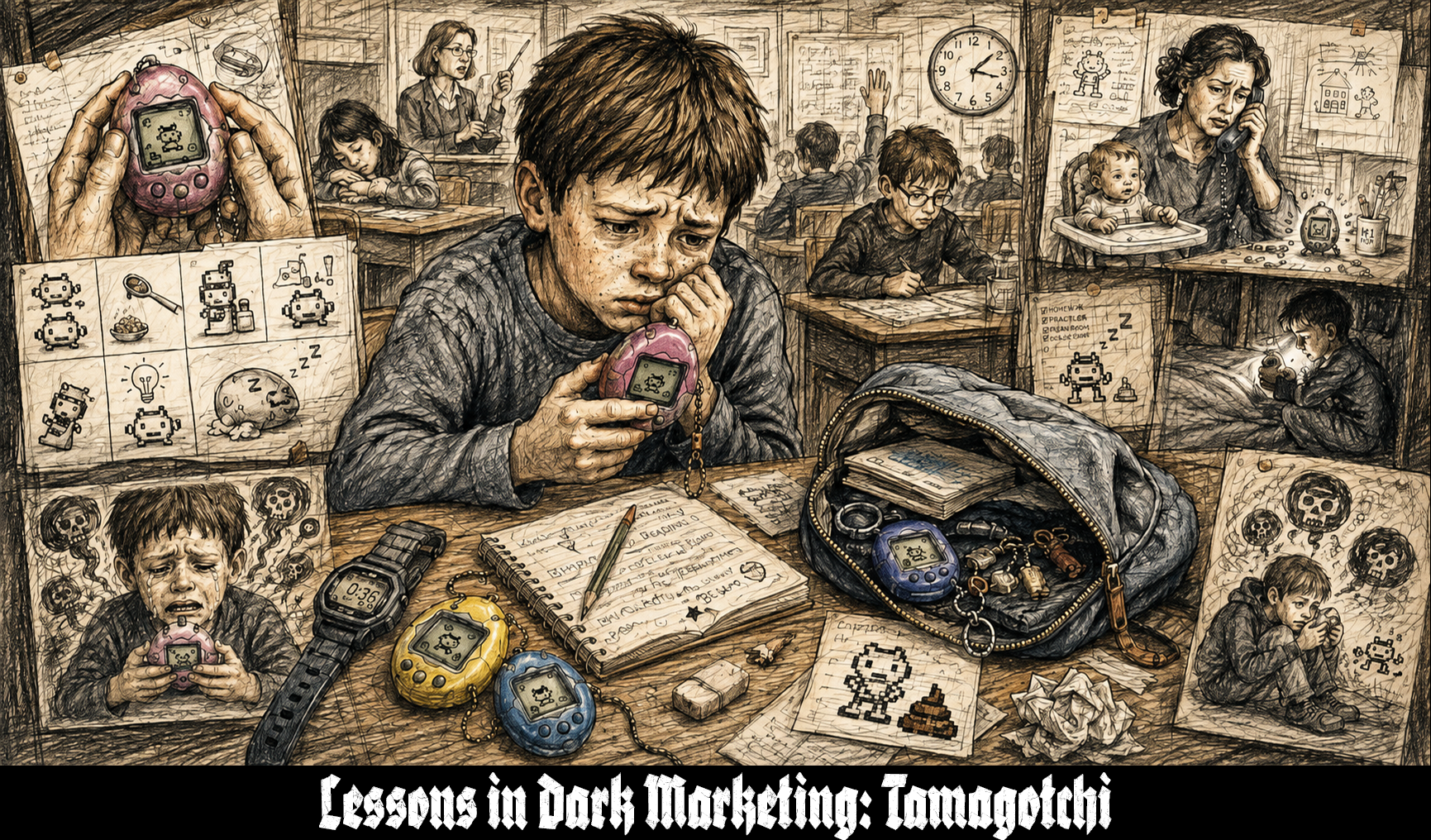
Somewhere in America during 1997, a child sat in math class pretending to understand long division while a plastic egg screamed from inside a backpack. The sound meant something had happened. The creature might be hungry. It might be sick. It might have filled its tiny digital bedroom with another pile of pixelated shit. It might need discipline, entertainment, medicine, or immediate emotional reassurance from a person who still needed permission to use the bathroom.
The teacher kept talking. The child kept staring at the backpack.
Inside that bag, a collection of black pixels had transformed neglect into an emergency. The creature didn’t care that class had started, the bus was late, dinner was ready, the family was leaving for church, or the customer had gone to sleep. Its needs continued on the product’s schedule. The toy had entered the child’s life carrying the one feature most games politely avoided: consequences for looking away.
That was the whole egg-shaped crime scene.
Bandai released the original Tamagotchi in Japan on November 23, 1996. The portable nurturing toy became a major craze among Japanese high-school girls before reaching the United States in May 1997 and spreading internationally. The official Tamagotchi history now reports more than 100 million units shipped worldwide as of July 2025. (たまごっち公式サイト)
The device was simple. A digital creature hatched inside a small egg-shaped case with an LCD screen and three buttons. The owner fed it, played with it, cleaned up after it, gave it medicine, disciplined it, monitored its condition, and watched it develop according to the quality of care. Current reproductions of the original programming still advertise that the creature grows from egg to child to adult, with the owner’s decisions determining which adult appears. (Bandai Namco)
That was the hardware. The machine was something else.
Tamagotchi turned affection into scheduled labor. It converted a cheap electronic toy into a dependent life form by giving it needs, vulnerability, memory, consequences, and the possibility of death. The customer didn’t simply play with the product. The customer became responsible for what happened when the product wasn’t being played with.
We’re looking at guilt converted into an engagement system, not harmless electronic companionship.
The creature lived inside the screen. The obligation lived inside the child.
The Product Didn’t Wait for the Child to Start Playing
Most toys remain inactive until somebody chooses to use them. A doll sits on the shelf. A board game stays in the box. A Game Boy cartridge doesn’t become angry because nobody completed a level during dinner.
Tamagotchi reversed that relationship. Once the egg hatched, the toy’s internal clock continued whether the owner felt like participating or not. Hunger increased. Happiness declined. Waste accumulated. Illness could develop. The creature aged. Its condition changed while the customer attended school, slept, traveled, ate, played outside, or attempted to remember what childhood had felt like before becoming the sole caregiver for a demanding black-and-white kidney bean.
That persistent activity gave the toy unusual authority. Tamagotchi didn’t ask, “Would you like to play?” It announced that something required attention. This distinction changed the emotional status of the product. Choosing to play a game feels recreational. Responding to a dependent creature feels responsible. The child could postpone entertainment without guilt. Postponing care felt like neglect.
The company had placed time inside the merchandise. Once activated, the device converted ordinary hours into opportunities for success or failure. Morning, lunch, afternoon, evening, and bedtime became checkpoints in a care routine.
This was brilliant because it removed one of the greatest weaknesses in toy marketing: the customer’s ability to forget the product exists. Tamagotchi refused to remain forgotten. It beeped. The sound reactivated the relationship. The customer might be reading, talking, studying, eating, or sleeping, but the toy could interrupt and reclaim priority. Attention didn’t need to begin with desire. It could begin with alarm.
This is dark marketing principle number one: When customers can choose when to engage, demand weakens; when the product creates its own schedule, engagement becomes obligation.
Tamagotchi didn’t wait in the toy box for attention. It filed a noise complaint from inside the backpack.
The Beep Turned a Toy Into an Emergency
The Tamagotchi beep was small, repetitive, electronic, and emotionally loaded.
A random sound from an ordinary toy can be ignored. A sound from a dependent creature suggests distress. The customer didn’t hear a machine producing a tone. The customer heard a pet calling for help.
That interpretation gave the beep power far beyond its technical complexity. The device didn’t need speech, animation, expressive eyes, or sophisticated artificial intelligence. A basic sound could trigger concern because the owner had already accepted the relationship.
The alarm also created uncertainty. The child often didn’t know which need had triggered it until checking the screen. Hunger, sickness, unhappiness, discipline, or waste might be waiting. The beep opened a small emotional question that demanded resolution.
This is the same structure used by later notification systems. A sound announces that something has changed. The user feels compelled to inspect the device. The inspection provides information, social reward, anxiety, disappointment, or relief. The cycle can repeat throughout the day without requiring a long session.
Tamagotchi trained this behavior before smartphones turned every adult into a nervous laboratory rat checking whether a rectangle had produced new information.
The product also benefited from the social meaning of interruption. A device that beeps during class, dinner, a meeting, or a movie announces its importance to everyone nearby. The owner must respond because something alive appears to depend on it.
That urgency increased attachment. Each interruption reminded the customer that the creature possessed needs independent of convenience. The burden became evidence that the relationship mattered.
This is dark marketing principle number two: Attach emotional meaning to an alert and interruption starts feeling like responsibility instead of annoyance.
The beep was three cents of electronics wearing the authority of a pediatric emergency.
The Creature’s Helplessness Made the Customer Feel Necessary
Tamagotchi didn’t present itself as a capable digital companion. It arrived helpless. TIt couldn’t feed itself, clean its environment, manage illness, maintain happiness, or survive without intervention. It required the owner to interpret needs and perform care through three tiny buttons.
That helplessness created power. Children spend much of their lives being managed by adults. Parents decide when they wake, where they go, what they eat, how money is spent, when homework happens, and whether a request is reasonable. Tamagotchi reversed the hierarchy. The child became the authority. A creature depended on them.
That feeling carried genuine emotional appeal. The child could provide care, make decisions, solve problems, and watch development unfold. The toy offered a small simulation of adulthood without requiring rent, health insurance, or a conversation with an actual landlord.
The dependence also gave the product moral weight. A child might lose interest in a puzzle, action figure, or ordinary electronic game. Losing interest in Tamagotchi meant abandoning something helpless. The toy made disengagement feel cruel.
That is a powerful retention system because it moves the burden from the company to the customer’s conscience. Bandai didn’t need to persuade the child to continue every day. The creature’s vulnerability handled the argument.
The customer could resent the obligation and still remain engaged because resentment didn’t erase responsibility. In some cases, the burden strengthened the bond. The more effort the child invested, the more meaningful the creature appeared.
This is dark marketing principle number three: Make the product dependent on the customer and continued use can feel like proof of character.
The child didn’t own a plastic egg. The plastic egg had acquired a junior employee who couldn’t legally quit.
Care Was Broken Into Tiny Repetitive Chores
Tamagotchi didn’t require one grand act of devotion. It required many small acts repeated across time. Feed the creature. Play the game. Check its condition. Clean the waste. Give medicine. Adjust discipline. Turn off the light. Return later and do another small thing. Each action was easy. The cumulative obligation was the product.
This structure made engagement sustainable because no individual task looked unreasonable. Feeding the creature took seconds. Cleaning the screen took seconds. Checking happiness took seconds. A parent asking why the child needed to interrupt dinner could be told that it would only take a moment.
The toy occupied life through accumulation. Several seconds became dozens of daily interruptions. Dozens of interruptions became a routine. The routine became attachment. Small tasks also created a continuous sense of participation. The child wasn’t waiting for a distant result. Every button press appeared to contribute to the creature’s survival and development.
That made the product feel responsive. Care produced visible changes. Neglect produced visible consequences. The child’s behavior mattered inside the system.
The chores were intentionally ordinary: feeding, cleaning, medicine, sleep, play, discipline. Those actions borrowed meaning from real care-giving. The kids recognized them as responsible behaviors even though the recipient was a few dozen pixels trapped in novelty plastic.
This gave routine maintenance the emotional dignity of nurturing. The toy didn’t say, “Press the middle button again.” It said the creature needed dinner.
This is dark marketing principle number four: Divide engagement into small acts that feel harmless alone but become habitual through repetition.
Tamagotchi built a full domestic labor schedule out of three buttons and a creature that couldn’t stop shitting on the floor.
Waste Made Neglect Visible
The digital deuce was one of Tamagotchi’s most effective design choices. Hunger and unhappiness can remain abstract. Poop occupies the screen.
The pixel pile showed that time had passed and care had failed. The owner could see the consequence of absence. The creature’s environment looked dirtier because the customer hadn’t responded quickly enough. That visual evidence created urgency and guilt. The toy didn’t need to explain that the owner had fallen behind. The screen displayed the accusation.
Waste also made care feel physical. Cleaning up after a real animal is one of the least glamorous parts of ownership. Tamagotchi reproduced that burden in symbolic form. The child wasn’t only enjoying a cute creature. The child was managing its unpleasant fecal output.
That gave the simulation credibility. A pet that required only affection would feel like entertainment. A pet that created mess imposed responsibility.
The task was absurdly simple. A few button presses removed the waste. The emotional meaning was larger than the action. The owner had restored order, protected health, and resumed competent care-giving.
The mess also served as a record of inattention. If multiple piles appeared, the screen became a crime scene documenting the owner’s absence. The creature had been left alone, and the evidence was waiting. This is how products turn inconvenience into attachment. The unpleasant task makes the relationship feel real because real relationships include unpleasant work.
This is dark marketing principle number five: Give neglect a visible residue and customers will return to erase evidence of their absence.
The digital turd was a status report written by the victim.
The Growth System Turned Care Into a Judgment of the Owner
The Tamagotchi creature didn’t develop randomly. Care affected the result.
Bandai’s original programming allowed the user’s performance to influence which adult form appeared. Feeding, happiness, discipline, and care mistakes shaped development. Modern reissues still emphasize that the owner’s care determines the adult character. (Bandai Namco)
That mechanic transformed the final creature into a judgment.
A desirable adult suggested competence. An undesirable one suggested failure. The creature’s appearance became a report card on the owner’s parenting.
This was more psychologically powerful than a simple score because the outcome looked alive. The customer didn’t receive seventy-two points. The customer received the kind of creature produced by their decisions.
The system encouraged replay. A child dissatisfied with the result could restart and attempt better care. Failure didn’t end the product. It created a new goal.
Different possible adult forms also gave the toy hidden depth. The customer might wonder what other creatures could appear and how behavior affected development. That uncertainty encouraged experimentation, comparison, and repeated raising cycles.
The growth system also supported social discussion. Children could compare which adults they had produced, claim expertise, exchange care theories, and judge one another’s results. The device became a public certificate of private behavior.
The owner’s identity became attached to the creature. A healthy, attractive, long-lived Tamagotchi reflected discipline and attention. A sickly disaster reflected neglect, confusion, or the unavoidable fact that children had school and couldn’t spend all day supervising a needy egg.
This is dark marketing principle number six: Make the product’s outcome reflect the customer’s behavior and performance anxiety will support repeated use.
The creature grew up looking strange, and a nine-year-old suddenly faced a digital custody evaluation.
Death Made Disengagement Feel Like Manslaughter
The most important feature of the original Tamagotchi was that it could die. That possibility changed everything. A game character that loses a life can restart. A Tamagotchi death felt personal because the creature’s condition had developed through the owner’s care. The child didn’t simply lose. The child had failed something dependent.
Every millennial had that one kid in their class that killed their Tamagotchi from neglect, while the American version “softened” the imagery by replacing the Japanese gravestone and ghosts with a smiling angel that flew away. The commercial system retained the consequence while adjusting the visual presentation for American sensitivities.
Death created stakes large enough to preserve attention. Hunger could be postponed. Waste could accumulate. Happiness could fall. The possibility of death gathered every smaller problem into one final threat.
The child knew the creature wasn’t biologically alive. That knowledge didn’t eliminate attachment. People routinely assign emotional significance to representations, characters, photographs, stuffed animals, stories, and digital identities. Tamagotchi intensified that tendency by making the creature responsive to care.
The owner had watched it hatch, fed it, played with it, cleaned its mess, treated illness, and observed growth. Death converted those accumulated interactions into grief and guilt. The threat also made every interruption feel justified. Leaving class, checking during dinner, asking a parent to babysit the device, or waking at night could be framed as preventing death. Few toy mechanics can compete with mortality.
Death served as a central engagement hook in early virtual pets which contrasts with the later free-to-play systems that avoided permanent loss. Dead users can’t continue spending. Tamagotchi came from an earlier commercial philosophy: threaten the relationship so the customer works to preserve it.
This is dark marketing principle number seven: Permanent consequences make routine engagement feel morally urgent.
The creature died, the screen displayed an angel, and the child received a plastic funeral with no bereavement leave.
Restarting Turned Grief Into Another Product Cycle
Tamagotchi death didn’t end ownership. The device could be reset. That transformed loss into retention. The child could grieve, feel guilty, promise to do better, and begin again with another egg. The product converted failure into a fresh care cycle.
This restart mechanism protected the toy from its own harshness. Permanent death created emotional stakes, but permanent product uselessness would have been terrible business. The creature died. The commercial relationship survived.
The new egg also offered redemption. The child could correct earlier mistakes, pay closer attention, produce a better adult, and prove that the previous death had been an unfortunate training incident rather than evidence of unfitness.
That emotional reset is stronger than an ordinary replay button. The customer isn’t repeating the same game only for entertainment. The customer is attempting to repair a moral failure. Each new creature can feel distinct because the owner carries memory from the previous one. The new pet inherits expectations, caution, and guilt. The product becomes more emotionally charged through repeated cycles.
Death and rebirth also allowed the same hardware to produce multiple attachments. Bandai didn’t need to sell a replacement device every time the creature died. The toy generated new emotional inventory internally. The customer could lose one relationship and receive another without leaving the product ecosystem.
This is dark marketing principle number eight: Make failure painful enough to matter but reversible enough to restart the customer.
Tamagotchi offered resurrection through a recessed button and called the resulting guilt customer retention.
The Lack of a Pause Button Made Ordinary Life the Enemy
Tamagotchi’s most manipulative feature may have been what it didn’t provide: a convenient pause. The creature’s needs continued while the owner attended school, visited relatives, traveled, participated in sports, completed homework, or experienced any other obligation created by the outside world. This meant ordinary life could threaten the relationship.
School became dangerous because the creature might need attention during class. Sleep became dangerous because condition could change overnight. Travel required planning. Family activities required negotiation. The product forced itself into decisions that had previously contained no electronic pet-care component.
A pause function would have protected the customer. It also would have weakened the illusion. Real pets can’t be paused. If Tamagotchi could be frozen whenever inconvenient, the owner could treat it as software. The absence of pause supported realism by manufacturing friction.
That friction then became the customer’s problem. Children smuggled devices into school, asked parents to supervise them, checked during lessons, and carried the egg throughout the day. Schools responded with restrictions because the toy’s schedule directly competed with classroom authority. A 1997 Honolulu report described schools reminding students that electronic devices were prohibited and treating Tamagotchi as potential contraband. (Hawaii Archives)
The product had engineered a conflict between care and compliance. A child following school rules risked neglecting the creature. A child caring for the creature risked punishment. That conflict increased emotional investment because sacrifice makes relationships feel important. The more inconvenience the customer endured, the easier it became to believe the object deserved that inconvenience.
This is dark marketing principle number nine: Refuse to accommodate the customer’s schedule and the customer may reorganize life around the product.
Algebra had become the unreasonable obstacle preventing emergency poultry care.
Parents Became Unpaid Tamagotchi Daycare Workers
When children couldn’t care for the device, somebody else had to inherit the obligation. That often meant parents. A child leaving for school could hand the Tamagotchi to a mother, father, grandparent, sibling, babysitter, or other adult with instructions about feeding, cleaning, medicine, sleep, and the catastrophic consequences of incompetence.
The toy spread its labor beyond the buyer. This was commercially useful because family participation reinforced the creature’s legitimacy. An adult who accepted care-giving duties acknowledged that the digital life deserved attention. The product became a shared household responsibility.
Parents might resent the task, but resentment still produced engagement. The adult checked the screen, learned the icons, responded to beeps, and understood why the child cared. The product had gained another user without another sale.
The arrangement also created conflict. A parent who forgot to feed the creature could be blamed for illness or death. The toy inserted itself into family relationships as a dependent whose suffering required an explanation. That blame intensified attachment because the child viewed the creature as vulnerable to adult negligence. The parent might see an irritating digital jagoff on a key-chain. The child saw a life entrusted to somebody who had failed the assignment.
Reports from the original craze described virtual-pet daycare arrangements emerging because owners couldn’t supervise the devices during school or work. The product’s demand for continuity created a small care economy around something that fit inside a pocket.
This was an extraordinary expansion of product reach. A toy purchased for one child began assigning tasks to adults who hadn’t requested access to the game.
This is dark marketing principle number ten: Make continuity dependent on other people and the customer will recruit an unpaid support network.
The parent had a job, bills, groceries, and now visitation rights with an electronic blob.
School Bans Made the Egg Feel Like Contraband
Tamagotchi created the perfect conditions for classroom conflict. It made noise. It required attention. It imposed consequences for neglect. It fit inside a pocket. It could be checked secretly. It competed with teachers for authority over the child’s attention.
Schools responded predictably. Administrators restricted the devices, confiscated them, and reminded students that electronic toys belonged at home. The bans didn’t erase demand. They confirmed the toy’s cultural importance.
A harmless object ignored by adults can remain ordinary. An object prohibited by authority becomes interesting. The ban tells children that the device possesses enough power to disrupt the institution.
That status turns ownership into rebellion. Smuggling the egg into class feels like protecting the creature from unreasonable adults. Checking it beneath a desk becomes both care-giving and defiance.
The controversy also generated free media. News reports explained what Tamagotchi was, why children loved it, why schools hated it, and what happened if the creature was neglected. Every complaint repeated the sales mechanism.
Parents who hadn’t heard of the toy learned that children were desperate to own one. The ban became social proof. Schools across different places were struggling with the same craze, which made the device appear unavoidable.
The product acquired a reputation before many customers encountered it in stores. It wasn’t simply a new toy. It was the toy causing institutional panic.
This is dark marketing principle number eleven: When authority bans the product, the ban can become evidence that the product matters.
The principal confiscated the egg and accidentally promoted it to forbidden fruit.
Scarcity Made Care-taking Feel Like a Privilege
Tamagotchi demand quickly outpaced supply during the original craze. In Japan, the device became a major social phenomenon. Bandai had sold several million units in Japan before the American launch, while customers lined up early in San Francisco when the product reached the United States.
Scarcity changed the emotional meaning of ownership. A demanding product might ordinarily appear inconvenient. A demanding product that’s difficult to obtain feels valuable. The customer becomes grateful for the burden because other people still want access to it.
This is one of scarcity’s strangest effects. It can make work feel like privilege. Feeding, cleaning, checking, and supervising the creature might become irritating, but surrendering the device would mean giving up something culturally scarce. The owner could complain while continuing to protect the object.
Scarcity also accelerated word of mouth. Sold-out stores, waiting lists, import demand, and frustrated shoppers created evidence that Tamagotchi was worth pursuing. Customers interpreted limited supply as validation.
The egg-shaped shell helped make ownership visible. It hung from key-chains, backpacks, bags, belts, and pockets. The customer didn’t need to explain that they had obtained the scarce product. The device advertised itself in public.
Different shell colors and designs added another layer. A child might own a Tamagotchi and still prefer a different version. The care-giving experience remained similar while the exterior allowed identity and collectibility to enter the purchase.
Scarcity secured the first sale. Variation created reasons to consider another.
This is dark marketing principle number twelve: When the burden is scarce, customers can mistake the privilege of ownership for proof that the burden is worthwhile.
The child had fought to obtain a full-time unpaid job and wore it proudly on a key-chain.
The Egg Shape Made Technology Look Harmless
Tamagotchi’s shell wasn’t designed like serious electronics. It was small, rounded, colorful, and egg-shaped. The form communicated birth, vulnerability, portability, and playfulness before the screen activated. That mattered because the device asked for unusual emotional commitment. A rectangular black gadget might have looked mechanical. The egg looked biological.
The shape prepared the customer for hatching. The creature didn’t simply turn on. It emerged. That beginning strengthened the illusion of life. The customer watched the egg stage, waited for the creature, and experienced arrival rather than setup. The product’s boot sequence became birth. The three-button interface also reduced intimidation. Children didn’t need technical skill. The device felt accessible, and the limited controls encouraged experimentation.
The shell functioned as both nursery and body. The customer carried the entire world of the creature in one object. Screen, home, hospital, bedroom, playground, and graveyard occupied the same plastic egg.
Portability increased intimacy. The toy stayed near the body. It could be held, checked, protected, concealed, and carried into private spaces. Physical closeness supported emotional closeness.
The egg also became an instantly recognizable silhouette. Competitors could imitate the digital-pet concept, but Tamagotchi owned the cultural image of the small electronic egg with three buttons.
That visual identity allowed the product to remain recognizable decades later, even as newer models added communication, color screens, wearable designs, and connected features. Bandai has continued selling reproductions built around the original shell and programming.
This is dark marketing principle number thirteen: Make the hardware symbolize the emotional promise before the customer presses a button.
The plastic looked like an egg, so the user supplied the miracle of birth.
The Character’s Simplicity Forced the Customer to Supply the Personality
The original Tamagotchi creatures were graphically primitive. The small LCD screen offered limited animation and expression. The creature couldn’t hold a conversation, remember detailed interactions, or demonstrate anything resembling sophisticated intelligence.
That limitation helped. Sparse information invites projection. The customer interprets the pixels, assigns personality, imagines feelings, and explains behavior. The creature becomes richer inside the owner’s mind than the hardware could have produced.
A detailed character might tell the user exactly who it is. A simple character leaves room for attachment. The child could decide that the creature was happy, stubborn, sick, lonely, needy, funny, or misunderstood. Small changes in animation carried emotional weight because the customer had learned to read them.
This is similar to how people attach emotion to simple faces, stuffed animals, puppets, and icons. The mind completes what the object only suggests. Tamagotchi’s official mythology still describes the characters as strange, adorable life forms that need care, grow attached to humans, eat, play, and make messes. The brand provides enough narrative to support affection without over-explaining the creature.
That emotional openness made every owner’s relationship feel personal. The same programming could support thousands of individual stories because customers supplied interpretation. The product didn’t need expensive artificial intelligence. It needed a hungry pixel and a child willing to believe the hunger meant something.
This is dark marketing principle number fourteen: When customers project personality onto a simple product, they perform the emotional labor that makes it feel alive.
Bandai supplied the pixels. The child wrote the soul.
Discipline Made Control Look Like Care
Tamagotchi wasn’t only about feeding and affection. The owner also had to discipline the creature. That mechanic complicated the relationship. Good care required denying demands, correcting behavior, and deciding when the creature needed firmness rather than comfort.
The child wasn’t simply a friend. The child became a parent. Discipline increased involvement because it required interpretation. Was the creature genuinely hungry? Was it seeking attention? Had it behaved badly? Which response would produce the best development?
These decisions gave the game moral texture. The owner couldn’t succeed through endless indulgence. Care became a balance of nurturing and control. That balance reflected familiar adult language about parenting. Children had heard that rules existed for their own good. Tamagotchi allowed them to occupy the other side of that argument. A child could now impose structure on a smaller dependent creature. The toy transformed authority into play.
Discipline also made unsuccessful outcomes easier to personalize. If the creature developed poorly, the owner might wonder whether they had been too strict, too permissive, inattentive, or inconsistent. That uncertainty supported replay. The next creature offered another opportunity to discover the correct parenting formula.
The system never needed to produce a single obvious answer. Confusion kept the customer engaged, comparing results, seeking advice, and experimenting.
This is dark marketing principle number fifteen: Give the customer authority over a dependent product and control will deepen emotional investment.
The child who couldn’t negotiate bedtime had become the household’s leading expert on developmental discipline.
The Toy Taught Children to Confuse Anxiety With Love
Tamagotchi attachment was built around vigilance. The customer checked because something might be wrong. The beep created urgency. The possibility of sickness created fear. The possibility of death created guilt. The lack of pause created pressure. The child could interpret this anxiety as affection. That confusion is commercially powerful. If worrying about the product feels like proof of love, then relief from worry requires continued engagement.
The child checks the screen and discovers the creature is fine. That relief rewards the checking behavior. Later, uncertainty returns. The customer checks again. This creates a loop in which anxiety generates action and action temporarily reduces anxiety.
Tamagotchi didn’t invent this pattern. Human relationships already contain concern, responsibility, and fear of loss. The toy distilled those emotions into a controlled system that could be carried in a pocket.
The product’s demands were simple enough to manage but serious enough to matter. That balance kept the owner inside a low-grade state of responsibility. The child might complain that the toy was annoying. The child might also panic when the battery weakened, the device disappeared, or someone else mishandled it. Burden and attachment reinforced one another.
The more attention the product demanded, the more significant it appeared. People don’t usually reorganize their day around objects that don’t matter. Once the child had done so, the effort itself became evidence that the creature deserved devotion.
This is dark marketing principle number sixteen: Create manageable anxiety around the product and customers may interpret the resulting vigilance as attachment.
The child called it love because “persistent low-level electronic panic” wouldn’t fit on the packaging.
The Legitimate Benefits Gave the Guilt Machine Moral Cover
Tamagotchi offered real value. It taught routine, cause and effect, planning, observation, patience, and responsibility. Children saw that neglect produced consequences and consistent care produced better development. The device could encourage empathy toward a vulnerable creature, even when that creature existed only as a simulation.
The toy also offered companionship. A child could carry it through school, travel, loneliness, boredom, and periods when a real pet wasn’t possible. Families living in apartments, households dealing with allergies, or parents unwilling to assume responsibility for an animal could offer a digital alternative.
The cost and risk were far lower than those of real pet ownership. The creature didn’t bite, damage furniture, require veterinary care, trigger allergies, or leave physical waste on a carpet. When the child lost interest, nobody needed to find a new home for an actual animal.
Those benefits made Tamagotchi easier to defend. Parents could frame the toy as training for responsibility. The child could demonstrate care, routine, and patience. The product had more substance than an ordinary electronic distraction.
The darker machinery used those benefits as cover. Responsibility became compulsion when the toy interrupted school and sleep. Empathy became guilt when the creature’s death felt like a moral failure. Routine became dependency when the customer couldn’t step away without consequences.
The legitimate lesson was that care matters. The commercial lesson was that a product demanding constant attention can call that demand character building.
This is dark marketing principle number seventeen: A product’s genuine developmental value can provide moral protection for a retention system built around pressure.
The toy taught responsibility, and the company generously defined responsibility as checking its product all day.
New Species Turned One Dependent Into a Product Line
A single Tamagotchi could generate repeated care cycles, but Bandai didn’t stop with one device. New versions introduced different creatures, themes, features, designs, and ways to interact. The official history lists a rapid series of releases following the original, including new species, angel-themed versions, and later models that expanded the concept. In 2004, Tamagotchi returned with infrared communication, allowing devices to connect and creating new social functions.
This transformed the product from one digital pet into a platform. A customer who had already experienced the original could be sold a different care-giving environment. The emotional structure remained familiar while the characters and features changed.
The company could renew demand without rebuilding the category. Customers already understood hatching, feeding, cleaning, development, and attachment. New models offered another creature worthy of care.
Communication features expanded the social machine. Devices could interact, which gave ownership value beyond private nurturing. Friends could connect pets, compare progress, and participate together.
That social compatibility also created pressure. A child whose friends had newer versions risked exclusion from current features. The old device might still function, but the social environment had moved forward.
Shell designs, collaborations, themed editions, and character crossovers added collectibility around the care-giving experience. Customers could want a model because of the creature, exterior design, brand partnership, or nostalgia. The product line learned how to sell both attachment and variation. The customer didn’t have to abandon the emotional relationship. The customer could acquire another dependent.
This is dark marketing principle number eighteen: Once customers learn the ritual, change the character and sell the obligation again.
The first digital pet died, and the product catalog arrived with several available replacements.
Nostalgia Brought the Neglected Creature Back to Life
Tamagotchi was built around rebirth, so the brand’s own revival was almost too appropriate. Bandai reintroduced the franchise in 2004, continued producing new generations, and later released reproductions of the original devices with familiar programming and shell designs. The brand now markets simultaneously to children and adults who remember the first craze. Bandai-Namco describes Tamagotchi as an intellectual property supported by two generations: parents and their children.
Nostalgia changed the sales pitch. Adults weren’t buying only a virtual pet. They were buying a memory of 1997: school backpacks, mall stores, translucent plastic, playground contraband, dial-up internet, and the distant historical period when the most demanding device in the house contained three buttons.
The old obligation returned looking simple compared with modern digital life. A Tamagotchi beeped because one creature needed food. A smartphone produces messages, work requests, breaking news, financial alerts, social judgments, advertisements, calendar demands, and notifications from an application that wants to explain why another application has sent a notification.
The primitive burden gained innocence through comparison. Adults could purchase the device as a collectible, fashion accessory, emotional artifact, or gift. They could revisit the care ritual with more patience, better scheduling, and enough disposable income to buy several shell designs.
The brand’s current scale demonstrates the durability of that relationship. Official figures surpassed 100 million units shipped worldwide by July 2025, and Bandai continued expanding the line with products such as Tamagotchi Paradise. Nostalgia allowed customers to remember the attachment while softening the guilt, inconvenience, and school-day panic. The emotional burden became charming because adulthood had supplied larger burdens.
This is dark marketing principle number nineteen: When an old compulsion becomes nostalgia, customers remember the affection and repurchase the machinery.
The digital pet came back because apparently adulthood hadn’t assigned enough things that could die without proper attention.
Modern Tamagotchi Added Connectivity Without Removing Dependency
The original Tamagotchi needed only a screen, buttons, clock, and battery. Later models added communication, wearable designs, color displays, downloadable content, and connected worlds. The technology evolved. The core relationship remained.
Bandai’s official history notes the 2004 return with infrared communication and later generations that introduced new forms of interaction. The 2021 Tamagotchi Smart brought the franchise into wearable form, while newer products continued expanding features and connectivity.
These additions increased the number of ways the customer could remain involved. The creature could interact socially, access new content, participate in broader digital environments, and occupy a device worn close to the body. The original product attached itself to the customer through guilt. Modern versions can add novelty, customization, social connection, updates, and ecosystem participation.
That expansion reflects a broader change in digital products. Early electronic toys were self-contained. Modern devices can become services with ongoing content, updates, events, and compatible products. The care-giving premise provides emotional continuity across those systems. New technology doesn’t feel like an unrelated feature package. It appears to enrich the life of the creature.
That framing can make platform expansion feel benevolent. The company isn’t adding another retention feature. It’s giving the customer more ways to care, connect, explore, and personalize. The same basic dependency can support increasingly sophisticated commercial structures because the creature remains the emotional intermediary.
This is dark marketing principle number twenty: Hide platform expansion inside the continuing life of a character customers already feel responsible for.
The egg learned to connect to the network, and the customer’s guilt received a software update.
The Case Study Breakdown
- The creature continued living outside active play: The product created its own schedule instead of waiting for the customer.
- The beep turned interruption into emergency: A simple alert acquired emotional authority through the pet relationship.
- Helplessness made the customer feel necessary: The creature’s dependence transformed engagement into responsibility.
- Care was divided into small chores: Feeding, cleaning, medicine, play, and discipline built routine through repetition.
- Waste made neglect visible: Digital mess documented absence and demanded corrective action.
- Growth judged the owner’s performance: The adult form reflected the quality of care and encouraged replay.
- Death created emotional stakes: Neglect could produce a permanent consequence inside the current care cycle.
- Restarting converted guilt into retention: Loss led directly into another egg and another attempt at redemption.
- The lack of pause made life compete with the product: School, sleep, travel, and family obligations threatened the creature.
- Parents became unpaid caregivers: The child recruited others to maintain the product’s continuity.
- School bans increased cultural importance: Confiscation and prohibition made the device feel powerful and rebellious.
- Scarcity made the burden desirable: Limited access turned constant care into a privilege of ownership.
- The egg-shaped shell communicated life: The hardware symbolized birth, vulnerability, and portability.
- Simple graphics invited projection: Customers supplied personality and emotional depth the technology couldn’t produce.
- Discipline gave the owner authority: Care involved control, judgment, and developmental responsibility.
- Anxiety became evidence of attachment: Constant checking felt like proof that the creature mattered.
- Real benefits supplied moral cover: Responsibility, routine, empathy, and companionship defended the pressure system.
- New versions resold the care ritual: Different species, shells, and features expanded one dependent into a product line.
- Nostalgia recovered the adult customer: Millennials repurchased childhood attachment through memory and collectibility.
- Connectivity expanded the ecosystem: New technology added engagement without removing the original dependency.
These mechanisms worked because every demand strengthened the illusion of life. The beep created urgency. The chores created routine. The routine created investment. Investment made death painful. Death made the next attempt feel redemptive. The lack of pause forced the creature into everyday life, and that inconvenience made the relationship feel more serious.
Tamagotchi also understood that attachment grows through labor. The customer cared because the customer had performed care. Every feeding, cleanup, game, medicine dose, and midnight check became another small investment in the creature’s survival. The product didn’t need advanced artificial intelligence. It needed a clock, a few changing conditions, visible consequences, and a customer willing to interpret obligation as affection.
This is dark marketing principle number twenty-one: When a product can make customers work for the relationship, the work itself becomes evidence that the relationship matters.
Tamagotchi sold a pet, assigned the customer a shift, and let exhaustion finish the bonding process.
What Marketers Should Learn From Tamagotchi
The first lesson is that time can become part of the product.
Tamagotchi continued changing outside active sessions, which made the device feel alive and gave customers reasons to return throughout the day. Products with evolving states, schedules, streaks, appointments, maintenance needs, or time-sensitive rewards can create stronger routines than products waiting passively for use.
The second lesson is that alerts become powerful when they carry emotional meaning.
The Tamagotchi beep wasn’t important because of its sound. It was important because the customer believed something vulnerable needed attention. Marketers should understand that notification strength comes from the relationship surrounding the alert, not the volume of the tone.
The third lesson is that small repeated tasks can build greater attachment than occasional large interactions.
Feeding and cleaning were simple, but their frequency made the creature part of daily life. Habit can be constructed through many low-friction actions that create a continuous sense of responsibility.
The fourth lesson is that customers become attached to outcomes reflecting their behavior.
Tamagotchi development served as a judgment of care. Products that visibly respond to customer effort can create pride, anxiety, experimentation, and replay.
The fifth lesson is that consequences make attention feel meaningful.
Death gave the care routine stakes. Modern marketers should handle this carefully because fear of loss can support engagement while also creating unhealthy pressure. The mechanism works precisely because customers don’t experience the consequence as trivial.
The sixth lesson is that a product can recruit an entire household when continuity requires help.
Parents caring for Tamagotchi during school became secondary users. Shared responsibility can expand product reach, but forced participation can also create resentment.
The seventh lesson is that simple design can invite greater emotional projection than excessive detail.
Tamagotchi offered limited graphics and behavior, leaving customers to imagine personality. A product doesn’t need to explain everything when the customer enjoys completing the story.
The eighth lesson is that genuine utility strengthens emotional marketing.
Tamagotchi taught routine, empathy, and cause and effect. Those benefits made the toy durable and credible. They also protected a system built around interruption, guilt, and fear of loss.
The ninth lesson is that a strong ritual can support multiple generations of products.
Hatching, feeding, cleaning, development, and death remained recognizable even as Bandai added communication, wearables, color screens, and connected features.
The tenth lesson is that nostalgia can reverse the meaning of inconvenience.
What felt stressful in childhood can feel charming in adulthood because memory preserves the emotional relationship while reducing the original pressure. Brands with demanding legacy products can recover customers by selling familiarity, simplicity, and personal history.
This is dark marketing principle number twenty-two: Create a ritual simple enough to remember, emotional enough to matter, and flexible enough to survive new technology.
Tamagotchi began with three buttons and discovered that guilt has excellent backward compatibility.
Final Diagnosis
Tamagotchi belongs in the Lessons in Dark Marketing museum because it transformed a cheap electronic toy into a dependent relationship and then made the customer responsible for maintaining the illusion.
The product offered real benefits. It encouraged routine, planning, empathy, observation, patience, and responsibility. It provided companionship to children who couldn’t own real pets. It turned limited technology into an emotionally convincing experience through elegant design.
The darker achievement was making attention feel morally compulsory.
The final diagnosis is beeping inside the backpack:
- Tamagotchi continued demanding care when the customer stopped playing.
- Its alerts turned ordinary interruptions into emotional emergencies.
- The creature’s helplessness made the customer feel necessary.
- Repetitive chores built habit through small acts of care.
- Digital waste made neglect visible.
- Development turned the creature into a judgment of the owner.
- Death made disengagement feel like personal failure.
- Restarting converted grief into another care cycle.
- The lack of pause forced the product into school, sleep, travel, and family life.
- Parents and other adults became unpaid support staff.
- School bans made the device feel dangerous and culturally important.
- Scarcity made ownership feel privileged.
- The egg-shaped shell made technology look vulnerable and alive.
- Simple graphics encouraged customers to invent personality.
- Discipline gave children a simulation of parental authority.
- Anxiety was confused with affection.
- Legitimate educational benefits protected the pressure system.
- New creatures and devices resold the caregiving ritual.
- Nostalgia brought Millennials back as adult customers.
- Connected features expanded the ecosystem without removing dependency.
- The product proved that customers can become attached to something because it inconveniences them.
That is why Tamagotchi belongs beside Pokémon cards, The Clapper, Chia Pets, Life Alert, Tupperware, collector plates, diet programs, cigarette campaigns, and every product that transformed an ordinary human vulnerability into a repeatable commercial system.
The child in math class still hasn’t heard the lesson. The teacher is explaining division. The backpack beeps again. The child knows the creature isn’t biologically alive. The child also knows that hunger is increasing, happiness may be falling, waste may be accumulating, and failure will eventually appear on the screen as illness, an angel, or another accusation written in pixels.
The teacher sees a distraction. The child sees a dependent life. Bandai sees engagement.
That tiny plastic egg didn’t contain a pet. It contained a schedule, an alarm system, a guilt mechanism, a developmental report card, a funeral, and a reset button capable of putting the customer back to work. The creature needed food. The creature needed medicine. The creature needed discipline. The creature needed attention during school, dinner, sleep, travel, and every other part of childhood that had previously escaped electronic supervision.
The child thought the responsibility proved the pet was real. The machine knew the responsibility was what kept the product alive.
Leave a Reply