
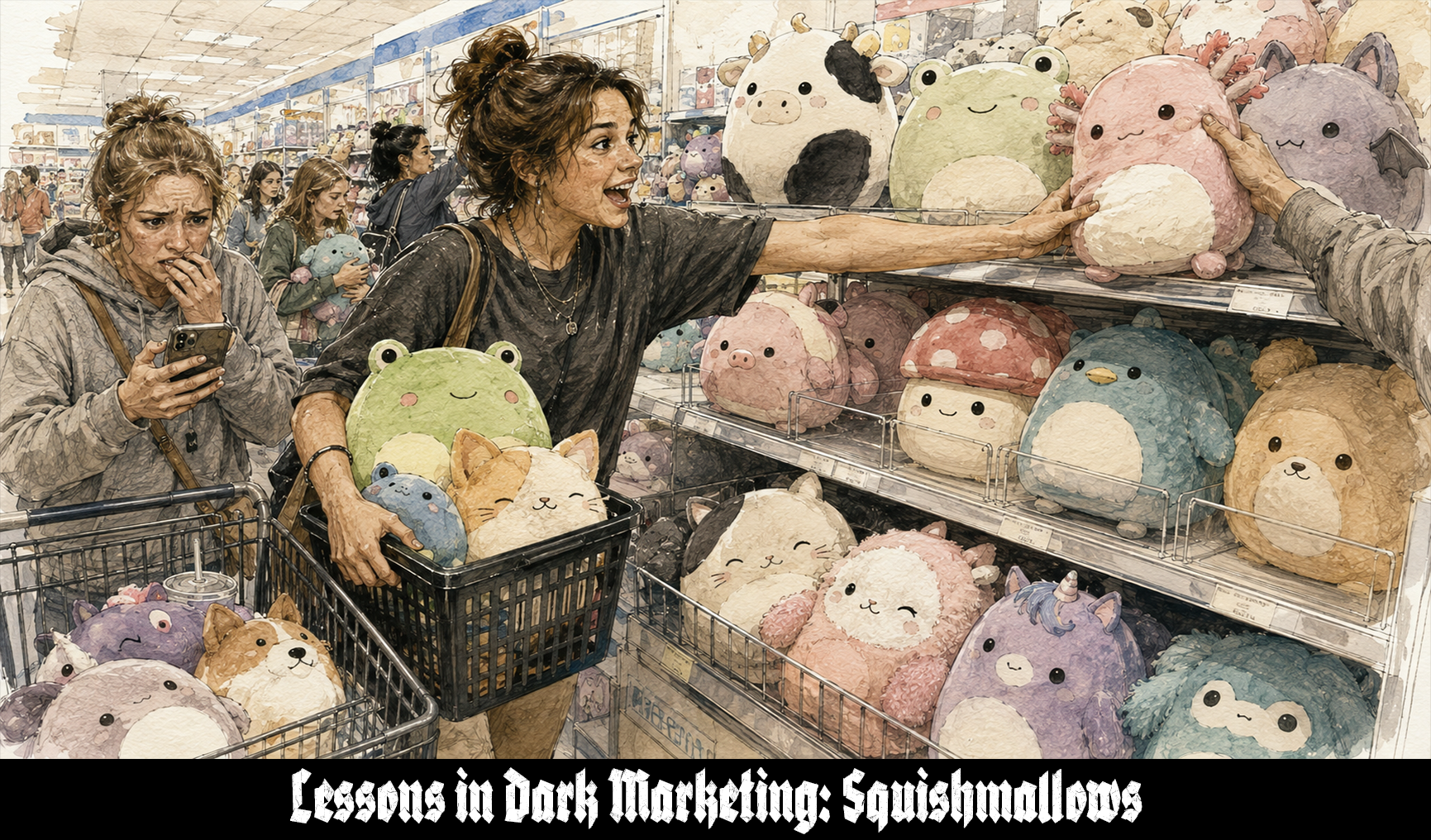
Somewhere around 2021, a grown adult walked into a Walgreens looking for a cow. They weren’t there for cold medicine, batteries, toothpaste, allergy pills, or one of the seventeen other things a person usually remembers they need only after entering a Walgreens. They were looking for one particular round polyester cow because somebody online had posted that this location might have received a shipment, another collector had already checked Target, and there was a developing concern that a reseller would reach the shelf first.
The cow had a name, and that was the important part. The customer wasn’t looking for a stuffed cow any more than somebody hunting a particular Pokémon card is looking for a piece of cardboard. They wanted Connor, and the fact that several perfectly soft animals were sitting ten inches away did absolutely nothing to solve the problem because those animals had committed the commercial offense of being somebody else.
That is when you know a stuffed-animal company has accomplished something remarkable. Squishmallows took one of the oldest, safest, least threatening consumer products imaginable and built around it a modern collecting machine powered by comfort, personality, identity, scarcity, retailer exclusives, social media, resale markets, adult disposable income, licensed nostalgia, and thousands of customers voluntarily reporting store inventory to one another.
The basic product could hardly look less dangerous. A Squishmallow is a rounded plush object with an extremely soft exterior, compressible filling, a simplified embroidered face, minimal limbs or appendages, and a hangtag introducing the character. There are no screens, batteries, subscriptions, charging cables, loot boxes, premium currencies, or terms of service requiring an attorney and a free afternoon.
Squishmallows launched in 2017 through Kellytoy and grew from a relatively small assortment into an enormous character universe. Designer Sunny Cho developed the rounded form after working with an unusually soft, stretchy fabric and drawing inspiration from Japanese plush aesthetics, while names and biographies gave the characters identities from the beginning. By early 2020, Kellytoy announced that more than 50 million Squishmallows had been sold, meaning the phenomenon already had serious commercial momentum before the pandemic arrived. Jazwares: 50 Million Squishmallows Sold
Jazwares acquired a majority stake in Kellytoy in April 2020, just as the cultural environment surrounding comfort products was about to change dramatically. By January 2021, Kellytoy said more than 71 million Squishmallows had been sold and Squishmallows-related social content had generated more than 529 million organic video views, while the assortment was expanding toward hundreds of individual characters. Kellytoy 2021 Squishmallows Announcement
The pandemic accelerated the machine because Squishmallows happened to be very good at providing something people suddenly valued more intensely: uncomplicated physical comfort. Children lost normal routines, teenagers spent longer periods isolated from friends, college life migrated into bedrooms, adults dealt with stress and uncertainty, and millions of people got enough screen exposure to make an object whose primary feature was “soft” look like advanced civilization.
None of that requires pretending Squishmallows are bad products. They’re genuinely pleasant to touch, affordable at many entry points, visually friendly, useful as pillows or decoration, easy to give as gifts, and capable of providing exactly the kind of low-stakes comfort customers say they receive from them. The legitimate benefit is part of what makes the commercial system so interesting because dark marketing becomes much harder to recognize when the customer has something completely real to defend.
The product was a soft stuffed animal with a name and personality, while the machine was something considerably larger. Comfort became a reason to collect, personalities prevented substitution, scarcity made patience dangerous, retailer fragmentation turned ordinary errands into hunts, and social media gave customers a reason to display the consequences of all that purchasing to everybody else. We’re looking at a pillow that learned the economics of Pokémon cards, and that is the case study.
Softness Wasn’t a Feature. It Was the Sales Demonstration.
Plush toys existed long before Squishmallows, so Kellytoy couldn’t build the category around the revolutionary discovery that children enjoy touching soft animals. Teddy bears had completed that market research before most modern toy executives were born. What Squishmallows needed was a physical distinction customers could understand immediately.
The stretchy outer material and unusually compressible filling created exactly that kind of difference. The product could be squeezed, collapsed, hugged, leaned against, and then recover its rounded form, making the tactile experience recognizable before the customer knew anything about the character, biography, rarity, or larger brand universe.
That is extraordinarily efficient marketing because the customer verifies the claim without trusting the company. Advertising can say something is soft, but a hand can determine whether that statement is bullshit in approximately two seconds, which means the shopper becomes both audience and product tester.
The same tactile quality widened the product’s possible uses. A Squishmallow could be purchased as a child’s toy, dorm-room decoration, couch pillow, travel companion, comfort object, bedroom accessory, or something an adult can squeeze while watching television without having to explain why they’ve established diplomatic relations with a stuffed frog.
That versatility matters because repeat purchases no longer have to look like obvious duplication. Another collectible figurine is clearly another figurine, while another Squishmallow can arrive under an entirely different household excuse depending on its size, character, destination, and the creativity of the person explaining why it absolutely does not count as “another one.”
This is dark marketing principle number one: When customers can physically verify the central promise immediately, the product itself can perform part of the sales pitch.
Squishmallows didn’t need to explain softness for very long because the polyester had already shaken hands with the customer.
The Pandemic Didn’t Create Squishmallows. It Changed What Softness Was Worth.
Squishmallows were already successful before COVID-19, which makes the pandemic part of the story more interesting rather than less. This wasn’t a manufacturer inventing emotional demand from nothing; it was a product whose existing attributes suddenly became more valuable because the emotional environment surrounding the customer changed.
Bedrooms became classrooms, offices, social spaces, entertainment centers, and refuges. People spent longer periods surrounded by the objects they controlled, while comforting physical environments became more important during a period when much of the outside world felt unpredictable, inaccessible, or generally committed to being a pain in the ass.
Jazwares leadership later acknowledged how strongly the pandemic accelerated Squishmallows and described the appeal around nurturing, coziness, affordability, and broad accessibility. The Washington Post likewise reported on the comfort appeal and the way families could add relatively inexpensive Squishmallows to ordinary shopping trips without treating each purchase like a major financial event. The Washington Post: How Squishmallows Became a Massive Toy Phenomenon
The emotional positioning also benefited from staying mostly on the safe side of medical claims. People could genuinely describe Squishmallows as calming, comforting, reassuring, pleasant to sleep with, or helpful during stressful periods without requiring the company to prove that a stuffed mushroom had become a licensed therapist.
The brand did occasionally drift close to wellness language. A 2021 Kellytoy release described the toys as suitable gifts for people with sensory issues or those experiencing stress or anxiety, which shows how easily legitimate comfort can develop a therapeutic halo even when the underlying product remains a plush toy rather than a medical intervention. Kellytoy 2021 Squishmallows Announcement
This is dark marketing principle number two: When cultural circumstances increase the value of an existing benefit, customers can emotionally reposition a product faster than traditional advertising ever could.
Squishmallows happened to be selling hugs during a historical period when ordinary human comfort had become unexpectedly complicated.
Comfort Became the Permission Slip for Accumulation
Collectors eventually need explanations for why the next object belongs beside all the previous objects. Squishmallows possessed an unusually durable answer because the basic product retained practical usefulness even after the collection had obviously stopped being about owning one stuffed animal.
A large Squishmallow can function as a pillow, while a medium one can live on a couch or bed and a smaller version can travel. Several can decorate a room, and a collector can sincerely use them instead of preserving everything untouched inside protective boxes while glaring at visiting children.
That gives accumulation an alibi. Twenty boxed collectibles look unmistakably like twenty collectibles, while twenty Squishmallows can still attempt to pass themselves off as an aggressive bedding strategy if everybody agrees not to conduct a formal investigation.
The explanation doesn’t have to be dishonest. Someone can genuinely appreciate the softness, enjoy a character, like the appearance of the collection, use several as pillows, and participate in the fandom simultaneously. The commercial advantage is that every additional purchase can draw from multiple motivations rather than standing naked as “I wanted to buy another thing.”
The collection therefore grows through individually reasonable decisions. Number twelve doesn’t have to justify numbers one through eleven because it only needs a persuasive reason for why number twelve makes sense today.
This is dark marketing principle number three: Collectibles accumulate more easily when every additional purchase can still claim an ordinary functional role.
According to the defense attorney, these aren’t fifty stuffed animals; they’re a highly diversified domestic-comfort portfolio.
Names Destroyed Substitutability
The character name printed on a Squishmallow tag may be one of the cheapest and most commercially powerful features in the entire system. A generic stuffed cow is merchandise, while Connor is an individual.
That difference changes what happens when inventory disappears. Somebody who wants a soft cow can accept another soft cow, but somebody who wants Connor can stand in front of eight available plush animals and sincerely conclude that the store has nothing.
Names make characters searchable, memorable, discussable, tradeable, photographable, requestable, and huntable. “Has anybody seen Connor?” works considerably better inside a collector community than “Does anyone know where they have the round white-and-black cow thing?”
This linguistic precision creates economic value because it weakens substitution. In ordinary retail, comparable products protect consumers from scarcity because another item can satisfy the same functional need; character branding undermines that protection by making products with almost identical functions feel emotionally different.
The Washington Post described Jazwares building Squishmallows around character identities, Squishdates, and backstories rather than treating the line as anonymous plush. Those narrative elements encouraged customers to go deeper into particular characters and relationships rather than evaluating the aisle solely by material function. The Washington Post
This is dark marketing principle number four: Give interchangeable products specific identities and customers become less willing to accept substitutes.
The warehouse sees plush inventory while the collector is explaining that Connor is not interchangeable with some random bovine imposter.
The Biography Turned a Hangtag Into an Identity Search Engine
Names tell customers which character they’re holding, but biographies tell customers why that character might matter. Squishmallows use small stories, personality traits, hobbies, ambitions, interests, and quirks to transform otherwise simple designs into emotional possibilities.
The biographies don’t need sophisticated storytelling because their purpose isn’t to launch a prestige drama about unresolved trauma inside the mushroom family. They need only enough specificity for a customer to recognize something familiar.
One character might like basketball, another might enjoy science, and somebody else may love cooking, books, music, travel, fashion, gardening, or an oddly specific hobby capable of making a shopper turn toward a friend and say, “This one is literally you.” That sentence is worth a hell of a lot more to a toy company than another paragraph describing polyester density.
The Washington Post reported an especially revealing example in which a collector purchased a Squishmallow after reading a biography identifying the character as a long-haul trucker looking for a travel companion. The physical product hadn’t changed, but a few sentences on the tag created enough emotional context to close the sale. The Washington Post
This also makes Squishmallows unusually effective gifts. The buyer can choose one because of a shared name, profession, personality trait, animal, hobby, birthday connection, or inside joke, allowing mass-produced inventory to behave like a personalized product without the factory customizing anything.
This is dark marketing principle number five: Attach identity cues to a mass-produced object and customers begin searching the catalog for emotional resemblance instead of material difference.
Squishmallows gave a polyester mushroom enough personality to qualify for somebody’s family Christmas photo.
“Squad” Turned Collecting Into Belonging
The word “collection” describes possessions, while “Squad” describes relationships. Squishmallows made that difference part of the brand language, and Jazwares continues to frame the experience around collecting and Squad membership rather than simple ownership.
The company’s own About page summarizes the loop with the wonderfully candid phrase “Squish. Collect. Repeat!” while official marketing repeatedly references the Squishmallow Squad and encourages fans to join it. Squishmallows About Page
That language allows characters and customers to mirror one another. The plush toys form a Squad inside the fictional product universe, while collectors form a social Squad around the product in real life.
Another purchase therefore gains social utility. A new Squishmallow can be photographed, discussed, traded, compared, ranked, hunted, displayed, or used to participate in conversations with other collectors.
Community also creates expertise. Serious fans learn names, sizes, Squishdates, retailers, exclusives, older designs, new releases, tag variations, licensed editions, rarity classifications, secondary-market prices, restock patterns, and enough specialized information to transform stuffed-animal ownership into continuing education.
That knowledge makes leaving the category harder because the consumer has invested more than money. They may have accumulated friendships, routines, status, vocabulary, habits, and expertise that would disappear along with the purchases.
This is dark marketing principle number six: Turn ownership into group membership and customers begin accumulating social capital alongside physical products.
The stuffed animals occupy the bed, while the Squad takes up residence in the customer’s identity.
Infinite Assortment Made Completion Unnecessary
A fixed collectible line eventually gives customers the dangerous experience of finishing. Squishmallows built something safer for long-term revenue: an enormous character universe where completion is so unrealistic that nobody has to pretend it is the objective.
By 2022, Jazwares was describing more than 1,000 Squishmallows designs, and the assortment continued expanding through original characters, licensed properties, seasonal designs, foods, fantasy creatures, animals, colors, variants, and increasingly strange concepts that imply somebody has probably attended a meeting about whether breakfast food needs a personality. Jazwares Licensing Expo Announcement
The important part is that customers aren’t told they should own everything. They’re invited to discover favorites, which makes impossible completion feel like freedom instead of failure.
A collector can ignore 95 percent of the catalog and remain completely vulnerable to the next five releases. The manufacturer doesn’t need every product to appeal to every buyer because a sufficiently broad assortment keeps creating new personal exceptions.
Someone who doesn’t care about cows may care about axolotls, while another person unmoved by axolotls may discover that their economic judgment collapses around Bigfoot. The company only needs enough designs that every customer periodically encounters something capable of defeating restraint.
This is dark marketing principle number seven: The strongest endless collections don’t require customers to own everything; they continuously manufacture new opportunities to discover another personally irresistible exception.
Squishmallows eliminated the finish line by politely insisting nobody was racing toward one.
Representation Expanded Both Belonging and Assortment
Squishmallows also widened the emotional range of its character universe through representation. Reporting has documented characters with varied identities and disabilities, allowing children and adults to encounter differences inside a cheerful consumer universe without every representation being framed as tragedy or instruction. The Washington Post
That can provide genuine emotional value. Consumers often respond positively when a brand gives them, their children, or someone they know a recognizable point of identification that didn’t previously exist in the category.
The commercial effect exists beside that legitimate benefit. Every additional identity, personality, profession, disability, interest, or life experience also creates another possible connection between a specific product and a specific customer.
That doesn’t make representation cynical by definition. It means meaningful inclusion and commercial segmentation can operate simultaneously, and marketers should understand that doing something culturally positive doesn’t magically remove the economic incentive attached to broader identification.
This is dark marketing principle number eight: Representation can provide genuine emotional value while simultaneously expanding the number of customers who can identify with a product assortment.
Inclusion can be meaningful and profitable at the same time, which is precisely why responsible marketers need to understand both sides of the transaction.
Size Created Another Collection Without Inventing Another Character
Squishmallows have appeared in sizes ranging from tiny collectibles to plush large enough to consume serious portions of household furniture. The Washington Post reported products ranging roughly from two to twenty-four inches, while the brand continued adding clips, miniatures, and other formats. The Washington Post
Different dimensions create distinct use cases even when the character remains identical. The small one goes on a shelf, the clip travels on a bag, the medium one becomes the standard plush, and the giant one slowly establishes territorial control over the couch while everyone keeps calling it a pillow to avoid acknowledging the occupation.
This lets Jazwares monetize existing attachment repeatedly. The company doesn’t need to teach the customer who the character is again because recognition has already been purchased emotionally.
Size also creates a price ladder. A child can enter with something inexpensive, a gift giver can choose something more substantial, and a dedicated collector can purchase a larger version without leaving the same emotional property.
The formats feel less redundant because they can serve different physical roles. A five-inch version and a twenty-inch version may represent the same character, but the customer can still tell a plausible story about why they’re different purchases.
This is dark marketing principle number nine: Once customers love a character, multiple formats allow the company to resell attachment without rebuilding it.
The collector already owns the cow, but apparently this cow has a separate job description.
Low Prices Turned Serious Spending Into a Series of Harmless Tuesdays
Squishmallows have historically occupied approachable price points compared with many collector categories. The Washington Post reported common retail pricing ranging from around $5.99 to $39.99 in 2023, leaving smaller versions comfortably inside impulse-purchase territory. The Washington Post
That lowers the emotional importance of each decision. A $400 collectible announces itself as financial behavior requiring reflection, while a $10 or $15 plush can become Tuesday.
Repeated small purchases are dangerous because consumers don’t naturally experience them as one total. Forty purchases across eighteen months create forty separate circumstances and forty separate justifications.
This one was on sale, that one was exclusive, another came from Five Below, one shared a birthday with a friend, two were gifts, one was the last on the shelf, and another apparently doesn’t count because reward points were involved. The total expenditure gradually disappears into biography.
The Washington Post profiled an adult collector with roughly 400 Squishmallows who estimated spending more than $2,000, which demonstrates how easily harmless individual transactions can aggregate into serious money. The Washington Post
This is dark marketing principle number ten: Fragment significant lifetime spending into inexpensive individual transactions and customers may never encounter the resistance created by seeing the total in advance.
Nobody spent two grand on plush; they made a couple hundred unrelated decisions that unfortunately share an address.
Broad Distribution Turned Everyday Errands Into Discovery
Squishmallows eventually spread through chains such as Walmart, Target, Walgreens, CVS, Costco, Five Below, Hallmark, and numerous specialty retailers. The line’s broad distribution meant consumers didn’t need to enter a dedicated toy store to encounter the brand. The Washington Post
That attached collecting to ordinary life. Somebody buying shampoo could check Walgreens, somebody buying groceries could investigate Costco, and somebody entering Five Below for a charging cable could discover that the trip had unexpectedly developed a mushroom component.
The cost of checking inventory becomes almost zero once the customer is already there. A person doesn’t necessarily experience the visit as a Squishmallow shopping trip because the plush section is simply attached to something they were going to do anyway.
Repeated incidental exposure creates endless impulse opportunities. Every normal errand carries a low-level possibility that a new character might be waiting somewhere nearby.
This is dark marketing principle number eleven: Place collectibles inside ordinary retail routines and necessary errands become recurring opportunities for unnecessary discovery.
Walgreens didn’t need the collector to arrive looking for plush because the prescription pickup was already doing the transportation work.
Retailer Exclusives Made One Store Insufficient
Mass distribution creates a problem for collectible brands because universal availability makes patience rational. If every retailer carries the same products continuously, the customer can wait.
Jazwares understood that danger. Company leadership has discussed limiting production, giving different retail channels different offerings, emphasizing unique styles and sizes, and avoiding oversaturation so the brand could remain collectible while operating at enormous scale. Jazwares on Squishmallows Growth and Collectability
Different retailers become different maps. One chain may have particular exclusives, another may carry larger versions, another may become known for seasonal releases, and specialty stores can offer products customers won’t reliably encounter elsewhere.
This encourages store-to-store movement because the customer can’t simply identify one convenient retailer and stay there. Knowledge about where products appear becomes part of collector expertise.
Retailers benefit because an exclusive Squishmallow can generate traffic from shoppers who might not otherwise enter the store. The plush therefore becomes customer acquisition for the retailer as well as revenue for the manufacturer.
This is dark marketing principle number twelve: Differentiate collectible assortments by retail channel and customers gain reasons to visit multiple sellers instead of waiting for one convenient source.
The frog isn’t missing; the frog has simply given you a regional travel itinerary.
Squish Hunting Turned Retail Friction Into Entertainment
There is a meaningful psychological difference between shopping and hunting. Shopping assumes the product should be available, while hunting makes uncertainty part of the activity.
Collectors began describing the ritual as “Squish hunting,” which could involve visiting several stores, checking shelves, following restocks, comparing locations, posting sightings, and searching for specific characters. The Washington Post profiled collectors who followed local Squishhunting groups, traveled considerable distances, and described the rush of finding desired characters in terms more commonly associated with games of chance. The Washington Post
That language reframes inconvenience. An empty shelf is poor service when the customer expects reliable inventory, but it becomes another chapter when the shopper has accepted searching as entertainment.
Effort can also increase emotional attachment. A character found after six stores carries a story, and the story can make ownership feel more meaningful than clicking “Buy Now” from the couch.
Social media compounds the effect because even failed hunts generate content. The shopper can film the trip, show empty shelves, build anticipation, and return with another installment when the search continues.
This is dark marketing principle number thirteen: When customers reinterpret acquisition difficulty as gameplay, retail friction can produce entertainment instead of simple dissatisfaction.
The empty shelf used to mean inventory failed; now it means episode two starts at Target.
Scarcity Changed the Question From Desire to Regret
Ordinary shopping asks, “Do I want this enough to buy it?” Scarcity asks the more commercially dangerous question, “What happens if I leave it here?”
The first encourages evaluation, while the second activates loss aversion. A customer who assumes something will remain available can consider budget, space, priorities, and whether the bed still possesses any visible mattress.
A customer who thinks the character might disappear starts imagining future regret. The purchase becomes insurance against the possibility that patience turns out to have been a mistake.
Squishmallows could produce this pressure without making the entire brand scarce. Thousands of products remained available while individual characters, variants, sizes, seasonal releases, and retailer exclusives could become difficult enough to generate urgency.
That balance is powerful because universal scarcity eventually drives customers away. Selective scarcity lets people continue succeeding often enough that they remain willing to hunt for the frustrating products.
This is dark marketing principle number fourteen: Selective scarcity keeps a collectible market welcoming enough for participation while making individual products urgent enough to weaken patience.
There are thousands of Squishmallows available, which is wonderful news unless you want the one squishy jagoff that requires satellite surveillance.
Jazwares Eventually Put Scarcity on the Tag
The system became considerably less subtle when Jazwares formalized scarcity through an official Squishmallows Rarity Scale. The company explicitly describes the scale as a way to increase the “thrill of the hunt,” which is collectible marketing with the hood open. Squishmallows Rarity Scale
The numbers are specific. Rare Squishmallows are limited to 75,000 units globally, Ultra Rare releases to 50,000, and Special Edition products to a maximum of 20,000, while Select Series, Check-In Series, and Founders Edition products use other forms of limited quantity, restricted location, channel exclusivity, or redemption.
At that point scarcity stops being collector folklore based on an empty Walgreens shelf. Scarcity becomes a manufacturer-defined product attribute that can be communicated directly to the customer.
The tag now tells customers not only who the character is but how unusual ownership is supposed to feel. Production quantity joins color, size, biography, and design as another reason to prefer one plush over another.
This is dark marketing principle number fifteen: Once customers already care about scarcity, formalize it and production limits themselves become merchandise.
Manufacturing fewer stuffed animals can make the surviving stuffed animals feel more valuable without adding another ounce of stuffing.
Limited Drops Put a Clock Around Affection
Rarity determines how many products exist, while limited releases determine how long customers feel safe thinking about them. The combination transforms an emotional purchase into a deadline.
An ordinary plush can be reconsidered next week. A limited release forces the customer to predict whether it will sell out, whether it will return, whether resale prices will rise, and whether tomorrow’s restraint will become tonight’s regret.
That weakens deliberation because the product doesn’t need to become more useful for hesitation to feel more expensive. The customer is purchasing both the character and protection against the possibility of missing the character.
Limited releases also reward constant attention. Fans who monitor social accounts, retailer pages, collector communities, official releases, and product announcements have better odds of finding scarce inventory before everybody else.
Marketing then stops behaving purely like interruption. The customer voluntarily seeks the message because missing the message might have a cost.
This is dark marketing principle number sixteen: Put a deadline around an object customers already love and attention becomes part of the price of participation.
The stuffed animal doesn’t need to yell “buy me now” when uncertainty can quietly threaten to leave without you.
TikTok Made Bedrooms Into Catalogs
Squishmallows were extraordinarily suited to social media because accumulation is visually obvious. A shelf containing one hundred plush requires no explanation.
The brand’s organic visibility exploded during the pandemic boom. Kellytoy reported more than 529 million organic video views around Squishmallows-related tags by January 2021, while later reporting described billions of organic impressions as collection culture spread across TikTok and other social platforms. Kellytoy 2021 Squishmallows Announcement
The important part is what those customers were showing. Fans posted collections, hunts, hauls, rare finds, store shelves, trades, rankings, gifts, new releases, and bedrooms increasingly incapable of proving that drywall existed behind the plush.
That turns quantity into social proof. A conventional advertisement saying “people love this product” is a corporate claim, while a collector showing two hundred Squishmallows is physical evidence that one person considered repeat purchasing worthwhile an alarming number of times.
The display can also create aspiration. A new fan watching a veteran collector may begin imagining what their own shelves could look like, subtly shifting the norm from owning a plush toward building a visible collection.
This is dark marketing principle number seventeen: When ownership accumulates visibly, customers can advertise repeat purchasing simply by showing the consequences of repeat purchasing.
The bedroom tour becomes a commercial whose strongest visual aid is the complete disappearance of available shelving.
Restocks Turned Supply-Chain Information Into Content
Scarcity gave Squishmallow content a recurring plot because inventory constantly generated questions. Which store received a shipment, which characters arrived, whether somebody already cleared the shelf, and whether a particular location was worth driving to all became useful information.
Local groups and social accounts circulated those answers. The Washington Post reported collectors following Squishhunting communities, tracking releases, sharing inventory information, and helping one another locate desired products. The Washington Post
That transforms logistics into marketing. A store receives inventory, one customer discovers it, the customer posts a photograph, several other collectors see the photograph, and some decide to visit the store.
Those visitors may still buy something even if the original character is gone. The first customer has effectively performed localized demand generation without considering themselves an advertiser.
The community becomes a decentralized inventory-alert system because information has social value. Retail stocking, normally an invisible back-end process, becomes episodic consumer media.
This is dark marketing principle number eighteen: When availability matters enough to customers, ordinary supply-chain information becomes content capable of generating demand.
Somewhere, a store employee opened Tuesday’s carton and accidentally created breaking news.
Organic Fandom Made Traditional Advertising Less Important
Squishmallows became a remarkable example of a brand benefiting from customers who sincerely wanted to show the product. Jazwares leadership later described an approach focused on going where fans already were instead of relying only on conventional marketing, pointing to fan-heavy environments such as VidCon. Jazwares on Squishmallows Growth
That distinction matters because a polished commercial announces itself as persuasion. A collector showing their bedroom, a creator filming a hunt, or somebody casually posting a favorite character can feel culturally different even when the commercial effect is enormous.
The enthusiasm can be genuine, which makes the persuasion more credible rather than less. People usually trust visible enjoyment more readily than a corporation explaining that its products inspire visible enjoyment.
That is especially valuable with younger consumers who have spent most of their lives surrounded by sophisticated advertising and can recognize conventional selling language quickly. The marketing becomes harder to reject when it arrives inside fandom rather than interrupting fandom.
This is dark marketing principle number nineteen: The strongest social advertising may come from customers whose genuine enthusiasm performs the persuasion without feeling like advertising.
Squishmallows didn’t need to invade the feed because customers were already turning the feed into a plush aisle.
Resellers Monetized the Distance Between Desire and Access
Scarcity inevitably attracted people whose interest in Squishmallows was considerably less emotional. Resellers learned that getting to desirable inventory first could generate significant aftermarket premiums.
The Guardian documented collectors complaining about shelf clearing and inflated resale prices while describing sellers who made substantial money flipping desirable Squishmallows. The same reporting showed how resentment toward resellers could damage the experience for ordinary collectors while simultaneously reinforcing the perception that certain characters had serious market value. The Guardian: Inside the Squishmallows Collecting Boom
The reseller adds essentially nothing to the physical product. The plush isn’t softer, the stitching isn’t better, and the biography hasn’t received a Pulitzer.
They sell access.
That access becomes valuable because names and identities have already weakened substitution. Somebody who wants any stuffed cow can wait, while somebody who wants Connor may decide waiting is unacceptable.
The aftermarket also influences people who never plan to resell anything. A $20 plush can look financially responsible after the customer has seen the same character listed for $70 elsewhere.
This is dark marketing principle number twenty: Secondary-market premiums can make ordinary retail spending feel prudent by changing the customer’s reference price.
The customer is still buying polyester, but somebody on Mercari has managed to turn paying retail into a small financial triumph.
Adult Collectors Removed the Most Important Toy-Business Gatekeeper
Traditional toy marketing contains an inconvenient split between desire and payment. Children want products while adults usually control the money.
Squishmallows escaped much of that limitation by becoming culturally acceptable among adults. Jazwares and outside reporting have repeatedly identified adults as an important part of the audience, with profiles of collectors in their twenties and thirties owning hundreds of characters. The Washington Post
That changes the economics because the customer now has independent income, transportation, online payment methods, and fewer gatekeepers. An adult can visit three Walgreens locations before work without presenting a formal procurement request to Mom.
The product also travels into adulthood more easily than a traditional toy because imaginative play isn’t required. Squishmallows can function as decor, comfort objects, fandom merchandise, pillows, collections, gifts, nostalgic items, or deliberately childish possessions owned by people who have concluded adulthood already contains enough beige furniture.
That extends the possible relationship with the customer. The buyer doesn’t have to age out because the brand can shift from toy toward comfort, decoration, identity, nostalgia, and collecting without changing the underlying product.
This is dark marketing principle number twenty-one: When a youth-oriented product becomes culturally acceptable for adults, the brand removes parental approval from the sales funnel and gains customers with their own money and mobility.
The child grew up, got direct deposit, and returned to the toy aisle without supervision.
Licensing Imported Other Companies’ Emotional Equity
Original characters established Squishmallows as a recognizable format, but licensing allowed Jazwares to recruit customers through emotional relationships other companies had already spent decades building. Sanrio, Pokémon, Disney, and numerous other properties eventually entered the Squishmallows ecosystem.
The Sanrio collaboration is a particularly clean example. Kellytoy introduced Hello Kitty, My Melody, Pompompurin, Badtz-Maru, Chococat, Keroppi, and other familiar characters as Squishmallows in multiple sizes, combining a long-established fandom with the newer Squishmallows collecting system. Jazwares: Sanrio Squishmallows Collaboration
That is commercially efficient because character attachment is expensive to create. Hello Kitty already has decades of emotional equity, while Pokémon customers require absolutely no tutorial explaining why Pikachu matters.
Squishmallows can borrow that relationship. A consumer who ignored hundreds of original characters may still buy a licensed version because they already love the outside property.
Once that happens, the consumer has crossed into the Squishmallows format. The next purchase no longer requires entering an unfamiliar product category because the first licensed character already opened the door.
This is dark marketing principle number twenty-two: Licensing lets a collectible system import attachment another company spent decades building.
Squishmallows didn’t need to invent Pikachu’s customer base because it only needed to determine whether Pikachu could survive becoming significantly rounder.
Miniaturization Solved the Problem of Running Out of Bedroom
Full-size plush eventually encounters an enemy no marketing department can negotiate away: square footage. Beds fill, shelves disappear, chairs become occupied, and closets eventually develop the structural characteristics of an avalanche zone.
Squishville reduced that friction by shrinking the characters to a two-inch scale. Jazwares launched the extension in 2021 with more than 150 planned characters alongside multipacks, mystery products, vehicles, fashions, accessories, playsets, and environments. Jazwares: Squishville Launch
The smaller scale dramatically expands collection capacity. A customer who hesitates before introducing another sixteen-inch plush into the house can rationalize several tiny ones with almost no spatial guilt.
Lower prices, multipacks, and smaller packaging reduce financial friction too. The customer can accumulate more characters while each individual purchase produces less physical evidence of the larger problem.
Miniaturization can also make completion psychology more tempting. Owning an enormous percentage of the full-size catalog is ridiculous, while collecting a small series of tiny characters begins looking almost manageable.
This is dark marketing principle number twenty-three: When physical space starts limiting collection growth, shrink the object and reopen the customer’s capacity to accumulate.
The bedroom was full, so capitalism responded by inventing smaller tenants.
Mystery Products Added Uncertainty to an Already Collectible System
Squishville didn’t only shrink the product because it also introduced mystery formats. Customers could buy packages containing characters that weren’t completely known before opening, bringing reveal psychology into a line that had previously centered more heavily on selecting identifiable plush.
That changes the transaction because the customer is buying both merchandise and uncertainty. The reveal becomes entertainment independent of the physical value of the miniature.
Duplicates become possible, which creates frustration but also additional reasons to trade or buy again. The customer who receives the wrong character hasn’t necessarily completed the desire that initiated the purchase.
That mechanism resembles trading-card packs and blind bags more than ordinary plush shopping. Low price, hidden outcome, collectible characters, and repeated attempts create a particularly effective combination because disappointment doesn’t necessarily stop the transaction cycle.
Jazwares’ own Squishville launch materials promoted mystery mini products alongside vehicles, multipacks, fashions, and playsets, making surprise part of the expanded ecosystem from the beginning. Jazwares: Squishville Launch
This is dark marketing principle number twenty-four: Hide the exact outcome inside a low-cost collectible and uncertainty can generate repeat demand that a transparent purchase would not create.
The company shrank the plush and somehow still found room inside the package for a tiny casino.
Squishville Turned Characters Into a World That Needed More Products
The original Squishmallow is self-contained. It doesn’t need a car, wardrobe, house, furniture, or accessories to perform its primary function of sitting there being soft.
Squishville changed that architecture. Once the miniatures had vehicles, outfits, cottages, environments, and playsets, the characters acquired needs that didn’t exist at full scale.
That is classic ecosystem marketing because previous purchases make later purchases more logical. A vehicle becomes more useful after the customer owns several characters, while a playset becomes more appealing after the collection has grown enough to populate it.
Products begin selling other products. The miniature stops being an isolated collectible and becomes an entry point into an environment where additional merchandise increases the perceived usefulness of what the customer already owns.
The change is commercially important because the company no longer has to rely exclusively on selling another character. It can sell infrastructure around the characters.
This is dark marketing principle number twenty-five: Once customers care about the characters, build an ecosystem around them and every invented environmental need can support another product category.
The Squishmallow started as a pillow and eventually developed a housing market.
Animation Turned Hangtag Personalities Into Intellectual Property
The personality system designed to differentiate plush also gave Jazwares something more valuable later: characters capable of existing outside the physical product.
In 2021, Jazwares partnered with Moonbug Entertainment to launch the animated Squishville YouTube series, extending established characters into stories and entertainment. The content could deepen recognition and attachment without requiring the consumer to be standing inside a toy aisle. Jazwares and Moonbug Squishville Announcement
That converts cheap narrative differentiation into intellectual property. Names and biographies originally help consumers tell one SKU from another, but once enough people recognize the characters, those identities can support animation, publishing, games, events, and licensing.
Media then feeds back into merchandise. A character appearing in stories can become more emotionally meaningful, making the physical version more valuable to somebody who now recognizes it from entertainment.
The toy advertises the story, while the story advertises the toy. Squishmallows reached that familiar merchandising machine from an unusually simple starting point because the brand began with soft objects and gradually discovered that all those tags had created a cast.
This is dark marketing principle number twenty-six: Simple character metadata can become valuable intellectual property once enough consumers recognize the personalities behind the products. What started as a hangtag eventually turned into casting notes.
Roblox Proved Softness Was No Longer Necessary
Squishmallows entered Roblox with a virtual experience where players could collect digital versions, interact with friends, participate in activities, and customize virtual spaces. That move revealed how far the brand had traveled from the tactile advantage that originally made the product distinctive. Jazwares: Squishmallows on Roblox
A virtual Squishmallow cannot be soft, function as a pillow, or be hugged after a bad day unless somebody has invented considerably stranger hardware than I’m aware of. Yet the digital characters still possessed value because customers had become attached to the names, faces, collecting logic, and community.
That is the point where a physical product becomes an intellectual-property platform. The tactile benefit creates the original brand equity, but the brand eventually learns to operate in places where the tactile benefit is impossible.
The customer is no longer purchasing only softness. They’re purchasing participation in Squishmallows as a recognizable world.
This is dark marketing principle number twenty-seven: Once customers become attached to character identity, a brand can monetize participation even where the original physical benefit no longer exists.
Digital Squishmallows are terrible pillows, which turned out not to matter anymore.
Lifestyle Licensing Turned Plush Into Customer Acquisition
As Squishmallows grew, Jazwares increasingly described the property as a lifestyle brand rather than simply a plush line. Licensing expanded into apparel, footwear, bedding, games, publishing, stationery, accessories, home products, beauty categories, and other consumer goods. Jazwares Licensing Expansion
That progression is the commercial endgame of character attachment. The plush introduces the customer, personalities create recognition, collecting creates community, and recognition creates enough brand equity to sell objects with no meaningful relationship to softness.
Eventually, somebody can sleep beneath Squishmallows bedding while wearing Squishmallows clothing beside a Squishmallow plush after playing a Squishmallows game. The original tactile proposition isn’t present in most of those transactions because the emotional value has migrated from the material into the brand.
The stuffed animal becomes customer acquisition for a much larger intellectual-property ecosystem. That protects the company from remaining trapped inside one physical product category because the Squad can follow customers into other parts of their lives.
This is dark marketing principle number twenty-eight: The highest-value consumer brands eventually separate emotional attachment from the product that created it so the relationship can be sold across unrelated categories.
The plush got the customer through the door, and the licensing department started measuring the rest of the house.
Jazwares Understood That Too Much Availability Would Kill the Machine
Mass-market success creates a paradox for collectible products. Companies want to sell enormous quantities, but customers stop feeling urgency when everything is always available.
Jazwares leadership has discussed that tension with unusual candor. Laura Zebersky described the importance of limiting production, differentiating products across retail channels, preserving unique styles and sizes, and avoiding oversaturation because collectability weakens when the market becomes too predictable. Jazwares on Squishmallows Growth and Collectability
That means the business wants abundance at the corporate level while preserving uncertainty at the customer level. Those goals can coexist if the company sells hundreds of millions of products while making individual consumers unsure whether their desired character will remain available.
Too little inventory becomes frustrating enough that customers quit. Too much inventory teaches customers that patience is safe.
The ideal collectible environment sits between those outcomes. Customers need enough success to believe the hunt is worthwhile and enough uncertainty to worry that waiting could cost them the thing they want.
This is dark marketing principle number twenty-nine: Collectible markets work best when customers experience enough abundance to remain optimistic and enough scarcity to remain impatient.
The shelf needs to look full enough to welcome you and empty enough to keep you moving.
The Company Eventually Formalized What Fans Had Already Invented
The most sophisticated feature of the Squishmallows machine may be that many of its strongest behaviors emerged from customers before the company fully formalized them. Fans created Squish hunting, restock reporting, collection tours, local groups, trading rituals, shelf photography, rarity conversations, and social hierarchies around particular characters.
That gave Jazwares an enormous pool of behavioral research performed voluntarily. The company could observe which activities increased enthusiasm, repeat shopping, store traffic, sharing, and community participation.
Official rarity reinforced hunting, retailer differences reinforced movement, limited releases reinforced attention, and fan-focused events reinforced the social identity surrounding the product. The company’s own current branding now makes the behavioral loop explicit with “Squish. Collect. Repeat!” while the Rarity Scale openly talks about enhancing the thrill of the hunt. Squishmallows About Page Squishmallows Rarity Scale
That is modern community marketing at a very high level because the company doesn’t need to invent every ritual inside a conference room. Customers prototype the behaviors, and the manufacturer institutionalizes the ones that keep the machine moving.
This is dark marketing principle number thirty: When customers independently invent purchasing rituals, formalizing the most profitable rituals converts organic fandom into commercial infrastructure.
The collectors built the treasure hunt, and the company eventually started printing the map.
The Case Study Breakdown
Here is the Squishmallows machine in plain English:
- The physical product delivers a genuine tactile advantage. Customers can verify the softness immediately, giving the entire system a real benefit strong enough to defend the initial purchase.
- The pandemic amplified the value of comfort. Squishmallows were already successful, but isolation, disrupted routines, and bedroom-centered life made the core physical benefit unusually relevant.
- Comfort gives accumulation functional cover. Additional plush can remain pillows, decoration, gifts, travel companions, or emotional objects even after collecting becomes the dominant behavior.
- Names weaken substitution. Customers learn to want Connor, Wendy, Cam, and other specific characters instead of settling for generic cows, frogs, or cats.
- Biographies create emotional matching. Hobbies, personalities, interests, and other identity cues allow mass-produced products to feel individually appropriate to particular buyers or gift recipients.
- Representation widens identification. More kinds of characters create genuine emotional value while increasing the number of customers who can find something personally meaningful inside the assortment.
- Squad language transforms possession into belonging. The collection becomes tied to community participation, shared vocabulary, status, expertise, and collector identity.
- An enormous catalog removes natural completion. Customers can ignore most products while continually discovering new favorites.
- Multiple sizes reuse the same emotional attachment. One character can generate several transactions through different price points and functional roles.
- Low prices fragment spending. Individually modest transactions can accumulate into substantial expenditure without ever feeling like one major financial decision.
- Broad distribution embeds discovery inside ordinary errands. Pharmacies, big-box chains, warehouse clubs, discount retailers, and specialty shops become constant opportunities for incidental exposure.
- Retailer exclusives make one store insufficient. Channel-specific products encourage collectors to visit multiple chains and transform plush into retail traffic drivers.
- Squish hunting turns uncertain inventory into recreation. Empty shelves become part of a continuing search instead of purely evidence of poor availability.
- Selective scarcity shifts decisions toward regret avoidance. Customers fear losing an opportunity rather than calmly evaluating whether they need the object.
- Official rarity turns production limits into product features. Jazwares tells collectors when limited quantities should increase the thrill of the hunt.
- Limited drops reward constant attention. Following announcements and collector communities becomes useful because information can determine access.
- TikTok turns collections into advertisements. Large personal inventories visibly demonstrate repeat buying and normalize accumulation.
- Restock information becomes marketing content. Customers voluntarily circulate local supply information that can generate immediate store traffic.
- Organic fandom reduces reliance on conventional advertising. Genuine enthusiasm from fans and collectors can persuade without looking like a traditional commercial.
- Resellers monetize access. Reaching desirable inventory first can create aftermarket premiums without improving the underlying product.
- Aftermarket pricing changes retail-price psychology. MSRP begins feeling like a bargain when customers repeatedly encounter inflated resale listings.
- Adult collectors eliminate parental purchasing friction. Independent consumers bring their own income, transportation, online accounts, and considerably fewer opportunities for somebody to say no.
- Licensing imports established fandoms. Pokémon, Sanrio, Disney, and other properties bring years of preexisting emotional attachment into the Squishmallows format.
- Miniaturization reopens physical collection capacity. Smaller formats lower price and storage barriers once full-size plush begins overwhelming available space.
- Mystery formats add reveal psychology. Customers can purchase uncertainty alongside the collectible, creating duplicates, repeat attempts, and another reason to buy.
- Squishville creates an ecosystem. Vehicles, fashions, playsets, and environments invent new needs around characters that originally required nothing except somewhere to sit.
- Animation transforms product identities into entertainment IP. Names and biographies written to distinguish inventory become raw material for stories that can deepen attachment.
- Roblox separates character value from physical softness. Virtual products demonstrate that the brand can remain meaningful even when its original tactile advantage disappears.
- Lifestyle licensing monetizes attachment outside plush. Clothing, bedding, games, stationery, publishing, and other categories convert character affection into broader consumer spending.
- Production management protects scarcity from mass-market success. Jazwares balances scale against oversaturation so customers can experience abundance and uncertainty simultaneously.
- The company formalizes customer-created rituals. Hunting, rarity, exclusives, social sharing, and community behavior become official parts of the brand after fans prove their commercial power.
Squishmallows worked because these mechanisms reinforced one another instead of depending on one brilliant advertising campaign. Softness justified the first purchase, personality differentiated the second, biographies supplied meaning, low prices reduced resistance, retailer differences created repeat discovery, scarcity accelerated decisions, TikTok displayed accumulation, adult fandom increased spending power, licensing imported new audiences, and formal rarity converted the hunt into an official feature.
This is dark marketing principle number thirty-one: The most effective collectible systems make every individual transaction feel reasonable while constructing a total system with no natural reason to stop.
Nobody needs three hundred Squishmallows, but the machine is exceptionally good at explaining why number 301 is an entirely separate matter.
What Marketers Should Learn From Squishmallows
The first lesson is that legitimate product quality makes aggressive marketing much easier to sustain.
Squishmallows are soft, comfortable, visually appealing, relatively accessible, and useful enough that customers have genuine reasons to love them before scarcity or social pressure becomes relevant. A manipulative sales mechanism becomes considerably harder to recognize when the consumer can accurately say the underlying product is good.
The second lesson is that cultural circumstances can radically change the commercial value of an existing benefit.
Squishmallows didn’t require a pandemic redesign because comfort became more important around the product, and companies that understand changing customer circumstances can often reposition what they already make instead of inventing something new.
The third lesson is that naming can transform assortment economics. Thousands of unnamed plush designs would look repetitive, while thousands of named personalities can look like a universe because identities prevent visually similar products from functioning as perfect substitutes.
The fourth lesson is that tiny amounts of narrative can generate enormous economic leverage.
A short biography costs almost nothing relative to manufacturing the plush, yet it can create personal identification, gifting logic, emotional attachment, searchability, and collector preference.
The fifth lesson is that representation can create social value and commercial value simultaneously.
Brands shouldn’t treat inclusion as a cynical SKU generator, but marketers should understand that giving more people authentic points of identification naturally broadens the number of customers who can form emotional attachments.
The sixth lesson is that community vocabulary can change how consumption feels.
“Squad” allows collecting to become participation, and participation produces relationships, expertise, status, routines, and content that make the customer’s investment much deeper than ownership alone.
The seventh lesson is that endless collections are strongest when completion isn’t explicitly required.
Squishmallows can keep producing new favorites indefinitely because customers aren’t forced to confront the absurdity of trying to own the entire catalog.
The eighth lesson is that variations should create new justifications for purchase.
Size, retailer, character, rarity, license, season, format, and use case give customers different stories for why the next product isn’t really the same purchase again.
The ninth lesson is that low entry prices can generate extraordinary lifetime value.
An inexpensive collectible becomes commercially formidable when customers repeat the transaction dozens or hundreds of times and experience each purchase separately.
The tenth lesson is that distribution strategy can become marketing strategy.
Squishmallows’ presence inside pharmacies, discount stores, warehouse clubs, mass retailers, specialty shops, and other ordinary environments continuously places the product near people who weren’t necessarily planning to shop for toys.
The eleventh lesson is that brands can use retailer differentiation to protect a collectible from becoming too convenient.
Different assortments and exclusives make patience less useful while helping retail partners generate traffic without competing solely on price.
The twelfth lesson is that friction isn’t always the enemy when customers interpret the friction as a game.
Squish hunting demonstrates how inconsistent availability can generate excitement, social interaction, content, travel, and emotional payoff instead of simple anger.
The thirteenth lesson is that selective scarcity is stronger than universal scarcity.
Customers need enough success to remain engaged, while occasional difficulty provides the urgency and status that make collecting emotionally intense.
The fourteenth lesson is that official rarity transforms uncertainty into structured behavior.
Once customers already care about difficult-to-find products, a formal rarity system teaches them how urgently they’re supposed to care.
The fifteenth lesson is that information itself can become part of the product experience.
Release schedules, restocks, shelf sightings, exclusives, rarity classifications, and resale prices give fans reasons to remain engaged between actual purchases.
The sixteenth lesson is that visually cumulative products are naturally suited to social media.
A large Squishmallows collection demonstrates repeat consumption in a way no corporate slogan could imitate without accidentally looking like evidence in a consumer-protection hearing.
The seventeenth lesson is that organic enthusiasm can outperform polished advertising when the product is culturally expressive.
Customers showing something they sincerely love can produce more credible persuasion than a campaign telling audiences what they ought to love.
The eighteenth lesson is that secondary markets influence primary markets even when the manufacturer never receives the resale premium.
High aftermarket prices increase urgency, reinforce perceived scarcity, and make normal retail prices look safer.
The nineteenth lesson is that adult collectors dramatically expand the economic ceiling of toy brands.
Independent income, transportation, online purchasing access, and freedom from parental approval can turn a childhood-style product into a much longer and more lucrative consumer relationship.
The twentieth lesson is that licensing becomes especially powerful after the product format develops an identity of its own.
A licensed Pikachu Squishmallow combines Pokémon attachment with Squishmallows attachment, allowing both properties to contribute value to the same purchase.
The twenty-first lesson is that physical constraints can create opportunities for product-line extension.
Miniatures solve storage friction while also creating space for mystery formats, multipacks, accessories, vehicles, and playsets that full-size plush never needed.
The twenty-second lesson is that character attachment can eventually become more valuable than the original physical product.
Animation, Roblox, consumer products, games, and lifestyle licensing demonstrate how a stuffed-animal company can gradually become an intellectual-property company.
The twenty-third lesson is that successful collectible brands have to manage abundance carefully.
Jazwares’ own concern about oversaturation shows that maximum availability isn’t the same thing as maximum long-term value because the business needs customers to feel both confident they can participate and uncertain that they can wait.
The twenty-fourth lesson is that the best community strategies often begin by observing rather than commanding.
Squishmallows collectors created many of the rituals that made the market powerful, and Jazwares’ most valuable strategic response was recognizing which behaviors should be supported, formalized, and turned into repeatable infrastructure.
This is dark marketing principle number thirty-two: The highest form of community marketing happens when customers teach the company how they enjoy being sold to and the company becomes smart enough to institutionalize the answer.
Squishmallows didn’t need to invent every obsession in the ecosystem because the fans were willing to prototype the profitable ones for free.
Final Diagnosis
Squishmallows belong in the Lessons in Dark Marketing museum because they transformed one of the least threatening consumer products imaginable into an extraordinarily sophisticated collecting system. Nothing about a smiling polyester frog looks aggressive, which is exactly why the machine works so well: the product remains soft, friendly, inexpensive at many entry points, emotionally comforting, and genuinely enjoyable while the commercial system surrounding it continuously provides another reason to keep participating.
- The softness is legitimate. Customers receive a real tactile benefit, which gives the first purchase an honest foundation and later collecting a durable defense.
- The pandemic amplified an existing advantage. Comfort became more valuable when isolation, disrupted routines, and anxiety made cozy physical environments unusually important.
- Functional flexibility disguises accumulation. Plush can remain pillows, decoration, gifts, travel companions, and comfort objects even after the collection becomes enormous.
- Names create specific desire. A customer searching for Connor can reject perfectly good substitutes because character identity has replaced generic product need.
- Biographies personalize mass production. Tiny stories help customers find themselves, friends, relatives, memories, and gift recipients inside an enormous catalog.
- Representation expands emotional identification. More kinds of characters give more people legitimate reasons to see themselves reflected within the brand.
- Squad language makes collecting social. The customer gains community, knowledge, status, and shared vocabulary alongside merchandise.
- The catalog has no meaningful endpoint. Collectors can continually discover new favorites without ever confronting completion as a realistic objective.
- Sizes create legitimate duplication. One character can occupy several price points and functional roles without feeling like the exact same purchase.
- Low prices fragment total spending. Significant lifetime expenditure can hide inside dozens of individually modest transactions.
- Ordinary retail creates constant exposure. Pharmacies, big-box stores, warehouse clubs, discount chains, and specialty outlets turn errands into acquisition opportunities.
- Retailer exclusives produce movement. Collectors have reasons to visit multiple stores because no single channel reliably contains the entire desirable assortment.
- Squish hunting turns inconvenience into recreation. Searching becomes a hobby, and unsuccessful store visits can remain emotionally useful because the hunt continues.
- Selective scarcity activates loss aversion. Customers start worrying about leaving products behind rather than calmly evaluating whether they need them.
- Official rarity gives scarcity authority. Production numbers and special tags tell consumers which products deserve additional urgency.
- Limited releases punish hesitation. Customers must weigh the possibility of future regret alongside ordinary desire.
- TikTok turns bedrooms into advertising inventory. Collections show other consumers what repeated participation looks like and normalize accumulation.
- Restocks turn logistics into content. Customers voluntarily distribute supply information that can send additional buyers toward stores.
- Organic enthusiasm supplies credible persuasion. Genuine fandom allows commercial exposure to arrive disguised as ordinary culture rather than conventional advertising.
- Resellers monetize access. Scarcity allows third parties to profit from reaching the shelf before emotionally committed collectors.
- The aftermarket changes MSRP psychology. Retail prices look increasingly reasonable when customers compare them with inflated secondary-market listings.
- Adult fandom removes the parent from checkout. Independent buyers dramatically increase the potential frequency, distance, and size of purchasing behavior.
- Licensing imports existing emotional relationships. Customers who don’t care about original Squishmallows can enter through characters they already love elsewhere.
- Miniatures reopen physical capacity. Smaller products make continued accumulation easier once the household begins running out of room.
- Mystery formats monetize uncertainty. The reveal itself becomes part of the product and gives customers another reason to repeat the transaction.
- Playsets manufacture new needs. Characters that once needed nothing except a bed suddenly acquire vehicles, outfits, homes, and environments.
- Animation turns tags into stories. Character differentiation becomes entertainment capable of strengthening merchandise attachment.
- Digital experiences separate identity from physical softness. Virtual Squishmallows prove the characters can maintain value even when the original tactile benefit disappears.
- Lifestyle licensing turns affection into a platform. The brand moves onto products throughout the customer’s life rather than remaining confined to stuffed animals.
- Controlled abundance protects urgency. Jazwares manages production and channel differences because unlimited availability would teach customers the commercially disastrous habit of waiting.
- Fan-created rituals become official strategy. Hunting, rarity, restocks, exclusives, collecting, and community engagement are eventually fed back into the product system itself.
None of this requires pretending Squishmallows are lousy products, because that would make the analysis weaker. They’re extremely good at the most obvious thing they promise: they’re soft, cheerful, comfortable, approachable, relatively affordable, and capable of giving people genuine enjoyment whether they sleep with them, decorate with them, give them as gifts, collect them, travel with them, or hug one because Tuesday has somehow lasted seventeen hours.
The commercial machine becomes visible only when those legitimate reasons begin multiplying. The first Squishmallow is comfortable, the second represents a favorite animal, the third shares a name with somebody important, the fourth has a funny biography, the fifth appeared unexpectedly at Walgreens, the sixth is rare, the seventh is a different size, the eighth is licensed, and the ninth costs twenty dollars at retail while somebody online wants seventy.
Every individual decision can make perfect sense while the total collection becomes completely absurd. There is no dramatic moment when the consumer crosses from reasonable ownership into a bedroom governed by plush municipal law because the machine replaces one enormous irrational decision with hundreds of individually defensible ones.
Eventually, the Squishmallows reach the bed, then the chair, then the shelves, then the closet, and finally the internet. The owner films the entire collection, posts it proudly, and unknowingly performs a remarkably persuasive advertisement for somebody whose bedroom still contains visible drywall.
Return to Walgreens, where the collector who came looking for Connor has finally reached the plush section. Connor is gone, which should logically end the trip, but another unfamiliar character is sitting near the back with a tag the collector hasn’t seen before.
The collector picks it up, squeezes it, reads the biography, remembers somebody mentioning the character online, notices the empty spaces surrounding it, and starts wondering whether it will still be there tomorrow. They entered the store looking for a cow and leave carrying a frog, which sounds like failure only if you misunderstand what the sales machine was designed to accomplish.
Squishmallows never needed customers to find exactly what they entered the store intending to buy. The system only needed to surround them with enough softness, personality, identity, scarcity, surprise, community, and possibility that going home empty-handed felt slightly less reasonable than changing the mission.
The Squad was never supposed to reach completion because completion would give the customer permission to stop. The better business model was keeping the Squad permanently, comfortably, adorably one member short.
Leave a Reply