
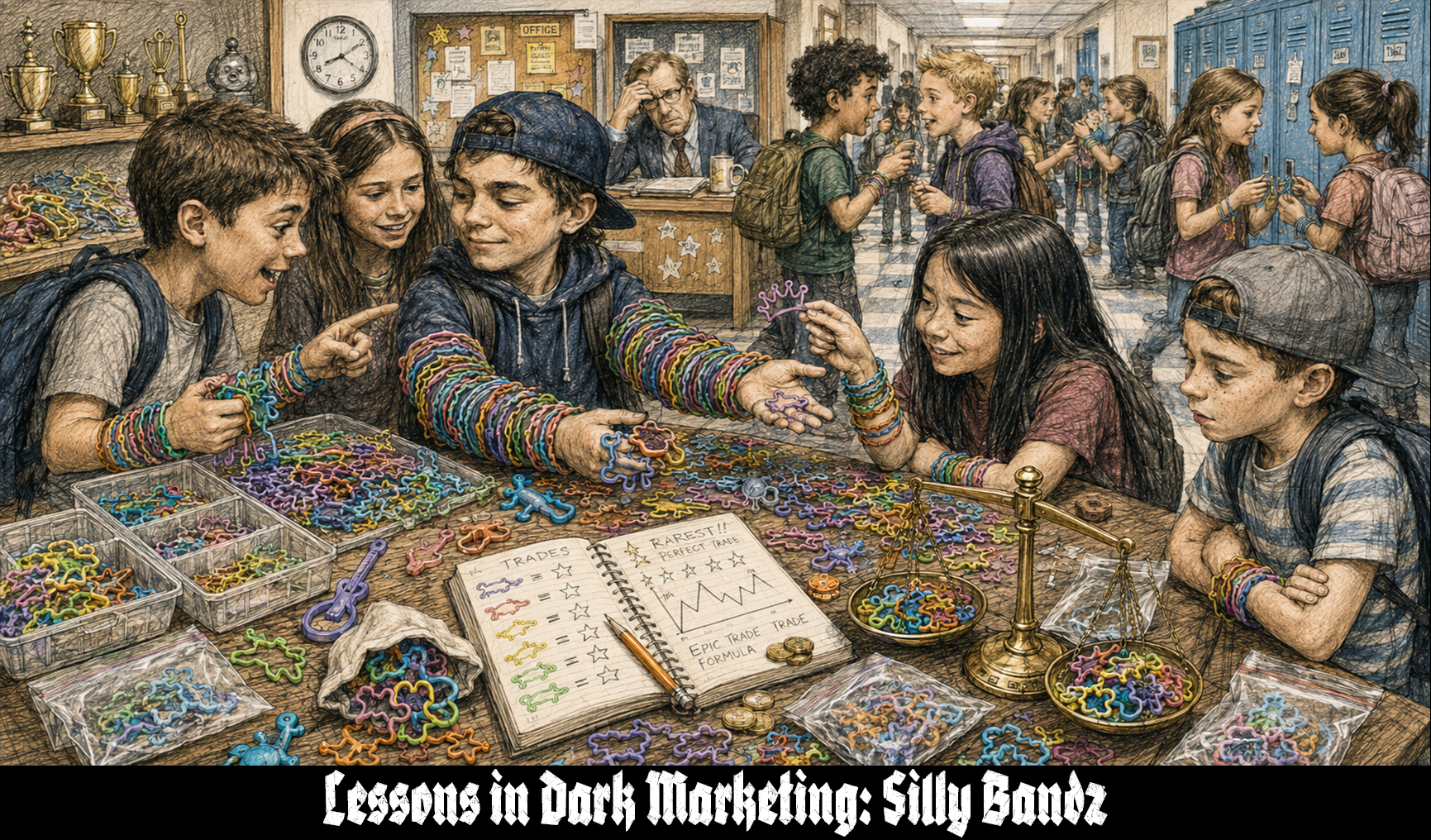
A child walks into school wearing forty rubber bands from wrist to elbow and immediately begins conducting international trade negotiations beside the pencil sharpener. The blue dinosaur is available, but only if the other party includes two princess crowns and a glow-in-the-dark guitar. The red elephant has sentimental value. The green turtle may be counterfeit. The orange seahorse is being held until lunch because another buyer has promised a rare baseball glove and refuses to provide collateral.
None of these objects has a practical use worth discussing. They’re pieces of colored silicone that collapse into shapeless loops when worn and return to recognizable forms when removed. Their manufacturing cost is tiny. Their functional advantage over a regular rubber band is that one of them can resemble a giraffe for several seconds before a child stretches it around a juice box. The children don’t care about the adult crap I just talked about.
The hallway has become a commodities exchange. The playground has become a trading floor. The teacher has become an exhausted securities regulator attempting to stop hostile takeovers during multiplication practice. That was the beautiful pint sized crime scene created by Silly Bandz.
The shaped silicone bands became a national American craze during 2009 and 2010. Robert Croak, the founder of Toledo-based BCP Imports, encountered a thinner Japanese version of shaped rubber bands and adapted the concept into a larger, thicker toy and fashion accessory for children. The Japanese design lineage dates to Passkey Design’s animal-shaped silicone bands from 2002, which were originally conceived as reusable design objects rather than disposable office supplies. MoMA still identifies Passkey Design’s Zoo Animal Rubber Bands as a 2002 Japanese design. (MoMA Design Store)
Croak’s commercial insight was straightforward and extremely profitable: stop treating the shaped band like clever stationery and reposition it as wearable childhood currency. The first Silly Bandz products appeared online in late 2008, and specialty toy stores helped build early demand. By May 2010, BCP Imports had gone from shipping roughly twenty boxes per day a year earlier to around 1,500 boxes per day, representing millions of bands each week. Croak’s business had grown tenfold in six months.
The product usually came in themed packs filled with animals, princess objects, dinosaurs, sports equipment, musical instruments, letters, holiday symbols, and whatever other recognizable outline could be squeezed into a plastic bag. Packs commonly sold for several dollars, placing them inside the parental sweet spot where the purchase felt inexpensive enough to approve repeatedly. TIME described twenty-four-band packages selling for about five dollars during the height of the craze.
Silly Bandz did have legitimate value. They were colorful, inexpensive, portable, easy to trade, and socially interactive. Children could sort them, collect them, compare them, invent meanings for them, exchange them, wear them, and use them as props in imaginative play. They required no batteries, screen, subscription, charger, software update, parental account, or privacy policy written by twelve lawyers hiding behind a cartoon mascot.
Those strengths supplied the perfect foundation for an astonishingly efficient peer-pressure machine. The product was a shaped silicone bracelet. The machine was status manufactured from abundance, scarcity manufactured from assortment, and social value manufactured by children who agreed that one rubber giraffe was worth three rubber dolphins because the market had spoken.
We’re looking at schoolyard speculation built from pocket money, not meaningful jewelry. That is the case study.
The Product Became Valuable After It Left the Package
A Silly Band had little commercial magic while lying flat inside a sealed bag. It became interesting when a child took it out, stretched it around a wrist, removed it, watched it return to shape, and showed it to somebody else. The object had a miniature transformation built into it.
That transformation created the demonstration. The band appeared to be an ordinary bracelet while worn. Once removed, it became a dinosaur, crown, car, dog, spaceship, musical note, or whatever else the mold was supposed to represent. The product carried a small reveal that children could repeat without adult assistance.
That mattered because children didn’t need advertising language to explain it. They could perform the pitch directly. “Look what this one turns into.” The object moved from wrist to desk. The shape returned. Another child reacted. The owner gained a brief moment of attention. The product had completed its sales demonstration.
Strong toy marketing often depends on movement, transformation, surprise, sound, collection, or an obvious physical action. Silly Bandz compressed several of those pleasures into an object smaller than a paper clip and cheaper than most vending-machine snacks.
The band also contained a reset mechanism. The reveal could happen repeatedly because the silicone returned to its original outline after being removed. Every demonstration refreshed the appeal.
This is dark marketing principle number one: Give a low-cost object a repeatable transformation and customers will turn ordinary handling into product theater.
Silly Bandz didn’t need a television commercial once every child’s wrist became a traveling before-and-after demonstration.
The Wrist Became a Public Inventory Report
Silly Bandz were designed to be worn in groups. One band looked accidental. Ten looked intentional. Thirty looked impressive. Fifty suggested that a child had acquired either extraordinary social standing or a parent who had lost control of the checkout line.
The wrist displayed quantity before anybody inspected quality. That visible accumulation was essential. A collection hidden inside a bedroom drawer creates private satisfaction. A collection wrapped around the body creates public comparison.
Children could enter a classroom and immediately estimate who had the most Bandz, who had the newest shapes, who possessed desirable colors, who had duplicates available for trade, and who had arrived at school with one lonely pink rabbit cutting circulation around the lower forearm.
The product turned ownership into a wearable scoreboard. That scoreboard encouraged repeated purchasing because each new pack increased visible mass. The child didn’t need a deep emotional attachment to every individual shape. Quantity itself performed status.
This is the same reason charm bracelets, sneaker walls, collectible pins, luxury logos, stacked festival wristbands, and enormous key-chains become social instruments. The object matters. The display of accumulation matters more.
Silly Bandz made that display unavoidable. The collection occupied the arm. The bands also rewarded excess visually. A single cheap bracelet looked cheap. A crowded wrist looked like a trend. The pile disguised the low material value through repetition.
This is dark marketing principle number two: When quantity is publicly visible, accumulation becomes a form of identity rather than a private purchasing decision.
One rubber dinosaur was landfill waiting for transportation; forty rubber dinosaurs became a personal brand.
Theme Packs Made Every Collection Incomplete
Silly Bandz weren’t sold as one universal assortment containing all possible designs. They arrived in themed packages. Animals. Princesses. Sports. Dinosaurs. Rock bands. Sea life. Fantasy shapes. Holiday icons. Licensed characters. Glow-in-the-dark editions. The themes gave children a reason to form preferences and gave the company endless opportunities to manufacture another package.
This was the collectibility engine. A child who liked dogs could want the animal pack. A child who liked baseball could want sports shapes. A child who already owned both could still lack the dinosaur set, fantasy set, music set, or whatever assortment appeared next.
The product had no natural completion point. That’s important because a complete product ends the transaction. A collection without a stable boundary keeps the customer available.
Silly Bandz could produce new shapes faster than children could develop satisfaction. The raw material remained the same. The commercial meaning changed with the mold, color, theme, and packaging. The company didn’t need to reinvent the bracelet. It needed to reorganize desire.
Themes also allowed children to turn product preference into personality. The child who wore sports Bandz could signal athletic identity. The princess assortment could perform fantasy and femininity. Dinosaur Bandz could communicate interest, age, or tribe. The shapes gave a few cents’ worth of silicone enough symbolic range to occupy several toy categories simultaneously.
This is dark marketing principle number three: Divide one simple product into identity-based assortments and every preference becomes a reason the collection remains unfinished.
Silly Bandz didn’t sell rubber bands in themes because children needed classification. The classifications gave the rubber bands somewhere else to go after the first package.
Low Prices Removed the Need for Serious Judgment
A pack of Silly Bandz was cheap enough to avoid becoming a major household decision. That was one of the product’s greatest advantages. Parents didn’t need to compare specifications, read reviews, consider durability, measure available storage, or wait for a birthday. A pack could be added to a shopping trip, used as a reward, purchased before a playdate, included in a gift bag, or surrendered during a child’s campaign of low-volume public whining.
Several dollars feels harmless. Repeated several dollars becomes a business model. The low unit price reduced resistance while the collectible structure increased frequency. Parents could say yes without feeling reckless because each individual transaction looked small.
This is how inexpensive products escape scrutiny. The customer evaluates the price of the package while the company profits from the pattern. A child asking for a sixty-dollar toy creates a visible confrontation. A child asking for a five-dollar package may create almost no confrontation at all. The purchase slips beneath the household threshold where financial judgment becomes inconvenient.
The product also benefited from gift-ability. A pack could function as a stocking stuffer, party favor, classroom reward, travel distraction, or minor peace offering from an adult who needed twelve quiet minutes inside a pharmacy. Silly Bandz turned affordability into repetition. The parent never needed to believe the object was important. The object needed to remain inexpensive enough that refusing felt more exhausting than purchasing.
This is dark marketing principle number four: Price a collectible below the customer’s threshold for serious evaluation and repeat purchases will hide inside ordinary spending.
Nobody scheduled a family budget meeting over five dollars’ worth of rubber seahorses, which is exactly why the rubber seahorses kept entering the house.
Trading Let Children Manufacture the Market
The company sold the original packs. Children created the secondary market. That market gave the bands much of their social power.A child could trade duplicates, negotiate for preferred colors, exchange several common designs for one desirable shape, or refuse an offer based on whatever private valuation system had emerged before recess.
No official pricing guide was required. The school community created one through behavior. Scarcity could develop locally even when the company had produced millions of units. A shape became rare because few children at a particular school possessed it. A color became desirable because a popular child wore it. A pack became valuable because one local store had sold out.
The market was irrational, which didn’t make it less real. Children learned that value could come from demand rather than material quality. A tiny bracelet became expensive in trade because people wanted it, other children recognized it, and the owner could withhold it.
This gave Silly Bandz a life beyond the original transaction. Products that can be exchanged remain active after purchase. They move between users, generate conversation, produce disputes, and expose more people to the brand.
The child who couldn’t buy a new pack could still enter the market by trading. That broadened participation and kept the social system alive. The company didn’t need to control every exchange. Children performed the work of assigning value, redistributing inventory, and making ownership emotionally consequential.
This is dark marketing principle number five: Build a product that customers can trade and they’ll create a market larger, louder, and more persuasive than the original retail transaction.
Silly Bandz sold the raw material and let fourth graders establish the commodities commission.
Duplicates Turned Waste Into Negotiating Power
Collectible packs create a problem: duplication. A child opens the package and discovers another orange guitar, another blue turtle, and another purple crown identical to several already sitting in a drawer.
Ordinary products treat duplication as waste. Silly Bandz converted it into trade inventory. The extra band could become bargaining material. It could be exchanged, gifted, loaned, combined into a larger offer, or used to recruit another child into the craze. This protected the package from disappointment.
Randomness wasn’t as central to Silly Bandz as it is to blind boxes or trading-card packs, since themed assortments were usually visible or identifiable. The broad product ecosystem still produced duplication through repeated packs, gifts, shared purchases, and overlapping sets.
Trading gave those duplicates a purpose. That purpose encouraged larger collections because extra units no longer looked useless. Every duplicate carried potential social value. The child could imagine a future trade even when no current trade existed.
The same logic appears in cards, stickers, digital items, toys, and collectibles. Duplication becomes tolerable when customers believe the extra object can unlock another object later.
This is dark marketing principle number six: Give duplicate purchases a social function and customers will reinterpret excess as inventory.
The second purple dolphin wasn’t a mistake. It was working capital.
Other Children Became the Advertising Campaign
Silly Bandz spread through schools, camps, playgrounds, sports teams, birthday parties, and neighborhoods with extraordinary speed. The product was almost perfectly designed for peer distribution. It was visible. It was cheap. It was portable. It was demonstrable. It was tradable. It came in varieties. It could be discussed quickly. It could be copied instantly by the next child whose parent stopped at a toy store.
Croak’s operation was shipping millions of Silly Bandz every week after a tenfold increase in business over six months. That kind of growth doesn’t require every child to encounter a polished national campaign. It requires the product to appear on enough wrists that absence becomes noticeable.
The product’s customers created visual saturation. A child might see Silly Bandz on classmates during math, on older children during lunch, on friends after school, and on siblings at home. Repetition built legitimacy. The band stopped looking ridiculous because everybody had agreed to wear several dozen of them.
This is one of the oldest mechanisms in fashion marketing. Visibility creates normalcy. Normalcy creates pressure. Pressure creates adoption. Adoption creates more visibility. The bands carried their own media plan.
This is dark marketing principle number seven: A product becomes difficult to resist when customers display it in the same social environment where purchasing pressure occurs.
Silly Bandz didn’t buy the classroom wall; they rented every available wrist.
Children Without Them Became the Warning
A status product needs an aspirational customer. It also benefits from a visible example of exclusion. Silly Bandz created both.
The child with a crowded wrist represented participation. The child without any became the person watching everyone else trade. That contrast carried more persuasive power than the object’s physical qualities. A rubber band can’t explain why it matters. Exclusion can.
Children are acutely aware of trends because school environments compress the social world. The same people are encountered repeatedly. Differences remain visible. A product can move from novelty to social requirement before adults understand why anybody cares.
The child without Silly Bandz didn’t lack a functional tool. They lacked entry into the conversation. They couldn’t compare shapes, negotiate trades, display favorites, or understand every minor dispute. The product became a language, and non-owners lacked vocabulary.
This made the purchase easier to justify at home. The child wasn’t simply asking for bracelets. They were asking for participation in a social activity involving peers.
The legitimate social benefit provided cover for the pressure. Trading could help children interact, negotiate, share, and form connections. The same mechanism could make a child feel conspicuously outside the group.
This is dark marketing principle number eight: When ownership becomes the admission ticket to a peer ritual, non-owners perform the consequences of refusing the product.
The empty wrist became an advertisement written in social discomfort.
School Bans Added the Thrill of Contraband
Schools began banning Silly Bandz because the bracelets distracted students, encouraged trading during lessons, caused arguments, and occasionally became projectiles.
TIME reported bans across schools in New York, Texas, Florida, Massachusetts, and other states in 2010. NBC New York reported that several Long Island schools and districts had prohibited the bands after teachers complained about distraction and students slinging them at one another. (TIME)
The bans confirmed the product’s cultural power. A toy becomes more interesting when adults declare it disruptive. The object stops being cheap plastic and becomes evidence of a youth culture important enough to frighten the administration.
Schools intended to reduce distraction. The prohibition could also increase the bands’ symbolic value. Contraband creates stories. Children hide the product, smuggle it, trade it privately, test enforcement, and discuss which teachers care. The rule becomes another reason to talk about the item.
The ban also generated free press. National and local news stories explained what Silly Bandz were, showed children wearing them, described the trading system, and repeated the argument that schools couldn’t control the craze.
Every disciplinary complaint contained the product demonstration.
This is dark marketing principle number nine: When authority bans a youth product, discipline can become proof that the product matters.
Silly Bandz entered school as bracelets and left the principal’s office as political prisoners.
Adult Confusion Made the Product Feel Like Childhood Property
Many adults looked at Silly Bandz and saw a bag of rubber. Children saw shapes, categories, trades, rarity, color, quantity, and group participation. That interpretive gap strengthened the trend.
A product can become more attractive to children when adults fail to understand it. Confusion gives the object generational privacy. Parents may control the money, but children control the meaning. The product didn’t require adult admiration. Adult admiration might have weakened it by making the trend feel supervised.
Silly Bandz remained simple enough for adults to purchase and strange enough for children to own culturally. The adult could appreciate the low price and harmless materials. The child could appreciate the social code. Both parties accepted the transaction for different reasons.
This two-audience structure is powerful. The buyer sees affordability. The user sees status. The buyer sees a bracelet. The user sees a portfolio. Adults could even dismiss the bands as stupid while continuing to purchase them. The company didn’t need to win the intellectual argument. The register still opened.
This is dark marketing principle number ten: A children’s product can benefit when the buyer understands the price while the user controls the meaning.
Parents bought rubber bands because they were cheap; children valued them because parents had no idea what the orange giraffe was worth on Tuesday.
Simplicity Allowed Infinite Imitation
Silly Bandz were easy to understand and easy to copy. Competitors flooded the market with similarly shaped silicone bracelets under names such as Zanybandz, Crazy Bands, Googly Bands, and other variations assembled by somebody who had located a thesaurus and a molding factory in china.
That imitation created legal and commercial pressure for the original brand. The SILLYBANDZ trademark was filed by BCP Imports in September 2009 for rubber or silicone wristbands in the nature of bracelets. Copycats threatened differentiation because the product’s basic concept wasn’t difficult to reproduce. A blue rubber elephant from one company could satisfy much of the same desire as a blue rubber elephant from another.
The flood of alternatives also reinforced the category. Children didn’t need every band to come from the original brand for the social ritual to continue. More manufacturers meant more shapes, more availability, more retail distribution, and more objects entering schools.
The brand could lose exclusivity while the craze gained oxygen. This is a common problem for simple viral products. The lack of technical complexity accelerates growth because manufacturing can scale. The same simplicity allows competitors to arrive before the original company has finished celebrating.
Silly Bandz needed brand recognition, packaging, licensing, speed, retail relationships, and new assortments to remain ahead of products that could deliver nearly identical physical utility.
This is dark marketing principle number eleven: Simple products spread quickly because customers understand them instantly, and competitors understand them just as quickly.
Silly Bandz opened a gold rush where every prospector arrived carrying the same bag of silicone spaghetti.
Licensing Let Pop Culture Manufacture Fresh Demand
Once the core shapes were established, licensing offered another path to renewed attention. Celebrity, character, sports, and entertainment tie-ins could transform the same silicone object into a branded collectible. Silly Bandz released collaborations connected with figures such as Justin Bieber and Kim Kardashian during the broader expansion of the craze.
Licensing imported an existing fan base into the product. A generic guitar shape competed on design. A celebrity-linked guitar carried emotional meaning supplied by somebody else’s fame.
That allowed the company to sell familiarity without building each identity from scratch. The customer already cared about the entertainer, team, character, or franchise. Silly Bandz converted that attachment into another assortment.
The physical difference could remain tiny. The symbolic difference justified the purchase. Licensing also kept the product culturally current. A shape tied to a popular celebrity or franchise could create urgency that a generic animal pack lacked.
The product became a delivery vehicle for other identities.
This is dark marketing principle number twelve: When the base product becomes familiar, borrow existing fandom to make another version feel necessary.
Silly Bandz discovered that a rubber microphone becomes more important after a famous person’s name is printed on the package.
Celebrities Gave Five-Cent Silicone a Fashion Alibi
Silly Bandz escaped the children’s toy category long enough to appear on celebrities and fashion-conscious adults. Vanity Fair reported in 2010 that figures including Mary-Kate Olsen, Sarah Jessica Parker, Agyness Deyn, Henry Holland, and Kelly Ripa had been seen wearing the bands. Celebrity adoption gave the trend a second layer of legitimacy.
Children didn’t need famous adults to validate the product, but celebrity visibility expanded the story. The bands could be described as fashion, irony, novelty, or playful self-expression rather than classroom clutter.
An inexpensive product gains enormous leverage when high-status people wear it. The object begins to appear democratic. Anyone can own the same bracelet as a celebrity because the price remains low.
This is aspirational marketing without economic exclusion. Luxury products sell distance from ordinary consumers. Silly Bandz sold proximity to cultural visibility for a few dollars.
The celebrity could wear the object ironically. The child didn’t care. Irony still photographs well.
This is dark marketing principle number thirteen: When high-status people adopt a cheap product, accessibility begins to feel like cultural participation rather than low value.
A five-cent bracelet can’t afford a publicist, but apparently it can borrow Sarah Jessica Parker’s wrist.
The Package Sold More Than Any Child Needed
Silly Bandz were commonly sold in multi-unit packs. That packaging decision accelerated collection before the child made a second purchase. A single bracelet might satisfy curiosity. A package of twelve or twenty-four established a miniature inventory immediately.
The child left the store with colors, categories, duplicates, trade possibilities, favorites, and enough visible quantity to participate in the trend. The package created the collection. This is important because habits often require critical mass. One object may be forgotten. A group of objects invites sorting, counting, wearing, arranging, trading, and comparison.
The multi-pack also disguised the cost of each piece. The parent evaluated the package price. The child evaluated the number of objects. Both interpretations made the purchase look generous.
The package could be divided among siblings, party guests, friends, or classmates, which increased distribution. One retail purchase could place several bands onto several wrists.
This is dark marketing principle number fourteen: Package a low-cost object in immediate abundance and the first purchase can create the behavior that drives the second.
Silly Bandz didn’t wait for children to build collections one bracelet at a time; they sold the starter portfolio in a plastic bag.
Fragility and Loss Protected Repeat Sales
Silly Bandz were portable because they were small. They were also easy to lose, stretch, snap, trade away, leave at school, bury in a backpack, abandon under furniture, or accidentally donate to the vacuum cleaner.
That impermanence helped repeat sales. Durable products eventually remove their customers from the market. A child who still owns the same complete set has less reason to replace it.
Silly Bandz moved constantly between wrists, desks, pockets, floors, backpacks, and other children. The product’s social use exposed it to disappearance. Parents could tolerate replacement because the price remained low. Children could justify replacement because the lost shapes had emotional or trade value.
The object was durable enough to be handled repeatedly and disposable enough that losing several didn’t end the category. This is a profitable balance. Cheap collectibles thrive when customers can accumulate them without protecting them carefully.
This is dark marketing principle number fifteen: A product that’s inexpensive to replace and easy to lose can convert ordinary disorder into recurring demand.
The household didn’t throw Silly Bandz away; the carpet, school bus, and washing machine absorbed them on behalf of the company.
The Product Borrowed the Logic of Trading Cards Without Needing a Game
Trading cards usually contain information, artwork, characters, rankings, rarity levels, or rules that support exchange. Silly Bandz stripped the system down further.
The bands didn’t need statistics. They didn’t need a game. They didn’t need printed rarity classifications. They didn’t need a fictional universe explaining why the purple rhinoceros mattered.
Children supplied the logic. Value could come from shape, color, scarcity, popularity, personal preference, or the fact that somebody else wanted the item badly enough to offer four replacements.
This made the product accessible. No rulebook stood between ownership and participation. A child could understand the market after watching one trade.
The lack of formal rules also allowed local cultures to develop. One school might value animals. Another might value glow-in-the-dark shapes. One friendship group might assign meaning to colors. Another might treat certain packs as premium.
The product became flexible enough to fit whatever hierarchy children invented.
This is dark marketing principle number sixteen: Remove formal rules from a collectible and customers may create social rules that bind them more tightly than the company could.
Silly Bandz gave children blank financial instruments shaped like zoo animals.
The Craze Collapsed Because the Product Had No Deeper Engine
Silly Bandz rose with astonishing speed and declined with the same lack of ceremony. By December 2010, Vanity Fair cited reports that 7-Eleven locations had experienced a 97 percent drop in Silly Bandz sales, while retailers shifted attention toward newer variants and other products.
The collapse revealed the weakness inside the success. Silly Bandz had visibility, trade, novelty, assortment, affordability, and social pressure. They didn’t possess a deep continuing experience.
There was no game world requiring the bands. No unfolding story. No skill system. No meaningful technological improvement. No permanent utility beyond functioning as ordinary rubber bands. No subscription. No digital account. No long-term identity platform.
The social market was the product. Once children stopped caring about the market, the silicone returned to being silicone.
This is why fads can generate explosive revenue and still offer weak durability. The product’s value depends on synchronized attention. Everyone must care at roughly the same time.
When that synchronization breaks, ownership loses much of its public meaning. The child who once wore fifty bands becomes a child with a drawer full of yesterday. The company attempted extensions, licenses, new designs, and related products, but no assortment could fully recreate the first shock of seeing the bands everywhere.
This is dark marketing principle number seventeen: When social attention supplies most of the value, demand can collapse as quickly as the crowd changes its mind.
Silly Bandz built a magnificent schoolyard economy on the monetary policy of “everybody likes these right now.”
The Case Study Breakdown
Here is the Silly Bandz machine in plain English:
- The bands contained a simple transformation children could demonstrate repeatedly.
- Wearing many bands turned the wrist into a public inventory display.
- Themed packs made every collection feel incomplete.
- Low prices reduced parental scrutiny and encouraged repeat purchases.
- Trading allowed children to create a secondary market.
- Duplicates became negotiating assets rather than waste.
- Children displayed the product inside the same schools where peer pressure operated.
- Non-owners became visible examples of exclusion.
- School bans transformed the bands into contraband and generated free publicity.
- Adult confusion helped children claim cultural ownership of the trend.
- Simple manufacturing invited copycats while expanding the category.
- Licensing imported celebrity, character, and franchise fandom.
- Celebrity adoption gave the cheap product a fashion alibi.
- Multi-unit packages created immediate collections.
- Loss, breakage, and constant trading supported replacement purchases.
- The product borrowed collectible logic without needing formal rules.
- Local peer groups manufactured rarity and exchange value.
- The entire market depended on synchronized attention.
- Once the social ritual faded, the physical product lost most of its power.
Silly Bandz worked because every weakness of the physical product became a strength inside the social system. The bands were cheap, so children could collect many. They were small, so children could carry them everywhere. They were visible, so ownership became public. They came in shapes, so difference could be discussed. They were tradable, so the product remained active after purchase. They were easy to lose, so replacement felt ordinary. Adults found them ridiculous, which allowed children to treat them as their own.
The company sold silicone. Children supplied scarcity, status, distribution, negotiation, enforcement, and market mythology.
This is dark marketing principle number eighteen: A low-value object can support a high-value craze when customers perform the social labor required to make ownership matter.
Silly Bandz handed children the rubber and let them build Wall Street beside the monkey bars.
What Marketers Should Learn From Silly Bandz
The first lesson is that a simple product needs a social action.
Silly Bandz could be worn, removed, revealed, counted, compared, sorted, and traded. Each action gave the object another opportunity to become visible. The product moved constantly between display and interaction.
The second lesson is that low prices can accelerate social adoption when public visibility matters.
Children could acquire enough bands to signal participation without waiting for a major gift occasion. The low cost helped the trend spread across households while multi-pack packaging made abundance immediate.
The third lesson is that assortment can create scarcity without reducing total supply.
Silly Bandz produced enormous quantities while individual shapes, colors, and themes still felt scarce inside local peer groups. The company flooded the market and children continued believing specific pieces were rare.
The fourth lesson is that customers can create value through exchange.
Trading gave duplicates purpose, increased conversation, pulled non-buyers into the ecosystem, and allowed products to circulate long after the original retail transaction.
The fifth lesson is that peer display can outperform conventional advertising.
Every crowded wrist showed quantity, color, popularity, and participation. The buyer wore the campaign inside the exact environment where other potential buyers could see it.
The sixth lesson is that a product aimed at children needs a separate argument for adults.
Silly Bandz were inexpensive, harmless-looking, portable, battery-free, and simple. Parents could approve them as minor toys while children valued them as social assets.
The seventh lesson is that institutional resistance can strengthen youth products when the prohibition confirms cultural relevance.
School bans generated press, stories, secrecy, and the thrill of owning something important enough to annoy adults.
The eighth lesson is that licensing can renew a familiar format, although it can’t permanently rescue a product whose underlying social ritual has collapsed.
Famous names and characters gave old silicone new meaning for a while. They couldn’t force children to keep caring forever.
The ninth lesson is that simplicity creates speed and vulnerability simultaneously.
Silly Bandz were easy to understand, easy to manufacture, easy to distribute, and easy to copy. The same qualities that fueled the craze weakened the company’s control over it.
The tenth lesson is that fad businesses must distinguish rapid attention from durable customer value.
Silly Bandz produced a massive cultural moment. The product didn’t create a strong long-term reason for children to remain after novelty and peer pressure moved elsewhere.
This is dark marketing principle number nineteen: The perfect fad product is cheap enough to spread, visible enough to pressure, varied enough to collect, and socially active enough that customers keep selling it to one another.
Silly Bandz achieved all four and still discovered that recess eventually ends.
Final Diagnosis
Silly Bandz belong in the Lessons in Dark Marketing museum because they proved that children could transform inexpensive silicone loops into a status economy more sophisticated than the product deserved.
The final diagnosis is wrapped halfway up the forearm:
- Silly Bandz turned a reusable design novelty into a mass-market children’s fashion craze.
- They made quantity publicly visible.
- They divided one simple object into endless themed collections.
- They kept prices low enough to avoid serious parental resistance.
- They converted duplicates into trade inventory.
- They allowed children to determine local rarity and value.
- They made peer groups responsible for advertising and distribution.
- They turned non-ownership into visible social exclusion.
- They used the wrist as a permanent product display.
- They benefited when schools banned them.
- They gained cultural ownership through adult confusion.
- They welcomed licensing as a source of fresh symbolic value.
- They borrowed celebrity visibility without becoming expensive.
- They created collections through multi-unit packaging.
- They benefited from loss, breakage, and casual replacement.
- They copied the commercial logic of trading cards without needing rules.
- They made children perform the labor of market creation.
- They grew rapidly because the product was simple.
- They attracted imitators because the product was simple.
- They collapsed when social attention moved to the next object.
- They demonstrated that perceived rarity can exist inside overwhelming abundance.
- They proved that material value has almost nothing to do with playground value.
The bands weren’t dangerous in any grand cultural sense. They were small, colorful, interactive toys that gave children something to share, discuss, collect, and trade. They created memories. They encouraged negotiation. They offered a social activity that didn’t require a screen, login, corporate surveillance system, or adult spending hundreds of dollars on downloadable clothing for a cartoon soldier.
That legitimate innocence made the marketing machine easier to miss. Silly Bandz didn’t need to persuade children that silicone was precious. They needed children to persuade one another that specific silicone was desirable. Once that happened, material value became irrelevant.
Return to the hallway.
A child is still standing beside the pencil sharpener with forty bands wrapped around one arm. Another child is inspecting a blue dinosaur for stretching damage. A third child has offered three common animals and one glow-in-the-dark guitar for a red princess crown. The teacher has announced that all trading must stop, which has increased trading by approximately nine hundred percent.
Five dollars entered the building as a plastic package. By lunch, it had become identity, inventory, status, scarcity, negotiation, jealousy, contraband, and a functioning secondary market.
Silly Bandz weren’t bracelets. They were five-cent financial delusion wearing itself as jewelry.
Leave a Reply