
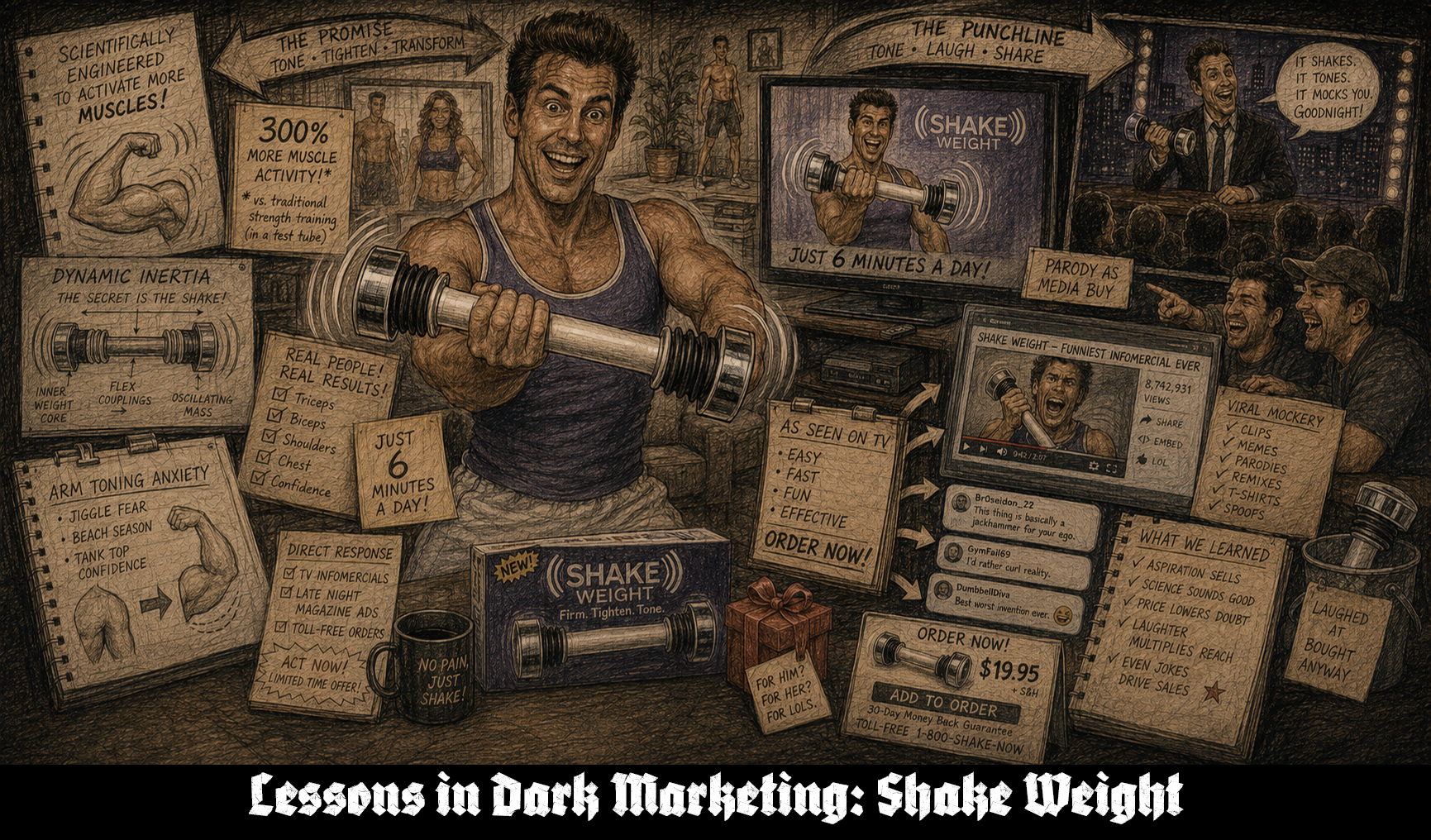
The Shake Weight’s first conversion wasn’t the sale. It was the moment one person dragged somebody else toward a television or computer and said, “You need to see this ridiculous thing.”
The product looked like a dumbbell assembled by someone whose understanding of exercise came entirely from obscene hand gestures. Its spring-loaded ends moved rapidly back and forth while attractive models gripped the center and maintained the determined facial expression of people trying desperately to convince America that everybody on the set was thinking about upper-body fitness. Nobody believed that.
The audience saw the movement, understood the visual implication immediately, and began doing the advertising for free. People replayed the commercial, emailed clips, demonstrated the motion to coworkers, brought it up at parties, laughed about it on television, and purchased the product as exercise equipment, a novelty gift, a household joke, or some combination of all three.
The Shake Weight reached the market in 2009 as a 2.5-pound device initially aimed at women. Its infomercial promised firmer arms and shoulders through a six-minute daily routine and claimed that the device could increase upper-body muscle activity by as much as 300 percent compared with some traditional weights. By August 2010, the $19.95 product had sold more than two million units, while versions of its advertisement had collected more than 3.6 million YouTube views and inspired appearances or parodies on programs including Saturday Night Live and Ellen. (Inc.com)
We’re looking at public humiliation converted into consumer reach, not a conventional fitness campaign. The product was a spring-loaded dumbbell. The machine was every person who laughed hard enough to show it to somebody else.
That is the case study.
The Product Looked Like the Joke Before Anyone Wrote It
The Shake Weight entered the market with an advantage most comedy writers would kill for: the product was already doing the bit. Its rapid back-and-forth motion created an obvious sexual resemblance that required no dialogue, explanation, punch line, or cultural sophistication. A viewer could understand the joke with the television muted from across the room.
That visual immediacy made the product unusually efficient.
A traditional fitness gadget needs several seconds to explain what it does, which muscles it targets, how the mechanism works, and why anybody should interrupt dinner to care. The Shake Weight appeared onscreen and created immediate attention because the body recognized the movement before the mind processed the sales claim.
The company had developed a product demonstration that functioned simultaneously as instruction, spectacle, and accidental obscenity. That is an extraordinary direct-response asset.
The viewer might reject every fitness promise in the commercial and still remember exactly how the product worked. Most advertisements struggle to communicate one memorable action. Shake Weight created an action so unforgettable that millions of people reenacted it while making fun of the company.
This is dark marketing principle number one: When the product’s demonstration is visually impossible to forget, ridicule can carry the instruction farther than persuasion ever could.
Shake Weight didn’t need customers to respect the movement. It needed them to remember it.
Embarrassment Forced the Audience to Pay Attention
Most infomercials face a simple problem. Nobody wants to watch them.
The audience recognizes the format, anticipates exaggerated claims, and begins searching for the remote control before the narrator finishes describing the revolutionary breakthrough unavailable in stores. Shake Weight interrupted that reflex.
The viewer hesitated because the commercial created social discomfort. Was the advertisement genuinely unaware of what the movement looked like? Was the entire presentation a deliberate joke? Were the models actually expected to perform that motion while maintaining eye contact with the camera?
The uncertainty held attention. Embarrassment can become an extremely powerful retention device because people continue watching to determine whether what they’re seeing is real. The commercial becomes a small social mystery. The viewer wants confirmation that the company has somehow spent real money producing the exact thing appearing onscreen.
That pause matters in direct-response marketing. Every additional second gives the product more time to communicate the price, promise, mechanism, phone number, website, and buying instructions.
The sexual implication wasn’t merely funny. It prevented the audience from leaving.
This is dark marketing principle number two: When embarrassment creates uncertainty, discomfort can keep customers watching long enough for the sales message to finish its work.
The commercial held attention by making people wonder whether everyone involved had lost the ability to recognize basic human movement.
The Commercial’s Seriousness Made the Product Funnier
The Shake Weight advertisement didn’t behave like comedy. That made it much funnier.
The models appeared focused. The narrator delivered fitness claims with direct-response authority. The device was presented as a legitimate technological advancement capable of solving a familiar body concern through disciplined daily use.
Nobody winked at the audience. That straight-faced presentation intensified the joke because the commercial refused to acknowledge the obvious visual interpretation. The viewer became the only person in the room permitted to notice what was happening.
Comedy often becomes stronger when the performer acts as though nothing unusual has occurred. Shake Weight accidentally or deliberately used that principle throughout the entire campaign.
Had the advertisement openly joked about the movement, it might have produced one controlled laugh and ended the conversation. By maintaining absolute seriousness, it gave the public the pleasure of discovering, repeating, and expanding the joke independently. The audience became the comedy department.
This is dark marketing principle number three: When the product is inherently absurd, treating it with complete seriousness can encourage customers to create the humor themselves.
Shake Weight didn’t tell the joke. It stood there with a straight face while America wrote several million versions of it.
Sexual Innuendo Became Free Distribution
Sex has always attracted attention in advertising, but the Shake Weight created a more useful variation. It attracted attention through implication.
The commercial didn’t need explicit language or nudity. The product’s movement supplied enough suggestion for viewers to understand the association, laugh about it, and circulate the footage while remaining able to show it on mainstream television.
That made the campaign highly portable. A genuinely explicit advertisement would have faced restrictions and limited placement. Shake Weight remained a fitness commercial that could appear during ordinary programming while carrying enough sexual resemblance to provoke adult conversation.
The ambiguity also protected participation. A person could share the clip while claiming to be discussing a ridiculous exercise device. The sexual joke remained available without requiring anyone to state it directly.
That gave the product access to talk shows, offices, living rooms, news segments, comedy programs, and internet sharing without needing to purchase specialized adult-oriented media. The innuendo became a distribution loophole.
This is dark marketing principle number four: Imply something culturally irresistible while preserving enough innocence for the content to travel through ordinary channels.
Shake Weight smuggled a dirty joke into daytime television inside a cardboard box labeled fitness equipment.
The Demonstration Made Explanation Unnecessary
The inventor, Johann Verheem, explained that an earlier inertia-based exercise product had used a less familiar shape and movement. His solution was to integrate the shaking mechanism into a recognizable dumbbell so consumers could understand the category immediately. (Inc.com)
That design decision mattered. The dumbbell supplied familiarity. The spring-loaded motion supplied novelty. Consumers didn’t need to learn an entirely new object. They recognized the basic category and saw the difference within seconds.
This combination is common in successful direct-response products. The best television gadgets often look familiar enough to understand and strange enough to demand attention. A completely ordinary dumbbell wouldn’t stop the viewer. A completely unfamiliar device would require too much explanation.
Shake Weight occupied the profitable middle. The customer could describe the product in one sentence: it was the dumbbell that shook back and forth. That description carried the visual, mechanism, joke, and product identity simultaneously.
This is dark marketing principle number five: Attach an unfamiliar mechanism to a familiar object and customers can understand the innovation before skepticism interrupts the pitch.
Shake Weight turned a Roman-era dumbbell into something a late-night host could explain without speaking.
Arm Anxiety Identified the Customer
Shake Weight was originally marketed toward women concerned about the appearance of their upper arms. That concern was commercially valuable because it involved a visible body area customers could examine, pinch, photograph, compare, conceal, and judge with very little assistance from medical science.
The infomercial didn’t need to create dissatisfaction from nothing. It entered a culture already prepared to treat women’s arms as another body part requiring constant surveillance.
Sleeveless clothing, photographs, celebrity coverage, magazine features, and beauty standards had created a ready-made insecurity. The product only needed to identify the concern and offer a simple ritual that appeared designed specifically for it.
Verheem said the timing was influenced by media attention surrounding Michelle Obama’s toned arms and the broader interest that attention generated among women. (Inc.com)
That cultural moment gave the product relevance. The customer wasn’t being invited into a broad strength-training program requiring months of progressive exercise. She was being offered a device for correcting one socially visible area through a short daily routine.
This is dark marketing principle number six: Isolate a visible body insecurity and customers may accept a narrowly designed product as the missing solution.
Shake Weight didn’t sell upper-body training. It sold a response to the moment a woman reconsidered raising her arm in a photograph.
The Product Turned “Toning” Into a Separate Category
Fitness marketing has long treated “toning” as a magical third condition existing somewhere between building muscle and losing fat. The language sounds precise while remaining commercially flexible.
Customers may interpret toning as becoming firmer, leaner, tighter, smoother, smaller, stronger, or more defined. The product can therefore promise a desirable visual change without explaining the full relationship among resistance training, body composition, nutrition, genetics, and progressive overload. Shake Weight fit beautifully inside that fog.
The device was marketed as a way to shape and firm the arms, shoulders, and chest without forcing women to identify with heavy lifting or bodybuilding. The inventor described traditional weight equipment as oriented toward men and bulking, while presenting Shake Weight as a more approachable answer for women. (Inc.com)
That distinction used gender anxiety as product positioning. The customer could pursue visible muscular change while avoiding the fear that conventional resistance training might produce an unwanted identity.
This is dark marketing principle number seven: Create a softer category around the same physical goal and customers who reject the original method may accept the renamed version.
Shake Weight sold resistance training after dressing it in the commercially friendlier language of toning.
Six Minutes a Day Made Commitment Sound Negligible
The commercial promised results through a six-minute daily workout. That number was doing far more than describing the DVD.
Six minutes sounds too small to disrupt a schedule, threaten motivation, require major preparation, or produce the familiar dread associated with exercise programs that begin by demanding an entirely new life.
The customer could imagine succeeding before beginning.
That is essential in quick-fix marketing. The product must reduce the perceived distance between the current self and the desired result. Long workouts make the distance visible. Six minutes compresses the journey into something that can supposedly happen beside the coffee table.
The promise also insulated the purchase from excuses. Everybody can find six minutes.
That makes failure appear less connected to the program and more connected to the customer. If the device requires only six minutes and still sits unused, the buyer may conclude that personal discipline was the missing ingredient.
The product keeps the credit. The customer receives the blame.
This is dark marketing principle number eight: Reduce the required commitment until refusal feels unreasonable and later failure can be assigned to the buyer’s lack of consistency.
Shake Weight made transformation sound shorter than the average commercial break and somehow still found a way to make customers feel guilty for avoiding it.
“Dynamic Inertia” Gave Shaking a Laboratory Coat
The company described the mechanism as “dynamic inertia.” That phrase was excellent marketing because it made a simple visible motion sound like proprietary exercise science. The customer saw a dumbbell moving rapidly on springs. The language invited her to interpret that movement as a technological process rather than vigorous shaking.
Scientific terminology can elevate an ordinary mechanism by suggesting that experts have identified a principle unavailable through conventional behavior. The product begins to look less like a novelty and more like the application of research.
“Shake it quickly” sounds cheap. “Dynamic inertia” sounds patentable.
The phrase also gave salespeople, narrators, journalists, and customers a respectable vocabulary for discussing an object whose public identity was rapidly becoming sexual comedy. People might laugh at the motion, but the company could respond with biomechanics, muscle activation, and scientific studies.
This is dark marketing principle number nine: Give an obvious mechanism a technical name and the terminology can carry authority the movement cannot generate on its own.
Shake Weight placed a laboratory coat over a joke and charged $19.95 for the consultation.
The 300 Percent Claim Used Comparison as Theater
The infomercial claimed the Shake Weight could increase upper-body muscle activity by as much as 300 percent compared with some traditional weights. The phrase “some traditional weights” performed critical legal and psychological work.
It sounded broad enough for viewers to hear superiority while remaining narrow enough to depend heavily on the comparison selected. A light Shake Weight could appear extraordinarily active beside a conventional dumbbell of equal weight during a controlled exercise, even if experienced exercisers would normally choose heavier weights and use a fuller range of motion.
An ACE-sponsored study later found that Shake Weight exercises produced an average of 66 percent more total muscle activation than equal-weight dumbbell exercises in its test, well below the advertised 300 percent claim. The researchers also found that the triceps often worked hardest even when another muscle was supposed to be the target. (ACE Fitness)
That doesn’t mean the device produced no exercise effect. It means the headline depended on how the question was constructed.
This is dark marketing principle number ten: Choose a narrow comparison that produces an impressive percentage and allow customers to generalize the result beyond the test.
Shake Weight didn’t need to defeat every form of strength training. It needed one large number with enough scientific vocabulary to intimidate the infomercial audience.
A Real Exercise Response Gave the Product Cover
The most interesting part of Shake Weight is that it wasn’t entirely useless. The ACE study found that the device generated significantly more muscle activity than equal-weight dumbbells during the tested movements. Researchers said it could produce some exercise response, particularly for people who were unaccustomed to resistance training, although they expected only modest effects for experienced exercisers. (ACE Fitness)
That limited utility strengthened the marketing.
A completely useless product eventually collapses under ordinary experience. A product that produces fatigue, soreness, or some measurable activation can support a much larger claim because the customer feels something happening.
The user’s arms burn. The muscles shake. The movement becomes difficult. The heart rate may increase. Those sensations create immediate evidence that the product is working, even when the long-term benefit remains narrower than the advertising suggests.
Dark marketing often thrives in the gap between “does something” and “does everything implied.”
This is dark marketing principle number eleven: A modest real benefit can support an exaggerated emotional promise because customers experience the proof before evaluating its limits.
Shake Weight didn’t need to be worthless. It needed to work just enough for the joke to arrive with a plausible alibi.
Fatigue Was Allowed to Masquerade as Effectiveness
Shake Weight could make users tired quickly. That sensation was commercially useful because consumers often interpret immediate discomfort as proof of superior exercise.
Burning muscles feel productive. Shaking arms feel challenged. Sweat feels like progress. The problem is that fatigue measures effort within the activity, not necessarily the quality, completeness, transferability, or long-term value of the program.
The ACE researchers noted that the device operated through isometric tension in a limited range of motion and questioned how much its training would transfer into everyday function. One researcher joked that the motion might help someone shake a spray-paint can, which is about as close as exercise science can get to telling a product to sit down and stop making speeches. (ACE Fitness)
Consumers rarely conduct that distinction while exercising. They feel the arms burn and assume the program has discovered something powerful.
This is dark marketing principle number twelve: Produce an intense short-term sensation and customers may mistake discomfort for comprehensive results.
Shake Weight made six minutes feel difficult enough to distract from the question of whether the movement deserved six months.
Novelty Made the Workout Feel More Advanced
New movements feel different. Different movements feel difficult. Difficult movements feel effective. That progression can create an illusion of advancement.
A customer accustomed to ordinary daily movement may find rapid oscillation exhausting because the body hasn’t practiced maintaining tension against that pattern. The novelty itself contributes to the sensation.
The product can then claim superiority based partly on unfamiliarity. This is especially effective in the fitness category, where customers constantly search for the exercise, device, program, machine, or routine that will finally unlock results previous methods failed to produce.
Conventional dumbbells appear boring because people have seen them for generations. Shake Weight appeared new, mechanical, specialized, and different enough to suggest that ordinary exercise had been missing an important principle.
The customer wasn’t merely purchasing weight. They were purchasing the possibility that innovation had solved the problem of inconsistency, boredom, or disappointing results.
This is dark marketing principle number thirteen: Make the movement unfamiliar enough to feel advanced and customers may interpret novelty as evidence of superior design.
Shake Weight sold the difference between “I’ve never done this before” and “nobody needed to do this before” without encouraging much discussion between the two.
The Price Converted Curiosity Into Ownership
At $19.95, Shake Weight sat inside the classic direct-response impulse range.
The price was high enough to suggest that the product was real equipment and low enough to make curiosity financially manageable. A customer didn’t need to believe every claim. She only needed to believe the product might work, might be funny, or might become useful for somebody else.
That flexibility expanded the market. A serious fitness buyer could purchase it as equipment. A skeptical customer could purchase it as an experiment. A friend could purchase it as a joke gift. A family member could buy it for someone whose arms had apparently become a matter requiring intervention.
The same transaction served several motives.
Low prices are especially powerful when the product has already become a cultural object. The customer may purchase recognition as much as utility. Owning the famous thing becomes worth the cost even when regular use remains doubtful.
This is dark marketing principle number fourteen: Price the product low enough that customers can buy the story without fully believing the promise.
Shake Weight didn’t need every buyer to trust the science. Some customers were willing to pay twenty dollars merely to bring the joke home.
Direct Response Turned Laughter Into an Immediate Transaction
The infomercial format didn’t merely create awareness. It told viewers exactly how to purchase the product while attention was at its highest.
That matters because comedy has a short emotional window. People laugh, share, imitate, and move on. Direct-response marketing places the phone number, website, price, bonus, and ordering instructions inside that window.
The customer didn’t have to remember the product later and search for it independently. The commercial converted spectacle into action immediately. Verheem said sales initially came primarily through the infomercial and website, with the product later becoming widely available through major retailers. (Inc.com)
That sequence allowed the company to capture both impulse demand and later retail recognition. Television created the joke. The website accepted the order. Retail stores collected the customers who wanted to see the absurd object in person.
This is dark marketing principle number fifteen: Place the purchase mechanism beside the emotional peak and the customer can convert amusement into ownership before skepticism returns.
Shake Weight didn’t wait for the laugh to settle. It placed an order form underneath it.
Buying the Joke Still Counted as a Sale
The company didn’t need every customer to purchase the Shake Weight for its intended purpose. Money collected from irony spends exactly like money collected from sincerity.
This is one of the most important lessons in novelty marketing. A product can attract buyers who doubt the claims, mock the design, or expect the purchase to become a household joke. Their motivation doesn’t reduce the revenue. The gift buyer becomes especially valuable.
A fitness product normally targets people interested in exercise. A ridiculous fitness product can also target birthdays, holidays, office exchanges, party gifts, practical jokes, and anyone searching for a recognizable object that will produce an immediate reaction.
The mockery expands the category. Instead of damaging the addressable market, embarrassment creates new purchase occasions.
This is dark marketing principle number sixteen: When ridicule becomes part of the ownership experience, skeptical consumers can become customers without changing their opinion.
Shake Weight didn’t have to win the argument. It only had to reach the cash register while everyone was still laughing.
Parody Became Unpaid Product Placement
The Shake Weight commercial inspired parodies and discussions on major television programs, including Saturday Night Live, Ellen, The Daily Show, and South Park. FitnessIQ openly acknowledged that the attention likely helped sales, while Verheem estimated that comparable paid product placement for several minutes of national television exposure would have cost millions. (Inc.com)
That is the dark marketing jackpot. The company created one commercial. The culture created variations. Every parody repeated the product name, showed the device, demonstrated the motion, and reminded viewers that the item could be purchased.
The jokes changed. The product remained recognizable.
Comedy programs believed they were commenting on the advertisement, but they also performed the core tasks of a media campaign: awareness, recall, demonstration, repetition, and conversation. The company received exposure without controlling the message.
For many brands, that loss of control would be dangerous. Shake Weight’s visual identity was so simple and unusual that almost any coverage preserved the important commercial information.
This is dark marketing principle number seventeen: When parody must reproduce the product accurately for the joke to work, criticism becomes a demonstration campaign.
Every comedian who mocked Shake Weight had to show the audience how to use one.
The Product Was Built for Reenactment
Some advertisements are easy to discuss. Shake Weight was easy to imitate. That made it socially contagious. A person could demonstrate the motion without owning the product, remembering the full script, or reproducing the commercial. The body became the playback device.
This matters because physical imitation deepens recall. The audience doesn’t merely remember an image. It performs the action, associates the movement with the product name, and invites other people into the joke.
The reenactment also creates a miniature social event. One person performs the motion. Another person laughs. Somebody mentions the commercial. A third person searches for the video. The cycle restarts.
The product’s physical simplicity turned ordinary people into street teams operating without pay, training, or dignity.
This is dark marketing principle number eighteen: Design a product action customers can imitate easily and social performance will distribute the brand beyond paid media.
Shake Weight understood something many expensive campaigns never learn: if the audience can perform the advertisement, the advertisement no longer requires a screen.
Mockery Became Social Proof
Repeated jokes can create the impression that everyone knows the product. Once everyone appears to know it, the object gains cultural importance.
That importance may be negative, but it still reduces purchase uncertainty. The customer recognizes the name, understands the mechanism, knows what reaction the product will produce, and expects other people to recognize it.
Recognition becomes a form of trust. The buyer may not trust the fitness claims, but she trusts the product’s ability to generate conversation. That is enough for novelty purchases.
A completely unknown ridiculous product is risky because the recipient may not understand why it’s funny. A nationally mocked product arrives with a built-in reference.
The joke has already been standardized.
This is dark marketing principle number nineteen: Repeated ridicule can create social proof by demonstrating that the product occupies a shared cultural space.
Shake Weight became safer to buy as a joke because millions of strangers had already agreed on the punch line.
The Company Accepted the Split Personality
Verheem described the Shake Weight as having a split personality: a product the company believed had legitimate exercise value and a product the public found provocative and funny. He also said the company hadn’t designed the sexual interpretation as its master plan, although the unusual movement helped the product stop viewers and the resulting media attention benefited awareness. (Inc.com)
That response was commercially intelligent. The company didn’t fight the joke hard enough to kill the exposure. It continued defending the product’s function while allowing comedy to carry the brand.
This created two simultaneous stories. Serious customers could hear about exercise science and muscle activation. Skeptical customers could enjoy the absurdity.
Retailers could sell to both groups.
The brand didn’t have to choose between legitimacy and spectacle because each side helped protect the other. The exercise claims gave the product a reason to exist, while the jokes gave people a reason to discuss it.
This is dark marketing principle number twenty: When a product can support both sincere and ironic consumption, allow both interpretations to remain commercially available.
Shake Weight sold exercise to believers and recognition to everybody else.
The Men’s Version Repackaged the Same Mechanism as Toughness
After the initial women’s product succeeded, FitnessIQ introduced a heavier five-pound version for men. The company changed the framing toward intensity, strength, and the challenge of completing the routine, while retaining the same basic oscillating mechanism. (Inc.com)
That extension revealed the gender machinery beneath fitness marketing. Women were sold toning, firmness, and concern about visible arm softness. Men were sold difficulty, endurance, power, and the humiliation of failing to last through the exercise.
The mechanism remained similar. The insecurity changed.
This is segmentation in its most obvious form. The company didn’t merely increase the weight. It rewrote the emotional reason for purchase around gender expectations.
Women were invited to correct appearance. Men were invited to prove capability.
The advertising could therefore sell two versions of the same strange object without asking either audience to adopt the other audience’s language.
This is dark marketing principle number twenty-one: Keep the mechanism and change the insecurity, allowing one product platform to serve multiple identity markets.
Shake Weight created a women’s concern and a men’s challenge from the same spring-loaded piece of equipment.
The Product Sold Fitness Without the Gym Identity
Many consumers want physical results without identifying as people who enjoy gyms.
They may dislike crowded spaces, intimidating equipment, complicated routines, monthly contracts, travel time, mirrors, locker rooms, or the presence of some loud jagoff throwing a barbell onto the floor as though he has personally defeated gravity.
Shake Weight offered an alternative identity. The customer could exercise at home, keep the device nearby, follow a short routine, and avoid entering a larger fitness culture. Verheem specifically promoted the idea that users could leave it on a coffee table and perform brief sessions throughout the day. (Inc.com)
That promise turned accessibility into positioning.
The product wasn’t competing only with dumbbells. It was competing with the psychological burden of becoming someone who follows a structured resistance-training program.
This is dark marketing principle number twenty-two: Offer customers the result associated with a demanding identity while promising they won’t have to become that kind of person.
Shake Weight sold the arms without requiring the buyer to join the civilization that had been building arms successfully for generations.
Coffee-Table Visibility Became a Behavioral Alibi
The coffee-table pitch was clever because visibility creates imagined accountability. A product stored in a closet disappears from attention. A product sitting in the living room remains available, recognizable, and mildly accusatory.
The customer can believe convenience will produce consistency. The barrier has been reduced because the device requires no setup, travel, clothing change, machine adjustment, or dedicated room. That idea helps justify the purchase before any exercise occurs.
The buyer imagines future use because the product appears easy to integrate into ordinary life. Whether the device actually remains on the table, migrates beneath the couch, or eventually enters the closet with the ThighMaster and several generations of abandoned abdominal equipment belongs to a later chapter. The purchase occurs during the optimistic phase.
This is dark marketing principle number twenty-three: Make future use easy to imagine and customers may buy the identity of consistency before demonstrating the behavior.
Shake Weight looked excellent sitting near the television, where the commercial could continue exercising even after the customer stopped.
The Product Became Content Before Content Became the Product
Shake Weight arrived during the growth of online video and demonstrated how a physical object could become valuable partly because it generated shareable material.
The commercial produced reaction. Reaction produced clips. Clips produced commentary. Commentary produced more awareness.
The cycle resembles modern campaigns built around unboxings, reactions, demonstrations, challenges, parodies, and intentionally strange product design.
The crucial difference is that Shake Weight didn’t need an organized creator campaign. The public performed the distribution because the object made people want to show it.
That kind of product is unusually efficient. A normal item requires content to create interest. Shake Weight created content by existing.
This is dark marketing principle number twenty-four: Design the product so that showing it becomes an entertainment act and every owner can become a media channel.
Shake Weight was exercise equipment with a built-in programming department.
The Joke Lowered Skepticism by Changing the Conversation
Consumers normally evaluate fitness products through effectiveness, durability, price, safety, and likelihood of continued use. Shake Weight gave the audience another question. How did this commercial get made?
That question pushed practical evaluation to the side.
People debated the sexual appearance, watched parodies, repeated jokes, and discussed the models’ movements. The product’s cultural absurdity consumed attention that might otherwise have been spent examining the claims.
This doesn’t mean the company intentionally created every joke. It means the jokes became commercially useful once they dominated the conversation.
Humor can reduce critical resistance because audiences lower their guard while laughing. A product presented as serious fitness equipment invites scrutiny. A product experienced partly as comedy can slip past the same standards because people purchase participation in the joke.
This is dark marketing principle number twenty-five: Change the consumer’s central question from “Does this work?” to “Have you seen this?” and awareness can outrun evaluation.
Shake Weight didn’t defeat skepticism. It gave skepticism something funnier to do.
The Product Survived Because Recognition Became the Real Benefit
Shake Weight’s fitness value had limits. Its recognition value didn’t.
The device became a shorthand for ridiculous exercise equipment, sexualized infomercials, quick-fix fitness, and the entire era of television products promising dramatic results through one peculiar motion.
That symbolic value outlasted the sales pitch. The product could appear as a joke in entertainment years later because audiences still understood the reference. Recognition became the durable asset.
This is what separates an ordinary failed gadget from a cultural artifact. Most infomercial products disappear because their functional promise weakens and nothing remains.
Shake Weight retained a role as an instantly identifiable object. The public remembered the shape. It remembered the motion. It remembered the discomfort of watching people perform the motion with complete seriousness.
The product became its own category.
This is dark marketing principle number twenty-six: When the product acquires symbolic meaning beyond its intended use, cultural recognition can outlive functional relevance.
Shake Weight’s longest workout occurred inside the public memory.
The Case Study Breakdown
Here is the Shake Weight machine in plain English:
- The product demonstration looked sexually suggestive before comedians added a joke.
- Embarrassment kept viewers watching long enough to hear the full sales pitch.
- The commercial’s straight-faced seriousness intensified the absurdity.
- Sexual implication gave the advertisement broad mainstream portability.
- A familiar dumbbell shape made the unfamiliar mechanism immediately understandable.
- Marketing isolated women’s upper-arm anxiety as the customer’s visible problem.
- “Toning” offered muscular change without the identity of heavy strength training.
- The six-minute routine made commitment sound too small to reject.
- “Dynamic inertia” gave rapid shaking a scientific vocabulary.
- The 300 percent claim depended on a favorable and narrowly framed comparison.
- Real muscle activation gave the exaggerated promise a practical alibi.
- Immediate fatigue could be mistaken for comprehensive exercise value.
- Novel movement made the product feel technologically advanced.
- The $19.95 price converted curiosity, skepticism, and humor into purchases.
- Direct-response ordering captured customers while the emotional reaction was strongest.
- Joke buyers generated the same revenue as sincere fitness buyers.
- Parodies repeated the product name, mechanism, and demonstration for free.
- The simple motion made the advertisement easy for ordinary people to reenact.
- Public ridicule created recognition and social proof.
- FitnessIQ allowed sincere and ironic interpretations to coexist.
- The men’s version changed the gendered insecurity while preserving the mechanism.
- At-home convenience sold results without requiring customers to adopt gym culture.
- Coffee-table visibility made future consistency easy to imagine.
- The product generated its own reaction videos, commentary, and entertainment.
- Humor shifted attention away from whether the fitness claims deserved scrutiny.
- Cultural recognition eventually became more durable than the exercise promise.
That is why Shake Weight worked. The company built a product with enough genuine resistance to defend itself as exercise, enough visual absurdity to attract national comedy, enough simplicity to demonstrate instantly, and a low enough price to convert laughter into ownership.
The public believed it was mocking the advertisement. The public was also repeating the advertisement.
This is dark marketing principle number twenty-seven: The strongest ridicule machine allows the audience to feel superior to the product while performing every action the product needs to remain famous.
Shake Weight turned humiliation into reach without requiring customers to realize they had joined the campaign.
What Marketers Should Learn From Shake Weight
The first lesson is that attention can remain commercially useful even when respect collapses.
Shake Weight became a national joke, but the joke repeated the brand name, demonstrated the product, and sent millions of people toward the commercial.
The second lesson is that visual communication can overpower copy.
The product’s movement explained its mechanism and created its cultural meaning before the narrator completed a sentence.
The third lesson is that embarrassment can function as audience retention.
People continued watching because they couldn’t believe the commercial was real, giving the sales message more time to work.
The fourth lesson is that a product with limited real utility can support a much larger promise.
Shake Weight produced measurable muscle activation, especially for inexperienced exercisers, but that modest truth helped protect claims suggesting a broader fitness breakthrough.
The fifth lesson is that percentages are only as honest as their comparisons.
A dramatic improvement over an equal-weight 2.5-pound dumbbell says far less than consumers may assume about superiority over a serious resistance-training program.
The sixth lesson is that ridicule can expand the market beyond intended users.
Shake Weight attracted exercise buyers, novelty buyers, gift buyers, collectors, office pranksters, and people who wanted to own a nationally recognized joke.
The seventh lesson is that parodies can become product placement when the object must be reproduced accurately.
Every spoof taught another audience how the Shake Weight looked and moved.
The eighth lesson is that products designed for reenactment travel farther.
The motion was simple enough for anyone to imitate, allowing ordinary conversations to become demonstrations.
The ninth lesson is that gender segmentation often preserves the product while changing the emotional trigger.
Women received language about toning and appearance, while men received language about toughness and intensity.
The tenth lesson is that convenience sells an imagined future self.
Customers purchased the idea that a six-minute device sitting nearby would create consistency without demanding a larger change in routine.
The eleventh lesson is that humor can divert critical attention.
Audiences became so focused on the commercial’s sexual appearance that the effectiveness claims received less cultural scrutiny than the joke.
The twelfth lesson is that a recognizable product can outlive its practical relevance by becoming a symbol of its category.
Shake Weight became shorthand for ridiculous fitness marketing because no competing object could reproduce the reference as efficiently.
This is dark marketing principle number twenty-eight: When a product becomes entertaining enough to circulate without persuasion, the audience can reject the sales argument while preserving the entire marketing system.
Shake Weight proved that people don’t need to believe an advertisement before they help distribute it.
Final Diagnosis
Shake Weight belongs in the Lessons in Dark Marketing museum because it converted sexual innuendo, body insecurity, scientific language, quick-fix promises, direct-response urgency, and public humiliation into one of the most efficient unpaid media campaigns in fitness history.
The final diagnosis is sitting on a coffee table beneath a thin layer of dust while somebody across the room still remembers the commercial:
- Shake Weight looked like a sexual joke before the public added commentary.
- The visual discomfort forced viewers to continue watching.
- Straight-faced presentation made the absurdity more powerful.
- Innuendo allowed the product to travel through mainstream media.
- The familiar dumbbell form made the mechanism easy to understand.
- Women’s arm anxiety created a narrowly defined consumer problem.
- “Toning” softened resistance training into a less intimidating category.
- Six minutes a day made commitment appear nearly effortless.
- “Dynamic inertia” gave the shaking motion scientific authority.
- A 300 percent headline allowed a narrow comparison to imply broad superiority.
- Independent testing found a real exercise response but more limited benefits than the advertising suggested.
- Short-term fatigue provided immediate emotional evidence of effectiveness.
- Novelty made the movement feel advanced.
- A $19.95 price made the joke affordable to own.
- Direct-response ordering converted laughter into purchases immediately.
- Novelty and gift buyers expanded the market beyond exercise customers.
- Television parodies supplied product demonstrations the company didn’t have to purchase.
- Reenactment turned ordinary people into unpaid brand performers.
- Mockery created social proof and national recognition.
- FitnessIQ preserved both the serious product story and the comic cultural story.
- The men’s version used toughness where the women’s version used appearance anxiety.
- Home use promised fitness results without gym participation.
- Coffee-table convenience sold the fantasy of future consistency.
- The product became shareable content before every brand demanded shareable content.
- Humor changed the conversation from effectiveness to spectacle.
- Cultural recognition remained valuable after the fitness claim lost relevance.
- Every dirty joke repeated the mechanism, image, and product name.
- The public believed it was laughing at the campaign while functioning as the campaign.
Shake Weight did not overcome public ridicule. It incorporated public ridicule into the media plan.
The commercial gave the audience a ridiculous motion, a serious narrator, attractive models, scientific vocabulary, an enormous percentage, a six-minute promise, and a twenty-dollar order form. The public supplied the jokes, parodies, reenactments, talk-show appearances, office demonstrations, and millions of unpaid impressions.
Nobody needed to admire the product. Nobody needed to defend the commercial. Nobody even needed to believe the claim. They only needed to turn toward another person and say, “You need to see this.” Then they pressed play. And the advertising started again.
Leave a Reply