
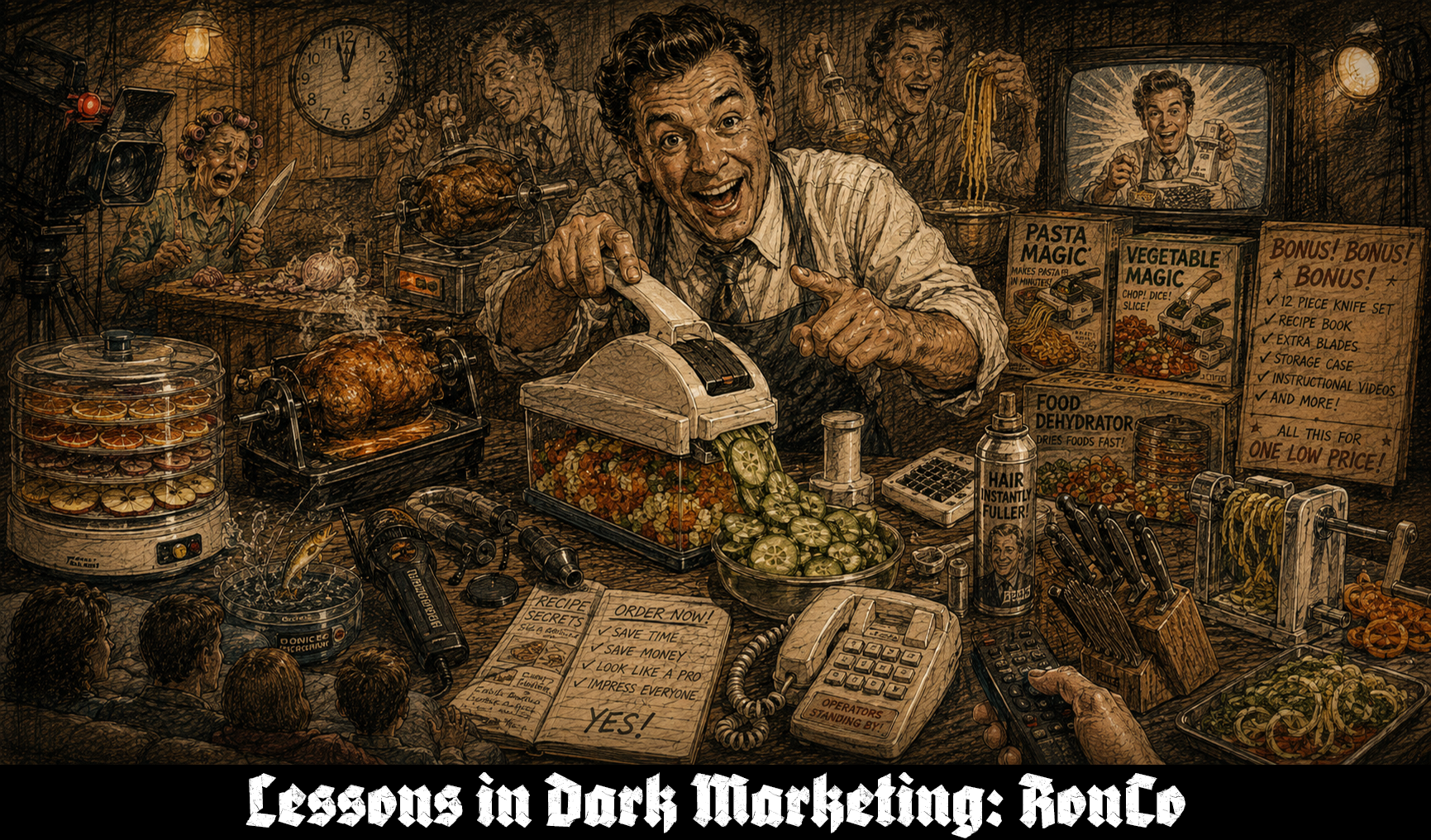
Ronco could make a perfectly functional kitchen look like a filthy medieval punishment chamber. That was the magnificent scam.
Your knives were dull. Your vegetables were uneven. Your chicken was dry. Your pasta came from a box like some kind of peasant. Your hair was thinning. Your fishing rod was inconveniently shaped like a fishing rod. Your eggs remained unscrambled inside their shells because apparently God had abandoned the American household.
Then Ron Popeil appeared.
He had a gadget, a demonstration, a solution, an offer, a bonus, another bonus, a larger bonus, and just when you thought the deal had finally reached the edge of human decency, the man leaned forward and announced:
“But wait, there’s more.” Of course there was more. There’s always more.
Ronco didn’t merely sell products. It created problems while the camera was running. The infomercial took ordinary household friction, exaggerated it into humiliation, introduced a countertop miracle, and kept stacking value until refusing to order felt like financial malpractice.
The product might have been a slicer, rotisserie, dehydrator, microphone, fishing rod, pasta maker, knife set, or aerosol can of hair-colored optimism. The machine remained largely the same.
- First, make the old method look unbearable.
- Then perform the miracle.
- Then increase the offer.
- Then repeat everything until resistance becomes exhaustion.
We’re looking at consumer desire manufactured during the presentation, not a simple explanation of existing demand.
The products were gadgets. The machine was televised conversion theater. That is the case study.
The Infomercial Invented the Need While Selling the Solution
Most conventional advertising assumes the customer already understands the problem. Ronco could not rely on that luxury.
Nobody woke up in a cold sweat because they did not own an Inside-the-Egg Scrambler. Very few marriages were hanging by a thread because the household lacked a Pocket Fisherman. America was not marching in the streets demanding aerosol hair fibers, countertop food dehydrators, or vegetables sliced at the speed of industrial logging equipment.
The desire had to be created. That is what the infomercial did.
It began by turning an ordinary activity into a painful mess. A knife struggled through a tomato. A chicken required basting. A pile of vegetables demanded time, skill, patience, and cleanup. The old method was made to look exhausting, unreliable, wasteful, and vaguely insulting.
Then the Ronco product entered the frame.
Suddenly, the task became smooth. The machine sliced, spun, sprayed, cooked, sealed, sharpened, or rotated with suspicious studio perfection. The customer had not arrived with a need. The presentation built the need in real time, then immediately relieved it.
This is dark marketing principle number one: When demand does not exist naturally, manufacture dissatisfaction with the customer’s current method.
Ronco did not wait for the audience to identify a problem. It taught the audience how to resent something they had tolerated five minutes earlier.
The Demonstration Became the Argument
Ron Popeil came from the world of live product pitching, where the object had to prove itself in front of a crowd.
Television gave that instinct a much larger stage.
The Veg-O-Matic was particularly suited to the medium because viewers could understand it instantly. Put in the vegetable, push down, and watch uniform pieces fall out. The New Yorker described the product as a near-perfect marriage of television and gadget because the machine could become the star of a quick, transparent demonstration.
That is the secret. Ronco products did not need abstract brand campaigns about family, heritage, or emotional authenticity. They needed a potato and a camera.
The demonstration replaced the argument. The viewer saw the object perform and began imagining the object at home. There was no need to read specifications or compare alternatives. The visual transformation created its own momentum:
- Whole vegetable.
- Push.
- Perfect slices.
What else do you need, a peer-reviewed study?
That visual clarity was especially important because many Ronco products might have sounded ridiculous in ordinary conversation. A product pitch can survive absurdity when the demonstration is satisfying enough.
This is dark marketing principle number two: If the product sounds unnecessary, make it visually irresistible.
Ronco did not ask the viewer to believe in the gadget. It let the gadget perform a little miracle and allowed the viewer’s imagination to handle the rest.
Ordinary Inconvenience Became Domestic Failure
Ronco advertising rarely treated inconvenience as a neutral part of life. Inconvenience meant you were doing something wrong.
The dull knife was not merely dull. It was wasting your time. The conventional oven was not merely an oven. It demanded attention, basting, checking, turning, and the constant threat of dry poultry. Store-bought pasta was not simply convenient food. It was evidence that you had surrendered the possibility of fresh, homemade excellence.
The infomercial placed the viewer on trial.
- Look at this mess.
- Look at this wasted food.
- Look at how hard you are working.
Look at the uneven slices, the dry meat, the disappointing hair, the tangled fishing equipment, the miserable kitchen. What kind of life are you running here, jagoff?
Then the product arrived as acquittal.
This was never just product education. It was emotional escalation. The audience had to feel the old way failing before the new way could feel miraculous.
This is dark marketing principle number three: A product becomes urgent when the old method is reframed as evidence of personal incompetence.
Ronco did not merely promise improvement. It created mild shame around continuing without the product.
Ron Popeil Was the Authority Because He Was the Salesman
Ron Popeil did not look like a detached celebrity reading copy for a product he had never touched. He looked like the man who had spent all afternoon in the kitchen figuring out how to prove you were an idiot for not owning it.
That mattered.
His authority came from visible familiarity. He operated the gadget. He explained the mechanism. He anticipated objections. He showed multiple uses. He moved with the confidence of somebody who had delivered the pitch a thousand times and would happily deliver it a thousand more.
The host and the inventor blurred together. That gave the pitch an unusual credibility. The audience was not watching an actor pretend to love a countertop appliance. They were watching the product’s chief evangelist personally put it through the routine.
Popeil also understood how to sell without appearing embarrassed by selling. There was no apologetic distance. No ironic wink. No corporate language about “solutions.” He was there to move product, and he treated that job like a legitimate public service.
That confidence reduced the customer’s embarrassment.
If Ron could present the machine with complete conviction, the viewer could order it without feeling like the only sucker in the room.
This is dark marketing principle number four: The salesperson becomes authority when nobody understands the product’s theatrical strengths better than they do.
Popeil was not standing between the product and the customer. He was part of the product.
“But Wait, There’s More” Turned Completion Into Suspense
“But wait, there’s more” is one of the greatest pieces of consumer conditioning ever smuggled into a sales pitch.
The phrase interrupted closure. The viewer believed the offer had been explained. The price had been given. The value had been established. The decision point was approaching. Then Ron stopped the decision.
Wait. There’s more.
That pause created suspense inside a commercial transaction. The viewer was trained to expect the deal to keep improving. Another attachment appeared. Another tool. Another blade. Another tray. Another instructional item. Another product supposedly included because Ron had apparently lost control of the warehouse.
The phrase made abundance feel imminent.
It also trained the customer not to evaluate the offer too early. Why make a decision now when the next thirty seconds may reveal another miracle? The audience remained inside the pitch because leaving before “more” arrived felt like abandoning value.
Ronco’s current branding still describes “But wait…there’s more” as its legendary tagline, showing how thoroughly the phrase became attached to the company’s identity.
This is dark marketing principle number five: Never let the offer feel complete while the customer still has resistance left.
“But wait, there’s more” was not a sentence. It was a retention device.
Bonus Stacking Made Hesitation Look Irrational
The bonus was one of the infomercial’s most useful weapons. A customer might hesitate over the core product. The price could feel high. The need could feel weak. The countertop could already be buried under the previous generation of plastic miracles.
Then the bonuses began.
- A knife.
- A tray.
- A recipe guide.
- A second gadget.
An attachment that solves a problem nobody mentioned until eleven seconds ago. Each bonus inflated the perceived gap between price and value. The offer became harder to reject because the customer was no longer evaluating one product. They were confronting a pile.
That pile did not need to contain things the customer genuinely wanted. It needed to look larger than the payment.
This is where direct-response arithmetic becomes emotional rather than financial. Ten mediocre items can feel like a better deal than one useful item if the presentation counts them aggressively enough.
The bonus stack also changed the fear. At the beginning of the infomercial, the customer feared wasting money by buying. By the end, the customer feared wasting value by refusing.
This is dark marketing principle number six: Stack enough additions onto the offer and caution begins to feel like loss.
Ronco made the buyer imagine everything they would fail to receive by walking away.
“Free” Was an Emotional Word Before It Was an Accounting Word
Direct-response advertising has always understood the magical power of “free.” The bonus could be included. Added. Doubled. Thrown in. Yours at no additional product cost. The exact terms might appear elsewhere in smaller language, but emotionally, the customer heard one thing:
Free.
That word suspends adult judgment.
A buyer who would question the need for one gadget may celebrate receiving a second gadget they need even less. The second object gains value because it has been liberated from price, even when the broader offer still carries conditions and costs.
The FTC’s guidance on “free” offers exists precisely because the term is such a powerful promotional device and because material conditions must be disclosed clearly enough to prevent misunderstanding.
Ronco’s larger lesson is not that every bonus was deceptive. The darker lesson is that “free” changes the customer’s emotional accounting. Once the word enters the pitch, quantity begins overpowering usefulness.
This is dark marketing principle number seven: Call the addition free and the customer may stop asking whether the addition has value.
A free object can become the decisive reason to buy a product the customer did not need in the first place.
Long-Form Advertising Wore Down Resistance
A standard commercial has seconds. An infomercial has time. That difference changes everything.
Long-form selling allows the advertiser to repeat the problem, demonstrate the solution, answer objections, introduce testimonials, show alternate uses, reveal bonuses, restate the price, compare the product with expensive alternatives, and circle back to the demonstration after the viewer’s skepticism has softened.
The infomercial does not merely communicate. It occupies.
The viewer may have encountered the program while channel surfing late at night, sitting alone, tired, bored, or half-paying attention. The infomercial then creates its own little world. The same product remains on screen long enough to become familiar. Familiarity becomes comfort. Comfort becomes plausibility.
The host does not need to win immediately. He can keep talking. That is the advantage.
Every minute gives the pitch another chance to weaken an objection. Every demonstration refreshes desire. Every bonus creates a new reason to stay. The viewer is not pressured through speed alone. They are softened through duration.
This is dark marketing principle number eight: When the customer resists the first pitch, extend the pitch until resistance becomes fatigue.
Ronco understood that repetition over time can make an unnecessary product begin to feel inevitable.
The Infomercial Created a World Where the Product Never Failed
Inside a Ronco presentation, the gadget lived under ideal conditions.
- The vegetables cooperated.
- The meat browned.
- The blades cut.
- The pasta emerged.
- The audience applauded.
The countertop remained conveniently clear despite the host unveiling enough attachments to occupy a small industrial park. This was product theater.
A demonstration is never neutral. The seller chooses the lighting, ingredients, sequence, angle, pace, preparation, and result. The product appears in the environment most likely to flatter it.
The customer sees the machine at peak performance without living through the storage, cleaning, assembly, maintenance, malfunction, replacement parts, learning curve, or moment three months later when it becomes a dust-covered monument beside the bread maker.
The infomercial collapses ownership into the most satisfying minute.
This is dark marketing principle number nine: Sell the peak moment and let the customer imagine away the maintenance.
Ronco products were rarely shown resting beneath a stack of unpaid bills and expired coupons. They were shown performing.
“Set It and Forget It” Sold Passivity as Mastery
The Showtime Rotisserie produced one of Popeil’s other defining phrases:
“Set it and forget it.”
The official Ron Popeil history lists the Showtime Rotisserie among his best-known products, while contemporary accounts identify the phrase with his television pitch for the appliance. (Ron Popeil)
The phrase is brilliant because it turns absence into a benefit. Traditional cooking requires attention. Check the temperature. Turn the meat. Adjust the heat. Baste. Watch. Think.
Ronco offered release. Put the food inside, set the controls, and stop participating. The machine becomes the competent adult in the kitchen while the customer walks away.
That is an extremely first world fantasy.
The customer gets the pride of a completed meal without the anxiety of active preparation. The product does not merely save time. It performs responsibility on the owner’s behalf.
“Set it and forget it” also reduces fear around the machine. The phrase promises that the process is simple enough to trust. You do not need expertise. You do not need vigilance. You do not need to hover around the appliance like an Italian grandmother protecting Sunday dinner from a family of culinary vandals.
This is dark marketing principle number ten: The best convenience promise lets the customer claim the result while outsourcing the attention.
Ronco sold culinary competence through strategic disengagement.
The Product Became a Shortcut to a Better Identity
Ronco gadgets rarely stopped at solving the immediate task. They implied a better version of the customer.
- The food dehydrator could make you more self-sufficient.
- The pasta maker could make you more authentic.
- The rotisserie could turn you into the person who served beautiful meals.
- The knife set could make you feel competent.
- Mr. Microphone could make you entertaining.
- The Pocket Fisherman could make you ready for spontaneous adventure.
- GLH-9 could make you look like a man whose scalp had not recently filed for bankruptcy.
The product became a shortcut to identity. That is much stronger than simple utility. The viewer was not buying an appliance. The viewer was buying the fantasy of becoming productive, prepared, admired, attractive, healthy, efficient, or interesting.
The gadget compressed transformation into a transaction.
This is dark marketing principle number eleven: Sell the identity created by using the product, even when the customer may barely use the product.
The machine did not have to remain central to the customer’s life. It only needed to make the improved self feel purchasable during the infomercial.
The Kitchen Became a Stage for Miracles
Ronco understood that the kitchen was full of repeatable pain.
- Cutting.
- Cooking.
- Cleaning.
- Measuring.
- Waiting.
- Watching.
- Storage.
- Waste.
Every repetitive task could be reclassified as a product opportunity. That made the kitchen perfect for direct-response theater. The audience already recognized the work. The results were visual. The ingredients were familiar. The improvement could be demonstrated quickly.
The kitchen also carried emotional weight. Food is tied to family, competence, hospitality, health, thrift, status, and care. A gadget could therefore sell much more than sliced vegetables.
It could sell the feeling of becoming the person who had dinner under control. That promise was especially powerful because domestic labor rarely ends. There is always another meal, another ingredient, another mess, another reason to feel behind.
Ronco turned that endless work into an endless product pipeline.
This is dark marketing principle number twelve: Enter a category where the labor repeats and the product can keep promising permanent relief.
The kitchen was not merely where the gadgets lived. It was the anxiety factory that made them plausible.
The Product Name Did Half the Pitch
Chop-O-Matic. Veg-O-Matic. Showtime Rotisserie. Pocket Fisherman. Mr. Microphone. Inside-the-Egg Scrambler. The names had no interest in subtlety. Good.
A direct-response product name should explain itself before the customer has time to wander off. Ronco names usually told you what the object did, what category it belonged to, or what fantasy it offered.
The suffix “-O-Matic” was particularly effective because it made ordinary action sound mechanized, automatic, and futuristic. Attach it to a kitchen task and suddenly the customer was no longer chopping vegetables. The machine was processing them through modern science.
The names also made parody easy.
That could have been dangerous for a prestige brand. Ronco did not require prestige. Every parody repeated the naming system and reinforced the larger category of televised miracle gadgets.
This is dark marketing principle number thirteen: Name the product like a demonstration and customers can understand the promise before seeing the machine.
Ronco did not waste precious attention on poetic branding. It called the contraption what the contraption did.
The Product Was Built to Be Shown to Other People
Many Ronco products contained a social feature the packaging did not need to print:
- Watch this.
- That is the sentence the owner imagined saying.
- Watch this knife cut through something absurd.
- Watch this machine slice the vegetable.
- Watch this chicken rotate.
- Watch this microphone put my voice on the radio.
- Watch this spray make the bald spot negotiate with reality.
The gadget became a household performance. That matters because demonstration products gain another layer of value from social attention. The buyer is not only purchasing utility. They are purchasing a future reveal.
The reveal lets the owner briefly become Ron Popeil. They can repeat the pitch, perform the transformation, and wait for the reaction. The product carries its advertising into the home because the owner reenacts the commercial for friends and relatives.
This is dark marketing principle number fourteen: When customers can easily demonstrate the product, ownership becomes unpaid sales training.
Ronco did not merely ship appliances. It shipped miniature stages.
Repetition Turned the Pitchman Into a Familiar Visitor
Ron Popeil appeared so frequently that his presence became part of American television culture. His official history says his media buys saturated American television for decades, while contemporary profiles describe his products and pitches as cultural fixtures that generated enormous sales. That repetition created familiarity.
The viewer may not have trusted every product, but they recognized the man. Recognition lowers resistance. The pitchman begins to feel less like a stranger and more like the relative who keeps showing up with another kitchen gadget and an alarming level of confidence.
This is one reason direct-response personalities matter. The host carries equity from one product to another. A successful demonstration teaches the customer to pay attention to the next one. The audience begins to trust the format even when the object changes.
Ronco became a system. The slicer could lead to the dehydrator. The dehydrator could lead to the pasta maker. The pasta maker could lead to the rotisserie. The pitchman remained the organizing principle.
This is dark marketing principle number fifteen: When the salesperson becomes familiar enough, each new product borrows credibility from the previous pitch.
Ron Popeil was the human continuity between a warehouse full of unrelated contraptions.
The Countertop Became a Graveyard of Purchased Optimism
The darker truth about many kitchen gadgets is that the customer often buys the life imagined around the product rather than the product’s actual role in daily life.
The pasta maker promises homemade meals. The dehydrator promises healthy snacks and self-sufficiency. The rotisserie promises beautiful dinners. The slicer promises efficiency. Then life continues.
Work runs late. Ingredients are missing. Cleanup becomes annoying. The machine has six pieces. The instruction book disappears. The excitement fades. The gadget moves toward the back of the cabinet beside the bread maker, juicer, electric carving knife, fondue set, and other archaeological evidence of previous self-improvement campaigns.
That does not mean the product was always useless. It means the purchase often happened during an emotional peak that daily behavior could not sustain. The infomercial sold a future routine. The customer purchased the tool before proving the routine would exist.
This is dark marketing principle number sixteen: Sell the equipment for the person the customer intends to become before reality can interrupt the fantasy.
Ronco made money in the gap between aspiration and habit.
The Offer Made Immediate Action Feel Responsible
Direct-response advertising does not want the viewer thinking about the purchase tomorrow. Tomorrow has daylight. Tomorrow has comparison shopping. Tomorrow has spouses, budgets, reviews, and the frightening possibility of common sense.
The infomercial needs the decision now.
That is why the pitch uses urgency, limited availability, special television pricing, bonuses tied to immediate response, and a phone number repeated until it starts appearing in dreams. The customer must be made to feel that waiting carries a cost. This is important because the underlying product may not be urgent at all.
Nobody needs emergency pasta production at 1:17 in the morning. The urgency exists inside the offer, not inside the household. That is the trick. The product solves a mild problem. The deadline creates a severe decision.
This is dark marketing principle number seventeen: when the product is not urgent, make the offer temporary.
Ronco could turn a countertop appliance into a now-or-never event without changing anything about the customer’s kitchen.
The Phone Number Converted Entertainment Into Action
The infomercial was entertaining enough to hold attention, but every minute pointed toward the same destination.
Call now.
The phone number transformed television from passive entertainment into a transaction channel. The viewer did not need to visit a store, remember the product tomorrow, or explain the decision to a retail employee.
They could order from the chair. That reduction in friction mattered enormously. The emotional peak created by the demonstration could move directly into purchase. The fewer steps between desire and payment, the less time available for doubt to return.
This is now ordinary in online commerce. See product. Tap link. Enter payment. Buy. Ronco was operating the earlier version through broadcast television and telephone ordering. The infrastructure was slower. The psychology was already complete.
This is dark marketing principle number eighteen: Build the purchase mechanism close enough to the emotional peak that reason cannot catch up.
The phone number was not administrative information. It was the exit ramp from persuasion into revenue.
Ronco Was Pre-Internet Creator Commerce
Ron Popeil was simultaneously the inventor, host, demonstrator, authority, personality, and sales channel.
That sounds familiar.
Modern creators sell cookware, cosmetics, supplements, courses, gadgets, and private-label products by placing personality between the audience and the transaction. The customer is not merely buying the object. They are buying through someone familiar who demonstrates it, endorses it, explains it, and provides a narrative around ownership.
Ronco operated that system before social media gave every jagoff with a ring light the opportunity to become a household pitchman.
- The platform was television.
- The creator was Ron.
- The content was the demonstration.
- The engagement was the phone call.
- The conversion was the order.
- The bonus stack was the offer architecture.
- The repeated tagline was the content strategy.
This is dark marketing principle number nineteen: Creator commerce did not begin with social media; social media merely gave every pitchman a channel.
Ronco was live-stream shopping before the live-stream, the chat, and the suspiciously enthusiastic affiliate army.
Parody Strengthened the Brand
Ronco became an easy target because the products, names, delivery, and demonstrations were so recognizable.
The company and Popeil were parodied across American entertainment. The official Ron Popeil history even highlights the cultural reach of the products, while contemporary profiles note how closely his pitch style became associated with television salesmanship.
Parody could have embarrassed the brand. Instead, it often confirmed the brand’s importance.
You cannot parody a sales format nobody recognizes. The joke only works when the audience already understands the rhythm: problem, miracle gadget, manic demonstration, incredible offer, and one more thing.
Every parody taught the structure again. That made Ronco bigger than an individual product. It became shorthand for an entire category of American selling.
This is dark marketing principle number twenty: Once parody requires no explanation, the brand has escaped advertising and entered culture.
Ronco could be mocked because Ronco had already won the recognition war.
The Case Study Breakdown
Here is the Ronco machine in plain English:
- The infomercial created dissatisfaction while introducing the product.
- Ordinary inconvenience was exaggerated into domestic failure.
- Visual demonstrations replaced slower rational evaluation.
- Ron Popeil became the authority because he knew how to perform the product.
- “But wait, there’s more” interrupted closure and retained attention.
- Bonus stacking made the offer feel larger than the price.
- The word “free” changed the customer’s emotional accounting.
- Long-form advertising repeated the pitch until resistance weakened.
- Studio demonstrations showed peak performance while hiding ownership friction.
- “Set it and forget it” sold passivity as competence.
- Each product promised access to a better identity.
- The kitchen supplied an endless supply of repeatable problems.
- Product names explained the demonstration before it began.
- Owners could reenact the commercial for friends and family.
- Popeil’s familiarity transferred credibility from one gadget to another.
- Customers bought equipment for future habits they might never develop.
- Temporary offers manufactured urgency around nonurgent products.
- Telephone ordering captured the buyer near the emotional peak.
- Ronco operated like creator commerce decades before social media.
- Parody spread the sales language and strengthened cultural recognition.
That is why Ronco worked. It did not merely identify products people wanted. It showed people a version of ordinary life that suddenly looked inefficient, frustrating, unattractive, and unnecessarily difficult. Then it provided a gadget, a host, a demonstration, a bonus, and a phone number.
This is dark marketing principle number twenty-one: The infomercial wins when the customer begins wanting the product before realizing the program taught them to want it.
Ronco manufactured the desire and closed the sale inside the same television block.
What Marketers Should Learn From Ronco
The first lesson is that demonstration can outperform description.
Ronco products became understandable in seconds because the audience watched the transformation happen.
The second lesson is that a weak need can support a strong offer.
The problem may be small, but the demonstration, bonuses, urgency, and personality can make the transaction feel substantial.
The third lesson is that repetition should carry useful information.
Ronco repeated the product’s name, operation, benefits, price, and ordering instructions until the customer could reconstruct the pitch from memory.
The fourth lesson is that personality can unify unrelated products.
Ron Popeil’s confidence and familiarity turned a collection of gadgets into a recognizable commercial system.
The fifth lesson is that bonuses change the emotional reference point.
The buyer stops asking whether the core product is worth the price and starts calculating how much value seems to be included.
The sixth lesson is that customers often buy intended behavior.
They purchase the pasta maker because they intend to become a person who makes pasta. The marketer sells the imagined routine before the routine exists.
The seventh lesson is that cultural ridicule can become distribution when every joke repeats the structure and product category.
The eighth lesson is that urgency must often be attached to the offer because the underlying problem is not urgent enough to force action.
This is dark marketing principle number twenty-two: The best direct-response systems combine a visible problem, a theatrical solution, a familiar guide, an expanding offer, and an immediate path to payment.
Ronco mastered the entire sequence before modern marketing software turned the same machine into landing pages, countdown timers, creator funnels, upsells, bundles, and one-click checkout.
Final Diagnosis
Ronco belongs in the Lessons in Dark Marketing museum because it proved that television could manufacture a consumer problem, perform the solution, inflate the value, exhaust resistance, and close the transaction without allowing the customer enough distance to ask whether any of this was necessary.
The final diagnosis is rotating slowly beneath the studio lights:
- Ronco turned ordinary household friction into a commercial emergency.
- It made functional kitchens look incompetent and outdated.
- It used demonstrations to bypass lengthy evaluation.
- It transformed Ron Popeil into inventor, host, authority, and salesperson.
- It turned “But wait, there’s more” into an attention-retention system.
- It stacked bonuses until refusal looked financially irresponsible.
- It used “free” to make quantity feel like value.
- It stretched the pitch long enough to weaken resistance.
- It showed products under ideal conditions and sold the peak moment.
- It turned “Set it and forget it” into a fantasy of effortless competence.
- It sold gadgets as shortcuts to identity and self-improvement.
- It mined the kitchen for endless repeatable anxieties.
- It named products like miniature demonstrations.
- It turned customers into secondary pitchmen inside their own homes.
- It monetized the gap between aspirational purchasing and actual habit.
- It manufactured urgency around products nobody urgently needed.
- It moved viewers from emotional excitement directly into telephone ordering.
- It created creator commerce before creators had platforms.
- It converted parody into cultural reinforcement.
- It proved that enough confidence, repetition, bonuses, and studio lighting can make almost any contraption feel like a household revolution.
That is why Ronco belongs beside The Clapper, Chia Pets, Life Alert, Avon, Tupperware, Tang, TV dinners, Reader’s Digest, Jell-O molds, Virginia Slims, and every modern sales funnel that turns a minor frustration into a limited-time offer with three bonuses and a countdown clock.
Ronco did not merely sell kitchen gadgets. It trapped ordinary inconvenience inside a television studio, beat it senseless with a product demonstration, and kept adding bonuses until hesitation looked financially irresponsible.
A dull knife. A dry chicken. A bald spot. A badly sliced tomato. A fisherman burdened by the outrageous dimensions of a normal fishing rod. A household that had somehow survived generations without mechanized vegetable domination.
Then Ron Popeil appeared with the answer.
He sliced. He diced. He sprayed. He rotated. He demonstrated. He repeated the phone number.
And just when the American consumer thought the pitch was finally over, the man looked directly into the camera and delivered the three most dangerous words in televised retail.
But wait. There’s more.
Leave a Reply