
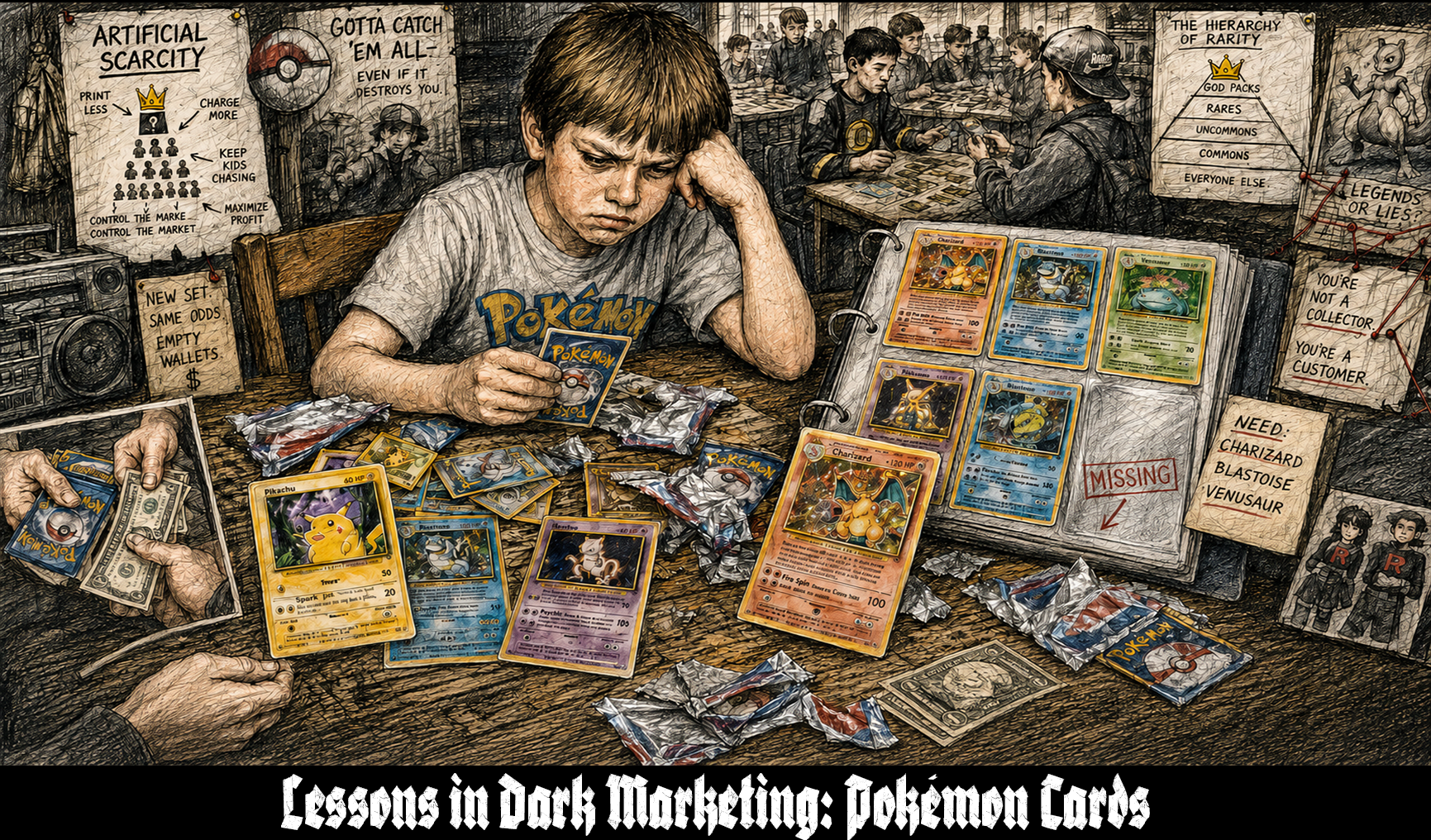
Somewhere in the world during 1999, a child sat at a kitchen table surrounded by torn foil wrappers, bent cardboard, six energy cards, three duplicates, and the rapidly collapsing patience of whichever parent had financed the entire operation.
The child had technically received everything promised by the package. There were genuine Pokémon cards inside. Some contained creatures. Others contained trainers, attacks, statistics, and enough tiny printed instructions to qualify the purchase as educational under the desperate standards of suburban parenting.
The child was still disappointed. There was no holographic Charizard. There was no Blastoise, Venusaur, Mew-two, or other cardboard dignitary capable of establishing playground authority before lunch. The purchase had increased the child’s possessions, expanded the collection, and produced several usable game pieces. The marketing machine had nevertheless trained the customer to experience this material gain as failure.
That is the whole foil-wrapped crime scene.
Pokémon began as a pair of Game Boy titles released in Japan in February 1996. The Pokémon Trading Card Game followed in Japan that October. The animated series arrived in Japan in 1997, while the television show and Pokémon Red and Blue reached the United States in 1998. The American Base Set launched in January 1999, after the games and television series had already introduced children to the creatures, their personalities, their relative power, and the central obligation to capture them.
Creatures Inc. developed the card game, while Wizards of the Coast handled the early American release. The cards became such a commercial force that Hasbro agreed to purchase Wizards of the Coast for $325 million in September 1999. At the time, analysts estimated that Pokémon cards alone could generate approximately $225 million in sales during that year.
The physical product was a strategic card game. Players could construct decks, manage energy, compare strengths and weaknesses, calculate damage, anticipate an opponent’s decisions, trade cards, attend organized events, and appreciate an enormous range of illustrations.
The machine was something else. The machine combined character attachment, randomized acquisition, visible rarity, incomplete sets, social comparison, peer enforcement, speculative value, continuous expansion, and one of the most commercially efficient slogans ever pointed at a child.
Pokémon cards did not merely offer creatures to collect. Pokémon cards defined completeness, hid the path to completeness inside sealed packages, assigned unequal status to the contents, and placed the entire system inside schools where children could advertise, appraise, trade, envy, pressure, and occasionally swindle one another without the company renting a single square foot of retail space.
We’re looking at childhood desire converted into an endlessly renewable purchasing obligation, not merely a card game.
The cards a kid had was the evidence. The real product was the card a kid was missing.
The Slogan Turned Collecting Into Homework
“Gotta Catch ’Em All” sounded like an invitation to adventure. It was also a command, a purchasing objective, a definition of success, and a diagnosis of failure compressed into four words.
That slogan did something most toy advertising never accomplishes. It told the child exactly when ownership would become sufficient, then established a standard almost nobody could realistically satisfy.
Liking Pikachu was insufficient. Owning a Pikachu was insufficient. Having several favorite creatures was insufficient. Building a deck capable of winning against friends was insufficient. The child had been assigned a mission whose natural endpoint required possession of the entire Pokémon commercial universe.
That transformed collecting from a casual activity into unfinished work. A toy usually satisfies the transaction when the customer receives the toy. A collection remains psychologically open as long as one numbered space stays empty. The binder does not celebrate the ninety cards already present. It directs attention toward the twelve missing cards with the bureaucratic cruelty of an unpaid utility bill.
The slogan also transferred responsibility for dissatisfaction onto the child. The company had produced the cards, distributed the packs, broadcast the show, and supplied the mission. The customer remained responsible for failing to catch ’em all.
That is a valuable arrangement for the seller. Every incomplete collection feels like a personal shortcoming rather than a designed feature of the product line. The child does not accuse the manufacturer of constructing an unreachable target. The child requests another booster pack.
The slogan worked across the entire franchise because the games, cartoon, cards, toys, books, and promotional merchandise all repeated the same fundamental behavior. Pokémon were supposed to be discovered, captured, cataloged, trained, compared, traded, and displayed. Accumulation was built into the mythology before the customer reached the card aisle.
This is dark marketing principle number one: Define satisfaction as completion, then retain complete control over what completion requires.
The child could own a binder thick enough to stop a door and still feel like a failed wildlife administrator because one shiny dragon remained at large.
The Booster Pack Hid the Product Until After the Money Changed Hands
A normal retail transaction allows the customer to inspect the product before purchasing it. The buyer sees the shirt, book, toy, sandwich, or household appliance and decides whether that specific object deserves the price. The booster pack reverses the arrangement. The customer pays first. The product reveals itself afterward.
That is a remarkably aggressive commercial privilege. The package conceals which cards are inside, the cards carry unequal desirability, and the emotional value of the purchase remains unresolved until the wrapper has been destroyed. Returning the disappointing pack becomes practically impossible because the act required to inspect the merchandise also eliminates the condition necessary for a return.
In 1999, American Pokémon booster packs generally contained eleven cards. Prices ranging from approximately $3 to $11 while highly desired cards could command more than $100 on the emerging secondary market. Children also brought substantial amounts of cash to school in hopes of purchasing cards directly from classmates.
The sealed wrapper changed what the customer was buying. The child did not purchase Charizard. The child purchased the possibility of Charizard. That distinction allowed the same desired card to motivate repeated transactions without ever being supplied.
The pack also made disappointment commercially productive. A customer who could buy the desired card directly might complete the transaction once. A customer purchasing chances can fail repeatedly while interpreting each failure as evidence that success may be waiting inside the next pack. They had kids literally chasing the dragon.
Physical card packs share formal similarities with digital loot boxes because both exchange money for randomized contents of unequal desirability. Research has cautioned against treating every physical booster pack as clinically equivalent to traditional gambling, and a 2021 study found much weaker evidence connecting physical card-pack spending with problem gambling than researchers have found with some digital loot-box systems. The behavioral resemblance remains useful for marketing analysis: uncertain reward, anticipation, reveal, unequal outcomes, disappointment, and another immediate opportunity to purchase.
Pokémon did not require a roulette wheel, flashing casino floor, or pit boss named Vinnie the snake. That little foil jagoff only needed to conceal the contents long enough for hope to complete the transaction.
This is dark marketing principle number two: When uncertainty creates the emotional payoff, sell repeated chances instead of reliable outcomes.
The child left the register holding eleven cards and one professionally packaged maybe.
Opening the Pack Became a Ceremony
The booster pack did more than conceal the merchandise. It created a ritual around discovering it. The child selected a pack from the display and inspected the wrapper artwork as though one illustration might carry better luck than another. Some customers squeezed the package, weighed it in their hands, compared it with neighboring packs, or developed private superstitions about which pack should be chosen. None of that changed the printed contents. It changed the emotional involvement before opening.
Then came the reveal. The wrapper split. The cards emerged. The customer moved through the commons and uncommon while delaying the card expected to carry the greatest possibility of rarity. The sequence transformed a few dollars of printed stock into a miniature suspense production.
The ceremony mattered because anticipation can become more pleasurable than ownership. The unopened pack contains every desired possibility at once. Charizard may be inside. Blastoise may be inside. The rarest card in the set may be waiting behind the wrapper. Once the package opens, that infinite possibility collapses into another energy card and a creature whose primary market function appears to be disappointing children.
This is why sealed products can retain emotional power even when the buyer already owns hundreds of cards. The collection may be large, but the unopened package still contains mystery. The customer is purchasing an event that lasts several seconds and can be restarted through another transaction.
The reveal also turned purchasing into entertainment. Opening cards could be performed for friends, siblings, classmates, and eventually online audiences. The customer did not simply acquire inventory. The customer staged a small dramatic production with surprise, tension, celebration, and the occasional facial collapse of a child who had just paid a significant portion of their allowance money to discover another Metapod.
This is dark marketing principle number three: Turn product delivery into a ritual so the customer can become addicted to the moment before ownership.
The wrapper was a curtain, the kitchen table was a stage, and another damn energy card was waiting in the wings.
Rarity Created a Cardboard Caste System
Pokémon cards announced their hierarchy through rarity symbols, holographic treatments, character popularity, artwork, set position, promotional distribution, and the immediate reactions of other children.
The cards were physically similar rectangles of printed material. The rarity system gave them dramatically different social weight.
A common card could be useful in a deck and still receive almost no admiration during a binder inspection. A holographic card could become the centerpiece of a child’s public identity even when the owner barely understood the rules printed beneath the illustration. Game-play value and social value occupied neighboring economies.
This distinction allowed rarity to operate beyond the actual game. A child did not need to understand deck construction to recognize a shining surface. The product communicated status visually. That made the hierarchy accessible to young customers, casual collectors, siblings, parents, and classmates who had never completed a full match.
The company established the supply tiers, but children supplied the enforcement. One child opened a binder. Another leaned closer. A third announced that a particular card was rare, valuable, powerful, fake, damaged, improperly sleeved, or somehow worth three of whatever somebody else owned. Within seconds, the group had created a market analysis department beside the cafeteria milk cooler.
Visible hierarchy is commercially useful because it teaches customers to desire upward. The common card explains what ownership looks like. The rare card explains what superior ownership looks like. The customer can participate at the lower level while remaining permanently aware of the higher one.
Every ordinary pull therefore served two purposes. It added another card while reminding the child which class of card had failed to appear. The product line gave every customer something and taught them that something better existed.
This is dark marketing principle number four: Make status visible inside the product so customers can enforce the hierarchy without company supervision.
Pokémon did not need a velvet rope around the rare cards. The holographic foil handled admissions.
Charizard Became the Playground Fort Knox
Every collectible system benefits from one object that absorbs the largest share of desire. Pokémon had Charizard. Charizard was already positioned for importance before many children opened their first pack. The creature looked like a dragon, breathed fire, carried enormous visual authority, and occupied a prominent place in the games and animated series. The card inherited that emotional groundwork.
Once children agreed that Charizard represented the superior prize, the card became more than one collectible among many. It became a measuring instrument.
Other cards could be evaluated according to how many of them might equal one Charizard. Trades could be proposed around its supposed value. Rumors could circulate about who owned one, who had seen one, who had damaged one, and whose cousin supposedly possessed several because every elementary school economy, much like the market itself, requires at least one lying commodities analyst.
A dominant chase object simplifies the market. Children may struggle to memorize every rarity tier, print variation, and strategic value. They can understand that Charizard is the card everybody wants.
That concentrated desire also improved the booster-pack system. The customer did not need to desire every possible rare card equally. One legendary target could justify repeated purchases while every lesser card became a consolation prize.
Charizard’s power came partly from scarcity and partly from consensus. Children watched other children react to the card and learned how important it was supposed to be. Desire became socially authenticated. The card seemed valuable because everybody wanted it, and everybody wanted it because everybody understood that it was valuable.
The same circular logic supports luxury handbags, sneakers, limited watches, speculative collectibles, and suburban houses with kitchen islands large enough to land aircraft. The object becomes proof of importance because the market has already agreed to behave as though possessing it matters.
This is dark marketing principle number five: Give the collection one unmistakable prestige object so every lesser purchase can orbit the fantasy of obtaining it.
Charizard was less a card than a central bank with wings.
The Binder Turned Private Ownership Into Public Evidence
A collection hidden in a bedroom can satisfy the owner. A collection carried into school can recruit customers.
The binder transformed Pokémon ownership into display. Plastic pages arranged cards into rows, empty slots identified missing pieces, duplicates could be grouped together, and prized cards could occupy positions of ceremonial importance.
This created an exhibition system around the merchandise. The child purchased the cards, purchased or borrowed the binder, organized the display, transported it into public, opened it for classmates, and invited comparisons. The company received advertising without purchasing media or compensating the miniature sales representative.
The binder also made quantity visible. A stack of loose cards can feel chaotic. A filled page looks like progress. Several filled pages look like commitment. A nearly complete set looks like a mission that would be irrational to abandon after so much work.
Empty binder spaces were even more useful. They converted absence into something visible and countable. The child could identify exactly where the collection failed. The missing card no longer existed as a vague desire. It occupied a rectangular vacancy between completed achievements.
That vacancy became a purchasing prompt. Every time the binder opened, the customer encountered the unresolved gap again. The product display functioned as a privately maintained advertisement for whatever the owner did not yet possess.
The binder also encouraged preservation. Cards became objects to sleeve, protect, flatten, organize, and keep away from food, water, younger siblings, sticky fingers, and the one friend whose entire handling technique involved bending cardboard at the center. Ownership expanded into maintenance.
This is dark marketing principle number six: Give customers a display system that celebrates possession while repeatedly exposing what remains missing.
The binder looked like storage, but the empty pocket worked the sales floor.
Trading Turned Friendship Into a Marketplace
The word “trading” made the Pokémon Trading Card Game sound social, collaborative, and harmless. It also transformed existing relationships into distribution channels.
A friend was no longer only a friend, they were a friend who possessed inventory.
That changed the structure of childhood interaction. The child carrying desirable cards attracted attention. The child seeking desirable cards initiated conversations. Classmates compared holdings, proposed exchanges, evaluated condition, challenged claims, and developed elaborate theories about fairness without assistance from contract law.
Trading produced genuine social benefits. It gave shy children a structured reason to approach one another. It encouraged negotiation, categorization, memory, communication, and decision-making. A card could begin a friendship because the object supplied a topic before either child had to improvise one.
The same system also created opportunities for pressure, manipulation, exclusion, and wildly uneven deals. Older or more knowledgeable children could exploit younger collectors. Children could regret trades, demand reversals, accuse one another of lying, involve teachers, and transform recess into a securities dispute involving imaginary animals. Playgrounds became informal flea markets and buy-and-sell bazaars. School officials cited conflicts, distraction, aggressive trading, and children carrying significant cash to school for card purchases.
The company did not need to manage every trade. Customer participation expanded the utility of every card. An unwanted pull might still possess value because somebody else wanted it. The trade network therefore softened disappointment and kept cards circulating through the social environment.
Every negotiation also renewed awareness of the product. Children discussed rarity, value, sets, favorites, and missing cards. The customer community continuously refreshed the marketing message through ordinary conversation.
This is dark marketing principle number seven: Design customer interaction so relationships become marketplaces and social activity becomes product circulation.
Friendship entered recess carrying a binder and left with an exchange rate.
Duplicates Turned Failed Purchases Into Working Inventory
Randomized products create a problem for the seller. Customers repeatedly receive items they already own. Pokémon converted that weakness into another feature. A duplicate card could be added to a deck, stored as a backup, traded to another child, given to a sibling, displayed in a separate collection, or retained because someone had declared that it might become valuable later. The disappointing card rarely had to be treated as completely useless.
This protected the booster pack from practical judgment. When a child opened another common card, the purchase could still be defended as producing trade material. The product supplied its own excuse before the parent finished asking what happened to the money.
Duplicates also created liquidity. A child could enter the trading economy without surrendering a favorite card. Repeated ownership produced negotiable surplus, and negotiable surplus generated more interactions with other collectors.
That social usefulness changed the emotional status of failure. The pack had failed to deliver the desired card, but the contents could be reassigned to a future transaction. Disappointment became inventory.
The system worked especially well because children controlled the valuation. One classmate might dismiss a duplicate as worthless. Another might need that exact card to complete a page, improve a deck, or satisfy an inexplicable attachment to a weak creature. The same piece of cardboard could recover value by moving to a different customer. That possibility prevented the product from reaching a dead end. Almost every card could return to circulation. The failed purchase remained active inside the ecosystem, where it could motivate trades, comparisons, and additional purchases.
This is dark marketing principle number eight: Give disappointing outcomes a secondary function so failure can continue moving through the market as value.
The fourth Weedle had not been wasted. It had been promoted to regional trade liaison.
The School Ban Became Proof That the Product Mattered
By late 1999, schools across the United States were restricting or banning Pokémon cards because the trading, arguing, buying, selling, and collecting had become disruptive. Bans from Connecticut to California handed down by administrators dealing with distraction, damaged friendships, missed buses, classroom interruptions, cash transactions, and disputes over trades. My elementary-school principal described the craze as having become a monster, which was unusually accurate branding for an administrator attempting to stop pocket monsters.
A school ban should theoretically damage a children’s product. In practice, prohibition can increase cultural importance. The ban communicates that the object carries enough power to frighten adults. The card is no longer merely a toy. It is contraband. Bringing it to school becomes a small act of rebellion. Possession gains excitement because authority has confirmed that something serious is happening.
The controversy also generated media coverage. Parents who did not understand Pokémon learned that children were obsessed with it. Teachers discussed it. News outlets explained it. Psychologists commented on it. Every attempt to diagnose the craze repeated the product name and demonstrated the intensity of demand.
Scarcity of access can also intensify desire. A child prohibited from trading during school does not necessarily stop wanting cards. The activity moves to sidewalks, buses, bedrooms, parks, after-school programs, and private conversations. Restriction changes the location while preserving the obsession.
The bans supplied social proof at a national scale. A product capable of disrupting schools from coast to coast appeared culturally unavoidable. Parents could reject it and risk making their child the only person excluded from the conversation, or they could purchase a few packs and hope civilization survived.
This is dark marketing principle number nine: When authority reacts to a craze, the reaction can certify the product’s cultural power.
The principal confiscated the binder and accidentally issued a press release.
The Cartoon and Video Games Pre-Sold the Emotional Attachment
The Pokémon cards did not introduce unknown characters and ask children to care about them. The emotional work had already been performed.
Children had watched Pikachu refuse a Poké Ball, seen Charmander abandoned in the rain, chosen starter Pokémon in the Game Boy titles, battled gym leaders, memorized creature types, argued about evolutions, and developed personal favorites before encountering many of the cards.
That sequence mattered. The card was never only an illustration. It represented a creature the child already knew.
A generic fire dragon printed on cardboard might attract attention. Charizard carried memories, victories, television episodes, game strategy, personality, and status. Pikachu arrived with an established emotional biography. The product entered the store carrying attachment manufactured across several media.
The franchise also made each medium advertise the others. The television series promoted the creatures. The games taught collection and battling. The cards converted those activities into a portable physical system. Movies, toys, books, fast-food promotions, and clothing kept the imagery visible between purchases.
This is more powerful than ordinary licensing. The products didn’t just share logos. They trained the same behavior. The child watched characters being collected and battled, collected and battled them in the video game, then purchased cards that allowed another form of collecting and battling.
The customer moved through the franchise while repeating the core commercial action. Every medium made the next purchase feel like continuation rather than expansion.
That distinction reduces resistance. A child asking for Pokémon cards does not appear to be adopting a new hobby. The cards feel like another part of the world already entered through television and games.
This is dark marketing principle number ten: Build emotional attachment in one medium and collect the transaction in another.
The cartoon introduced the friends, the Game Boy assigned the mission, and the cards sent the monthly invoice.
The Actual Game Gave Randomized Collecting Respectability
Pokémon cards were never empty branded cardboard. The game possessed legitimate strategic depth. Players constructed decks, balanced Pokémon with trainer and energy cards, managed resources, calculated damage, anticipated weaknesses, planned evolutions, and adjusted to shuffled draws. Organized play eventually created leagues, judges, tournaments, and international championships. The Pokémon Company’s official history records the first Pokémon World Championships in 2009, while the company continues to support competitive and casual card play.
This genuine utility matters because it explains the product’s longevity. A fad built entirely on novelty eventually collapses when the novelty wears off. A functioning game provides reasons to retain the cards, purchase new ones, meet other players, study strategies, and return after the original childhood frenzy has passed.
The game also protected the purchasing system from criticism. Parents could view the cards as a strategic hobby rather than simple consumption. Children could point toward reading, arithmetic, memory, planning, and social interaction while privately pursuing the emotional blast of opening a rare card.
The respectable activity and the randomized acquisition system occupied the same package. That allowed each to defend the other. When critics focused on collecting, supporters could discuss the strategy. When parents questioned the expense, children could explain deck construction. When the cards appeared frivolous, the rule-book supplied intellectual dignity.
Many children barely played the formal game. Their cards lived in binders, pockets, boxes, plastic sleeves, and bedroom piles that resembled evidence collected after a tiny casino raid. The existence of the game still gave every card a theoretical purpose.
That theoretical purpose was commercially valuable. A useless duplicate might become strategically relevant. A less popular creature might possess a useful attack. A new expansion might change the competitive environment and turn an overlooked card into something desirable.
This is dark marketing principle number eleven: Attach genuine utility to an emotionally driven product so the practical benefit can defend the entire sales machine.
The rule-book stood at the front door wearing a tie while the booster packs ran a numbers racket in the basement.
Educational Benefits Gave Parents a Respectable Explanation
Pokémon cards required children to read, calculate, memorize, organize, negotiate, compare, plan, and make decisions. Those benefits were real. A child studying card statistics practiced numerical comparison. Building a deck required categorization and basic probability. Playing involved reading comprehension, sequencing, and strategy. Trading encouraged negotiation and communication. Organizing a collection required attention to sets, symbols, names, and systems.
For some children, Pokémon created motivation that school materials failed to generate. A reluctant reader might study a card because understanding the attack mattered socially. A shy child might communicate more comfortably through a structured game. A student uninterested in arithmetic might suddenly calculate damage because a plastic trophy, cafeteria reputation, and a Psyduck were at stake.
Those benefits made the product easier for adults to approve. A parent could purchase cards while describing the expense as educational, social, or intellectually stimulating. The pack became easier to justify because the contents appeared capable of producing development rather than merely demanding another allowance payment.
The educational framing also reduced conflict between child and parent. The child wanted status, surprise, favorite creatures, and rare cards. The parent wanted reading, strategy, socialization, and a quiet afternoon. The same purchase allowed both parties to tell themselves a different story.
This is one of dark marketing’s most useful arrangements. A product can satisfy an emotional desire while offering a practical explanation that sounds better when repeated to another adult. The legitimate benefits should not be dismissed. They helped Pokémon become more than a disposable craze. The manipulation appeared when those benefits were allowed to shield the entire acquisition system, including repeated purchases driven primarily by rarity, disappointment, and social pressure.
This is dark marketing principle number twelve: Give the buyer a respectable reason to approve the purchase while the customer pursues a less respectable emotional reward.
The parent bought literacy, and the child bought a chance to humiliate Brandon at recess.
New Sets Moved the Finish Line Before Satisfaction Could Arrive
A collection becomes commercially dangerous when the customer can finish it. Completion creates satisfaction. Satisfaction creates stopping. Stopping is terrible for quarterly growth. Pokémon solved this through expansion sets, new creatures, new artwork, promotional releases, alternate treatments, evolving mechanics, and later generations of the franchise. The customer could complete one set and immediately discover another definition of completeness.
The expansion system had a legitimate creative purpose. New cards kept game-play from becoming stagnant. They introduced strategies, combinations, illustrations, and creatures. Competitive environments could evolve, collectors could discover new art, and new customers could enter through current products rather than hunting for material printed years earlier.
The commercial outcome remained equally important. Every release reopened acquisition. A child who had collected the Base Set could move toward Jungle, Fossil, Team Rocket, and later expansions. New video games introduced new generations of Pokémon, which supplied new characters for the card system. The world grew, and the shopping list grew with it.
This was more effective than simply reprinting the same merchandise. The company framed additional inventory as discovery. The customer was not being asked to buy more cardboard. New creatures had appeared. New regions existed. New strategies had become possible. The universe had expanded, and apparently the binder had a civic duty to keep up.
Continuous expansion also protected the slogan. Catching them all could remain the mission because “all” was a temporary quantity. Every completed objective waited for corporate revision.
The customer could experience progress without ever reaching permanent closure. That is the ideal commercial state: enough achievement to preserve motivation, enough incompleteness to preserve purchasing.
This is dark marketing principle number thirteen: When the customer approaches completion, expand the world faster than the collection can close.
Pokémon left the finish line in place and attached it to the back of a moving truck.
First Editions and Condition Created Scarcity Inside Scarcity
Random rarity was only the first layer. Pokémon cards eventually developed hierarchies based on print runs, editions, promotional origins, production variations, language, condition, and professional grading.
That allowed two visually similar cards to carry dramatically different collector value. A child could own Charizard and later discover that the card lacked the correct edition marker, belonged to a less desirable printing, had whitening along the edges, contained a scratch across the holographic surface, or had been permanently disqualified from greatness by being carried in a pocket beside a leaking fruit snack.
This expanded the definition of rarity. The customer no longer needed merely to own the character. The customer needed the correct version in the correct condition.
Professional grading pushed this logic further by assigning numerical judgments, sealing cards inside protective cases, recording populations, and transforming tiny defects into price differences. PSA continues to maintain separate registries and population information for first-edition, Shadowless, and other Base Set varieties, demonstrating how collecting eventually became forensic enough to distinguish entire asset classes through minor printing details.
Condition anxiety changed how the product was handled. A game piece was supposed to be shuffled, played, traded, and touched. A collectible asset was supposed to remain flat, centered, clean, sleeved, graded, protected, and preferably untouched by the child who supposedly owned it.
This tension created another commercial miracle. The same card could encourage play while becoming more valuable when preserved from play. Customers could purchase cards for decks, cards for binders, cards for grading, and sealed products intended to remain permanently unopened. The product no longer needed consumption to generate value. Refusing to use it became another form of participation.
This is dark marketing principle number fourteen: Create distinctions within rarity so ownership can remain inadequate even after the customer obtains the desired object.
The dragon had finally been caught, but the corner showed whitening, so the family remained in disgrace.
The Secondary Market Made Playground Rumors Feel Like Finance
Pokémon cards developed resale value almost immediately. Children understood that certain cards could be exchanged for money, large groups of lesser cards, or enough social leverage to dominate several recess periods.
In 1999 sought-after cards were selling for more than $100 and had kids bringing their parents cold hard cash to school to buy them.The aggressive trading and hoarding of Pokémon cards is like schoolyard stock-market speculation, with children holding cards because they expect somebody else to pay more later. That secondary market changed the emotional meaning of the original purchase. A booster pack no longer contained only game pieces and collectibles. It might contain profit.
The possibility of resale supplied financial moral cover. A parent could tolerate the expense because the cards might become valuable. A child could describe collecting as investment. A disappointing pack could be defended by the future possibility that ordinary cards might appreciate.
Most cards would never produce spectacular returns. That fact mattered less than the existence of a few examples capable of supporting the fantasy. A market does not need every participant to profit. It needs enough visible winners to keep possibility alive. One highly valuable card can provide justification for thousands of unsuccessful purchases because every sealed pack appears to contain a private route toward the exceptional outcome.
Children began learning speculative language before many understood interest rates. They discussed value, scarcity, condition, demand, trade ratios, and future appreciation. The playground looked like a flea market because the product had supplied enough financial mythology to make friendship feel like floor trading.
This also intensified regret. Trading away a card that later became valuable could haunt the former owner for decades. Damaging a card became a financial mistake. A parent discarding a childhood collection became the villain in an adult story about hypothetical wealth.
This is dark marketing principle number fifteen: Let a few exceptional resale outcomes provide investment language for a market driven mainly by emotion.
The allowance purchase entered the house as a toy and demanded to be treated like a retirement account.
Millennial Nostalgia Put a Necktie on the Childhood Compulsion
Millennials eventually aged out of elementary school, but the Pokémon card machine did not lose them. It waited. The children became adults with salaries, credit cards, display shelves, online marketplaces, climate-controlled storage, professional grading services, and unresolved feelings about the holographic card they never obtained.
Nostalgia reopened the customer relationship. The cards represented childhood bedrooms, school lunches, Game Boy batteries, Saturday-morning television, mall stores, neighborhood friendships, and a period before student debt, housing costs, layoffs, health insurance, and seventeen monthly subscriptions began feeding on the adult paycheck.
Purchasing Pokémon cards could feel like emotional recovery. The adult was not just buying cardboard. The adult was reclaiming a missed experience, restoring a lost collection, correcting a bad childhood trade, or purchasing the pack that a parent had refused twenty-five years earlier.
Resale language made the return easier to defend. The adult collector was investing in sealed product, monitoring populations, acquiring graded assets, diversifying the collection, and studying market trends. Childhood desire returned wearing business-casual clothing.
The market produced real high-value sales, and some collectors genuinely profited. PSA records active pricing and population data for multiple Charizard varieties, while auction coverage continues to document substantial prices for scarce, high-grade Pokémon cards.
Those exceptional outcomes allowed emotional purchasing to borrow financial seriousness. A sealed box could be retained because it might appreciate. A graded card could be displayed as an asset. A large purchase could be described as strategy rather than an adult attempting to heal an old cafeteria wound with disposable income.
The nostalgia cycle also reunited the original customer with new products. Parents could introduce Pokémon to their children, purchase anniversary releases, collect modern artwork, and participate in a franchise that now contained both childhood memory and present family identity. The machine did not need to create desire from scratch. It only needed to locate the desire already stored beside the old binder.
This is dark marketing principle number sixteen: When childhood desire becomes embarrassing, translate it into the respectable languages of nostalgia, collecting, and investment.
The binder came out of the closet wearing a necktie and requested recognition as an alternative asset class.
The Cardboard Ritual Eventually Moved Into the Phone
The clearest proof that the pack-opening machine was more important than the cardboard arrived when Pokémon recreated the ritual digitally. Pokémon Trading Card Game Pocket launched in October 2024 with collecting as its central theme. The official product description emphasizes the daily thrill of opening packs, provides two free five-card packs per day, recreates the physical package through swiping, sound, and vibration, and includes display features that encourage users to show their cards to friends. The developers also planned regular releases of additional packs.
That is the original machine translated with remarkable honesty. The wrapper became an animation. The physical tear became a finger swipe. The card texture became visual effects. The binder became a digital collection file. The playground display became a global sharing feature. The expansion cycle became a software content schedule.
The company did not discard the old ritual when technology changed. It preserved the emotional sequence: receive pack, open pack, reveal cards, inspect rarity, display favorites, notice gaps, wait for another pack, and return tomorrow.
The daily free packs also introduce appointment behavior. The customer is given a recurring reason to open the application. Collection becomes routine. Routine becomes retention. Retention creates an audience for new packs, events, cosmetic features, and future monetization.
The physical card game required a trip to the store and money from a parent. The digital version can place the ceremony in a pocket and refresh it every day. The product no longer waits at the cash register. It reminds the customer that another reveal has become available. The technology changed dramatically between the kitchen table in 1999 and the smartphone in 2024. The consumer psychology barely needed an update.
This is dark marketing principle number seventeen: Preserve the emotional ritual when moving a product into a new medium because the ritual may be more valuable than the object.
The foil wrapper disappeared, but the phone still knew exactly how to make the customer hope for Charizard.
The Case Study Breakdown
- The slogan converted ownership into obligation: “Gotta Catch ’Em All” defined partial possession as unfinished work.
- The booster pack concealed the purchase: Customers paid before learning which version of the product they had received.
- The opening ritual monetized anticipation: Suspense became part of the merchandise.
- Visible rarity created social hierarchy: Symbols, foil, characters, and scarcity communicated status immediately.
- Charizard concentrated desire: One dominant prestige card gave the entire system a recognizable summit.
- Binders turned collections into advertisements: Customers displayed ownership while exposing their remaining gaps.
- Trading converted relationships into markets: Friends and classmates became buyers, sellers, appraisers, and distribution channels.
- Duplicates preserved failed purchases: Unwanted cards retained value as deck material, gifts, or trade inventory.
- School bans certified cultural power: Adult resistance made the cards feel important, disruptive, and unavoidable.
- The wider franchise pre-sold attachment: Television and video games created affection before the card transaction.
- Legitimate gameplay provided moral cover: Strategy, competition, and community defended randomized collecting.
- Educational benefits reassured parents: Reading, arithmetic, memory, and negotiation supplied respectable purchase explanations.
- Expansion sets prevented permanent completion: New cards and creatures repeatedly reopened the collection.
- Edition and condition multiplied scarcity: Owning the correct character remained insufficient without the correct version and grade.
- The secondary market supplied investment mythology: Exceptional resale prices justified ordinary emotional spending.
- Nostalgia recovered the adult customer: Millennials returned with money and renamed childhood desire as collecting.
- Digital packs preserved the original ritual: The phone recreated anticipation, reveal, display, incompleteness, and daily return behavior.
These mechanisms worked because each one repaired a weakness in another part of the system. Randomized packs could have produced resentment, but duplicates retained trade value. Collecting could have appeared wasteful, but gameplay and educational benefits supplied utility. Completion could have ended purchasing, but expansions reopened the mission. Childhood interest could have expired, but nostalgia recovered the customer. Physical distribution could have limited participation, but the digital version placed the ritual inside a device carried all day.
Almost every outcome directed the customer back into the same loop. A rare pull produced excitement. A disappointing pull produced another attempt. A duplicate produced trade inventory. A completed page revealed an incomplete page beside it. A finished set waited for the next expansion. An old collection became nostalgia. Nostalgia became investment. Investment became another reason to buy.
This is dark marketing principle number eighteen: The strongest commercial systems transform success, failure, ownership, disappointment, social participation, and memory into separate entrances to the same purchasing cycle.
Pokémon did not build a sales funnel. It built a circular route and handed every child a bicycle.
What Marketers Should Learn From Pokémon Cards
The first lesson is that a collection needs a clearly visible unit of incompleteness.
Pokémon used numbered sets, rarity systems, character catalogs, binder spaces, and an explicit completion slogan. Customers always understood what remained missing. A vague desire may produce occasional purchasing, but a visible gap creates a task.
The second lesson is that the buying experience can become more valuable than the purchased object.
Booster packs sold suspense before they delivered cards. The wrapper, selection ritual, delayed reveal, and possibility of rarity gave the transaction theatrical structure. Marketers working with mystery products or randomized assortments should also recognize the ethical burden created when the system targets children or financially vulnerable customers.
The third lesson is that status works best when customers can identify it without expert instruction.
Pokémon rarity was visible through foil, symbols, artwork, character reputation, and community reaction. Customers did not need to understand the full game to recognize the card everybody wanted.
The fourth lesson is that failed purchases need a secondary purpose. Duplicates could be traded, played, displayed, gifted, or saved.
That utility softened disappointment and kept undesirable outcomes circulating. A product system becomes harder to abandon when even failure can be renamed as inventory.
The fifth lesson is that customer participation can replace parts of the media budget.
Pokémon cards were portable, displayable, negotiable, and socially legible. Every binder opened at school became a catalog. Every trade became a product discussion. Every argument over value refreshed the hierarchy.
The sixth lesson is that legitimate value can protect a more aggressive emotional mechanism.
Pokémon offered real strategy, art, reading, arithmetic, organization, friendship, and competition. Those strengths made the product durable and credible. They also gave randomized acquisition a shield against criticism.
The seventh lesson is that expansions should feel like world-building rather than inventory replacement.
New Pokémon, regions, artwork, attacks, and strategies made additional products feel like discoveries. The company enlarged the universe and allowed the purchasing requirement to arrive disguised as exploration.
The eighth lesson is that prestige objects can organize an entire product category.
Charizard gave children one recognizable summit. Most customers would not obtain the ideal version, but every pack could still be purchased under the authority of that possibility.
The ninth lesson is that the customer’s life stage can change while the underlying desire remains usable.
Pokémon first sold surprise and status to children, then sold nostalgia, preservation, family connection, and speculative value to adults. The message matured while the collection mechanism remained intact.
The tenth lesson is that a successful ritual can survive the disappearance of the original medium.
Pokémon TCG Pocket recreated the pack through digital sound, vibration, swiping, display, and scheduled availability. Cardboard had become optional because anticipation was the durable product.
This is dark marketing principle number nineteen: build the purchase around an emotional ritual, a visible hierarchy, and an unfinished mission, and the customer may carry the system across childhood, technology, and adulthood.
Pokémon sold cards in 1999 and eventually discovered that the wrapper, the wait, and the missing creature were portable.
Final Diagnosis
Pokémon cards belong in the Lessons in Dark Marketing museum because they demonstrate how a genuinely excellent product can support an even more sophisticated psychological sales machine. The cards offered strategy, art, literacy, arithmetic, competition, organization, friendship, and cultural connection. Those benefits explain why the game endured. The darker achievement was attaching those benefits to a purchasing system that taught children to experience incompleteness, uncertainty, rarity, social comparison, and speculative value as reasons to keep spending.
The final diagnosis is sitting inside the binder:
- Pokémon turned collecting into an assigned mission.
- The slogan made incomplete ownership feel like failure.
- Booster packs concealed the specific product until after payment.
- Pack opening transformed purchasing into suspense entertainment.
- Rarity converted similar pieces of cardboard into social classes.
- Charizard centralized desire around one prestige object.
- Binders made ownership public and incompleteness visible.
- Trading transformed friendships into commercial networks.
- Duplicates kept disappointing purchases economically active.
- School bans increased the cards’ reputation and cultural importance.
- Television and video games created attachment before the card sale.
- Strategic gameplay gave the collecting system genuine value and moral protection.
- Educational benefits gave parents respectable reasons to finance the craze.
- Expansion sets moved the finish line before satisfaction could settle.
- Print variations and grading created scarcity inside existing scarcity.
- Secondary-market prices made childhood desire sound like finance.
- Nostalgia brought Millennials back as adults with greater purchasing power.
- Digital packs preserved the same psychological ritual without needing cardboard.
- The system turned almost every possible customer outcome into another reason to return.
That is why Pokémon cards belong beside The Clapper, Chia Pets, Life Alert, Tupperware, Reader’s Digest, collector plates, diet programs, cigarette campaigns, and every other product that found an ordinary human weakness and built a repeatable sales machine around it.
The child at the kitchen table had received eleven cards. Several were usable. A few were new. One might help complete a deck. Another could be traded at school. The parent saw an opened package and a small pile of printed cardboard. The child saw unfinished business.
The missing holographic card remained somewhere else. It might be inside the next pack. It might be inside the pack after that. It might already belong to a classmate who would open a binder the following morning and allow the entire lunch table to witness what superior ownership looked like. That possibility was enough to restart the machine.
The wrappers accumulated. The binder expanded. The duplicates became inventory. The rare cards became status. The school became a marketplace. The childhood collection became an adult investment story. The cardboard became digital, and the phone learned how to reproduce the sound and sensation of opening another pack.
The product promised a world filled with creatures waiting to be caught. The marketing operation caught something more valuable: a generation of children who could be taught that owning plenty should still feel exactly like missing one.
Leave a Reply