
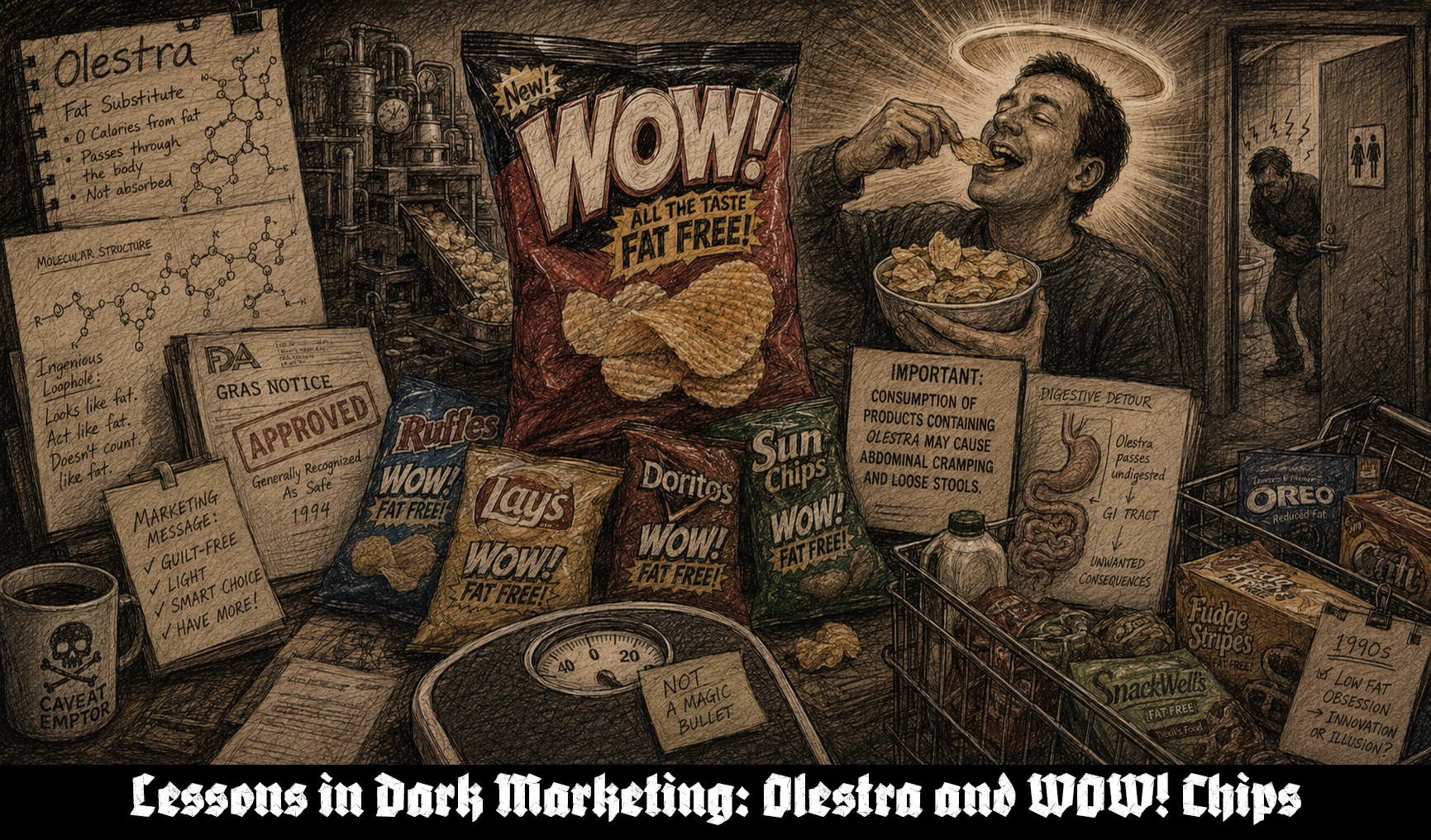
Olestra promised Americans they could keep the potato chips, remove the fat, avoid the guilt, and send the consequences somewhere farther down the digestive tract.
That was the entire scientific miracle.
Snack companies took one of the least nutritionally serious foods in the grocery store, replaced its conventional fat with an ingredient the body could not absorb, stamped FAT FREE across the package, and presented the result as progress. The potato remained fried, salted, processed, flavored, packaged, and engineered for continued eating, but the most frightening number on the 1990s nutrition label had been reduced to zero.
Apparently, that meant the chip had been rehabilitated.
Olestra was a fat substitute developed by Procter & Gamble and marketed under the name Olean. Its molecular structure allowed it to provide some of the cooking qualities and mouthfeel of fat while passing through the digestive system without being absorbed in the usual way. The Food and Drug Administration approved it in 1996 for use as a fat-and-oil replacement in prepackaged savory snacks, but required products containing it to carry a warning about possible abdominal cramping, loose stools, and interference with the absorption of certain vitamins and nutrients. Manufacturers also had to add vitamins A, D, E, and K to compensate for some of those nutritional effects. (GovInfo)
Frito-Lay launched WOW! Chips nationally in 1998 across familiar brands including Lay’s, Ruffles, Doritos, and Tostitos. The line recorded about $347 million in first-year sales and became the best-selling new product in the United States that year. America did not merely accept the possibility of a consequence-free potato chip. America rushed the display like the Surgeon General had discovered that nacho cheese dust counted as preventive medicine. (Los Angeles Times)
The product was a fat-free snack. The machine was nutritional absolution sold by the bag.
WOW! Chips arrived during a period when federal dietary guidance and public health campaigns strongly emphasized reducing total dietary fat. The 1995 Dietary Guidelines advised Americans to choose a diet low in fat, saturated fat, and cholesterol, while national campaigns had spent years encouraging low-fat eating. Food companies recognized the commercial opportunity and began translating serious dietary advice into a parade of fat-free cookies, frozen desserts, dressings, cakes, and snacks whose main nutritional achievement was having one villain removed while the rest of the circus remained open for business. (Health.gov)
Olestra gave the industry its most literal expression of that logic. Instead of asking consumers to eat fewer chips, the industry offered a chemically engineered way to preserve the behavior while changing the arithmetic printed on the package.
We’re looking at junk food laundering its reputation through one nutrient, not a breakthrough in dietary wisdom.
That is the case study.
Fat Became the Nutritional Supervillain
The WOW! Chips campaign entered a culture that had already learned to treat dietary fat as the central explanation for weight gain, heart disease, guilt, failed diets, tight clothing, and every miserable interaction with a bathroom scale.
That public concern did not appear from nowhere. Health authorities had legitimate reasons to advise people to moderate total fat and especially saturated fat within an overall diet. The marketing industry performed its usual act of intellectual vandalism by taking nuanced advice about dietary patterns and flattening it into one commercially useful commandment: fat is bad.
Once that simplification took hold, a product carrying zero grams of fat could borrow the emotional appearance of health even when it remained a heavily processed snack designed for casual over-consumption. Consumers could scan the front of the package, see FAT FREE, and mentally acquit the product before examining anything else.
The claim did not need to make potato chips nutritionally complete. It only needed to remove the nutrient customers had been trained to fear most.
This is dark marketing principle number one: When the public identifies one ingredient as the source of dietary evil, removing that ingredient can make an otherwise unchanged category feel morally rehabilitated.
WOW! Chips did not have to become vegetables because fat had already been appointed the defendant.
The Industry Converted Public Health Advice Into Product Theater
Dietary guidance is supposed to help people understand patterns of eating across days, weeks, and years.
Food packaging has a different objective.
It needs to move one item through the checkout line.
That difference creates a powerful distortion. A recommendation to reduce excessive dietary fat can become a front-of-package spectacle in which companies reformulate highly processed foods, enlarge one favorable claim, and imply that the entire product has been transformed.
The consumer sees a simplified health message without the broader dietary context. The manufacturer receives the authority of public health without accepting the burden of public health.
WOW! Chips became especially effective because the product appeared to solve the dietary problem without requiring any behavioral change. Customers could continue buying the same brands, eating the same category, reaching into the same bag, and consuming the same familiar flavors. The scientific innovation would handle the responsibility on their behalf.
This is dark marketing principle number two: Take legitimate public guidance, isolate the easiest claim to monetize, and sell compliance without requiring the customer to alter the underlying behavior.
The industry converted “eat a balanced diet lower in excessive fat” into “keep eating chips, Einstein, we fixed the number.”
The Package Sold Nutritional Innocence
Snack food is usually marketed through pleasure. WOW! Chips added innocence. That was the more valuable benefit. The customer already knew potato chips tasted good. Frito-Lay did not need to explain salt, crunch, seasoning, or the mysterious gravitational force that causes an open family-size bag to become an empty personal-size bag during one television program.
The real obstacle was guilt. WOW! packaging attacked that obstacle directly by presenting the product as fat-free. The claim allowed the customer to interpret continued snacking as a better decision rather than the same decision with a different ingredient system. Some might even interpret that as healthy.
The product became a permission slip.
A regular chip carried the emotional burden of indulgence. A WOW! Chip offered indulgence with administrative paperwork suggesting the offense had been downgraded.
This is dark marketing principle number three: When customers already desire the product, remove the moral resistance surrounding the purchase instead of increasing desire.
WOW! Chips sold relief from guilt more aggressively than they sold potatoes.
Familiar Brands Made an Unfamiliar Chemical Feel Safe
Olestra was unfamiliar. Lay’s, Doritos, Ruffles, and Tostitos were not. That brand architecture mattered because consumers were not being asked to trust an unknown laboratory snack introduced by a company called Advanced Gastrointestinal Solutions Incorporated. They were being offered new versions of products already associated with parties, school lunches, television, convenience stores, cookouts, and decades of ordinary eating.
The parent brands transferred familiarity to the ingredient.
A consumer who might hesitate over the word Olestra could still recognize the bag, logo, flavor, shape, and advertising voice. The scientific novelty was wrapped inside cultural normality.
This was an elegant trust-transfer system. Procter & Gamble supplied the technology, Frito-Lay supplied the shelf power, and established snack brands supplied emotional reassurance.
The customer did not have to understand the chemistry because the Doritos logo had apparently completed the peer review.
This is dark marketing principle number four: introduce an unfamiliar technology through familiar brands and existing trust will reduce the customer’s instinct to examine the innovation closely. The laboratory entered the pantry wearing a name the family already knew.
“WOW!” Made the Product Sound Like an Event
The name WOW! did an enormous amount of work. It did not sound clinical, cautious, medicinal, or defensive. It sounded surprised, delighted, loud, and simple enough to be shouted by a television audience after someone revealed the calories.
The exclamation point mattered because the product needed to feel like a breakthrough rather than a compromise.
Fat-free versions of familiar foods often carry the emotional expectation of sacrifice. They may suggest thinner texture, weaker flavor, reduced satisfaction, or the general sensation of eating a cardboard envelope while thinking about your moral failings.
WOW! reversed that expectation.
The name promised that the product’s difference would produce amazement. The customer would taste the chip, examine the label, and become overwhelmed by the impossibility of flavor surviving without fat.
The digestive system might eventually have its own interpretation of the exclamation point, but that occurred after purchase.
This is dark marketing principle number five: Give a technical workaround an emotional name and customers can experience the product as a cultural event rather than a food-science experiment.
“Sucrose Polyester Savory Snack Line” would not have moved $347 million in chips.
Science Became the Escape Hatch From Moderation
The least exciting dietary advice is usually the most durable.
Eat a varied diet. Pay attention to portions. Consume more nutritious foods. Limit excessive intake of heavily processed snacks. Move regularly. Accept that no ingredient can negotiate directly with your pants.
That advice requires judgment and moderation. Olestra offered an escape hatch. The customer would not have to reduce the snack. Science would redesign the snack so the body could avoid absorbing the fat.
That promise fit a recurring commercial fantasy: every consequence can eventually be engineered out of the behavior producing it.
We want sweetness without sugar, stimulation without exhaustion, tanning without skin damage, gambling without losses, debt without repayment, and potato chips that pass through the body like a visiting consultant who refuses to join payroll. The product becomes attractive because it allows technology to replace restraint.
This is dark marketing principle number six: When moderation feels emotionally expensive, sell a technical loophole that preserves the behavior while appearing to remove the penalty.
Olestra let the customer outsource discipline to molecular design.
The Body’s Failure to Absorb Olestra Became the Product Benefit
Most food advertising treats absorption as desirable. Nutrients enter the body. Energy becomes available. The product nourishes, strengthens, restores, or supports.
Olestra reversed the argument.
Its commercial value came from the fact that the body did not absorb it in the ordinary way. The ingredient could provide some characteristics of fat, pass through the digestive tract, and contribute no absorb-able fat calories from the olestra itself.
The body’s refusal became the benefit.
That is a remarkable piece of product positioning. The same biological fact that created concern about gastrointestinal effects and nutrient interactions also produced the fat-free claim customers wanted.
The mechanism and the consequence were neighbors.
Marketing invited customers to admire one side of the relationship while treating the other as manageable fine print.
This is dark marketing principle number seven: When the product benefit and the product liability arise from the same mechanism, enlarge the benefit and force the liability into disclosure language.
Olestra’s inability to participate normally in digestion was presented as freedom from fat until digestion submitted its own customer review.
The Warning Label Fought the Front of the Bag
The FDA-required statement was unusually direct. It informed consumers that olestra could cause abdominal cramping and loose stools, could inhibit absorption of some vitamins and other nutrients, and that vitamins A, D, E, and K had been added. (The Washington Post)
That warning created a fascinating packaging conflict. The front of the bag promised liberation. The disclosure described a gastrointestinal negotiation.
One side shouted that the chips contained no fat. The other explained that the ingredient producing this miracle would pass through the body and might alter the afternoon schedule.
The package therefore contained both the fantasy and the receipt.
Marketing depended on the front panel winning the argument before the customer turned the bag around. The pleasure claim was visual, immediate, and emotionally positive. The warning was smaller, technical, and located where consumers encounter the consequences of reading.
This is dark marketing principle number eight: Place aspiration where customers look first and consequences where customers must choose to continue looking.
The bag gave freedom the headline and digestion the legal department.
The Warning Became More Memorable Than the Benefit
Most warnings disappear into packaging. The olestra warning became the product’s identity.
That happened because the subject was too intimate, embarrassing, and visually suggestive to remain ordinary regulatory language. Consumers might forget the precise calorie count, but they remembered that the chips came with a bathroom-related disclaimer.
The warning escaped the package and entered comedy, news coverage, workplace conversation, schoolyard jokes, and popular memory. The cultural shorthand became more graphic than the actual required wording, with “anal leakage” frequently attached to the product even though the label itself referred to abdominal cramping and loose stools.
That distinction did very little to save the brand. No one wants to uncontrollably shit themselves publicly or privately. Once the public imagination associates a snack with emergency underwear calculations and the best place to discard your newly skid-marked underpants, the marketing department no longer controls the product story.
This is dark marketing principle number nine: A warning involving embarrassment can overpower every abstract product benefit because consumers remember vivid social risk better than nutritional arithmetic.
Zero grams of fat was a number; losing bowel confidence on a white sofa was a real scenario.
The Product Promised Indulgence Without Payment
WOW! Chips depended on a familiar bargain: the customer could keep the pleasure while avoiding the price.
That promise appears across dark marketing because it bypasses the internal negotiation that normally limits consumption. The customer does not have to choose between enjoyment and restraint because the product claims to have reconciled them.
The danger is psychological compensation. A person who believes a product carries fewer consequences may feel licensed to consume more of it. One serving becomes several because the customer interprets reduced fat or calories as additional available capacity.
The bag may technically describe a serving size, but the emotional message describes abundance. The product says the restriction has been removed, and the customer responds with the enthusiasm of someone recently informed that accounting has stopped tracking expenses.
This is dark marketing principle number ten: Reduce the perceived cost of consumption and customers may increase the behavior the reformulation was supposed to improve.
The miracle of guilt-free snacking can become a larger bag disappearing under more confident management.
“Fat Free” Functioned as a Moral Category
Food claims do more than describe ingredients. They classify people.
A customer choosing the fat-free product can feel disciplined, informed, modern, health-conscious, and capable of controlling temptation. The person selecting the conventional version can appear careless, indulgent, or unwilling to make the obvious better choice.
That moral layer turns packaging into identity.
WOW! Chips allowed customers to participate in snack culture while maintaining the self-image of someone making responsible decisions. The product carried enough nutritional language to protect the consumer from the social meaning of buying junk food.
The customer could place the bag in a cart containing soda, frozen pizza, cookies, and whatever else the week required, then allow FAT FREE to stand there like a small public monument to personal virtue.
This is dark marketing principle number eleven: Give indulgence a moral label and customers can purchase the product as evidence about their character.
WOW! Chips turned one reformulated snack into a performance of dietary responsibility.
Reduced Calories Became Permission to Ignore the Category
WOW! Chips did contain fewer calories per serving than conventional versions, and that was a legitimate numerical difference. Contemporary reporting described an ounce of olestra chips at roughly half the calories of a conventional one-ounce serving. (The Washington Post)
The dark marketing problem emerged when the reduction encouraged consumers to treat the category itself as resolved.
A lower-calorie potato chip remains a potato chip. It does not automatically provide the nutritional qualities of fruit, vegetables, nuts, legumes, whole grains, or a balanced meal merely because one number has improved.
Packaging, however, rewards narrow comparison. The new chip is placed beside the old chip, and the favorable difference becomes the entire argument. The customer is encouraged to ask which chip contains less fat and fewer calories rather than whether the bag deserves such a large role in the diet.
This is dark marketing principle number twelve: Compare the reformulated product only with the least favorable version of itself and the customer may never evaluate the larger category.
WOW! Chips won the courtroom by ensuring the only other defendant was regular chips.
The Brands Preserved the Taste Ritual
Olestra needed to imitate the sensory function of conventional fat closely enough to preserve the snack ritual. The crunch, salt, seasoning, mouthfeel, bag noise, finger dust, and repeated hand-to-mouth motion all had to remain recognizable. Customers were pursuing familiar pleasure with altered nutrition numbers.
That continuity was commercially essential.
A health product that required customers to learn a new behavior would face more resistance. WOW! Chips retained the basic ritual and asked consumers to change only the package selected.
The customer could continue eating during television, parties, lunches, drives, and moments of boredom without building an unfamiliar habit. The innovation disappeared into an established routine.
This is dark marketing principle number thirteen: Preserve the customer’s ritual while altering the claim around it and adoption becomes easier because the behavior already has a home.
WOW! Chips did not ask America to abandon the snack aisle; they offered the snack aisle an alibi.
The First-Year Sales Became Proof of the Idea
WOW! Chips produced approximately $347 million in sales during 1998, making them the best-selling new product in the country that year. That commercial performance demonstrated the enormous demand for indulgence presented as consequence-free. (Los Angeles Times)
Success created its own credibility.
Large sales suggested that consumers accepted the product, that retailers trusted it, that the technology worked, and that objections might belong to a fussy minority standing between the public and progress.
The numbers could therefore support the marketing story beyond the revenue itself. Millions of purchases looked like mass validation.
The problem is that trial and trust are different measurements. A product can generate enormous curiosity, promotional attention, distribution, and initial purchase while failing to earn durable acceptance. First-year sales reveal how powerfully the promise attracted consumers. They do not prove that the promise survived contact with experience.
This is dark marketing principle number fourteen: Use rapid trial as evidence of long-term value and curiosity can masquerade as loyalty.
WOW! Chips won the first purchase before the customer’s digestive system received voting rights.
Consumer Experience Became the Brand’s Unpaid Opposition Campaign
Advertising creates expectations. Experience determines whether those expectations survive. WOW! Chips promised carefree enjoyment, but some consumers reported cramping, diarrhea, oily discharge, fecal incontinence, and other gastrointestinal problems after eating olestra-containing products.
By 2002, the Center for Science in the Public Interest said that close to 20,000 reports had been forwarded to the FDA by CSPI and Procter & Gamble, while also acknowledging that it was campaigning aggressively against the ingredient. These were consumer reports rather than proof that every complaint had been medically verified or that typical consumption produced severe effects, but the stories were graphic enough to dominate public perception. (CSPI)
The brand faced an enemy more persuasive than a competing advertisement. It faced anecdotes. A scientific explanation can discuss dose, frequency, individual response, study design, and statistical incidence. A consumer can describe what happened in the car, and why the drivers seat needs to be re-upholstered.
Guess which story travels faster at work.
The most damaging product experiences involved embarrassment, urgency, clothing, public places, and the sudden reclassification of nearby bathrooms as critical infrastructure. Those stories carried emotional detail no nutritional chart could defeat.
This is dark marketing principle number fifteen: When product failure produces vivid personal stories, every affected customer becomes a distribution channel for the opposition.
Olestra had laboratory data; the public had stories nobody wanted illustrated.
The Industry Had to Argue With the Customer’s Body
Procter & Gamble defended olestra with research and maintained that the public perception exaggerated the frequency and severity of gastrointestinal problems. The FDA later reviewed post-market studies and adverse-event information and concluded in 2003 that the special warning statement was no longer warranted, removing the requirement while leaving olestra approved for savory snacks. (HFPAP External)
That regulatory history requires accuracy.
The FDA did not conclude in 2003 that every complaint had been imaginary, nor did the original warning prove that every consumer would experience severe distress. The agency concluded after review that the mandatory label statement no longer accurately communicated the evidence and should be removed.
The marketing problem had already moved beyond regulatory wording.
Consumers do not wait for a Federal Register notice before forming an association between a snack and digestive risk. Once that association becomes cultural memory, revised scientific guidance may have limited power to repair the brand. The company found itself arguing that customer fears were overstated while customers remembered a product famous for requiring the argument.
This is dark marketing principle number sixteen: Once the public associates the product with bodily betrayal, proving the risk was less dramatic than believed may still leave the brand trapped inside the image.
“The warning is no longer required” is technically meaningful and commercially miserable.
Regulatory Approval Became a Trust Substitute
FDA approval gave manufacturers an essential defense. The ingredient had been reviewed. The permitted use met the agency’s food-additive safety standard. Post-market monitoring and label conditions had been established.
Those facts mattered and should not be dismissed. The darker move occurred when regulatory approval became a substitute for the customer’s broader evaluation of whether the product was desirable, trustworthy, nutritionally meaningful, or worth the social risk attached to it.
Safety approval answers a regulatory question. Marketing quietly encourages consumers to hear a much larger endorsement. The FDA had not declared WOW! Chips a wise foundation for the American diet. It had approved olestra for specified use under established conditions.
The package could still borrow the authority surrounding that decision.
This is dark marketing principle number seventeen: Use regulatory permission as emotional reassurance even when the regulator answered a narrower question than the customer assumes.
The government approved an additive for defined uses; the snack aisle heard a trumpet announcing guilt-free civilization.
Vitamin Fortification Turned Compensation Into a Benefit-Looking Detail
Olestra could interfere with the absorption of fat-soluble vitamins and other nutrients, so products containing it were required to include vitamins A, D, E, and K. The warning explained that those vitamins had been added because of olestra’s effects rather than to enhance the food’s nutritional value. (The Washington Post)
That clarification was important because added vitamins often create a health halo.
Consumers see a list of vitamins and may assume enrichment, improvement, or added nourishment. In this case, the vitamins functioned as compensation for an ingredient interaction. The same letters that might make cereal look fortified could make olestra snacks look nutritionally upgraded unless the reason for their presence was explained.
This reveals how easily corrective measures can be mistaken for benefits. The product creates a nutritional issue, adds something to offset part of that issue, and may emerge with more impressive-looking packaging language than the original snack.
This is dark marketing principle number eighteen: When the product requires compensation, present the compensation carefully enough that customers may experience it as added value.
The vitamins arrived to repair the paperwork and risked receiving applause for improving the building.
The Product Made Portion Size Someone Else’s Problem
Olestra’s digestive effects were closely connected to consumption patterns and individual response, but snack foods are famously poor vehicles for moderation. The bag is resealable in the same sense that a casino has an exit. Technically, the option exists.
WOW! Chips entered a category designed around continued eating. Seasoning, crunch, convenience, packaging, and serving context all encouraged customers to reach back into the bag before the previous chip had completed its farewell ceremony.
That created an awkward contradiction.
The ingredient’s tolerability could depend partly on how much was consumed, while the product category profited from people consuming beyond a small serving.
Marketing celebrated abundance and reduced guilt while the warning depended on restraint. The customer was given a product positioned as freedom and a serving size functioning as probation.
This is dark marketing principle number nineteen: Sell a reformulated indulgence through the language of permission, then rely on customers to practice the moderation the product was marketed to help them avoid.
The bag encouraged confidence while the digestive system preferred accounting.
The Customer Carried the Consequence After the Brand Collected the Sale
The company’s financial transaction ended at purchase. The consumer experience continued. That timing matters because many dark marketing systems separate the moment of persuasion from the moment of consequence. The pleasure, claim, discount, approval, and excitement occur before the product’s costs become visible.
WOW! Chips delivered the marketing benefit at the shelf and any gastrointestinal problem later, often somewhere far from the retailer, advertiser, laboratory, or executive meeting.
The brand received the revenue immediately. The customer retained the uncertainty. This separation protected the sale. Nobody stood at the checkout lane with a twenty-minute observation period and a folding chair.The customer bought the promise in public and discovered the limits in private.
This is dark marketing principle number twenty: Design the transaction so the emotional reward arrives before the practical consequence and the company can complete the sale before the customer completes the experience.
Olestra outsourced the aftercare to whoever owned the nearest restroom.
Comedy Destroyed the Brand’s Control of Language
Once WOW! Chips became a punchline, the company lost control over the product vocabulary. Marketers wanted consumers discussing fat, calories, flavor, innovation, and choice. The culture discussed anal leakage in the same breath as your favorite chip brand.
That replacement was fatal because the unofficial language is always more memorable than the official language. The brand could purchase advertising, issue scientific explanations, change labeling, and refine claims, but it could not stop consumers from summarizing the product through one crude gastrointestinal association.
Comedy can perform as a form of cultural regulation. It reduces corporate grandeur, strips technical language of authority, and compresses a complicated controversy into a joke people repeat without permission.
That repetition preserved awareness while poisoning desire.
The public remembered WOW! Chips extremely well. It simply remembered them in the worst commercially useful way possible.
This is dark marketing principle number twenty-one: When ridicule produces a stronger product description than advertising, awareness can remain high while purchase intent dies.
WOW! achieved immortality after losing control of what the exclamation point meant.
The Warning Label Became a Visual Contradiction Nobody Could Ignore
Most food claims rely on consumers believing the product’s advantages outweigh its compromises. WOW! Chips presented that negotiation directly on the package.
The consumer could see a celebratory name, a fat-free promise, familiar branding, and a warning involving abdominal cramping and loose stools within the same visual system.
The contrast was so extreme that it became self-parody. A product positioned as carefree indulgence had arrived with a regulatory message asking customers to consider their gastrointestinal calendar. The marketing suggested a party while the label suggested remaining aware of the building layout.
That contradiction created distrust beyond the specific warning. Consumers could reasonably wonder what kind of miracle required such unusual disclosure.
This is dark marketing principle number twenty-two: When the claim and warning describe emotionally incompatible experiences, the packaging becomes evidence against its own promise.
WOW! wanted the bag to say celebration and ended up printing an evacuation plan.
The 2003 Label Change Could Not Reverse Cultural Memory
In 2003, the FDA removed the special olestra warning-label requirement after reviewing additional evidence and concluding that the statement was no longer warranted. The regulatory change addressed the government’s assessment of the label, but it could not erase years of jokes, complaints, headlines, and personal stories. (HFPAP External)
This is the difference between legal status and brand status. A regulator can amend a rule. A company can change a package. A retailer can update inventory. None of them can order the public to forget.
The warning had become part of the product biography. Removing it risked generating another round of coverage reminding everyone why it had existed.
The brand faced a communications trap. Keeping the warning preserved fear. Removing the warning revived discussion of the fear.
This is dark marketing principle number twenty-three: Regulatory repair cannot automatically reverse cultural damage once the warning has become more famous than the product benefit.
The government could remove the sentence from the bag without removing it from the joke.
Rebranding Could Change the Name but Not the Association
Frito-Lay eventually moved away from the WOW! identity and sold olestra-containing products under “Light” branding. The relabeling attempted to preserve the lower-fat, lower-calorie benefit while distancing the chips from a name that had become culturally radioactive. (TasteFluent Consulting)
That is a familiar corporate response. When the product story becomes contaminated, rename the product, redesign the package, reduce the spectacle, and hope customers interpret the change as evolution rather than witness protection.
Rebranding can help when the old name carries baggage the underlying product does not. It works less effectively when the baggage is the underlying product.
Consumers who recognized olestra did not need the word WOW! to remember the controversy. The ingredient carried the association into the replacement branding.
This is dark marketing principle number twenty-four: A new name can distance a product from a failed campaign, but it cannot distance the product from the mechanism that created the failure.
The bag changed clothes while the digestive system recognized the suspect.
WOW! Chips Became a Monument to Nutritional Reductionism
The deepest problem with the product was larger than olestra. It was the belief that health could be reduced to removing one disfavored nutrient from an indulgent food.
That logic allowed consumers and manufacturers to avoid discussing dietary patterns, portion sizes, food quality, satiety, frequency, and the relationship between individual products and the rest of the diet.
One number improved, so the product became “better.” The improvement may have been real within that narrow comparison. The cultural interpretation became much larger than the number justified.
This is how health halos work. A favorable claim expands until it covers the entire object, then begins excusing behavior beyond the claim itself.
WOW! Chips became a snack-food version of a defendant arriving in court with one parking ticket dismissed and demanding immediate sainthood.
This is dark marketing principle number twenty-five: Improve one measurable attribute and allow consumers to generalize the improvement across the entire product. Nutritional reductionism gave the chip a halo too large for the bag.
The Case Study Breakdown
Here is the Olestra and WOW! Chips machine in plain English:
- Public concern about dietary fat created a ready-made nutritional villain.
- Food companies converted nuanced health guidance into a simple fat-free sales claim.
- WOW! Chips sold relief from guilt alongside crunch and flavor.
- Familiar brands transferred trust to an unfamiliar fat substitute.
- The name WOW! made a technical workaround feel like a consumer breakthrough.
- Olestra allowed technology to appear to replace moderation.
- The ingredient’s lack of ordinary absorption produced both the product benefit and the controversy.
- The fat-free promise dominated the front of the package while warnings about fecal incontinence appeared elsewhere.
- The warning became more culturally memorable than the calorie and fat reductions.
- Reduced perceived consequences could encourage customers to eat with greater confidence.
- “Fat free” functioned as a moral category as well as a nutritional statement.
- Comparisons with regular chips discouraged evaluation of the broader snack-food category.
- Familiar taste and eating rituals reduced resistance to the new ingredient.
- Enormous first-year sales made curiosity look like durable trust.
- Graphic consumer complaints became an unpaid opposition campaign.
- The industry had to debate the public’s bodily experiences using scientific evidence.
- FDA approval supplied reassurance while answering a narrower question than many consumers assumed.
- Added vitamins could look like enrichment even though they compensated for olestra’s nutritional effects.
- The category encouraged continued eating while tolerability could depend on amount consumed.
- Companies collected the sale before consumers experienced any later consequences.
- Comedy replaced the official product language with a damaging cultural shorthand.
- The package’s celebratory promise and gastrointestinal warning created an unforgettable contradiction.
- Removal of the warning-label requirement could not erase the product’s cultural reputation.
- Rebranding changed the name without changing the ingredient association.
- The entire campaign encouraged consumers to judge food through one favorable number.
- Olestra preserved the snack behavior while relocating responsibility to chemistry and the customer.
That is why WOW! Chips exploded and then became one of the most memorable product cautionary tales of the 1990s. Frito-Lay combined familiar brands, enormous distribution, reduced-calorie claims, fat-free positioning, scientific novelty, and a national audience desperate to believe that dietary consequences could be engineered away.
This is dark marketing principle number twenty-six: the strongest dietary loophole allows customers to preserve the indulgence, preserve the identity, and believe the manufacturer has removed the need for restraint. WOW! Chips offered the same hand entering the same bag with a cleaner conscience and a more complicated trip through the body.
What Marketers Should Learn From Olestra and WOW! Chips
The first lesson is that public health guidance becomes commercially dangerous when marketers reduce it to a single nutrient.
The message may begin with legitimate advice, but packaging can transform that advice into a simplistic moral system where removing one ingredient appears to redeem an entire category.
The second lesson is that guilt can be a larger barrier than desire.
Consumers already wanted potato chips. WOW! Chips grew by reducing the emotional resistance that followed the desire.
The third lesson is that familiar brands can normalize unfamiliar technology.
Lay’s, Doritos, Ruffles, and Tostitos gave olestra access to trust that a stand-alone laboratory brand would have needed years to build.
The fourth lesson is that names frame interpretation before consumers understand the mechanism.
WOW! told customers to experience the product as a breakthrough before they evaluated the ingredient.
The fifth lesson is that consumers are attracted to solutions preserving the behavior that created the problem.
Products promising sweetness without sugar, fat without absorbable fat, and pleasure without consequences sell an escape from moderation rather than a new habit.
The sixth lesson is that the same mechanism can produce both the differentiating benefit and the reputational risk.
Marketers cannot treat the two as unrelated merely because one appears in advertising and the other appears in disclosure.
The seventh lesson is that warnings involving vivid social embarrassment may dominate abstract benefits.
Consumers can understand lower calories intellectually while remembering digestive humiliation emotionally.
The eighth lesson is that initial sales measure trial more reliably than trust.
Distribution, curiosity, promotion, and a compelling claim can produce a spectacular launch before repeat behavior reveals the actual relationship.
The ninth lesson is that consumer anecdotes can overwhelm controlled messaging when the experiences are graphic, personal, and easy to retell.
A brand can challenge the interpretation while remaining trapped inside the story.
The tenth lesson is that regulatory approval cannot replace consumer confidence.
An ingredient can remain legally permitted while the product becomes commercially unacceptable.
The eleventh lesson is that corrective measures must be explained carefully.
Added vitamins intended to compensate for nutritional effects can accidentally strengthen a health halo if customers interpret them as bonus nourishment.
The twelfth lesson is that rebranding has limits.
A new identity can escape an unpopular campaign, but it cannot easily escape a product mechanism customers already recognize.
The thirteenth lesson is that cultural memory outlives package changes.
Once a product becomes a joke, removing a warning or changing a label may revive the association rather than bury it.
The fourteenth lesson is that marketers should never confuse a narrower technical improvement with a broader promise of health.
Customers may draw that conclusion, but the brand remains responsible for the implication it has carefully arranged.
This is dark marketing principle number twenty-seven: When a product invites consumers to believe an impossible promise, every technical qualification becomes a future betrayal waiting for the customer to notice.
WOW! Chips sold consequence-free indulgence in a world where consequences had merely changed departments.
Final Diagnosis
Olestra and WOW! Chips belong in the Lessons in Dark Marketing museum because they transformed America’s fear of dietary fat into a mass-market scientific loophole, then used familiar brands and fat-free language to make heavily processed snack food look morally improved.
The final diagnosis is sitting beside an empty chip bag within urgent walking distance of the John:
- Olestra turned the body’s inability to absorb an ingredient normally into a marketable advantage.
- Federal low-fat guidance supplied the cultural environment for the product.
- The food industry reduced complicated nutritional advice to one villainous nutrient.
- Frito-Lay used established snack brands to normalize an unfamiliar additive.
- The WOW! name framed the product as a breakthrough before customers evaluated it.
- Fat-free labeling provided emotional absolution as well as nutritional information.
- The product allowed customers to preserve the snack habit while believing science had removed the penalty.
- Lower calorie and fat numbers created a health halo around an indulgent category.
- Familiar flavor and ritual made the reformulation easy to adopt.
- First-year sales demonstrated the enormous appeal of consequence-free indulgence.
- The required warning created a direct conflict between the package fantasy and digestive reality.
- Gastrointestinal language became more memorable than every positive claim.
- Consumer complaints and humiliating anecdotes traveled faster than technical explanations.
- The company had to argue with experiences customers believed had occurred inside their own bodies.
- Regulatory approval supplied authority without guaranteeing market acceptance.
- Vitamin fortification risked looking like enrichment despite serving a compensatory purpose.
- The product category encouraged continued eating while the warning depended on restraint.
- Customers received any consequences after manufacturers had already completed the transaction.
- Comedy seized control of the product language and preserved the worst possible association.
- Removal of the warning requirement could not remove the warning from cultural memory.
- Rebranding WOW! as Light changed the package while preserving the ingredient controversy.
- The campaign encouraged customers to judge the product through one favorable nutrient claim.
- The product became a national lesson in the difference between technical permission and consumer trust.
- Olestra did not eliminate the consequences of junk food; it relocated them and marketed the relocation as innovation.
WOW! Chips offered America the fantasy that chemistry had repealed moderation. The customer could keep the crunch, salt, seasoning, television ritual, party bowl, familiar brand, and repeated handfuls while the fat somehow disappeared from both the label and the moral accounting.
The promise was irresistible because it demanded almost nothing from the buyer. Nobody had to change the diet, reduce the portion, reconsider the category, or accept that pleasure and consequence occasionally arrive in the same bag.
Science would handle it. The front label declared victory, the warning requested caution, the customer opened the package, and Frito-Lay collected the money. Then the ingredient continued through the digestive system exactly as designed.
Olestra did not remove the consequences from junk food. It moved them from the nutrition label to the bathroom and called the bowel movement innovation.
Leave a Reply