
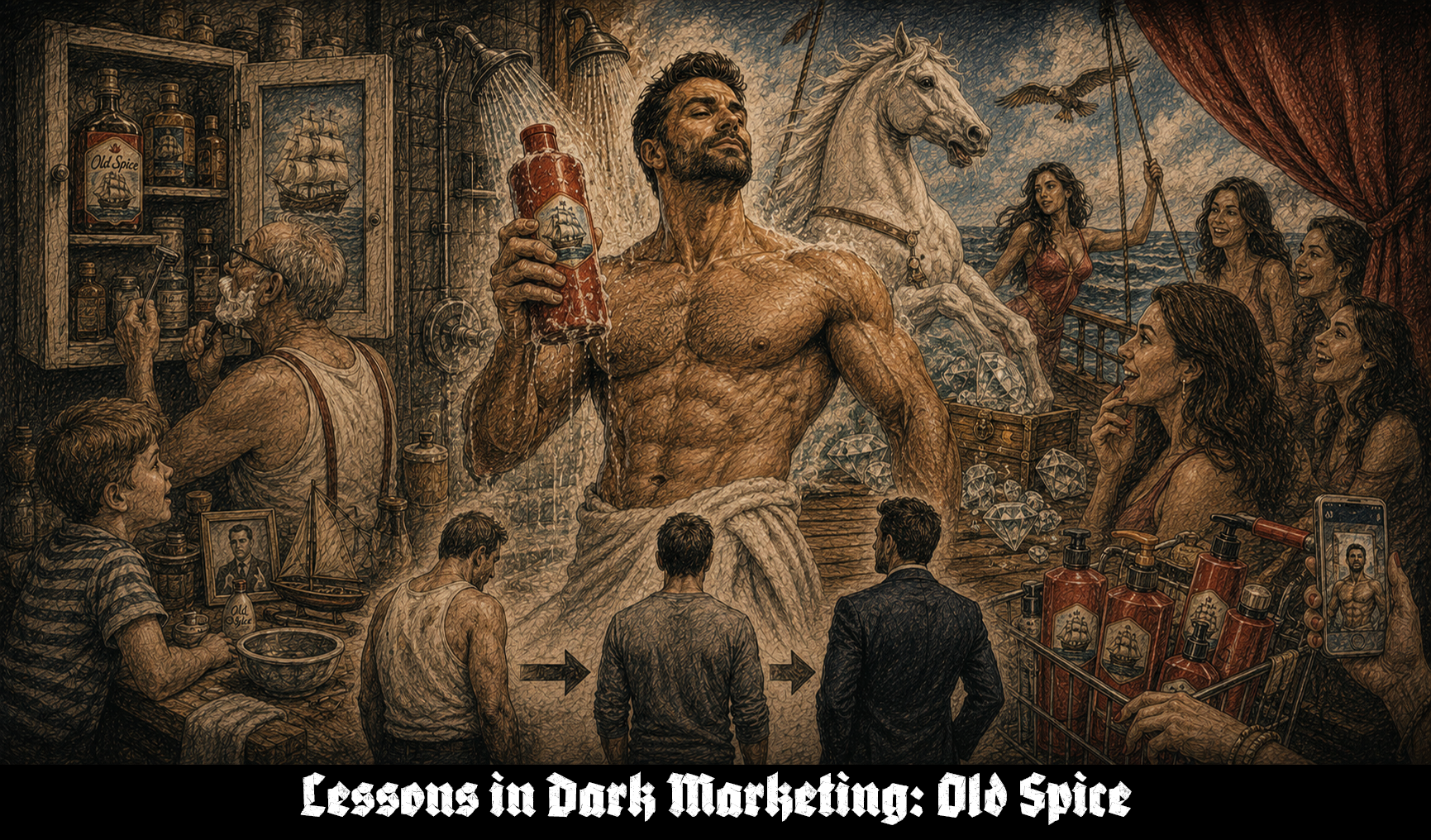
Old Spice took a bottle that smelled like somebody’s grandfather preparing for a lodge meeting and turned it into a ticket for horses, diamonds, ocean voyages, impossible confidence, and a bathroom-based personality transplant.
That was the entire fragrant little resurrection. A heritage grooming brand associated with fathers, grandfathers, nautical bottles, medicine cabinets, and aftershave applied with the solemnity of military paperwork suddenly appeared beside a shirtless spokesman who could step from a shower onto a boat, produce theater tickets from his hand, turn them into diamonds, and arrive on a horse before the customer had enough time to ask what any of this had to do with body wash.
The product cleaned skin and added fragrance. The marketing promised something considerably larger: masculine adequacy, romantic desirability, social confidence, adventure, wit, physical authority, and the ability to command a room while wearing nothing beyond a towel and the expression of a man who has never apologized for anything.
Old Spice began as Early American Old Spice for women in 1937, followed by a men’s line in 1938. Procter & Gamble acquired the Old Spice fragrance, skin-care, antiperspirant, and deodorant business from Shulton in 1990. By the late 2000s, the brand carried decades of recognition, but that history also created an age problem. Old Spice was familiar, trusted, and culturally embedded, yet it risked feeling like a product inherited from the bathroom of an older relative rather than selected by a younger man constructing his own identity.
Wieden+Kennedy and Old Spice eventually built the campaign around one commercially important fact: women made roughly 60 percent of men’s body-wash purchases. The resulting strategy addressed women directly while selling men a masculine product, creating a conversation between the person expected to use the body wash and the person frequently placing it in the shopping cart. (Wieden+Kennedy)
“The Man Your Man Could Smell Like” launched online during Super Bowl weekend in 2010 and appeared on television shortly afterward. The campaign’s initial goal was to increase body-wash sales by 15 percent. Wieden+Kennedy reported that Old Spice Red Zone Body Wash sales had risen 60 percent year over year by May 2010 and had doubled by July. (Wieden+Kennedy)
We’re looking at male insecurity converted into confident comedy, not a routine hygiene campaign. Old Spice sold men a louder character, sold women an imaginary upgrade to the man already occupying the bathroom, and placed the supposed transformation inside a plastic bottle beside the shampoo.
That is the case study.
Old Spice Had to Escape Its Own History
Old brands possess an advantage younger companies would gladly rob a bank to obtain: recognition. They also inherit baggage.
Old Spice carried decades of trust, familiarity, visual identity, and cultural memory. The problem was that much of that memory belonged to older generations. A younger customer could recognize the name while associating it with his father’s medicine cabinet, his grandfather’s aftershave, or a ceramic bottle sitting beside a razor old enough to qualify for historic preservation.
That association didn’t make the product bad. It made the product socially inherited.
Young men often want established masculine symbols, but they prefer to experience those symbols as personal choices rather than objects handed down with instructions to become their fathers. Old Spice had to preserve the authority of age while escaping the smell of age.
The solution wasn’t to deny the brand’s history. The campaign drowned the history inside absurd modern confidence. Old Spice stopped behaving like a quiet legacy product asking younger consumers to appreciate tradition. It became the loudest man in the room and acted as though the room had always belonged to it.
This is dark marketing principle number one: When brand heritage begins feeling like customer age, preserve the authority of the past while replacing the emotional meaning surrounding it.
Old Spice didn’t become young by pretending it had been invented yesterday. It made inherited masculinity strange, theatrical, and entertaining enough to feel newly chosen.
The Brand Turned Obsolescence Into Authority
A weaker campaign might have apologized for Old Spice’s age. That would have been a mistake. Apologizing tells the customer that the brand agrees with the insult. It confirms that the product is old-fashioned, embarrassed, and seeking permission to remain on the shelf.
Old Spice used confidence as a laundering mechanism.
The campaign behaved as though decades of masculine grooming history gave the brand greater authority to define manhood. It didn’t ask younger customers whether Old Spice still belonged in the bathroom. It announced that the bathroom had been waiting for Old Spice to return and restore order.
That posture converted possible obsolescence into expertise.
The brand’s age became evidence that it understood men, scent, attraction, confidence, and the deeply important national question of why a person’s body wash apparently smelled like a woman’s moisturizer.
This is dark marketing principle number two: When customers interpret age as irrelevance, recast longevity as authority and make the brand sound too confident to require approval.
Old Spice escaped the nursing home by walking into the shower like it owned the plumbing.
The Real Target Was Often Standing Beside the Customer
The most important strategic decision in the campaign was recognizing that the user and purchaser were frequently different people.
Old Spice body wash was intended for men, but women made a large share of the category’s purchases. Wieden+Kennedy described the campaign as an attempt to provoke conversation between couples and persuade female shoppers to choose a masculine-smelling Old Spice product over alternatives the campaign characterized as “lady-scented.” (Wieden+Kennedy)
That insight changed the advertisement’s voice.
The spokesman didn’t begin by addressing men. He opened with “Hello, ladies,” immediately acknowledging the person whose hand might actually lift the bottle from the shelf.
This did more than improve targeting. It created a triangle. The spokesman addressed the woman. The woman compared him with her partner. The partner became the person whose current scent, grooming choices, confidence, or general romantic performance was being evaluated.
Old Spice positioned itself as the bridge between the man the woman had and the exaggerated masculine fantasy appearing onscreen.
This is dark marketing principle number three: When the purchaser and user differ, speak to the purchaser’s dissatisfaction while making the user believe the product protects his identity.
The woman received an upgrade fantasy. The man received instructions for avoiding comparison failure. Old Spice received the household purchase.
“Hello, Ladies” Established Control Immediately
The first two words of the advertisement did more than identify the audience. They established the spokesman’s authority.
He didn’t sound nervous, needy, rehearsed, or pleased that somebody had agreed to listen. He addressed women with the calm certainty of a man who expected attention and had never experienced the emotional inconvenience of wondering whether anybody found him attractive.
That confidence was the actual product demonstration.
The body wash could not visibly prove scent through television. The audience couldn’t smell the commercial. Old Spice therefore demonstrated the social result associated with the scent.
The spokesman’s voice, posture, body, gaze, and control over the scene acted as sensory substitutes. The audience couldn’t smell him, but it could see what smelling like him supposedly produced.
This is dark marketing principle number four: When the medium cannot demonstrate the product directly, dramatize the identity customers are expected to associate with using it.
Old Spice couldn’t transmit fragrance through a television. It transmitted a man who appeared completely certain that fragrance had already solved his life.
The Spokesman Was an Impossible Comparison Standard
The Old Spice Man wasn’t designed to represent an ordinary customer.
He was designed to defeat one.
He was muscular, handsome, composed, articulate, adventurous, romantically attentive, financially suggestive, and capable of moving through impossible scenes without losing eye contact or dropping his towel. He stood on a boat, offered theater tickets, produced diamonds, mounted a horse, and delivered every line with the confidence of a man who had never been asked to reset a forgotten password.
The woman watching the advertisement was invited to compare her partner with this impossible creation. The man watching was invited to feel the comparison occurring.
That comparison powered the sales message because the product offered a small, affordable way to narrow an absurdly large gap. The customer couldn’t purchase the body, boat, horse, diamonds, voice, or supernatural control over geography. He could purchase the scent. That was enough for the campaign to suggest progress.
This is dark marketing principle number five: Create an impossible comparison figure, then sell customers one attainable attribute associated with the fantasy.
Old Spice didn’t promise to turn the buyer into the spokesman completely. It sold him the least expensive piece of the costume.
Humor Allowed the Brand to Insult Men Without Losing Them
The campaign’s central argument was rude. Your man does not look like this man. Your man does not sound like this man. Your man does not possess these gifts, experiences, muscles, or romantic abilities. Your man may smell like something purchased from the wrong side of the bathroom aisle.
Presented sincerely, that message could have created defensiveness. Humor made the insult enjoyable. The rapid absurdity told men that the campaign wasn’t conducting a serious personal attack. Everybody could laugh at the impossible standard while still absorbing the underlying judgment.
That is one of humor’s most commercially useful functions. It lowers resistance to an insult by allowing the target to participate in the joke. The customer can laugh while being told he is inadequate because the inadequacy arrives inside a performance too ridiculous to challenge directly.
This is dark marketing principle number six: Wrap the customer’s insecurity in comedy and he may repeat the insult as entertainment before recognizing it as persuasion.
Old Spice called the man disappointing, gave him a horse, and somehow convinced him to share the video.
Masculinity Became a Product Upgrade
The campaign treated masculinity as something that could be increased through consumption. This is a familiar commercial trick. A customer already possesses an identity, but the brand introduces doubt about whether he possesses enough of it.
He may be a man, but does he smell like one? He may use body wash, but is it the correct masculine body wash? He may have a partner, but does she look at him the way the advertisement suggests she would look at the Old Spice Man?
The product becomes an upgrade path.
Masculinity stops being a complicated social, emotional, behavioral, and cultural identity. It becomes a feature that can be installed during a shower. That simplification benefits the brand because products excel at solving narrow, purchasable problems. They perform less impressively when asked to provide character, competence, courage, maturity, or emotional stability.
Old Spice attached those difficult qualities to scent, where the transaction could remain manageable.
This is dark marketing principle number seven: Reduce an identity anxiety to one purchasable feature and the customer can experience consumption as self-improvement.
Old Spice couldn’t make a man more responsible, interesting, capable, or emotionally intelligent before breakfast. It could make him smell different and allow the advertisement to imply that the rest had followed.
Scent Became a Substitute for Personality
Fragrance is invisible. That makes it ideal for symbolic exaggeration.
A customer can’t easily separate the scent from the meaning the brand has attached to it. The smell arrives together with packaging, advertising, memory, gender coding, romantic expectation, and social context.
Old Spice used fragrance as a shortcut toward personality.
The spokesman didn’t say the customer would merely smell clean. He suggested the product belonged to a man who could command attention, travel, provide gifts, create adventure, and remain absurdly calm while reality rearranged itself around him.
The scent became evidence of a larger character.
That allowed a common hygiene product to escape commodity status. Soap cleans. Body wash cleans. Competing fragrances smell pleasant. Old Spice offered the possibility that the smell would communicate something socially valuable before the customer spoke.
This is dark marketing principle number eight: Attach personality traits to an invisible sensory feature and customers may purchase the feature as a substitute for developing the traits.
The bottle couldn’t make a man interesting. It could announce that somebody in the advertising department had completed the interesting part for him.
The Shower Became a Masculine Transformation Chamber
The bathroom is an ordinary room. Old Spice turned it into the entrance to a fantasy world.
The customer begins in the shower as an ordinary man. The product supposedly moves him toward the man on the boat, the horse, the beach, or whatever impossible masculine environment appears next.
That transformation structure matters because grooming products are used in private but judged socially. The customer performs the ritual alone while imagining how other people will respond later.
The shower therefore becomes a preparation room for public identity.
Old Spice amplified this dynamic by making the cleansing process sound like character construction. The buyer wasn’t merely removing sweat and odor. He was preparing the version of himself expected to emerge from the bathroom.
This is dark marketing principle number nine: Turn a private routine into preparation for social judgment and the product can occupy the space between the customer’s current identity and desired presentation.
Old Spice made the shower feel like a backstage area where average men prepared to enter a world that had apparently been waiting for their scent.
The Product Promise Expanded Beyond Anything Body Wash Could Deliver
A bottle of body wash performs several useful tasks. It cleans skin. It produces lather. It adds fragrance. It may help the customer feel refreshed and prepared.
Old Spice placed those practical benefits beneath a mountain of emotional promises involving confidence, attraction, adventure, luxury, sexual relevance, and masculine status. That inflation is common in mature product categories because practical differentiation becomes difficult. Most body washes clean effectively. Many smell pleasant. Packaging and price vary, but the functional category remains crowded.
The brand therefore competes through meaning. Old Spice wasn’t selling superior access to soap technology. It was selling the emotional world surrounding the soap.
This is dark marketing principle number ten: When functional differentiation becomes weak, expand the symbolic promise until the customer stops evaluating the product as a commodity.
Old Spice didn’t win by proving that its bubbles had greater moral character. It turned the bubbles into evidence that a horse might be nearby.
Rapid-Fire Absurdity Prevented Inspection
The commercial moved quickly. The spokesman shifted from shower to boat, from tickets to diamonds, and from one impossible visual to another without giving the audience enough time to evaluate any claim.
That pace functioned as misdirection. A slow advertisement invites questions. Why should body wash affect romance? Why is the woman comparing her partner with a paid model? What evidence connects scent to status? Why is there a horse in the bathroom?
A fast advertisement turns questions into applause. The audience spends its attention following the transitions, admiring the staging, listening to the monologue, and waiting for the next impossible transformation. The product claim passes through the spectacle without being examined closely.
This is dark marketing principle number eleven: Move the audience through entertainment faster than skepticism can organize itself.
Old Spice didn’t answer objections. It placed them on a boat, covered them in diamonds, and rode away before they could speak.
The Single-Take Illusion Made Authority Look Effortless
The original advertisement appeared to unfold through one continuous performance as the environment transformed around the spokesman. That visual construction strengthened the character. Cuts can reveal production. Continuity creates the impression that the spokesman controls the world in real time.
The shower wall disappears, the boat arrives, objects appear, and the horse enters without the character losing his composure. He doesn’t react because the environment behaves as he expects.
That effortless authority became part of the masculine fantasy. The world changes, but the man remains stable.The audience understands that the commercial involves production design, staging, choreography, and effects. The emotional reading survives anyway.
This is dark marketing principle number twelve: make the production appear effortless and the spokesman’s control over the advertisement will become part of the product’s identity.
Old Spice sold a man so composed that even the commercial’s special effects reported to him.
Women Were Turned Into Judges of Male Adequacy
Addressing women created purchasing influence, but it also assigned them a specific role.
They became judges.
The commercial encouraged women to assess how their partners looked, smelled, behaved, and compared with the Old Spice Man. The woman’s dissatisfaction became the pressure applied to the male customer.
That structure allowed the brand to manipulate both sides of the relationship.
Women received permission to expect an upgrade.
Men received evidence that the evaluation was already underway.
The product became a small act of relational defense. A man could choose Old Spice partly because he enjoyed the scent, but the campaign also suggested that refusing the product left him exposed to comparison.
This is dark marketing principle number thirteen: turn one partner into the evaluator and the other into the improvement project, then sell the product as a compromise between desire and insecurity.
Old Spice entered the relationship through the shower and behaved as though it had been invited to conduct performance reviews.
The Campaign Sold Women an Imaginary Replacement
The Old Spice Man represented a strange romantic proposition.
He wasn’t exactly asking women to leave their partners. He was asking them to imagine a version of their partners carrying his scent and, by association, some portion of his appeal.
That was commercially safer than selling replacement directly.
The woman could keep the man.
The product would supposedly upgrade the experience.
This fantasy allowed Old Spice to borrow romantic dissatisfaction without threatening the household structure responsible for repeat purchases. The campaign needed the couple to remain together, continue buying groceries, and continue evaluating the man’s smell.
This is dark marketing principle number fourteen: offer customers an imaginary replacement while selling a product that allows them to preserve the existing relationship.
Old Spice gave women the fantasy of another man and men the relief of knowing the fantasy could supposedly be bottled.
The Campaign Preserved Male Pride Through Exaggeration
An impossible spokesman can create insecurity, but he can also protect the audience from feeling directly humiliated.
Nobody reasonably believes body wash will produce a yacht, diamonds, or equestrian transportation inside a bathroom.
That absurdity gives men emotional distance.
The customer can laugh at the fantasy while accepting the smaller proposition that scent matters and Old Spice offers a more masculine option.
The exaggerated promise creates cover for the believable promise.
This is a useful advertising structure. The brand overstates the emotional world so aggressively that the audience lowers its guard around the modest conclusion hidden inside it.
This is dark marketing principle number fifteen: exaggerate the fantasy beyond credibility and the smaller behavioral request can enter beneath the joke.
Old Spice wasn’t asking men to believe they would become the spokesman. It was asking them to buy the bottle while pretending the comparison had been harmless.
The Brand Used Gender Coding as Product Differentiation
The campaign repeatedly contrasted masculine Old Spice with “lady-scented” body wash. That language created a gender boundary around fragrance. The scent itself didn’t possess biological sex. The packaging, advertising, vocabulary, and cultural associations assigned it one.
This helped Old Spice differentiate itself inside a crowded category. A customer wasn’t merely selecting among fragrances. He was selecting which gendered identity the fragrance communicated.
The brand turned body wash into a declaration. That strategy also created anxiety around accidental femininity. A man using a scent coded as soft, floral, or insufficiently masculine could be portrayed as failing to understand the social meaning of his own shower products.
This is dark marketing principle number sixteen: When products perform similar functions, divide them through identity coding and make the wrong choice feel socially revealing.
Old Spice did not need women’s body wash to clean poorly. It needed men to fear what using it might imply.
The Joke Made Old Masculinity Safe for Younger Men
Old Spice carried traditional masculine symbols: ships, adventure, strength, confidence, romance, physical authority, and the idea that a man should command his environment.
Those symbols could have felt stale if presented with total sincerity. Humor modernized them.
The campaign allowed younger customers to consume exaggerated masculinity while maintaining ironic distance. The man could enjoy the swagger without admitting he took the swagger seriously.
That distance was culturally useful. Sincerity makes identity claims vulnerable. Irony allows the customer to participate while preserving deniability.
He could purchase Old Spice because the commercials were funny. He could repeat the lines because everybody knew the reference. He could enjoy the masculine associations while claiming the entire experience was merely entertainment.
This is dark marketing principle number seventeen: Use irony to preserve an aging identity system for customers who would reject the same system if presented sincerely.
Old Spice made traditional masculinity acceptable by allowing men to laugh before placing it in the cart.
The Campaign Made Recognition More Valuable Than Explanation
The Old Spice Man became recognizable almost immediately. His voice, towel, posture, delivery, and impossible transitions created a character the audience could identify before the product demonstration finished.
That recognition reduced the amount of explanation future advertisements required. Once the character had been established, Old Spice could place him in new situations, introduce new jokes, create response videos, and extend the campaign without rebuilding the strategic premise from the beginning.
The character became a container for the brand.
This is dark marketing principle number eighteen: Build a recognizable commercial character and future messages can borrow meaning without repurchasing the entire explanation.
Old Spice no longer had to describe masculine confidence. It could place the spokesman onscreen and allow the audience to retrieve the association from memory.
Real-Time Responses Turned Advertising Into Personal Attention
The follow-up response campaign transformed the spokesman from a television character into an apparently responsive public figure.
During two and a half days, Wieden+Kennedy created 186 personalized videos responding to questions and comments gathered from Twitter, Facebook, Reddit, and other online conversations. The One Club and Wieden+Kennedy describe the work as a real-time branding experiment in which the Old Spice Man addressed fans, celebrities, media figures, and organizations directly through rapid YouTube responses. (Wieden+Kennedy)
That changed the relationship between audience and advertisement. Traditional commercials speak to demographic groups. The response videos spoke to named individuals.
The viewer could imagine that the character might respond personally, which increased participation, commenting, sharing, and attention. Even people who never received a video could watch the possibility unfold.
The brand converted advertising into a temporary public lottery for recognition.
This is dark marketing principle number nineteen: Make mass advertising appear personally responsive and customers will compete for acknowledgment from the campaign.
Old Spice turned a body-wash spokesman into a celebrity oracle answering questions from inside a towel.
Personalization Made the Audience Supply the Script
The response campaign benefited from an enormous unpaid creative department.
The public submitted questions, jokes, comments, requests, marriage proposals, challenges, and conversational material. The brand selected from that pool and converted audience participation into content.
That structure reduced the distance between customer and campaign. People weren’t merely watching the advertisement. They were feeding it.
Every question provided information about what the audience found funny, interesting, surprising, or socially valuable. The company could respond quickly and allow the conversation itself to guide production.
This is dark marketing principle number twenty: Invite the audience to supply raw material and the campaign can convert engagement into market research, scripting, and distribution simultaneously.
Old Spice received ideas, attention, content prompts, and unpaid promotion from people delighted to assist the company in selling them soap.
Speed Created the Illusion of Intimacy
The personalized videos appeared quickly enough to feel spontaneous.
That speed mattered because delayed personalization feels processed. Near-real-time responses feel conversational.
The audience could see a comment become a video while the broader cultural discussion was still active. The brand appeared alert, alive, and unusually close to the people watching it.
Behind that appearance was an intensive production operation involving creatives, strategists, developers, and producers. The intimacy was industrially manufactured. (Wieden+Kennedy)
That does not make the achievement less impressive. It makes the mechanism clearer. The customer experienced personal attention. The company operated a rapid-response content factory.
This is dark marketing principle number twenty-one: Build enough production infrastructure behind spontaneity and industrial marketing can feel like individual conversation.
Old Spice created intimacy at assembly-line speed.
Celebrity Responses Borrowed Existing Audiences
The response campaign addressed celebrities, public figures, media outlets, and recognizable internet personalities alongside ordinary users.
That allowed Old Spice to enter multiple existing audiences.
A response directed toward a celebrity could be shared by the celebrity, discussed by entertainment media, watched by fans, and circulated beyond the brand’s normal reach.
The personalized message functioned as both content and bait. The recipient received attention. Old Spice received access.
This is dark marketing principle number twenty-two: Personalize content toward people with existing audiences and the recipient’s social reach can become part of the media plan.
The brand made a short video for one person and allowed that person’s public relevance to distribute it toward thousands or millions more.
The Social Campaign Turned Viewers Into Participants
Most advertising divides people into two groups: the company speaks, and the audience receives. Old Spice created a third role.
The participant.
Participants asked questions, shared videos, followed responses, guessed who would be addressed next, and treated the campaign like an ongoing entertainment event.
That participation changed the emotional relationship to the commercial message. People usually resent interruptions. They seek experiences. The campaign made the advertisement feel like an experience the audience had voluntarily entered.
This is dark marketing principle number twenty-three: Transform the advertisement from an interruption into an event and viewers may seek out the same commercial content they would normally avoid.
Old Spice persuaded people to refresh YouTube while waiting for another body-wash advertisement to appear.
Virality Was Built on a Strong Product Sentence
The campaign’s spectacle can distract from the simplicity of its central claim. Your man could smell more masculine by using Old Spice. That sentence was clear, repeatable, and connected directly to purchase.
The boats, horses, diamonds, monologues, and response videos expanded the campaign, but they didn’t replace the product message. This is why the campaign produced more than views.
Wieden+Kennedy reported that the initial goal was a 15 percent increase in body-wash sales, while Old Spice Red Zone Body Wash sales rose 60 percent by May 2010 and doubled by July. P&G’s 2011 annual report also credited the work with helping drive body-wash volume and described women’s purchase influence as central to the strategy. (Wieden+Kennedy)
The entertainment remained attached to a behavior. Buy this product for the man in your household.
This is dark marketing principle number twenty-four: Viral attention becomes commercially useful when the audience can connect the spectacle to one clear purchase decision.
Old Spice didn’t merely become famous. It made the shopping instruction famous.
Sales Growth Turned Creativity Into Corporate Proof
Advertising people love cultural impact. Companies love revenue. Old Spice produced both.
The sales results gave the campaign a second life inside the marketing industry. The work became proof that humor, online video, audience participation, and real-time production could produce measurable business effects.
That reputation generated awards, case studies, conference discussions, classroom analysis, and years of retrospective praise. Effie noted that “The Man Your Man Could Smell Like” won three Gold Effies in 2011 with a campaign budget below $500,000, emphasizing the effectiveness of launching online around Super Bowl weekend and amplifying the idea interactively. (Effie)
The campaign therefore marketed Old Spice while also marketing a philosophy of advertising.
This is dark marketing principle number twenty-five: When a campaign produces visible business results, the advertising industry will continue distributing the story long after the original media buy ends.
Old Spice sold body wash to consumers and sold case studies to marketers for the next decade.
The Campaign Made the Spokesman More Important Than the Formula
Most customers knew the Old Spice Man better than they knew the ingredients inside Old Spice body wash. That is normal for identity-driven consumer products.
The spokesman carried the meaning. The formula delivered the routine function.
This creates both power and risk. A strong character makes the brand memorable, but it can also overshadow product differentiation. Customers remember the horse, diamonds, towel, and monologue while retaining only a general impression that Old Spice smells masculine.
For a mature grooming brand, that may be enough. The category often depends on familiarity, scent preference, shelf recognition, price, habit, and brand identity more than deep technical evaluation.
This is dark marketing principle number twenty-six: When the category’s functional differences are difficult to dramatize, let a character become the product’s most memorable feature.
Old Spice sold a bottle, but the public stored a shirtless man in its memory.
The Campaign Trained Customers to Recognize an Advertising Voice
Old Spice’s reinvention extended beyond one spokesman.
Wieden+Kennedy described the brand voice as something developed over years through collaboration involving advertising, product development, engineers, perfumers, packaging designers, and other teams. The agency said the work leading to “The Man Your Man Could Smell Like” was the result of sustained experimentation rather than one isolated breakthrough. (Wieden+Kennedy)
That continuity allowed Old Spice to develop a recognizable style.
Absurd masculinity. Impossible situations. Overconfident narrators. Unexpected escalation.
A product claim delivered through an argument that behaves as though reality has become optional. Once customers understood that language, later campaigns could vary the character while preserving the tone.
This is dark marketing principle number twenty-seven: Build a recognizable voice rather than depending entirely on one execution and the brand can survive changes in spokesperson, product, and platform.
Old Spice turned absurd masculine confidence into an asset larger than any single commercial.
Later Campaigns Expanded Masculinity Into a Full Entertainment Universe
Old Spice continued developing campaigns around male grooming, relationships, confidence, hair, skin care, friendship, and increasingly elaborate branded entertainment.
The 2019 “Men Have Skin Too” campaign used comedy to promote a broader skin-care collection and present Old Spice as an authority on men’s moisturizing and grooming needs. Wieden+Kennedy described the campaign as part of the brand’s effort to give men more product options and bring attention to a collection featuring ingredients positioned around skin care. (Wieden+Kennedy)
Other campaigns built robotic squids, endless advertisements, barbershop performances, dramatic relationship stories, and absurd demonstrations of scent technology. The brand had escaped the confines of one bathroom joke. It became a platform for masculine absurdity capable of carrying new products.
This is dark marketing principle number twenty-eight: Once the brand owns an entertainment territory, introduce new products through the territory instead of rebuilding relevance from the product outward.
Old Spice could sell deodorant, body wash, hair products, and skin care because the audience already understood the world in which those products behaved.
Product Expansion Turned the Character Into Shelf Space
A successful brand revival creates opportunities beyond the original item.
Old Spice expanded across body washes, deodorants, antiperspirants, sprays, hair products, and skin-care offerings. The masculine-comedy identity made these extensions feel related even when the products served different grooming functions.
The customer could build a routine inside one branded world.
This increases commercial value because the first successful purchase becomes an entry point. A man who adopts the deodorant may become more receptive to the body wash, shampoo, spray, or moisturizer carrying the same identity.
The brand no longer competes for one decision. It competes for ownership of the bathroom.
This is dark marketing principle number twenty-nine: Use one emotionally powerful product story to create permission for the brand to occupy adjacent habits.
Old Spice didn’t merely want a place beside the shampoo. It wanted the shelf, the shower, the sink, the gym bag, and whatever dignity remained after the customer used all of it.
Confidence Became a Sensory Benefit
Body wash cannot provide psychological confidence in the same predictable way it provides cleansing. It can contribute to the customer feeling prepared, attractive, fresh, or socially comfortable. Marketing expands that subjective effect into a central promise.
Old Spice made confidence feel like something the customer could smell.
The scent becomes a private reassurance and a public signal. The man believes he smells better, expects other people to notice, and adjusts his behavior accordingly.
That behavioral change may produce a real social effect. The product does not directly create charisma. The customer’s belief about the product can influence how he carries himself.
This is where symbolic marketing becomes difficult to separate from lived experience. A product may fail to deliver the grand promise materially while helping the customer perform the promise psychologically.
This is dark marketing principle number thirty: Sell customers a sensory cue they can use to trigger the identity the advertisement has taught them to expect.
Old Spice placed confidence in a bottle, then relied on the buyer to supply the confidence after smelling it.
The Campaign Let Men Purchase Irony and Sincerity Together
A customer could buy Old Spice because he genuinely liked the fragrance. He could buy it because his partner preferred it. He could buy it because the advertisements were funny. He could buy it because the brand felt masculine.
He could buy it ironically while still using it sincerely every morning. Those motives didn’t conflict at checkout.
This gave Old Spice unusual flexibility. The same bottle could appeal to customers who took the masculine positioning seriously and customers who enjoyed the campaign precisely because it mocked masculine advertising.
Irony created deniability without reducing revenue.
This is dark marketing principle number thirty-one: Allow customers to interpret the brand sincerely or ironically and both identities can lead toward the same purchase.
Old Spice didn’t care whether the buyer believed in the horse. It cared whether the bottle entered the shower.
The Customer Was Invited to Laugh While Being Corrected
At the center of the campaign was a disciplinary message. Men needed to improve.
They needed to smell more masculine, choose a better product, satisfy the woman buying the body wash, and move closer toward the commercial ideal.
Old Spice delivered that correction as entertainment.
That is why the campaign avoided feeling like an ordinary lecture about hygiene. The customer didn’t experience the brand as a disapproving parent, partner, or deodorant commercial showing coworkers recoiling from body odor.
He experienced it as comedy. The correction became socially acceptable because the audience wanted the performance.
This is dark marketing principle number thirty-two: When the customer needs to be corrected, make the correction entertaining enough that he voluntarily returns for another lesson.
Old Spice told men they were using the wrong soap and made the accusation one of the most beloved advertisements of its era.
The Case Study Breakdown
Here is the Old Spice machine in plain English:
- A legacy brand turned its age from a liability into masculine authority.
- Humor allowed Old Spice to modernize traditional masculine symbols without abandoning them.
- The campaign targeted women because they made a large share of men’s body-wash purchases.
- Women became judges of male scent, attractiveness, and adequacy.
- Men became the improvement project influenced by that judgment.
- “Hello, ladies” established the spokesman’s confidence and identified the purchasing audience immediately.
- The Old Spice Man served as an impossible comparison standard.
- The product offered one affordable attribute associated with an otherwise unattainable fantasy.
- Comedy allowed the campaign to insult male customers while preserving their participation.
- Masculinity was reduced to an upgrade available through a shower product.
- Fragrance became a substitute for personality, confidence, status, and adventure.
- The shower became a private transformation chamber preparing the customer for public judgment.
- Emotional promises allowed body wash to escape commodity competition.
- Rapid-fire absurdity prevented the audience from examining the product claim closely.
- The apparent continuity of the commercial made the spokesman’s authority look effortless.
- Women received an imaginary replacement fantasy while keeping the existing partner.
- Exaggeration protected male pride while preserving the smaller sales argument.
- Gender coding made the wrong body wash appear socially revealing.
- Irony allowed younger men to consume traditional masculinity with emotional distance.
- A recognizable spokesman compressed the brand’s meaning into one character.
- Real-time response videos transformed advertising into personalized public attention.
- Audience questions became free scripting, research, and content material.
- Production speed made industrial advertising feel conversational.
- Celebrity responses borrowed audiences the brand had not built.
- Viewers became participants actively waiting for more commercial content.
- A simple purchase instruction connected viral attention with sales behavior.
- Strong business results gave the campaign decades of industry afterlife.
- The spokesman became more memorable than the product formula.
- Old Spice developed a recognizable advertising voice that survived beyond one character.
- Later campaigns expanded the brand into an entertainment universe surrounding male grooming.
- Product extensions allowed the brand to occupy more of the customer’s bathroom routine.
- Scent became a psychological cue for performing confidence.
- Customers could purchase the brand sincerely, ironically, or through a mixture of both.
- The campaign corrected male behavior while making the correction enjoyable.
- Old Spice sold women an upgrade fantasy and sold men protection from comparison.
- The bottle cleaned skin while the advertising promised an entire masculine character.
That is why Old Spice worked.
The brand found the actual household purchaser, identified the social insecurity surrounding male grooming, created an impossible spokesman, and delivered the insult through enough humor and spectacle that customers volunteered to spread it.
This is dark marketing principle number thirty-three: The strongest identity campaign allows one audience to judge, another audience to feel judged, and both audiences to enjoy the advertising enough to repeat the message.
Old Spice turned the household shower into a negotiation about masculinity and positioned itself as the bottle capable of settling the argument.
What Marketers Should Learn From Old Spice
The first lesson is that legacy brands shouldn’t automatically abandon their history.
Old Spice preserved the authority and recognition created by age while changing the emotional interpretation of that age through comedy, speed, and exaggerated confidence.
The second lesson is that the user and purchaser may require different messages.
Old Spice grew by speaking directly to women who often purchased men’s body wash while giving male users a reason to accept the choice without feeling excluded from the campaign.
The third lesson is that humor can deliver harsh positioning more effectively than seriousness.
Men were invited to compare themselves with an impossible ideal, but the absurdity allowed them to participate without openly conceding insecurity.
The fourth lesson is that a strong archetype can carry more meaning than a list of product benefits.
The Old Spice Man communicated confidence, desirability, strength, adventure, and status before the advertisement needed to discuss fragrance.
The fifth lesson is that identity marketing converts commodities into symbolic purchases.
Body wash becomes more valuable when the customer believes it communicates something socially important about the user.
The sixth lesson is that impossible promises can protect believable ones.
Nobody expected the product to create diamonds or horses, but the comic exaggeration made the smaller claim about smelling more masculine feel reasonable.
The seventh lesson is that a clear strategy can survive elaborate execution.
The commercial contained boats, tickets, diamonds, transitions, and a horse, but the shopping instruction remained simple enough to remember.
The eighth lesson is that personalization can transform mass advertising into perceived intimacy.
Old Spice used real-time responses to make individual users feel visible while the broader audience watched the recognition process.
The ninth lesson is that audience participation can become production infrastructure.
Questions, comments, and requests supplied creative material while also generating distribution and public conversation.
The tenth lesson is that speed affects how customers interpret personalization.
Responses produced while the conversation remained active felt alive and personal in ways delayed campaign assets would not.
The eleventh lesson is that strong brand voices support product expansion.
Once Old Spice owned absurd masculine comedy, it could introduce deodorants, hair care, skin care, and additional scents without rebuilding the identity from the beginning.
The twelfth lesson is that measurable sales protect creative risk.
Cultural attention becomes easier for a corporation to celebrate when the campaign also moves product.
The thirteenth lesson is that irony expands the customer base.
People can enjoy a brand sincerely, mock it affectionately, and continue purchasing the same product without resolving the contradiction.
The fourteenth lesson is that advertising can correct the customer while feeling like a reward.
Old Spice turned a message about inadequate male grooming into entertainment people actively sought out.
This is dark marketing principle number thirty-four: When a campaign makes the customer enjoy the mechanism evaluating him, persuasion can feel like participation rather than pressure.
Old Spice didn’t merely convince men to smell different. It convinced them that being judged by the brand was part of the fun.
Final Diagnosis
Old Spice belongs in the Lessons in Dark Marketing museum because it turned inherited masculinity, female purchasing influence, male insecurity, absurd confidence, romantic comparison, and social-media personalization into one of the cleanest brand resurrections in modern advertising.
The final diagnosis is standing in a shower that has somehow become a boat while a horse waits just outside the bathroom that inside a clam shell:
- Old Spice escaped its grandfather image without surrendering the authority of its age.
- The brand used humor to make traditional masculine symbolism feel modern.
- Women were targeted because they made a large share of men’s body-wash purchases.
- The campaign encouraged women to compare their partners with an impossible spokesman.
- Men were offered scent as the least expensive way to narrow the comparison gap.
- “Hello, ladies” established the purchasing audience and the character’s confidence immediately.
- The Old Spice Man became a substitute demonstration for an invisible fragrance.
- Masculinity was presented as a consumer upgrade available through body wash.
- Fragrance became a shortcut toward personality, confidence, adventure, and status.
- The shower became a preparation room for public identity.
- Humor lowered male resistance to the campaign’s insulting premise.
- Absurd exaggeration protected the smaller and more believable product claim.
- Rapid pacing kept entertainment ahead of skepticism.
- Seamless visual transitions made the spokesman appear to control reality.
- Women received an imaginary replacement while preserving the existing relationship.
- Gender coding made hygiene choices appear socially meaningful.
- Irony allowed younger men to consume an older masculine identity without embarrassment.
- The spokesman became more memorable than the body-wash formula.
- Personalized response videos turned the advertisement into a public attention machine.
- Audience questions supplied content, research, conversation, and free distribution.
- Fast production created the illusion of one-to-one interaction at mass scale.
- Celebrity responses borrowed existing fan bases and media attention.
- Viewers began seeking out advertisements voluntarily.
- A simple shopping instruction connected cultural attention with sales growth.
- Sales results transformed the campaign into a permanent advertising case study.
- The brand voice expanded into deodorant, hair care, skin care, and additional grooming categories.
- Old Spice positioned itself as an authority over the entire male bathroom.
- Confidence became something customers could supposedly activate through scent.
- Ironic buyers and sincere buyers produced identical revenue.
- The campaign allowed men to laugh while being told to improve.
- Women were sold the fantasy of a better-smelling partner.
- Men were sold protection against becoming the disappointing man in the comparison.
- The product performed basic hygiene while the advertising promised a complete character transplant.
- Old Spice didn’t sell body wash. It sold an exaggerated masculine personality in a bottle and made the customer feel sophisticated for laughing during the transaction.
The Old Spice campaign worked because it understood that body wash had become too ordinary to sell through cleanliness alone. The brand needed insecurity, romance, gender, spectacle, humor, participation, and a spokesman capable of making a plastic bottle feel like the missing ingredient between an average bathroom and an impossible life.
The woman saw the man her man could smell like. The man saw the comparison he was expected to survive. The audience saw a comedy routine worth sharing, and the retailer saw a product suddenly moving faster than anyone had planned.
The customer bought the scent. The campaign supplied the character.
And somewhere inside a corporate office, a very serious group of people discovered that the fastest route out of grandfather’s medicine cabinet involved a towel, a boat, two theater tickets, several diamonds, and a horse.
Leave a Reply