
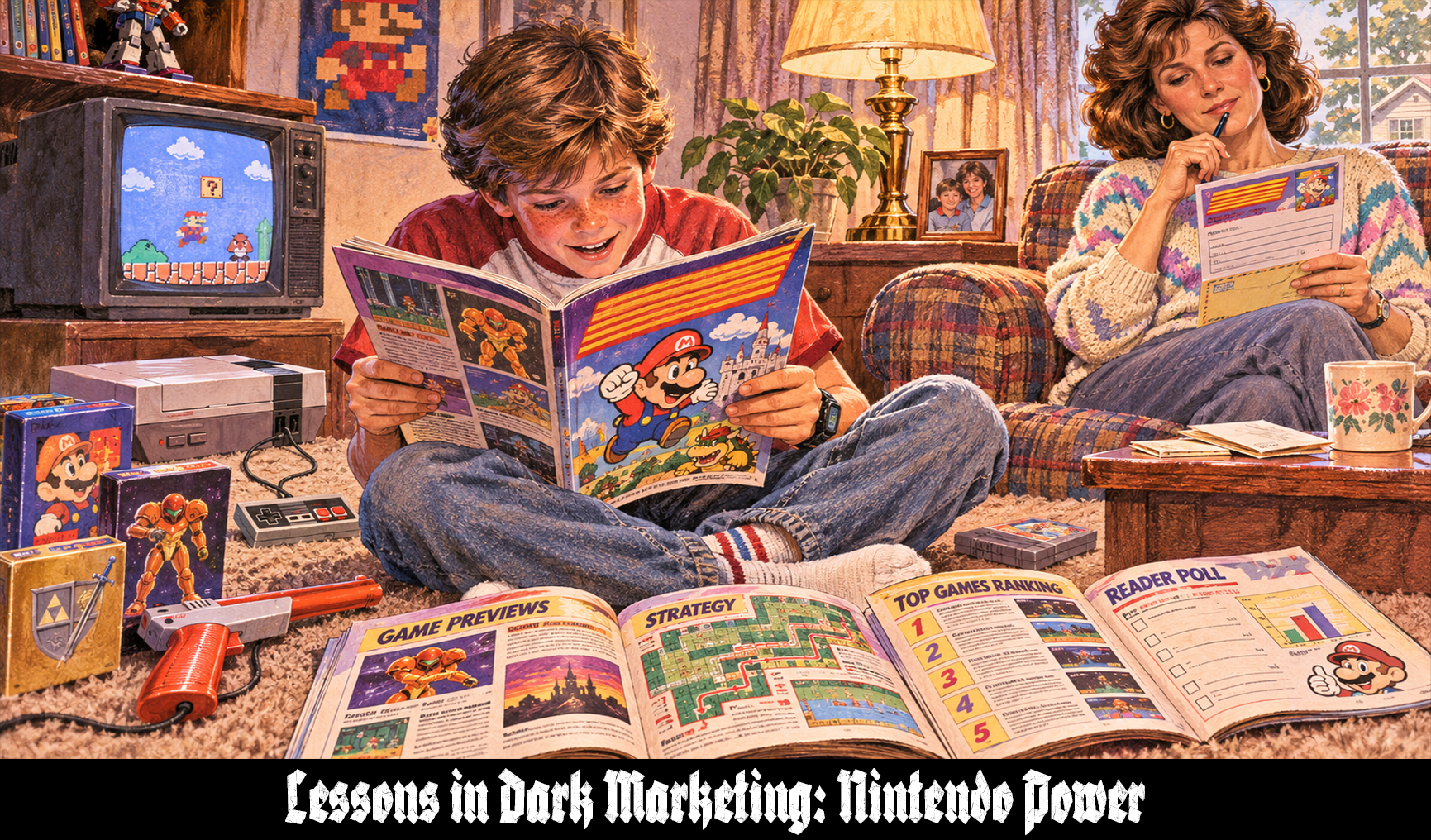
It is 1989, and somewhere in an American living room a child has spent the better part of Saturday trying to figure out why a little green man with a sword cannot get through a door. The television has been switched off twice because the machine supposedly needs a rest, the kid has drawn a map on school notebook paper, and an older brother has been consulted despite possessing no useful knowledge whatsoever. There is a rumor at school about a hidden passage, but the rumor came from a boy who also claimed his uncle worked for Nintendo, so its credibility is approximately equal to that of a weather forecast delivered by a squirrel. The game is sitting inside the Nintendo Entertainment System, a very expensive birthday or Christmas present that has somehow become an instrument of domestic aggravation.
Then a magazine arrives in the mailbox. Its cover makes a familiar video game look like a Hollywood production, its pages contain colorful maps of places the child has been trying to imagine from tiny blocks on a television screen, and there are tips that might finally get the little bastard through the door. The kid sits on the carpet and reads the thing with a concentration normally unavailable for homework, chores, church, or anybody else’s birthday party. He discovers how to reach one secret and, in the process, discovers several games he didn’t know he was supposed to want. The magazine has managed to accomplish something the family’s school district would find nearly miraculous: it has made a child study willingly.
In the kitchen, a parent sees a magazine subscription. It looks educational enough. There are words, diagrams, charts, strategies, and the occasional evidence that the child is developing patience and problem-solving skills rather than simply turning his brain into the contents of a microwave dinner. The parent has already bought the Nintendo, bought some cartridges, and heard more than enough about Mario. Paying for a publication that helps the child enjoy what the family owns might even seem financially responsible. At least the magazine is cheaper than buying a new game every time the old one gets difficult.
Nintendo sees a much more interesting arrangement. The company has a customer’s mailing address, a continuing reason to contact the household, an audience willing to pay attention to its product recommendations, a magazine whose editorial content it can direct, a mechanism for collecting customer preferences, and an extremely effective way to introduce more games to children who have already demonstrated they love Nintendo. It has turned troubleshooting into promotion and turned promotion into something families may willingly pay to receive. The kid thinks he bought the secret to the hidden passage. The company has opened a very different sort of door.
That is the Nintendo Power crime scene. The magazine gave children real, often excellent help. It also occupied a peculiar commercial position: the same company that sold the hardware and controlled access to its software marketplace published the publication telling customers which games deserved their attention, how those games worked, and what they should look forward to next. The reader could receive useful advice and genuine entertainment while participating in a carefully constructed brand relationship that made the next cartridge seem increasingly natural. You didn’t need to interrupt the article with an advertisement when the article itself could make a game desirable.
The history is unusually clear because several of the people who built the operation have explained how it worked. Nintendo launched its North American magazine in July/August 1988 after operating a game-counseling service and a free Nintendo Fun Club newsletter. Nintendo marketing executive Gail Tilden became its founding editor in chief, working closely with game expert Howard Phillips and Japanese publishing and design collaborators. The publication ran for 285 issues through December 2012, with Future US taking over publishing under license in 2007. That timeline is established in the Nintendo of America company history, the Video Game History Foundation’s collection catalog, and detailed interviews with the magazine’s original staff collected by Game Developer.
There was nothing dishonest about the existence of an official Nintendo magazine. Its identity was printed on the cover, and plenty of children understood exactly whose name they were reading. The more consequential issue was the arrangement of incentives. A business responsible for selling more games also became a trusted source of guidance about games, childhood expertise, customer service, product rankings, contests, reader identities, and what came next. The public received valuable information, while Nintendo accumulated attention and influence that the public had paid to help maintain. If you’re looking for the moment a Generation X childhood hobby began to resemble a subscription-funded customer relationship management program, you can probably find it in the mailbox.
The Game Counselor Was the First Clue That Playing Created a Second Product
Before the magazine existed, Nintendo learned that many children needed help after buying games. An NES owner could become stuck in a dungeon, unable to find a key, unable to beat an enemy, or convinced that a cartridge had become personally offended. Nintendo’s phone counseling service provided a way to ask someone who knew the game what to do next. Howard Phillips, who helped build that service, later explained that customer calls multiplied as the console found its audience, and that the company looked for more efficient ways to give players the answers they needed. His account appears in Game Developer’s interview with the founding editors and in a later Nintendo Life conversation with Phillips.
This matters because the commercial relationship didn’t stop at the point of sale. Nintendo had discovered that playing games generated questions, questions generated requests for help, and help could keep customers engaged with the games they already owned. The customer didn’t necessarily need a new cartridge at that moment. Sometimes the customer needed to be rescued from the cartridge already purchased so that the family’s next purchase would still seem like a good idea. Nintendo was watching a new category of service develop around an existing product, and the demand for that service revealed an entire publishing opportunity.
This is dark marketing principle number one: When a product creates recurring problems that customers want solved, the solution can become another channel for commercial influence.
Nintendo sold the challenge, discovered the demand for answers, and began building a business relationship around the space between them.
The Registration Card Turned a Child’s Game Into a Household Address
Inside Nintendo hardware and software packaging were opportunities for customers to send back contact information and join the Nintendo Fun Club. Gail Tilden has described how those product inserts were used to collect names and addresses, build the club’s mailing list, and send information directly to players. This was a deliberate direct-response operation from the beginning, not an accidental fan community that a corporate employee discovered while wandering through the office looking for a stapler. Tilden recalled the system in the 2012 Game Developer oral history and again in a 2025 Video Game History Foundation interview.
The process was simple enough for the pre-internet household. Buy a product, find a card, fill it out, mail it back, and get something valuable in return. From the player’s perspective, it was an invitation into the club. From Nintendo’s perspective, the sale had produced an identifiable household that could receive more messaging, more offers, more product information, and eventually a subscription pitch. The company wasn’t asking a child to understand database marketing. It was giving a child a reason to recruit the family’s kitchen table and postage stamp into database marketing.
This is dark marketing principle number two: A small benefit attached to product registration can convert an anonymous purchase into a durable customer contact.
Nintendo turned the warranty-card era into the beginnings of a remarkably well-informed fan mailing list.
The Free Fun Club Newsletter Made Corporate Contact Feel Like a Privilege
Nintendo Fun Club News began as a free publication offering tips, information, and glimpses of games. The club format made the relationship feel exclusive without requiring Nintendo to create a genuinely exclusive customer group. Membership was the act of identifying yourself as a fan and agreeing to receive Nintendo’s material. Howard Phillips explained that the newsletter emerged partly because answering every question by telephone wasn’t practical, while Tilden described the publication as a way to support people who had already bought the hardware. In the late 1980s, receiving a free newsletter about your favorite pastime could feel like a rare invitation from the people who made the thing you loved.
The word club did enormous work. It suggested belonging, shared knowledge, and privileges available to somebody who had taken the trouble to join. Yet the organization supplying that belonging was also the company that needed the member to keep buying games. The child was happy to be recognized as a Nintendo fan, while Nintendo was happy that the fan had handed over an address and demonstrated a willingness to open company mail. A free newsletter could make the next piece of corporate correspondence feel less like an intrusion and more like a delivery from a friend.
This is dark marketing principle number three: Give customers a membership identity before asking them for a continuing financial commitment.
The Nintendo Fun Club made the mailbox feel like an extension of the game room, and that turned out to be a highly profitable place to establish a relationship.
Six Hundred Thousand Free Readers Became a Marketing Budget With a Problem
By the time the free newsletter had grown substantially, Nintendo was paying to print and mail information to hundreds of thousands of households. Tilden recalled roughly 600,000 Fun Club readers around the Mike Tyson’s Punch-Out!! period and said the expanding publication was consuming a surprising amount of marketing money. The company had proved the audience existed, but it had also proved that generosity could become expensive when the recipients kept joining. Nintendo of America president Minoru Arakawa saw an opportunity to turn that support operation into a paid magazine, borrowing from a Japanese publishing culture where children bought detailed periodicals about the entertainment they followed. Game Developer documents the decision, including Tilden’s admission that subscriptions helped pay the cost even though the magazine remained a marketing expense.
That last distinction is important. A paid subscription didn’t need to earn the kind of profit an independent publisher might require if the magazine also encouraged people to buy more Nintendo products. The reader could contribute to printing and mailing costs while the company retained the promotional benefit of a publication devoted to its own entertainment system. A household was now paying to support the delivery of material designed, in part, to support future household spending. The customer and the marketer could both feel they had gotten a bargain, which is when an arrangement like this becomes especially durable.
This is dark marketing principle number four: An effective marketing expense becomes more attractive when its audience can be persuaded to subsidize it.
Nintendo found people who were pleased to pay for something the company had previously paid to send them.
The Free First Issue Was a Trial Subscription Disguised as a Gift
The debut issue of Nintendo Power, dated July/August 1988, featured Super Mario Bros. 2 on its cover. Nintendo mailed millions of complimentary copies to its existing contacts rather than starting from the reasonable assumption that strangers would seek out a new magazine published by their game-console manufacturer. Sources vary on the exact number of copies distributed, with some historical accounts citing about 3.2 million and others about 3.6 million. Tilden herself later recalled approximately 3.2 to 3.3 million free copies and about 1.3 million paid subscriptions after the campaign, an extraordinary conversion for a new publication. Her recollections appear in Game Developer and the Video Game History Foundation interview.
Those first readers weren’t being asked to imagine what they might receive. They were given a full demonstration they could hold, fold, read, and spread across the carpet. The game maps were there, the secrets were there, the excitement about future cartridges was there, and the subscription invitation arrived after the family had already seen the value. Nintendo applied a straightforward trial strategy to a magazine that itself supported a larger product business. The first issue didn’t need to persuade children to care about Nintendo. Nintendo already had millions of children who cared, and it mailed them a convincing reason to care about the next Nintendo product.
This is dark marketing principle number five: Sampling is most persuasive when it arrives inside an existing relationship and demonstrates practical value before asking for payment.
Nintendo mailed a sales pitch that could help a kid beat a video game before the kid realized it was also selling the magazine.
They Put the Brand in the Magazine’s Name and Called It Power
Nintendo had been using a marketing line built around playing with power, and the magazine’s name extended that language into the publishing business. Tilden recalled that potential titles were discussed, but Arakawa insisted that Nintendo’s name be part of the masthead. It was a sensible branding decision with a significant behavioral effect: even when the child wasn’t playing the console, the child could be engaged with something explicitly called Nintendo. The company had turned an advertising idea into a regular publishing identity, a fact Tilden discussed in the founding-editors interview.
Power was a particularly effective word for this audience. It made strategy knowledge sound like mastery, the magazine sound like equipment, and the reader sound like somebody gaining an advantage unavailable to ordinary children. The pages could teach legitimate gaming skills, but the language also suggested that Nintendo was the source of the very power the reader was supposed to possess. That is a useful arrangement for a company whose products contain the problems a customer is trying to conquer. The solution arrived bearing the name of the organization that manufactured the original challenge.
This is dark marketing principle number six: Attach the master brand to the language customers use to describe competence and belonging.
Nintendo wasn’t content to be the name on the console when it could also become the name on the kid’s confidence.
The Magazine Spoke Like a Classmate Instead of a Parent
One of the more revealing editorial decisions was whom the magazine pretended to be talking with. Tilden said the publication avoided treating readers as children being lectured by adults, and that the staff deliberately stayed out of photographs so the magazine would feel focused on the player. She described it as a peer-to-peer product in a 2013 interview about the magazine’s beginnings. This wasn’t an accidental tone achieved by hiring a particularly enthusiastic proofreader. It was a deliberate attempt to make the company sound like someone who belonged in the reader’s gaming world.
For Generation X, that mattered. A great deal of childhood marketing involved adults announcing what children should want, often with the subtlety of a car salesman conducting a birthday party. Nintendo Power offered a different relationship, one in which the source of guidance seemed to share the child’s obsession with the game. A strategy tip from a corporation sounded tedious. A trick from a magazine that seemed to know exactly why you were angry at a dungeon felt like insider knowledge. Nintendo’s adult marketing organization learned to remove the adult from the conversation without removing the marketing organization.
This is dark marketing principle number seven: Customers trust a brand voice more readily when it sounds like someone experiencing the problem alongside them.
The company stayed in charge of the conversation while making the conversation feel delightfully free of authority figures.
The Magazine’s Physical Weight Made the Entertainment System Look Bigger
Early Nintendo Power issues were substantial, colorful objects filled with features, illustrations, screenshots, maps, letters, cartoons, and predictions about games still to come. The debut issue promised more than a hundred pages of information and arrived as something children could read repeatedly rather than an advertising flyer to discard. In an era when television showed only a little portion of a game world at a time, opening a magazine with a large map could make the software feel more ambitious than its graphics alone allowed. The magazine created a sense of scale around games that were technically limited by the hardware of their day.
A thick publication also conveyed an argument about the size of Nintendo’s universe. A console with a few cartridges might look like a toy, but a console accompanied by an entire magazine of secrets, routes, game characters, and future releases looked like a serious hobby. This gave the hardware social credibility and made its software library appear culturally important. The paper served the game, and the game justified the paper. Nintendo had managed to give pixels the supporting literature of an established entertainment industry.
This is dark marketing principle number eight: Detailed supporting media can make a product category feel more expansive, sophisticated, and permanent than the product alone suggests.
The NES sat under the television, while Nintendo Power quietly explained why it deserved an entire shelf of accompanying literature.
The Maps Made the Invisible World More Desirable
A player looking at The Legend of Zelda or Metroid could see only the immediate screen and whatever knowledge the child managed to retain from yesterday. Nintendo Power offered large, meticulously assembled maps showing relationships between rooms, pathways, hidden locations, and challenges. Howard Phillips described the effect as giving children a view of places beyond the visible television screen, while Tilden explained how difficult the maps were to create with the technology available at the time. Their teams in Japan had to capture and assemble many small images into usable layouts, sometimes working piece by piece to build a picture of an entire environment. The production process is documented in Game Developer’s interview.
This was genuinely wonderful customer service, and it was also a remarkable act of product presentation. A map could show the child a world bigger than the part the child had managed to reach, transforming confusion into anticipation. A person who had never played the game could see those maps and begin to want a cartridge because the magazine made the adventure look achievable and enormous at the same time. The diagram was both a solution for the owner and an advertisement for the prospective owner. Nintendo didn’t need to misrepresent the game when it could reveal how much more game existed.
This is dark marketing principle number nine: Showing customers the hidden scale of a product can both increase satisfaction and generate desire among people who don’t yet own it.
Nintendo took a maze you couldn’t navigate and turned it into an argument for buying the maze.
Classified Information Turned Useful Tips Into Contraband
One of the magazine’s signature departments was Classified Information, which presented passwords, tricks, special techniques, and hidden features with the atmosphere of a file that had escaped from somebody important’s desk. Tilden recalled that the section used a confidential, almost intelligence-agency look because secret codes and game knowledge were particularly valuable before players could search online. A trick for skipping a difficult obstacle or unlocking something obscure could become the most important paragraph in the entire issue. The magazine gave practical answers a presentation suggesting that readers were being let into something they weren’t quite supposed to know.
The psychology was elegant. Ordinary instructions are helpful, but secrets are social currency. The child who learns a hidden technique can demonstrate it to friends, trade the knowledge, or become the classroom authority on a particular game. The magazine printed that authority with Nintendo’s permission, and the discovery was all the more exciting because the copy treated it like restricted information. The child could feel rebellious while using a corporate-approved code printed in a corporate-owned publication. Nintendo had figured out how to sell the sensation of getting away with something while personally distributing the evidence.
This is dark marketing principle number ten: Package routine information as privileged knowledge and customers will attach status to possessing it.
Nintendo made the cheat code feel like an act of espionage, then charged a subscription fee for access to headquarters.
Counselor’s Corner Made Customer Service Read Like a Feature
The magazine also translated game-counseling expertise into recurring editorial material. Questions about confusing levels and difficult games could be answered once in print rather than repeatedly by employees on the telephone. Howard Phillips explained that the publication’s tip sections helped solve the problems responsible for disproportionate numbers of calls, while Tilden recalled that even ordinary hardware questions could be reframed as reader letters rather than dry corporate notices. The approach brought support into the magazine without making the child feel as though a repair department had taken over the entertainment. Game Developer’s interview describes both mechanisms.
There was a quiet business efficiency behind the friendliness. The same answer could serve thousands of readers, reduce pressure on Nintendo’s counseling service, and give the subscriber a reason to save the issue. It also kept the corporation in the role of helpful expert rather than distant manufacturer, which mattered when a household had to decide whether buying more Nintendo products was a safe investment. Each successful tip was a little demonstration that the company understood its customers and would be there after the sale. Good service became brand persuasion without having to stop being good service.
This is dark marketing principle number eleven: Customer support becomes a more powerful retention tool when it is packaged as content people choose to consume.
Nintendo turned the troubleshooting department into something a child might read under the covers with a flashlight.
Howard and Nester Taught Children Through Somebody Else’s Stupidity
The comic Howard & Nester paired Nintendo expert Howard Phillips with a fictional child who was often too impatient, confident, or stubborn to take good advice. The joke was familiar to anyone who has watched a young person insist that an obviously impossible maneuver will work on the next try. Phillips explained that Nester was designed partly around the way children resist being instructed, and that the strip could teach game techniques by allowing its young character to make mistakes on the reader’s behalf. The history comes from Phillips and Tilden’s recollections.
This is unusually clever educational packaging because it lets the reader maintain pride. The child doesn’t have to accept a lecture from a company representative. The child gets to laugh at a cartoon kid who makes the same mistake, recognize the solution, and return to the game believing the lesson was self-discovered. The characters also gave the publication a continuing personality, making the magazine more like a familiar entertainment property than a collection of technical instructions. Nintendo managed to place a small comedy duo between a customer and a product problem, then used the duo to make both the product and the publication more enjoyable.
This is dark marketing principle number twelve: Teach through a fictional stand-in and customers can accept correction without feeling corrected.
Nintendo understood that an embarrassed child might ignore a lecture but happily learn from another child’s spectacular failure.
The Letter Column Made Nintendo Look Like a Community Newspaper
Reader letters, gaming achievements, questions, and reports of unusual discoveries created the impression that Nintendo Power belonged as much to its audience as to its publisher. A child could see a name and hometown in print and reasonably believe that other children were helping shape the conversation. Some readers were genuinely contributing knowledge, and the magazine gave their excitement a public place to live. This was a meaningful social service in a period when the nearest gaming community might consist of three school friends, a sibling, and the kid at the rental counter who claimed he had finished everything.
But publishing a reader’s experience also performed a marketing function. It supplied testimony that didn’t sound like corporate copy, made game enthusiasm look widespread, and gave customers an incentive to send more information to Nintendo. The more the magazine reflected its readership, the easier it became to treat the publication as a community rather than as a company-controlled channel. Both descriptions contained some truth, which is precisely why the arrangement worked so well. Real letters and real friendships were the raw material of a relationship whose headquarters remained in Redmond, Washington.
This is dark marketing principle number thirteen: Giving customers a visible role in media can convert their enthusiasm into social proof for the brand that owns the platform.
Nintendo let children recognize themselves on the page while ensuring that every page still belonged to Nintendo.
The Power Meter Was a Recommendation System Wearing a Lab Coat
The magazine assessed games through a system of evaluations that drew on internal players, game counselors, and eventually children who tested products. Phillips described how standardized ratings fed the magazine’s Power Meter, and Tilden explained that strongly reviewed titles were more likely to receive substantial attention. These evaluations weren’t invented scores selected by a marketing executive five minutes before an advertising deadline. Nintendo really did use gameplay assessment and tried to identify which releases were likely to satisfy customers. The same 2012 founding-editors interview makes that clear.
The conflict came from the setting in which those recommendations appeared. The company evaluating the games was also the owner of the platform that benefited when customers bought compatible games, and the publication decided how much space those games would receive. A strong evaluation could be meaningful, but the entire recommendation environment remained commercially aligned with Nintendo’s system. For the reader, the ratings made an enormous library easier to understand. For the company, they helped direct attention toward software it considered worth supporting, while presenting the selection process through a reassuring numerical framework.
This is dark marketing principle number fourteen: Measurements become influential when customers interpret them as objective shortcuts through complicated choices.
Nintendo’s scores could reflect real judgments and still strengthen Nintendo’s control over the buying conversation.
The Cover Became a Reward Publishers Couldn’t Buy at Any Ordinary Newsstand
For a game publisher, receiving major coverage in Nintendo Power could mean exposure to a vast audience of people who already owned the hardware needed to play the game. Tilden recalled that licensees wanted their releases featured, and that the magazine resisted covering games its internal evaluations considered weak. She also described the significance of a cover and explained that Nintendo’s access to game code let the editorial staff examine upcoming releases early. Cover placement wasn’t a minor decoration. It was a powerful signal to subscribers that this particular cartridge deserved attention ahead of dozens of competing cartridges.
That made the cover a valuable form of commercial currency even if the company wasn’t selling ordinary display advertisements inside the publication. A publisher could have spent real money building a game, only to discover that one of the most effective ways to reach the game’s core market depended on favorable attention from the platform owner’s magazine. Nintendo didn’t need to charge for every square inch to possess influence over what readers encountered. Its attention was valuable enough on its own, and the distribution list made that attention especially difficult to replace.
This is dark marketing principle number fifteen: When a brand owns a trusted discovery channel, editorial placement becomes an economic asset even if no one calls it an advertisement.
The cover was supposed to tell children what was exciting, but every publisher knew it could also help determine what sold.
The Magazine’s Exclusive Focus Made the Competition Practically Disappear
An independent games magazine could discuss rival consoles, competing publishers, unfavorable industry trends, and products that had nothing to do with Nintendo. For much of its history, Nintendo Power concentrated on Nintendo hardware and compatible software, creating a self-contained universe in which the relevant question was which Nintendo game to play. This was a natural editorial identity for an official company magazine, not a covert rule or some shocking discovery. But it had a significant consequence for children whose main regular source of game information came through the publication. Alternative platforms were not given the same opportunity to appear as normal choices inside that world.
The practical effect was subtler than telling readers that competing machines were evil. A child could pore over dozens of game features and begin to feel that nearly every worthwhile new adventure happened to require the Nintendo already sitting beneath the television. Limited attention is a competitive advantage when all the options on the page keep directing customers back to the same hardware ecosystem. By helping readers choose among Nintendo games, the magazine reduced the number of moments in which they might ask whether they wanted a Nintendo game in the first place.
This is dark marketing principle number sixteen: Define the editorial boundaries of a category and the audience may mistake the boundaries of your coverage for the boundaries of the market.
Nintendo didn’t have to win every comparison when its own magazine could avoid making many comparisons at all.
An Advertising-Free Magazine Could Still Be One Long Advertisement
Early Nintendo Power didn’t operate like a conventional advertising-supported magazine packed with unrelated paid display ads. Tilden has explained that the magazine relied on subscriptions and the marketing value of supporting Nintendo’s software business, rather than selling its pages in the normal way. This had a real benefit: the reader received dense maps, illustrations, tips, and game features instead of endless interruptions from car companies and cereal brands. The Game Developer interview documents the business logic, while the Video Game History Foundation conversation describes the absence of ordinary paid advertising during the early period.
It would be lazy to conclude that this made every review dishonest or every page worthless. It would be just as lazy to pretend the absence of a conventional advertisement made the entire enterprise commercially neutral. A company magazine can perform promotional work by selecting which subjects exist, which releases receive enthusiasm, which products appear on the cover, and which customer problems get solved. The promotion becomes easier to accept because much of the content is genuinely useful. The child didn’t need to tolerate ads between the good stuff. In this model, the good stuff was the medium through which product demand grew.
This is dark marketing principle number seventeen: Marketing becomes harder to recognize when its primary form is valuable information rather than an obvious sales interruption.
Nintendo made the advertising argument so entertaining that many readers had no reason to object to hearing it.
Game Publishers Learned to Court a Magazine Owned by Their Landlord
Nintendo licensed other companies to make compatible games, giving players access to an expanding library created by many developers. Those publishers needed customers to know their products existed, and Nintendo Power offered an unusually efficient way to reach a concentrated audience. Tilden and Phillips have said that coverage wasn’t simply available to the highest bidder, and the staff took pride in turning down unimpressive games. Yet the magazine was still tied to the company that controlled the hardware those publishers depended on, and a featured placement could give a release enormous visibility.
The relationships produced a peculiar balance of cooperation and dependence. Outside developers gave Nintendo variety, characters, innovations, and software sales; Nintendo gave the developers a large audience and a prominent channel for discovery. The game company could earn favorable coverage through quality, but the platform owner still controlled the medium where so many customers learned about quality. It was possible for a publication to be operated with sincere editorial standards while existing inside a structure that concentrated commercial power. The jagoff who thinks everything is fine because no one handed over a briefcase of cash has failed to notice that the building, the mailbox, and the subscriber list already belong to the same company.
This is dark marketing principle number eighteen: Commercial leverage doesn’t require falsifying recommendations when the platform owner controls access to the audience and the trusted publication reaching it.
Nintendo’s magazine could reward good games while making Nintendo the judge of which rewards mattered.
Pak Watch Made the Future Feel Like an Unfinished Shopping List
Sections previewing upcoming Game Paks offered readers a look at releases that might be months away from their living-room television. The first issues included Pak Watch, and early magazine contents show how tightly previews were integrated into the larger experience of tips, maps, and current games. A child might buy the magazine to solve an existing puzzle and leave it with a list of future purchases already forming. That mixture was ideal for a platform whose commercial health required new software to keep flowing into households that already owned the machine.
Anticipation is a useful product even before anything can be bought. By showing a future game in advance, the magazine could help children learn its name, recognize its images, talk about it at school, and prepare to ask a parent for it. Each preview was a small investment in the next retail conversation. The information was exciting because these games genuinely promised new experiences; the manipulation lay in arranging the excitement as a repeating calendar of things a reader might feel incomplete without owning. A guide for enjoying today’s game quietly became a catalog for tomorrow’s allowance.
This is dark marketing principle number nineteen: Mix current-use content with carefully timed future previews and customer satisfaction turns naturally into the next purchase intention.
Nintendo helped children finish the game while making sure they knew which game would be waiting afterward.
The Nintendo Power Top 30 Turned Popularity Into a Shopping Argument
The magazine’s ranking features combined information about popular games and gave readers a sense of which titles mattered most in the wider gaming culture. Early issues included a Nintendo Power Top 30 and separate inputs associated with players, dealers, and experts, presenting popularity and judgment as visible order rather than playground rumor. Their distinctions were meaningful to readers who wanted to know whether a favorite game was popular with other children, gaming specialists, or the stores selling it. The preserved first issue and historical breakdown of its columns show that these were regular components of the magazine’s effort to organize game information.
Lists like that make uncertainty easier to manage, which is particularly useful when the product is expensive and its box doesn’t tell the whole truth about its quality. A parent can justify choosing a popular game because other people apparently like it. A child can justify wanting it because the rankings have given it an official position in the culture. The top games may have earned their status, but displaying the status can intensify demand and keep people talking about the same releases. Nintendo didn’t invent popularity. It gave popularity a regularly updated table, wrapped it in a company magazine, and sent it to the customers whose purchases helped determine the next table.
This is dark marketing principle number twenty: Public rankings convert other customers’ behavior into a reason for the next customer to follow.
Nintendo transformed the simple question of which game was good into a monthly hierarchy that children could argue over and parents could use to rationalize spending.
The Player’s Poll Was a Research Questionnaire Dressed for a Contest
The Player’s Poll invited readers to report preferences and participate in contests, offering the excitement of being heard and the possibility of winning something memorable. Tilden was remarkably candid about the commercial purpose. In the founding-editors interview, she explained that the cards helped Nintendo monitor which games readers liked and also ask direct-marketing and research questions. The sweepstakes prizes were part of the attraction, and outside licensees could contribute experiences that helped draw attention to their games. Game Developer records her account.
There is a difference between learning about your customers and exploiting them, and simply asking for opinions doesn’t establish wrongdoing. But the structure is worth examining. A child had been invited into a club, mailed a magazine, asked to rate games, encouraged to enter a contest, and given an opportunity to provide more information about what the household wanted. The data flowed toward the company that controlled the magazine and stood to benefit from the purchases the research might influence. A game-loving child experienced participation. A marketing department received a stream of structured answers from people unusually qualified to explain what future gaming customers would buy.
This is dark marketing principle number twenty-one: Make market research feel like community participation and customers may give you better information because answering is enjoyable.
Nintendo could learn what its readers wanted while making readers feel that their opinions were part of the show.
The Prize Was the Reason to Return the Survey
A survey about preferences can feel tedious, especially when the respondent is an eleven-year-old who would rather play a video game. A contest with an extravagant prize is different. Early Nintendo Power sweepstakes offered highly theatrical rewards and experiences, and Tilden recalled occasions when licensees supplied unusual prizes to encourage participation and attention. Some contests involved trips, celebrity meetings, or themed adventures that turned a magazine activity into the possibility of an extraordinary childhood story. The magazine’s founding editors described this as part of the reader-poll strategy.
That gave the simple act of answering questions a second purpose. Returning a card could make a reader feel involved in determining future coverage, but it also felt like buying a lottery ticket without having to explain why. The more desirable the prize, the easier it was to encourage the reader to finish the poll rather than abandon it halfway through. The contest supplied motivation; the research answers supplied business intelligence. In a household where no one had ever heard the expression customer acquisition cost, the magazine had found a way to make a child volunteer information in exchange for a chance to win a spectacular vacation.
This is dark marketing principle number twenty-two: Rewards can increase participation in activities whose main business value lies somewhere other than the reward.
Nintendo put the dream vacation on the postcard and placed the research questions where the child’s pencil had to pass on the way to the mailbox.
Nintendo Power Let Kids Compete in Public Without Leaving the Living Room
The magazine celebrated high scores, unusual achievements, clever discoveries, and devoted players. For children whose gaming lives existed mostly within their households and schools, seeing a name appear in a national publication could confer real prestige. A score that had impressed only the family suddenly belonged to a much wider competition, one populated by children in other cities who were just as determined to prove they had mastered a game. Nintendo had helped turn private amusement into something that could be measured, compared, and admired. The first issue’s preserved reader-achievements material makes clear that the publication actively invited readers to submit the accomplishments that would make this shared conversation possible.
This mattered commercially because a hobby feels more important when it has an audience. An achievement worth reporting becomes an achievement worth pursuing, and the pursuit creates hours of engagement with a cartridge that might otherwise have been abandoned. The magazine didn’t need to invent the desire to win. It could offer a larger stage on which that desire made sense. A child who once wanted to beat a game could now want to beat the game well enough for Nintendo to notice, and Nintendo was happy to receive the correspondence documenting the effort.
This is dark marketing principle number twenty-three: Public recognition can give a private activity a social life and increase the time customers invest in it.
Nintendo turned the high-score screen into a possible invitation to the national stage, which is a lot of ambition to load onto a plastic cartridge.
The Posters Turned a Bedroom Into an Advertising Space the Family Paid For
Many issues included pull-out posters featuring game imagery, characters, and memorable artwork. The child might tape one above the bed, another inside a closet door, and a third where an adult would eventually discover it while attempting to clean the room. These objects were legitimate gifts to readers who loved the imagery. They also allowed Nintendo-related intellectual property to remain visible long after the magazine had been read and put away. The historical account of the magazine’s first issues and archival collectors’ issue guide document pull-out posters as part of the publication’s original formula.
That detail deserves more attention than it usually receives. A page inside a magazine has a limited life unless the reader opens it again, but a poster can become part of the room’s permanent visual environment. The characters displayed there may acquire the intimacy of familiar possessions before the child has even played their games. A parent might believe the subscription bought reading material, while a portion of that material was designed to become a display for Nintendo properties inside the child’s home. The brand was no longer visiting through a commercial or a magazine. It had been promoted to bedroom decoration with the child’s enthusiastic cooperation.
This is dark marketing principle number twenty-four: Give customers display-worthy material and advertising can become a voluntarily installed part of their personal space.
Nintendo’s characters didn’t always need to buy wall space when the kid supplied the tape.
The Magazine Made a Game World Feel Like a Place Worth Collecting
A long feature on a game could contain maps, characters, item descriptions, strategies, secrets, enemies, and images of places a player might never have discovered alone. Together those details created a kind of supporting mythology around the cartridge. The physical game remained a compact piece of software, but its world now had guidebooks, charts, artwork, and documentation. A child could collect the publication as an extension of the game and come to value a release not only for what happened on the screen but also for how much material existed around it.
This is the same mechanism that makes fictional universes commercially expandable. Once a product contains a world rather than a single experience, there can be endless legitimate reasons to revisit, explain, map, archive, and merchandise it. Nintendo didn’t have to pretend the games were vast. Some were already remarkably sophisticated. The magazine made their complexity visible, teachable, and collectible, and doing so increased the emotional significance of the entire console library. A game could occupy a shelf, a magazine stack, a bedroom wall, and the child’s imagination simultaneously.
This is dark marketing principle number twenty-five: Detailed companion content increases the emotional surface area of the original product.
Nintendo gave its games a paper afterlife and made each cartridge feel less like a purchase that could ever truly be finished.
Dragon Warrior Proved a Free Game Could Sell the Magazine
The most spectacular subscription offer was also one of the clearest demonstrations of how many jobs Nintendo Power could perform simultaneously. Dragon Warrior, the American release of Dragon Quest, had struggled to find the audience Nintendo hoped for, and the company had unsold inventory. Nintendo offered copies of the game with subscriptions to Nintendo Power, giving people a cartridge along with a publication that could help explain how to play it. Tilden later acknowledged both the inventory problem and the hope that the promotion would introduce American players to Japanese role-playing games. A preserved overview of the magazine’s 1989 Dragon Warrior supplement documents how Nintendo paired that game with a detailed printed explanation even before the free-cartridge subscription promotion. In her 2025 conversation with the Video Game History Foundation, she also recalled how difficult it became to renew some of those subscriptions once the free-game customers reached the end of their terms.
Consider the number of interests served by that single offer. Nintendo could move inventory, bring new households into the subscriber file, give an unfamiliar genre a better chance of finding fans, and ensure the recipient possessed both a game and a reason to read the publication. The customer might feel that buying a subscription had somehow produced a free game, while Nintendo could feel that an overstocked game had produced a subscription and perhaps a future role-playing customer. The incentive was generous, but its generosity wasn’t random. The company used an existing product’s commercial problem to help solve a publication’s audience problem, then used the publication to support the product category.
This is dark marketing principle number twenty-six: A low-demand product can become a valuable acquisition incentive when paired with a service that increases its usefulness.
Nintendo found a way to turn a difficult inventory situation into a mailing-list expansion and a lesson in how to play an unfamiliar genre.
They Didn’t Just Sell Games. They Taught Americans What Kinds of Games to Want
In Japan, role-playing games had already developed a major following, but American console players couldn’t automatically be expected to understand the genre’s slower pacing, menus, statistical progression, and conventions. Nintendo used Nintendo Power to explain how these games worked and why somebody who loved fast arcade action might find pleasure in wandering around, gathering equipment, and talking to townspeople. Tilden described a sustained effort to introduce Final Fantasy, including repeated coverage, guides, contests, and related promotions. Her Video Game History Foundation interview places these campaigns inside a deliberate effort to grow demand for a category that didn’t yet have the same American audience.
That is a deeper form of marketing than telling a child that a game is exciting. It is teaching the child how to recognize excitement in an experience that initially looks slow, complicated, or strange. Instructions lower barriers to adoption, and successful adoption creates demand for more of the same sort of product. The publication could introduce a vocabulary for items, spells, levels, quests, and party management, making an unfamiliar form of entertainment feel less intimidating. Nintendo wasn’t simply advertising another game. It was helping create the kind of customer who would understand and eventually want a whole new shelf of games.
This is dark marketing principle number twenty-seven: Educate customers into a product category and the education can enlarge the market itself.
Nintendo helped children acquire a taste for the very kind of software it wanted them to buy next.
The Final Fantasy Campaign Shows the Difference Between Coverage and Cultivation
The founding editors have emphasized that game quality mattered to the magazine’s decisions, and that the staff didn’t blindly surrender every cover to corporate pressure. That defense is supported by specific accounts of internal rating systems and decisions to limit coverage of weak releases. Yet Tilden also recalled sustained campaigns for promising but unfamiliar games, including continued attention to Final Fantasy and elaborate promotions designed to keep it in view. A series of features could be built around a game that Nintendo wanted American customers to learn to appreciate, with editorial knowledge and promotional activity reinforcing each other. These recollections appear in the 2025 Video Game History Foundation interview.
The distinction matters because advertising isn’t always a lie and editorial influence isn’t always a bribe. Sometimes the company genuinely believes a product is good and uses its media to train customers to recognize that goodness. The problem is that this process still gives the company an unusual capacity to direct taste. A magazine can repeatedly explain why a particular kind of game deserves attention until the audience has enough knowledge, familiarity, and curiosity to buy one. That can create a wonderful cultural outcome and a powerful commercial advantage at the same time. Nintendo Power was capable of honest enthusiasm that also happened to be exceptionally useful to Nintendo’s business.
This is dark marketing principle number twenty-eight: Repeated educational coverage can cultivate demand more effectively than a single promotional claim.
Nintendo didn’t need to force readers to like role-playing games when it could spend months helping readers discover why they might.
Early Access Let Nintendo’s Magazine Own Tomorrow Before Competitors Saw It
The magazine’s staff often received access to unreleased games through Nintendo’s licensing and approval arrangements. Tilden explained that licensees knew Nintendo Power would be able to examine game code submitted for testing, giving its editors time to develop features before the public could buy the finished product. For a print publication with long production lead times, that access was extremely valuable. It also distinguished the official magazine from outside publications that couldn’t automatically expect access to the same internal pipeline. Game Developer documents the arrangement.
This created a promotional advantage that didn’t depend on falsifying a single word. An official publication could prepare detailed coverage while rival magazines were still waiting for material or asking developers for a preview. The depth of Nintendo’s access helped produce the maps and guidance that made its magazine genuinely different. Yet the same arrangement also reinforced the magazine’s authority as the place where players learned about upcoming games first. Nintendo owned the console system, supervised the pipeline of compatible games, and published a magazine that could benefit from privileged access to that pipeline. In a market where information itself was scarce, the ability to get information first was a form of commercial power.
This is dark marketing principle number twenty-nine: Control over early product information can make a company’s own media the default source for customers seeking answers.
Nintendo could preview tomorrow’s shopping list before the average kid had even heard that tomorrow’s games existed.
A Magazine Can Shape Demand by What It Leaves Out
One of the founders’ strongest defenses of the publication was that unappealing games frequently received less attention. This was an understandable editorial choice, and it protected readers from pages of enthusiasm about titles that testers considered disappointing. The same editorial policy, however, created a system in which inclusion and omission carried commercial weight. A child reading Nintendo Power saw the games the magazine had decided deserved space, explanations, rankings, and sometimes a cover. The weaker products might get a small mention or no memorable treatment at all, while the most promising ones could dominate the reader’s imagination.
This could be useful consumer guidance and still narrow the marketplace. The magazine wasn’t a comprehensive, independent accounting of every possible option, and Nintendo never needed it to be. Its purpose included keeping families satisfied with the NES category and encouraging confidence in future purchases. The editor could make a perfectly sincere choice about a game and also make an economically important choice about which games occupied the customer’s attention. What went unmentioned never had the same opportunity to become part of a child’s wish list. In commerce, absence from the conversation can be just as consequential as a negative review.
This is dark marketing principle number thirty: A curator influences demand through exclusion as well as endorsement.
Nintendo could make its recommendations more credible by refusing to celebrate everything, while keeping the power to decide what deserved celebrating.
The Magazine Knew That Giving Away the Ending Would Destroy the Product
A strategy guide that reveals every secret and the ending of a game can remove the very mystery that made the game worth playing. Nintendo’s editorial teams had to decide how much information helped a customer without spoiling the experience. Tilden recalled that the magazine generally tried to provide enough guidance to let readers advance without revealing the final payoff. This editorial restraint was sensible for anybody who cared about games as games. It was also sensible for a company whose continued success depended on players feeling satisfied rather than cheated out of discovery. Her later account describes this balance directly.
From a marketing perspective, the boundary between useful help and complete disclosure is an interesting one. Reveal too little, and the reader may remain frustrated enough to abandon the game. Reveal too much, and the publication can reduce the emotional reward of actually playing it. Nintendo Power tried to keep its readers moving without replacing the experience the cartridge was supposed to provide. The result was information carefully rationed to preserve both enjoyment and anticipation. The magazine made a reader confident enough to continue but ideally curious enough to remain invested, which is precisely the psychological position a recurring entertainment business wants.
This is dark marketing principle number thirty-one: Support customers enough to sustain participation while preserving the discovery that keeps the product emotionally valuable.
Nintendo understood that the secret had to be revealed selectively or there would be no reason to care about the next secret.
The Calendar Created a New Reason to Be Excited Every Month
The original magazine appeared every other month, and for a period Nintendo used special strategy guides to fill some of the gaps. By January 1991, the publication had moved to a regular monthly schedule. That change altered the rhythm of the relationship. The magazine no longer arrived as an occasional treat but as a predictable piece of household media, something the child could anticipate through the mail and compare with previous issues. A monthly publication produced twelve recurring occasions to discuss existing games, introduce upcoming releases, and renew Nintendo’s place in the reader’s attention. The magazine’s issue chronology and the history drawn from original issues establish the shift.
Regularity mattered because a game cartridge’s attention cycle could fade. A child might spend a few weeks obsessed with one title and then move on to school, sports, another toy, or an entirely different hobby. A new issue reminded the household that the NES ecosystem was still alive, populated, and producing things worth discussing. The company didn’t need every reader to buy a cartridge every month. It needed to remain mentally available when the child next asked for something. A publishing calendar could become a marketing calendar with the elegant advantage that subscribers expected and welcomed its arrival.
This is dark marketing principle number thirty-two: Predictable content delivery keeps a product category present between purchase occasions.
Nintendo turned the next issue’s arrival into a small rehearsal for wanting the next cartridge.
The Strategy Guides Made Buying the Game Feel Like Only Half the Purchase
Nintendo also experimented with more concentrated guide formats, including publications dedicated to individual games. A guide that maps a dungeon, explains combat systems, or clarifies an unfamiliar genre gives players real value, particularly when the original game offers little assistance. Nintendo Power‘s editorial operation produced special strategy material and, for a period, alternated full guides with regular magazine issues before moving to a monthly schedule. The preserved publishing history identifies the strategy-guide period, while the Video Game History Foundation’s archival catalog documents the magazine’s surviving supplemental editions.
The business model was becoming more layered. First a family bought the hardware, then cartridges, then a magazine subscription that helped explain the cartridges, and sometimes additional printed material became desirable because a particular game was complicated enough to justify its own book. The guide might prevent an expensive game from going unfinished, which is a real consumer benefit. It could also make the supporting material feel like part of the complete experience, extending the marketplace beyond the piece of plastic that entered the console. A game could create the demand for an explanation, and the explanation could make another game look worth buying.
This is dark marketing principle number thirty-three: Complex products can support entire categories of companion purchases and services.
Nintendo gave families something to buy when the game was too hard, then demonstrated why the next complicated game might also be worth the trouble.
A Publication That Actually Helped Was Harder to Dismiss as Advertising
Here is where a cheap condemnation of Nintendo Power would miss the most interesting part. The maps really could save hours. The tips really could make a difficult game enjoyable. The evaluations involved people who spent time playing and comparing software. The magazines were often beautifully assembled, filled with inventive art, practical information, and a sense that the people producing them cared about the games. The most effective part of the commercial machinery was that it solved actual problems for its audience. The reader didn’t have to be deceived into appreciating the product, because there was plenty worth appreciating.
That genuine usefulness made the brand influence more durable. A parent who had seen the child enjoy one expensive cartridge instead of abandoning it could see the subscription as worthwhile. A child who had used a map successfully could trust the magazine’s next recommendation. Every accurate answer reinforced the publication’s authority, and every moment of helpfulness increased the chance that future promotional messages would be read rather than dismissed. Nintendo’s commercial interest was visible, but the service was good enough that readers could accept the relationship anyway. This was the sophisticated part: the value made the influence credible.
This is dark marketing principle number thirty-four: The strongest brand persuasion can grow out of useful service whose benefits are undeniable.
Nintendo was persuasive because the magazine often deserved the reader’s trust, which made the moments of commercial guidance even more consequential.
The Subscriber Became the Kid Everybody Else Needed
A single magazine could reach far beyond the household that paid for it. On a playground in 1989, children exchanged game rumors, compared high scores, and argued over whether a secret was real or something a kid named Kevin had invented to avoid admitting he couldn’t finish the level. The child with the latest issue of Nintendo Power had a tangible way to settle disputes. The magazine could be carried to school, borrowed by friends, left open at a sleepover, or consulted by siblings crowding around a television. Nobody needed a formal referral program for its information to spread.
This gave Nintendo a social distribution network built from the usefulness of its content. Each subscriber could become a local source of tips and recommendations, with the magazine lending authority to both the advice and the games featured in the advice. The publication was a paid product in one household and shared media in several more. That’s a remarkably efficient form of influence because the information didn’t arrive through a company representative. It arrived through somebody whose opinion the listener already valued. Generation X learned plenty about gaming from one another, and Nintendo supplied a surprising amount of the material that traveled between them.
This is dark marketing principle number thirty-five: Useful branded information can travel through customers as peer advice, extending influence beyond the people who purchased the content.
Nintendo could put one magazine in a bedroom and let the neighborhood distribute the rest of its message for free.
The Child Read the Magazine, but the Parent Paid for Its Consequences
There were always two audiences in the living room. The child received the magazine and saw secrets, characters, challenges, game recommendations, and an opportunity to become more impressive at something the adults didn’t understand. The parent paid the subscription fee and perhaps appreciated the concentration, reading, and practical help. But the magazine could also produce a sequence of future requests for hardware, cartridges, accessories, and additional guides. The child could finish reading an issue with a sense of achievement while the parent eventually discovered that achievement had somehow generated a list of things requiring money.
This is a classic split between user and buyer. The magazine’s voice spoke primarily to the child’s interests, but its commercial effects were often realized through adult purchasing decisions. In that setting, a recommendation didn’t need to convince the parent directly. It needed to make the child enthusiastic enough to persuade the parent later, armed with illustrations, rankings, and the claim that every other child already understood how important the game was. The parent’s willingness to fund the magazine could support a pipeline of product demand the parent never knowingly agreed to sponsor. Nintendo gave the family both a reasonable service and a continuing source of reasonable-sounding arguments for spending.
This is dark marketing principle number thirty-six: Content aimed at the user can generate demand that a different household member must finance.
Nintendo sent the child a magazine and let the child handle the more exhausting part of the sales presentation at dinner.
Donkey Kong Country Proved the Mailing List Could Become a Television Network
By the mid-1990s, Nintendo’s consumer database was valuable beyond paper magazines. To promote Donkey Kong Country, the company distributed a behind-the-scenes videotape demonstrating the game’s computer-rendered visual style. A January 1995 San Francisco Chronicle report described a plan to send the video to roughly one million Nintendo Power subscribers and another million gaming enthusiasts drawn from customer databases. Tilden later recalled the tape as an effort to show people what the graphics could do in a way print alone couldn’t communicate, a history she discussed with the Video Game History Foundation.
This is the part of the story that should interest anyone studying modern marketing automation. Nintendo had already built a network of people interested enough to register hardware, read game information, respond to mailings, and possibly pay for a subscription. When a major new game required a different demonstration, the company could use that relationship to deliver a new medium directly into homes. The magazine’s subscribers became a targeted audience for a videocassette campaign, and the company could bypass some of the limitations of ordinary advertising. The original direct-response cards had matured into a mechanism for mailing promotional video to people who had shown they wanted Nintendo in their lives.
This is dark marketing principle number thirty-seven: Once a brand owns a reliable customer relationship, it can move that relationship across formats and keep promoting new products through it.
Nintendo’s magazine list didn’t stop being useful when the company wanted to sell a game with a videotape instead of a map.
The Internet Eventually Made the Secret Knowledge Less Exclusive
Nintendo Power survived changes in hardware, audiences, editorial leadership, and the game industry for more than two decades. Nintendo itself published the magazine until 2007, when Future US took over under license, and the final issue appeared in December 2012. The Video Game History Foundation archive records all 285 main issues, while Ars Technica’s 2012 report documents Nintendo’s confirmation that publishing would end. The closure wasn’t evidence that the original strategy had been pointless. It was evidence that the information environment had changed underneath it.
Once players could find maps, walkthroughs, rankings, rumors, videos, and discussion in countless online locations, no official print magazine could possess the same practical monopoly on knowing what to do next. The customer who once waited for a tip in the mailbox could search for it in seconds, compare competing recommendations, and learn from people entirely outside Nintendo’s editorial control. The magazine had built trust by making scarce knowledge accessible, and the internet made knowledge abundant enough that the subscription became harder to justify. Nintendo’s legacy didn’t disappear, but the mechanism through which it had turned help into a controlled, recurring information channel lost much of its original advantage.
This is dark marketing principle number thirty-eight: A business built around privileged information must adapt when that information becomes widely available elsewhere.
Nintendo made a generation grateful to receive the answers, but the internet eventually taught that generation to stop asking Nintendo for permission to find them.
The Case Study Breakdown
Here is what Nintendo Power sold, delivered, collected, and reinforced at the same time. None of these mechanisms requires pretending the magazine was worthless or that its editors invented their recommendations.
- Customer identification: Hardware and game registration gave Nintendo a way to connect purchases with real households and mail future information directly to them.
- Club-based belonging: Free Fun Club material made communication from the company feel like membership in a community rather than unsolicited promotion.
- Audience-funded marketing: The paid magazine helped offset the expense of distributing content that also encouraged continuing purchases in the Nintendo ecosystem.
- Sampling and conversion: Millions of complimentary first issues demonstrated usefulness before asking readers to subscribe.
- Helpful authority: Accurate maps, detailed strategies, game-counselor advice, and internal evaluations made the publication a genuinely useful source of gaming knowledge.
- Information scarcity: Secrets, previews, and proprietary access to games increased the value of a magazine published before online guides became ubiquitous.
- Managed discovery: Features, covers, rankings, and editorial omissions helped determine which games occupied the reader’s attention.
- Closed-category framing: An official Nintendo-focused publication encouraged readers to evaluate their options primarily within Nintendo’s hardware and software ecosystem.
- Research presented as participation: Player polls, letters, and contests gathered useful customer opinions while making the audience feel involved.
- Social amplification: Reader achievements, playground discussion, and shared magazines carried Nintendo’s information beyond paying subscribers.
- Demand cultivation: Strategy features and repeated coverage helped players appreciate unfamiliar genres and made future purchases easier to imagine.
- Cross-media direct response: Subscriber and customer lists eventually supported campaigns such as the Donkey Kong Country promotional videotape.
- A split household sale: Children consumed the information and developed preferences while parents financed the subscription and many of the purchases that followed.
The important fact is how these mechanisms supported one another. Nintendo could collect an address from a cartridge buyer, deliver a helpful publication, convert a portion of that audience into subscribers, use the magazine to learn preferences and encourage new interests, and reach the same household again with more game information. None of that guaranteed a sale, and there was no secret mind-control switch hidden in the cartridge slot. It did, however, create a commercially favorable environment in which customers repeatedly chose to spend time with the company’s messages because those messages often improved their entertainment. The influence was strongest when it was inseparable from satisfaction.
This is dark marketing principle number thirty-nine: When education, customer support, research, community, and product promotion operate through one trusted channel, each legitimate benefit can reinforce the commercial power of the others.
Nintendo didn’t have to replace childhood fun with a sales pitch. It learned how to make the sales pitch travel inside childhood fun.
What Marketers Should Learn From Nintendo Power
The first lesson is that usefulness is a stronger foundation for continuing influence than interruption.
Children didn’t subscribe to the magazine because Nintendo had developed a particularly clever way of shouting about cartridges. They wanted maps, secrets, advice, game reviews, and information that made their favorite pastime better. Modern marketers still make the mistake of assuming any steady stream of content qualifies as a relationship. Nintendo Power shows the difference between showing up and providing something somebody would be annoyed to lose. The magazine earned attention because it repeatedly solved problems, and that attention created opportunities to introduce products without needing to beg for every moment of consideration.
The second lesson is that the customer relationship can be worth more than the price of the content itself.
Tilden described Nintendo Power as an ongoing marketing expense even after subscription fees helped fund it. That makes more sense when you recognize the full system: access to identified households, repeat opportunities to explain software, direct contact with readers, opportunities for audience research, and a sustained association between Nintendo and helpful expertise. A publication doesn’t need to become a separate profit center to have enormous value to the business that owns it. But marketers should also recognize the ethical consequence. When the publication serves both the customer and the seller, its commercial purpose needs to remain understandable rather than being concealed behind borrowed editorial credibility.
The third lesson is that expertise becomes especially persuasive when customers need it at the exact moment a product frustrates them.
Nintendo saw how complex games could create disappointment and used guidance to restore enjoyment. That reduced the chance that a family’s expensive purchase would feel wasted, while also making the brand responsible for solving the problem. Modern products generate the same opportunity through tutorials, help centers, education programs, user communities, and onboarding systems. If the business makes an honest effort to reduce friction, the customer can benefit and become more loyal. The danger appears when a company starts designing avoidable frustration because it has realized frustration can produce another marketable service.
The fourth lesson is that curation carries responsibility because attention is scarce even when information isn’t.
Nintendo’s founding editors have described sincere game evaluations and real resistance to promoting disappointing software. Those standards matter. The magazine also had an unavoidable incentive to keep readers interested in products that worked on Nintendo hardware, and readers benefited from understanding that relationship. Today’s brand-owned publications, creator partnerships, newsletters, podcasts, and platform recommendation systems face the same issue. A recommendation can be sincerely believed and still reflect the commercial incentives and category boundaries of the organization making it. The proper defense is transparency, sound judgment, and an awareness that omission can be influential too.
The fifth lesson is that participation is one of the best ways to gather information, but it shouldn’t become an excuse to disrespect the people participating.
The Player’s Poll was a genuinely engaging way for readers to register opinions, and it was also a research instrument. Contests were fun, and they helped increase response. That combination is commercially effective because people are more willing to tell a brand what they think when the activity feels rewarding. Modern marketers have more sophisticated tools for collecting opinions and behavioral data, but the obligation is the same. Don’t turn the customer into a research subject whose enthusiasm is treated as a blank check for any kind of targeting or exploitation.
The sixth lesson is that a brand can teach a market to appreciate something it doesn’t yet understand.
The magazine’s campaigns around Dragon Warrior and Final Fantasy helped communicate the appeal of slower, more complex forms of play. For any organization introducing a product that requires a new habit or unfamiliar vocabulary, education can be more effective than repetition of a slogan. Explaining how the product works can create understanding, understanding can generate enjoyment, and enjoyment can lead to future demand. But that is also why education deserves scrutiny when the educator owns the products being recommended. The power to teach customers what to value should be treated as a commercial responsibility rather than a license to define reality for them.
The seventh lesson is that owned media can provide enormous leverage, but information control is a temporary advantage.
Nintendo built a trusted print channel at a moment when game knowledge was difficult to obtain. The arrival of online guides, communities, and competing sources didn’t erase the magazine’s cultural importance, but it changed the reasons a customer would need it. A brand that survives only because customers can’t find alternatives is vulnerable once those alternatives become accessible. A brand whose information is genuinely good has a better chance of remaining valuable even when exclusivity disappears. Nintendo’s best work in the magazine was worth reading because it helped, not simply because the company happened to know the secret first.
This is dark marketing principle number forty: The most durable owned-media strategy earns voluntary attention through real value, then risks that trust every time it treats editorial authority as a private sales channel.
Nintendo demonstrated the enormous business advantage of helping customers, and how easily helping customers can become an apparatus for deciding what they should want next.
Final Diagnosis
In the Lessons in Dark Marketing museum, Nintendo Power belongs in a display case between a battered gray NES cartridge and a glossy modern newsletter dashboard. The museum placard should explain that a video-game company discovered its customers needed help, built a publishing operation around that need, and eventually taught millions of children to treat its corporate communications as useful, entertaining, and socially valuable. Beside the case sits a kitchen-table subscription card. The exhibit is funny because the whole operation can be explained with paper, ink, postage, and a child who cannot find the stupid dungeon key.
The final diagnosis is straightforward, even if the business model was unusually sophisticated. The parts become easier to recognize once the warm childhood memories are separated from the machinery that delivered and amplified them.
- The product: A colorful, detailed, frequently useful video-game magazine published first by Nintendo of America and later under license.
- The audience: Children and teenagers who wanted to play better, discover secrets, compare games, and belong to a wider gaming culture.
- The buyer: Often a parent paying for the magazine, the hardware, and the software purchases the magazine could help inspire.
- The legitimate value: Maps, strategies, tips, reviews, previews, community, game literacy, and an extraordinary archive of gaming history.
- The emotional promise: Insider status, mastery, discovery, recognition, and the feeling of belonging to the world of Nintendo.
- The commercial machinery: Customer registration, direct mail, paid subscriptions, editorial curation, research polls, contests, rankings, privileged product access, and repeated exposure to compatible games.
- The central tension: A trusted source of consumer information was owned by a company with a direct financial interest in what consumers chose to buy.
- The lasting lesson: The same information can help customers make better decisions while guiding them toward the commercial preferences of whoever controls the source.
It is tempting to conclude that the magazine manipulated children because Nintendo wanted to sell video games. That would be a shallow case study, and it would ignore the genuinely useful work the staff performed. Nintendo Power mattered because it was good at what it claimed to do. It made confusing games comprehensible, gave players access to beautifully assembled information, helped children discover new forms of entertainment, and treated their hobby as something worth taking seriously. Those achievements created precisely the authority Nintendo needed to make its recommendations matter. The commercial lesson becomes more uncomfortable once you acknowledge that readers had excellent reasons to trust the publication.
Go back to that living room in 1989. The child is still sitting on the carpet, flipping pages and examining a map as though it contains the route to a missing family fortune. The parent is satisfied because the magazine seems to have rescued an expensive cartridge from abandonment. By dinner, the child has found the secret passage, discovered a new game in the preview section, and prepared an argument for why that game would be an entirely reasonable birthday present. Nintendo has helped solve the family’s immediate problem and improved its chances of creating the next one. The magazine will come again, the child will read it again, and the process can repeat until the hardware changes, the subscription ends, or somebody invents a search engine.
The parent paid for a magazine that helped the child finish the game. Nintendo published a magazine that made sure finishing one game was rarely the end of wanting another. Both sides got something real from the arrangement, which is why Nintendo Power deserves a place in the darker history of modern marketing. The company found a way to make its own commercial voice sound like the friend who knew where the hidden passage was, then persuaded a generation of children that getting advice from that friend was an essential part of playing.
Leave a Reply
You must be logged in to post a comment.