
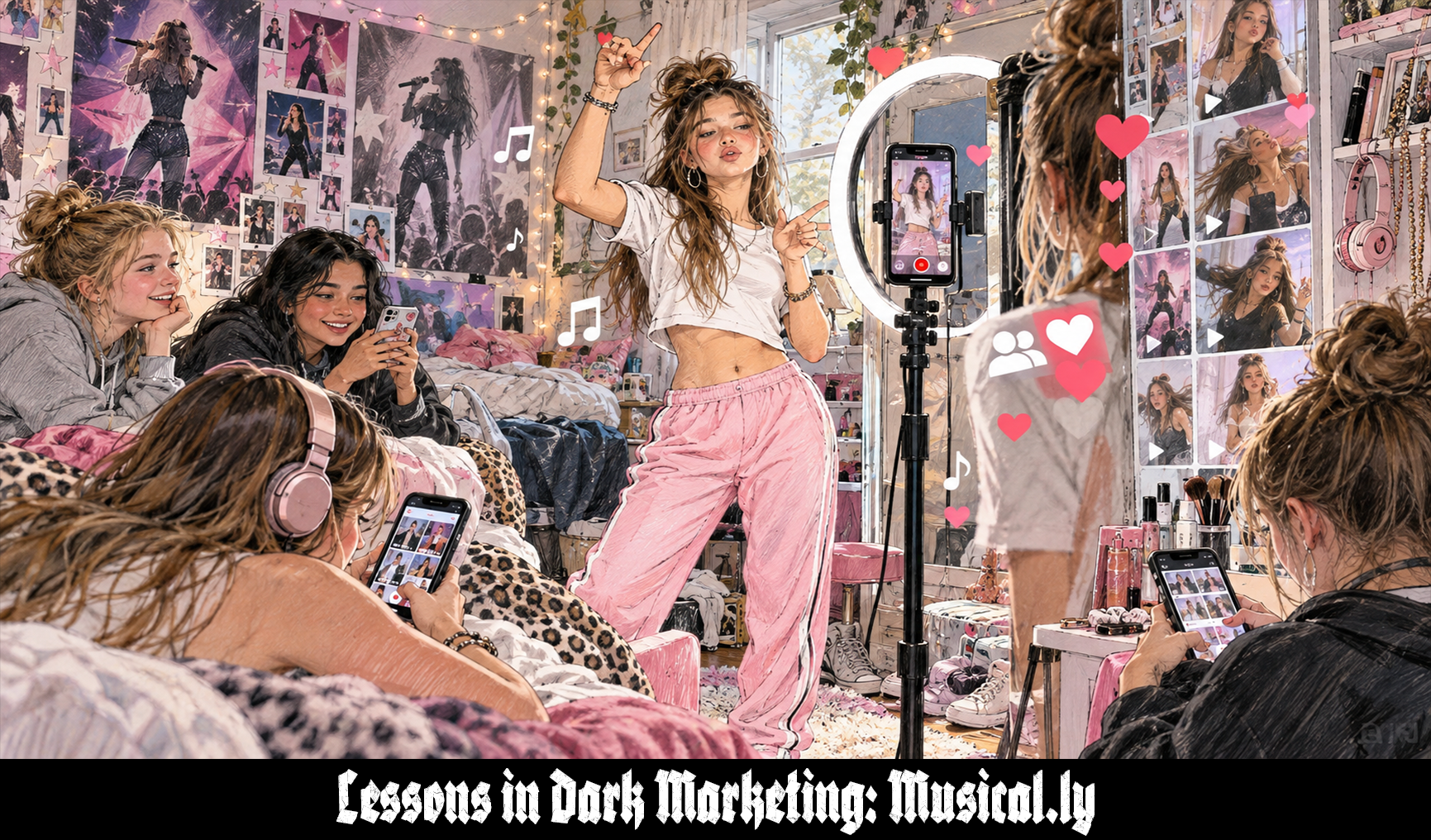
Somewhere around 2016, a thirteen-year-old propped a phone against a bedroom lamp, backed up three steps, pressed record, and silently mouthed somebody else’s chorus with the concentration of a person defusing a bomb. The song was already famous, the singer was already famous, the choreography was probably borrowed from somebody else on the app, and the entire performance might last fifteen seconds. None of that made the stakes feel small, because the little red record button had quietly turned a bedroom into an audition room where the judges were classmates, strangers, an engagement algorithm, and a platform that had learned how efficiently adolescent self-consciousness could be converted into content.
The finished video did not need an original melody, a recording studio, a band, a microphone, or even the ability to sing. It needed a face, a phone, a familiar piece of music, a willingness to perform, and enough repetition to make the performance look effortless. Musical.ly’s great commercial insight was not that teenagers wanted to lip-sync. Teenagers had been singing into hairbrushes, mirrors, camcorders, and whatever unfortunate household object could pass for a microphone for generations. The breakthrough was turning that private rehearsal into a measurable public product, then surrounding it with rankings, followers, comments, challenges, celebrity examples, algorithmic distribution, fan hierarchies, and the possibility that the next fifteen seconds might move somebody one step closer to internet fame.
That distinction matters because Musical.ly itself disappeared. ByteDance acquired the company in 2017 and merged Musical.ly into TikTok in August 2018, moving users, accounts, content, and fan relationships into the new platform rather than simply shutting the community down. The brand name died, but many of the behavioral mechanics survived, which makes Musical.ly less interesting as a dead app than as a laboratory where a generation was taught that creativity could be templated, fame could be quantified, songs could become social prompts, and performing for an invisible audience could feel like an ordinary part of being a teenager. TikTok’s 2018 merger announcement described the transition as a unification of two short-form video communities, while ByteDance’s corporate history lists the Musical.ly acquisition and later merger as milestones in TikTok’s global expansion.
Musical.ly did not invent teenagers performing for attention, and it did not invent short video, fandom, lip-syncing, social ranking, or viral music. What it did exceptionally well was remove enough friction from all of those behaviors that millions of young users could repeat them every day, then let the platform turn the repetition into distribution, culture, advertising inventory, music promotion, creator labor, and eventually an acquisition reportedly worth hundreds of millions of dollars. The physical product was an app. The psychological product was a portable stage where attention always looked one performance away.
The Failed Education App Taught Musical.ly That Effort Was the Enemy
Musical.ly’s origin story is unusually useful because the founders did not begin by trying to build a lip-sync empire. Alex Zhu and Luyu Yang first worked on an educational social-video concept that asked users to create short instructional material, but Zhu later described the format as boring, difficult to research, and difficult to produce. The project failed, yet it taught the team a principle that became central to Musical.ly: content creation had to become extremely light if ordinary users were going to do it repeatedly. In a 2016 interview, Zhu explained that a content community needed creation to be something users could finish within seconds rather than minutes. Forbes’ interview with Alex Zhu captures that lesson directly from the founder.
That failure matters because social platforms often talk about empowering creativity while quietly engineering around the fact that creativity is hard. Original ideas require confidence, preparation, skill, and the willingness to risk making something nobody cares about. Musical.ly removed huge portions of that burden. The song already existed, the emotional tone already existed, the rhythm already existed, and the user could focus on interpretation, expression, movement, editing, and appearance rather than beginning with an empty canvas. The platform did not eliminate creativity, but it dramatically narrowed the amount of creativity required before participation could begin.
This is dark marketing principle number one: When user-generated content is the product, reducing the effort required to create it can matter more than increasing the sophistication of the tools.
Musical.ly learned from a failed education app that asking people to make something meaningful is expensive, while asking them to perform inside a ready-made template can scale like hell.
Lip Sync Battle Accidentally Handed Them Product-Market Fit
Musical.ly’s founders did not initially understand exactly why their app was attracting bursts of new users. Zhu has said the team noticed recurring Thursday-night download spikes and eventually connected them to the television show Lip Sync Battle, after which viewers were searching app stores for ways to make similar performances. Instead of treating the search traffic as an interesting coincidence, Musical.ly made lip-syncing more prominent inside the product and repositioned the app around the behavior users were already telling them they wanted. The company did not need to invent the demand because another piece of culture had already created it. Forbes documents Zhu’s explanation of that pivot.
That is a sharper marketing move than it first appears. Many companies spend fortunes trying to teach customers a new behavior, while Musical.ly found a behavior already receiving television exposure, search traffic, celebrity participation, and social permission. The app became the easiest place to continue the experience after the show ended. In effect, a television franchise was spending money to normalize the activity, and Musical.ly was waiting downstream with a product that let viewers imitate it immediately. The product did not have to create the cultural itch because it only had to become the easiest place to scratch it.
This is dark marketing principle number two: When culture is already teaching consumers a behavior, the cheapest growth strategy may be positioning your product as the obvious next step.
Musical.ly did not need to convince teenagers that lip-syncing could be entertaining because television had already completed the orientation seminar.
Borrowed Music Removed the Terror of the Blank Page
A blank page is psychologically expensive because it asks the creator to decide what the thing should be before making it. Musical.ly replaced that problem with a catalog. Users could select a familiar song or sound, hear the timing, understand the emotional mood, and begin constructing a performance around material that already carried meaning. Academic research on the platform described Musical.ly as a system where users could select songs from an extensive music database, use sounds from other users, and combine those templates with filters and time-based effects. Jill Walker Rettberg’s 2017 study in Social Media + Society documented how central those shared sounds were to the platform’s creative language.
This is one of the most important differences between Musical.ly and a conventional camera app. A camera app gives you a tool and asks what you want to make. Musical.ly frequently gave you the material first and asked what version of it you wanted to perform. That distinction lowered the embarrassment threshold because users did not have to present an original song or monologue and ask the world whether it was good. They could stand inside a cultural object the audience already recognized. The borrowed song acted as scaffolding, camouflage, emotional shorthand, and social proof all at once.
This is dark marketing principle number three: Templates reduce creative risk by letting consumers borrow meaning before they contribute identity. The teenager did not have to walk onto the stage alone because Ariana Grande, a punch line, or a familiar movie quote was already standing there with them.
Lip-Syncing Offered Stardom Without Requiring the Voice
Musical.ly’s central trick was that users could perform the emotional surface of pop stardom without possessing the underlying musical skill. They could gesture, pose, emote, dance, cut, slow down, speed up, and inhabit a song while the difficult part, singing in tune on a professional recording, had already been handled by someone else. That did not make the performance worthless. It made the barrier to performing dramatically lower, which allowed far more people to experience the sensation of appearing musical without undergoing the years of work traditionally associated with becoming a musician.
The psychological benefit is enormous because many people want the identity associated with an activity long before they possess the competence required to perform it publicly. Musical.ly separated those two things. The app offered the visual language of the music video while outsourcing the audio credibility to the recording industry. A teenager could look into the camera with absolute conviction because the vocalist doing the technically difficult work was already mixed, mastered, famous, and impossible to embarrass. The user only had to synchronize their face with the fantasy.
This is dark marketing principle number four: A product can scale aspiration by separating the visible identity of expertise from the difficult labor required to earn that expertise.
Musical.ly sold access to the pose before the user had to pay the traditional price of becoming the person the pose represented.
Fifteen Seconds Made Performance Feel Cheap Enough to Repeat
Musical.ly’s early identity centered on extremely short clips, often around fifteen seconds, with later formats allowing longer videos. The duration was not just a technical format because it radically changed the emotional cost of creation. Fifteen seconds is short enough to retry repeatedly, short enough to memorize, short enough to practice a gesture sequence, and short enough for a user to convince themselves that one more take is not a serious commitment. WIRED’s 2016 profile described the app’s core experience as recording fifteen-second snippets while its user base expanded at a pace that was straining the company’s servers.
Shortness also changes failure. A bad three-minute performance feels like wasted effort, while a bad fifteen-second clip feels disposable. That makes perfectionism easier to indulge because the user can keep recording until the lighting, facial expression, timing, hair, hand movement, and camera angle finally produce something worth posting. The app made content cheaper to discard, which also made content cheaper to remake. What looked like spontaneous self-expression could hide a surprising amount of rehearsal because the cost of another attempt remained small.
This is dark marketing principle number five: Reduce the apparent cost of failure and consumers will tolerate far more repetition in pursuit of a publishable result.
Fifteen seconds did not eliminate perfectionism because it put perfectionism on a shorter production schedule.
Speed Controls Turned Simple Gestures Into Technique
Musical.ly’s editing tools let users change recording speed, reverse motion, apply filters, and manipulate time in ways that could make basic gestures appear more elaborate. The platform was not Adobe Premiere and did not need to be. The point was giving ordinary users enough transformation to feel like they were producing a music video without forcing them to become editors. Contemporary descriptions of the app repeatedly highlighted slow motion, fast motion, filters, and reversing as key parts of the creative experience. Teen-focused reporting from the period and Rettberg’s academic analysis both document the importance of those lightweight effects.
This created a useful illusion of production value. A small movement performed at the right recording speed could look unusually smooth when played back, while cuts and effects could hide the gap between amateur ability and polished presentation. The user experienced a little technological magic, and the audience saw something more stylized than a plain selfie video. The platform made technique partially purchasable through interface design, except the currency was not money. It was participation.
This is dark marketing principle number six: Give users tools that convert simple inputs into impressive-looking outputs and the product can make competence feel closer than it really is.
Musical.ly did not teach everyone cinematography because it gave teenagers a handful of buttons that could make bedroom choreography look suspiciously professional.
Popular Songs Arrived With Emotion Already Installed
Every famous song carries accumulated cultural work. It has radio exposure, artist branding, memories, lyrics, moods, celebrity associations, fan communities, and an existing audience that already knows where the chorus hits. Musical.ly allowed creators to borrow that emotional infrastructure instead of manufacturing it from scratch. A clip using a current hit did not need to explain its tone because the first half-second of audio could do the work immediately.
This created a two-sided advantage. Users received instant cultural relevance, while songs received thousands or millions of additional performances that could reinforce hooks through repetition. The app gradually became important enough to the music ecosystem that major distribution and licensing relationships followed. In 2017, Musical.ly shifted its music catalog relationship to Apple Music, a deal reported as expanding access across many more countries and giving Apple another promotional channel. TechCrunch covered the Apple Music partnership as Musical.ly was trying to deepen its global music infrastructure.
This is dark marketing principle number seven: When consumers create with culturally loaded assets, the platform can borrow decades of emotional investment without paying the psychological cost of building every experience from zero.
Musical.ly’s videos were short, but the songs entered each clip carrying far more than fifteen seconds of meaning.
The App Turned Rehearsal Into a Private Production Line
The public clip might last fifteen seconds, but the production process could take considerably longer. Users watched themselves, retried gestures, adjusted lighting, changed expressions, moved closer to the camera, changed songs, and repeated takes until the performance matched the version of themselves they were willing to publish. Musical.ly benefited from all of this invisible labor because the platform only needed the user to believe the next attempt might be better.
This is where social media’s language of authenticity starts becoming slippery. The clip looked casual because the format looked casual, yet casual-looking content could be intensely rehearsed. The user was not necessarily deceiving anyone; performance has always involved rehearsal. The darker mechanism was that the app made the production process feel like play while the platform accumulated a constant stream of fresh material. What would once have been a teenager practicing alone in a mirror became an unpaid content factory with a publish button.
This is dark marketing principle number eight: When production feels like self-expression, platforms can receive enormous amounts of labor without users experiencing the work as labor.
The bedroom mirror used to keep the rehearsal private, while Musical.ly quietly installed distribution at the edge of the dresser.
Calling Users “Musers” Turned Participation Into Identity
Musical.ly did not simply have users because it had “musers.” That language mattered. A generic user is someone who operates a product, while a named community member sounds like someone who belongs to a culture. The platform gave participation its own identity label, and that label helped turn a software behavior into a social role that could be recognized inside and outside the app. Contemporary reporting routinely used the term because the company and community had made it part of Musical.ly’s vocabulary.
Identity language is commercially useful because people defend identities more strongly than utilities. Nobody develops much loyalty around being a “calculator user,” but a person who sees themselves as a creator, fan, gamer, sneakerhead, collector, or muser can attach social meaning to participation. The label also creates an implied opposite: people who are inside the culture and people who are not. For teenagers, that boundary can become especially potent because adolescence already contains a great deal of experimentation around belonging, status, and self-definition.
This is dark marketing principle number nine: Name the community and ordinary product usage can begin behaving like membership.
Musical.ly did not just ask teenagers to open an app because it gave them a noun they could become.
Leaderboards Made Fame Look Like a Scoreboard
Musical.ly’s growth accelerated after it added more explicitly social features, including follower systems, comments, likes, and leaderboards showing popular content. Inc.’s 2016 account of the platform quoted Musical.ly’s U.S. leadership describing those additions as central to the app’s explosion in engagement. The platform was no longer just a creation tool because it had become an arena where attention could be measured and compared.
A leaderboard does something psychologically aggressive to creativity. It takes an activity that could be judged privately and gives it standings. The song becomes a performance, the performance becomes a post, the post becomes a number, and the number becomes evidence of where the creator sits relative to everybody else. That does not mean every user consciously chased the chart, but the existence of visible winners changes the meaning of participation. Somebody is on top, which means somebody else can imagine replacing them.
This is dark marketing principle number ten: Turn attention into a visible ranking and self-expression can begin behaving like competition even when nobody officially declared a contest.
Musical.ly put a scoreboard next to the bedroom stage, then acted surprised when teenagers started practicing harder.
Featured Placement Made Virality Feel Like a Prize You Could Earn
Musical.ly mixed followed accounts with featured, suggested, popular, and trending material, creating multiple ways for content to escape a user’s existing social circle. Contemporary descriptions of the service emphasized that popular clips could surface on leaderboards and discovery sections, while the company’s own leadership discussed designing discovery so ordinary creators had chances to receive engagement. Digiday’s guide to Musical.ly described feeds that combined followed creators with featured and suggested content, while Forbes recorded Zhu’s explanation that the company wanted creators to have opportunities to be discovered beyond their existing relationships.
That possibility changes posting behavior because every upload carries a tiny lottery ticket. The user is not guaranteed attention, but the existence of strangers who suddenly became famous on the platform proves that attention can arrive unexpectedly. A teenager does not need a realistic probability estimate when they can point to Baby Ariel and say the system sometimes chooses people who started with a phone in a bedroom. The platform only needs enough visible success stories to keep possibility psychologically alive.
This is dark marketing principle number eleven: When distribution is partly unpredictable, exceptional success stories can motivate ordinary users far beyond the statistical likelihood of receiving the same outcome.
Musical.ly did not need to promise fame because it only needed to keep fame visible.
Engagement-Based Distribution Turned Every Post Into an Experiment
Zhu described Musical.ly as moving toward an algorithmic system where videos receiving stronger engagement would gain more exposure while weaker performers would trend downward. That is a crucial shift from chronological publishing because the platform itself begins deciding which content deserves a larger audience based on how users react. Forbes’ founder interview captures Zhu comparing this to moving from a planned economy toward a market economy inside the app.
For creators, that turns every post into feedback. Different songs, gestures, facial expressions, editing styles, camera angles, captions, and posting habits can be tested against engagement. Even users who never articulate the process start learning what gets rewarded because the interface teaches them through numbers. The platform becomes a behavioral tutor. It does not need to issue a memo saying “perform more like this” when likes, followers, and distribution already deliver the lesson with more emotional force.
This is dark marketing principle number twelve: When an algorithm rewards engagement, creators learn to optimize themselves even if nobody ever formally teaches optimization.
The app does not have to tell a teenager which version of their face works best because the audience can run the experiment for it.
The Watermark Turned Every Competitor Into a Billboard
One of Musical.ly’s most important growth decisions was almost embarrassingly simple. Users were already sharing their videos to Instagram, Twitter, and other platforms, but Musical.ly discovered that its logo could be cropped out, which meant the content traveled without reliably telling viewers where it came from. The company repositioned the logo and added the creator’s username so exported videos carried visible attribution. According to Alex Zhu, that design adjustment helped accelerate growth dramatically, and the app reached the top of the U.S. App Store soon afterward. The Business Insider account republished by Yahoo Finance documents the change and the company’s interpretation of its impact.
This is growth hacking in its cleanest form because users did the media buying. Musical.ly did not need to purchase every impression on Instagram because its creators willingly carried the brand into Instagram’s feed. The content was entertaining enough to earn distribution, while the watermark converted that entertainment into attribution. The genius was not inventing sharing. It was refusing to let sharing become anonymous. The one detail in the whole thing is how obvious the tactic these jagoff used looks after somebody else has already made millions from it.
This is dark marketing principle number thirteen: When users export your product into larger networks, attach enough attribution that their self-promotion also becomes your acquisition campaign.
Musical.ly turned every proud cross-post into a tiny unpaid ad with a teenager’s face doing the media placement.
Musical.ly Grew by Riding Networks It Did Not Own
The watermark worked because Musical.ly understood that a young social network does not need to defeat every established platform if it can use them as distribution channels. Users created inside Musical.ly, then carried the finished clips to places where their friends already spent time. Instagram, Twitter, Facebook, and other networks became top-of-funnel exposure for a smaller app that could not yet match their audience scale. The creator wanted attention for themselves, and Musical.ly wanted attention for the product, so both interests traveled inside the same exported video.
This is a fundamentally different growth model from asking people to invite friends through a sterile referral email. The referral was entertainment. A friend did not receive a message saying “join Musical.ly” because they received a clip worth watching, complete with visible proof of where the clip came from. The content demonstrated the product while advertising the creator. The platform grew because the product output was itself an acquisition asset.
This is dark marketing principle number fourteen: The strongest referral loops do not feel like referrals because the user shares something they already wanted to show people.
Musical.ly did not ask teenagers to distribute corporate invitations because it let vanity handle fulfillment.
My City Manufactured Local Relevance and Introduced a Privacy Cost
One challenge for a growing social network is density. An app feels dead if users do not see enough relevant people, enough engagement, or enough evidence that anyone nearby participates. Zhu explained that Musical.ly introduced discovery features such as “My City” partly to give users more opportunities to be discovered. The Federal Trade Commission later noted a darker side of that feature, alleging that until October 2016 Musical.ly allowed users to view other users within a fifty-mile radius of their location. The FTC’s 2019 case summary and press release describes the location-related functionality as part of its broader children’s privacy allegations.
The growth logic is easy to understand. Local discovery makes a global network feel socially close, which can increase relevance and the chance that users recognize schools, neighborhoods, or familiar social circles. The safety problem is equally easy to understand once the audience includes children. A mechanism designed to create network density can also create unwanted discoverability, and the same feature can look like community-building to a growth team and exposure risk to a parent.
This is dark marketing principle number fifteen: A discovery feature that makes a network feel intimate can also make users more discoverable than they understand.
The commercial value of “people near you” changes considerably when some of the people being made easier to find are twelve.
BFF Turned Fandom Into a Formal Hierarchy
Musical.ly’s “Best Fan Forever” feature allowed creators to designate especially engaged followers and grant them special interaction privileges, including opportunities for duets and direct communication. Zhu described BFF as a way of rewarding the fans who consistently engaged and commented, while contemporary safety researchers also noted how the feature helped make the platform sticky. Forbes and the Cyberbullying Research Center’s contemporary overview both documented the feature and its role in creator-fan interaction.
This was a clever formalization of behavior that already exists in fandom. Fans compete for recognition from the person they admire, and the creator’s attention becomes a scarce reward. Musical.ly turned that emotional competition into a named platform status. Comment more, engage more, prove loyalty, and perhaps the creator will elevate you from ordinary follower to BFF. The platform did not invent parasocial desire, but it gave parasocial desire a badge and an interaction ladder.
This is dark marketing principle number sixteen: When attention from a creator is scarce, formalizing fan status can convert loyalty into competitive engagement.
Musical.ly took the ancient human desire to be noticed by somebody important and gave it a user-interface component.
Duets Let Users Borrow Proximity to Fame
The duet mechanic made two separate performances appear together, allowing users to share a song and a frame even when they were not physically together. For friends, that created a playful collaborative tool. For fans interacting with more popular creators, it created something more psychologically potent: the appearance of proximity. A teenager could occupy the same screen as someone with millions of followers and experience a miniature version of collaboration with a person who otherwise existed far above them in the platform hierarchy.
That matters because social status is often transferred through association. A photograph with a celebrity has value because it proves proximity, and a duet can provide a digital version of that proof. Musical.ly made that proximity reproducible through software. The fan did not need backstage access, a record label, or even the same city. They needed the interaction privilege and a song template.
This is dark marketing principle number seventeen: If status is difficult to acquire directly, products can sell or reward the experience of standing close to someone who already has it.
Musical.ly’s duet did not make every fan famous, but for fifteen seconds it could make fame look like it had accepted the collaboration request.
Q&A Made Creator Attention Feel Obtainable
Musical.ly also introduced a Q&A format that let fans pose questions and creators answer them through combined video. Zhu described the feature as a new engagement model that proved popular with influencers because it credited the fan’s question and produced another piece of content for the creator. The brilliance was that one interaction satisfied several parties simultaneously. The fan received recognition, the creator received a prompt, the audience received content, and Musical.ly received more activity without commissioning anything itself.
This is a recurring theme in social platforms: the most efficient features make one user’s emotional reward become another user’s production input. The fan’s desire to be noticed supplies the question, and the creator’s need to stay active supplies the answer. The platform sits in the middle collecting both sides of the exchange. Nobody has to feel exploited because everybody receives something they wanted, but the company still benefits from the interaction at scale.
This is dark marketing principle number eighteen: Design interactions where one user’s desire for recognition becomes another user’s content prompt and the platform gets production from both sides.
Musical.ly could generate another video because a fan wanted one person to say their name.
The Platform Manufactured Proof That Bedroom Fame Was Real
Musical.ly’s most powerful marketing assets were the users who became famous through Musical.ly itself. Baby Ariel, Jacob Sartorius, Loren Gray, and other creators gave the platform something no advertisement could manufacture as convincingly: visible evidence that an ordinary-looking teenager could acquire millions of followers without first arriving from television, film, or the music business. The Guardian’s 2016 reporting on Musical.ly stars described enormous fan followings, meetups, tours, mainstream media attention, and the emergence of an ecosystem around creators who had become famous inside the app.
The crucial word is “visible.” A platform does not need most users to become stars if a few stars remain constantly present as proof of possibility. Their success keeps the ladder psychologically real. Followers can see the bedroom origins, copy the hand gestures, use the same sounds, adopt similar editing techniques, and tell themselves the difference between obscurity and recognition may be one better performance rather than a structural lottery involving timing, looks, persistence, network effects, luck, and platform distribution.
This is dark marketing principle number nineteen: A small number of spectacular success stories can motivate a massive population if the path to success appears easy to imitate.
Musical.ly’s stars were not just creators because they were advertisements for the possibility that the app might choose you next.
Mainstream Celebrities Validated the Kids After the Kids Built the Culture
Musical.ly’s early appeal came heavily from young users, but established singers, actors, and entertainers eventually participated too. That mattered because celebrity adoption worked as backward validation. The app did not begin by persuading adults and then hoping teenagers followed. Teenagers made the platform culturally important enough that mainstream celebrities had reasons to enter the space where those teenagers already were. Contemporary coverage highlighted artists and entertainers joining Musical.ly because the audience had become impossible to ignore.
For young users, this is a powerful form of social confirmation. The weird app adults do not understand suddenly becomes a place where famous adults show up because they need access to the audience. The status relationship flips. Instead of teenagers trying to get into mainstream entertainment culture, mainstream entertainment starts entering the teenagers’ platform. That makes participation feel not only fun but culturally ahead of the adults who dismissed it.
This is dark marketing principle number twenty: When a youth platform becomes large enough that established celebrities must enter it, the arrival of those celebrities validates the early users who made it culturally valuable.
Nothing tells teenagers they were right faster than watching famous adults arrive late and pretend they had been invited from the beginning.
Songs Became Performance Templates Instead of Background Music
Musical.ly changed the commercial role of a song because a track was no longer simply something users listened to. It could become a script, gesture sequence, meme template, challenge prompt, identity signal, and repeated production asset used by thousands of creators. That creates more intimate repetition than passive listening because users rehearse a specific section, synchronize movement to it, record multiple takes, and then watch themselves perform it again during editing and posting.
For the music industry, this was extremely attractive. A hook that works on Musical.ly can become embedded inside thousands of user identities rather than remaining an audio object consumed at a distance. The fan is not just hearing the song because they are wearing it for fifteen seconds. A successful clip can also recruit other users who want to perform the same sound, creating a loop where cultural familiarity encourages participation and participation increases cultural familiarity.
This is dark marketing principle number twenty-one: Turn media from something consumers watch into something they perform and repetition becomes personally invested instead of passive.
Musical.ly did not just replay songs because it convinced teenagers to put the chorus on like a costume.
Hashtag Challenges Turned Advertising Into a Participation Prompt
Brands quickly learned that Musical.ly’s most valuable advertising behavior was not watching. It was making. Rather than limiting campaigns to conventional display impressions, marketers could ask users to create videos around a branded prompt, hashtag, song, or theme. That converted the audience into production capacity while making the campaign feel more like a community event than a commercial. AdExchanger’s 2016 coverage described campaigns with brands including Coca-Cola and Lionsgate, with the Coca-Cola effort generating more than 900,000 submitted videos.
This is one of the cleanest examples of dark marketing because participation disguises promotional labor. The user creates because the challenge is fun, because friends are doing it, because a favorite creator participated, or because the platform is highlighting the trend. The brand receives enormous volumes of consumer-made media without having to produce each piece. The customer’s face, bedroom, friends, gestures, and social network all become part of the campaign’s creative assets.
This is dark marketing principle number twenty-two: The most efficient social advertising turns the campaign into a format consumers want to perform themselves.
Musical.ly did not need to interrupt every video with an ad when it could persuade the audience to volunteer for the creative department.
Brand Challenges Borrowed the Credibility of Peer Participation
A conventional advertisement arrives labeled as persuasion. A challenge arrives labeled as something people are doing. That difference matters because the audience sees peers participating before it sees a marketing strategy. The message gains social proof from the volume of ordinary users making their own versions, and the brand can hide inside the momentum of the trend rather than carrying the entire burden of persuasion itself.
This is especially effective with teenagers because peer behavior is not background noise during adolescence. It is one of the primary signals people use to understand what is normal, funny, embarrassing, current, or worth joining. A branded challenge can convert commercial intent into apparent group behavior, then let social pressure handle a portion of the distribution. The brand does not have to say “please promote us” when the challenge format has already turned promotion into the price of joining the joke.
This is dark marketing principle number twenty-three: When commercial participation looks like peer behavior, social proof can carry persuasive weight the brand could never manufacture alone.
The ad becomes harder to recognize because your friend from algebra class is performing it in the kitchen.
Live.ly Put a Cash Register Inside Parasocial Attention
Musical.ly expanded into livestreaming with Live.ly, where creators could broadcast to fans in real time. That shift deepened the emotional relationship because live interaction feels more immediate, less edited, and more personally responsive than a prerecorded clip. Fans could also purchase virtual gifts, creating a direct way to convert attention into money. TechCrunch reported the launch of Live.ly, while The Guardian later described gift-based earnings among prominent livestreamers.
Virtual gifts are commercially elegant because the object being purchased is often less important than the social meaning attached to sending it. The fan buys a digital token because the token may produce recognition, gratitude, status, or emotional proximity to the creator. The creator receives financial reinforcement for staying active, the platform takes its share, and the fan experiences spending as participation rather than as a straightforward payment for media. Money enters the relationship disguised as applause.
This is dark marketing principle number twenty-four: When fans value recognition from creators, virtual goods can monetize the moment of being noticed more effectively than charging for access to the content itself.
Live.ly found a way to put a tip jar inside the parasocial relationship and decorate it with emojis.
Paying Creators Helped Keep the Stars From Leaving
Musical.ly’s leadership openly understood that top creators needed reasons to stay. Zhu discussed the importance of engagement and monetization opportunities because an influencer with a large follower count but weak interaction has little reason to keep posting. The BFF system, Q&A, live gifts, sponsorship opportunities, and broader creator ecosystem were not just fan features because they were retention tools for the people whose popularity attracted everyone else. Forbes records Zhu describing monetization as part of keeping top influencers sticky and financially motivated.
This exposes the two-class economy inside creator platforms. Ordinary users supply volume, experimentation, comments, likes, and cultural energy, while a smaller group of successful creators become strategic infrastructure. The platform needs the masses because they create the market, but it also needs visible winners because those winners keep the dream believable. Once creators can convert attention into income, the fantasy acquires a salary figure and becomes much easier to treat as a possible career rather than a hobby.
This is dark marketing principle number twenty-five: If aspirational users are the fuel, visible creators who earn money are the proof that keeps the fuel combustible.
A platform does not need to pay everyone well when a few highly visible checks can keep millions auditioning.
Public-by-Default Design Made Growth Easier and Privacy Harder
Musical.ly’s rapid growth came with serious privacy problems, especially because many users were children. The FTC alleged that user accounts were public by default, profile information could remain visible even when some privacy controls were used, and users could send direct messages. The agency also alleged that Musical.ly knew a significant number of children under thirteen were using the service while failing to obtain the parental consent required by the Children’s Online Privacy Protection Act. In 2019, the company, then operating under TikTok, agreed to pay $5.7 million to settle the FTC’s allegations. The FTC’s Musical.ly enforcement page and press release document the case.
The dark marketing lesson is not that public profiles are inherently sinister. Publicness is useful to social networks because public content can travel farther, attract strangers, generate engagement, and create the feeling of a larger community. The problem appears when growth incentives collide with a population that may not fully understand the long-term consequences of discoverability. A teenager wants followers today. A platform wants activity today. Privacy is often the only participant in the room asking what happens later.
This is dark marketing principle number twenty-six: Defaults are marketing decisions because the setting that produces the most growth may also become the behavior users accept without meaningful deliberation.
Musical.ly benefited when teenagers were easy to discover, which is exactly why the privacy consequences deserved more than a buried toggle.
The Under-Thirteen Audience Was Not an Accidental Footnote
The FTC’s complaint alleged that Musical.ly received thousands of parental complaints involving children under thirteen and that the company had actual knowledge that many underage users were on the service. The agency said Musical.ly had not originally asked users for age and failed to comply with COPPA requirements involving parental notice, consent, deletion, and retention. The settlement required the company to change practices and remove videos made by children under thirteen. The FTC complaint PDF provides the allegations in detail.
This matters for marketing analysis because younger users are extraordinarily valuable to culture-building platforms. They have time, imitate peers quickly, care intensely about identity and belonging, and can move trends through schools and friendship networks with a speed that adults routinely underestimate. Those same qualities also make ethical restraint more important. A business can look at adolescent social sensitivity and see growth potential, while a responsible product team has to see developmental vulnerability in the same frame.
This is dark marketing principle number twenty-seven: The younger the audience, the more carefully a company must distinguish between designing for enthusiasm and exploiting developmental vulnerability.
A growth chart does not become morally neutral just because the bars are being raised by children who still need permission to go on a field trip.
The Music Catalog Became Infrastructure for Global Expansion
Musical.ly’s relationship with the music industry evolved because a platform built on popular songs cannot scale indefinitely on informal access and fragmented licensing. By 2017, the company was large enough to strike a partnership in which Apple Music supplied song clips, expanding Musical.ly’s geographic reach and giving Apple another way to promote its subscription service. The arrangement reveals how deeply the app had embedded itself between music discovery, performance, and promotion. TechCrunch’s report on the Apple Music relationship described the partnership as part of the platform’s expansion.
The strategic lesson is that Musical.ly’s real product was not a camera with music added. The catalog was infrastructure. Without culturally recognizable sounds, the creation system loses much of its scaffolding, because users would have to supply more originality, more musical context, and more emotional work themselves. Licensing expanded the supply of templates, and every additional template increased the number of possible performances that could be generated from the same basic interface.
This is dark marketing principle number twenty-eight: When third-party culture is the raw material of user creation, access to that culture becomes growth infrastructure rather than a decorative feature.
Musical.ly needed songs the way a casino needs chips, except the teenagers kept taking the chips home and filming themselves with them.
The $800 Million to $1 Billion Acquisition Valued the Network, Not the Lip-Sync Button
ByteDance acquired Musical.ly in late 2017 in a deal reported by TechCrunch to be worth roughly $800 million to $1 billion. By that point, Musical.ly had already built a large Western user base, strong penetration among young Americans, a recognizable creator class, music relationships, engagement mechanics, and years of behavioral data around short-form video. TechCrunch’s acquisition report emphasized Musical.ly’s U.S.-heavy audience and ByteDance’s broader ambitions in mobile content.
It is easy to look at the purchase price and imagine ByteDance bought a lip-syncing application. That would be like saying someone bought a nightclub because they admired the chairs. The valuable asset was the populated network: users, social graphs, creators, habits, brand recognition, market position, and a behavior already normalized among an audience ByteDance wanted to reach. Software features can be rebuilt. A dense culture of people who open the software voluntarily every day is considerably harder to manufacture.
This is dark marketing principle number twenty-nine: In social platforms, the audience’s habits can become more valuable than the product features that originally attracted the audience.
ByteDance did not need another record button because it needed the millions of people already trained to press one.
The TikTok Merger Revealed That Followers Were Transferable Corporate Assets
In August 2018, Musical.ly users did not receive a funeral for their platform followed by instructions to rebuild elsewhere. The app was merged into TikTok, and TikTok’s announcement said existing creator accounts, content, and fan bases would move automatically into the upgraded service. TikTok’s merger announcement explicitly framed continuity of creators, content, and fans as part of the transition, while TechCrunch’s merger coverage described Musical.ly users being migrated into TikTok.
That transition reveals something uncomfortable about social identity online. A creator may experience followers as relationships, but the platform can also treat the aggregate relationship network as transferable infrastructure. People did not just build profiles. They built an asset that helped make the acquisition valuable, and when the corporate strategy changed, that social capital moved with the software. The users kept their audiences, which was genuinely beneficial to them, but the same continuity also made migration friction low enough for the company to consolidate the network without asking every community member to start over.
This is dark marketing principle number thirty: When users build relationships inside a platform, those relationships can become part of the corporate asset being acquired, merged, renamed, or redirected.
Your followers may feel like your community, but somewhere in a boardroom they can also look suspiciously like retained users.
Musical.ly Died, but the Behavioral Playbook Graduated
Musical.ly’s name vanished, yet the core behaviors it normalized became central to the next era of short-form video: sound templates, quick creation, algorithmic discovery, duets, challenges, creator aspiration, music-driven memes, vertical video, public performance, and the possibility that an unknown user could suddenly reach an enormous audience. TikTok did not simply repaint Musical.ly. ByteDance brought its own recommendation technology, product design, global strategy, and existing Douyin/TikTok experience. The important point is that Musical.ly had already trained a large Western audience to find the basic rituals normal.
That makes Musical.ly historically significant even if many current users barely remember the name. The company served as a bridge between older social-media logic, where people primarily followed people they knew or consciously selected, and a more performance-driven environment where sounds, formats, recommendation systems, and cultural templates could organize attention at enormous scale. Musical.ly taught teenagers to step onto the stage. TikTok later built a much larger theater around the behavior.
This is dark marketing principle number thirty-one: A product can disappear while the habits it normalized continue generating value inside the system that replaces it.
Musical.ly lost the logo, kept the choreography, and left the next platform with an audience already comfortable performing for strangers.
The Case Study Breakdown
- Musical.ly learned that creation had to be lightweight. Its failed education product showed the founders that ordinary users would not reliably produce difficult, research-heavy content at social scale.
- Lip Sync Battle revealed existing demand. The company repositioned around a behavior television and pop culture were already teaching audiences to enjoy.
- Popular music removed the blank page. Songs gave users mood, timing, structure, and cultural meaning before the user created anything original.
- Lip-syncing separated performance identity from musical skill. Users could inhabit the visual language of pop stardom without needing to sing professionally.
- Fifteen-second clips reduced the cost of failure. Short production made repeated takes, retries, and constant experimentation feel cheap.
- Lightweight effects manufactured production value. Speed controls, filters, and reversing helped simple gestures look more technically polished.
- Rehearsal became invisible labor. Users could spend substantial time perfecting clips while experiencing the work as play and self-expression.
- The word “muser” turned usage into identity. A named community created belonging beyond ordinary software participation.
- Leaderboards converted attention into competition. Popularity became measurable, comparable, and aspirational.
- Featured placement kept fame psychologically available. Visible breakout creators proved that an ordinary user could suddenly receive enormous attention.
- Engagement-based distribution trained creators to optimize themselves. Users learned which performances worked through likes, followers, and reach.
- The watermark converted sharing into acquisition. Exported videos advertised Musical.ly while creators believed they were primarily promoting themselves.
- Established social networks became free distribution. Instagram, Twitter, and other platforms carried Musical.ly’s branded output into larger audiences.
- My City increased network density while raising privacy concerns. Local discovery made the service feel socially close but could expose young users more broadly than they understood.
- BFF formalized fan hierarchy. Extra interaction privileges turned creator attention into a reward for persistent engagement.
- Duets manufactured proximity. Fans could appear beside creators and borrow some of the status associated with collaboration.
- Q&A made recognition productive. A fan’s desire to be noticed became a creator’s next content prompt.
- Platform-born stars advertised the dream. Baby Ariel, Jacob Sartorius, and other creators proved that fame could appear to begin inside an ordinary bedroom.
- Mainstream celebrity adoption validated the youth culture. Established entertainers followed teenagers into the space once the audience became too important to ignore.
- Songs became performance templates. Music was not just consumed because it became raw material for identity, gesture, imitation, and social participation.
- Brand challenges converted advertising into user labor. Consumers produced promotional content because the campaign was packaged as a social activity.
- Peer participation softened commercial intent. A branded challenge looked like something friends were doing rather than something a company was buying.
- Live.ly monetized parasocial attention. Virtual gifts attached spending to the emotional reward of creator recognition.
- Creator monetization kept visible winners active. Income opportunities helped retain the stars whose success made the platform aspirational for everyone else.
- Public-by-default design favored growth over deliberative privacy. Discoverability helped the network expand while creating serious risks for younger users.
- The under-thirteen audience made growth ethically complicated. The FTC later alleged that Musical.ly knowingly collected personal information from children without required parental consent.
- Music licensing became growth infrastructure. A larger catalog meant more templates, more cultural relevance, and broader international expansion.
- ByteDance bought the network, not just the feature set. Musical.ly’s audience, creator culture, habits, and Western reach were more strategically valuable than a lip-sync button.
- The TikTok merger exposed followers as transferable infrastructure. Accounts, content, and fan bases moved into the successor platform rather than remaining attached to the dead brand.
- Musical.ly disappeared while its habits survived. Short-form performance, sound templates, discovery, challenges, and creator aspiration became foundational behaviors in the platform era that followed.
Musical.ly’s power came from connecting these mechanisms rather than relying on one trick. A popular song lowered creative anxiety, the short format lowered commitment, editing tools increased polish, sharing spread the watermark, discovery offered fame, stars proved fame was possible, fan hierarchies increased engagement, brand challenges monetized participation, and live gifts monetized emotional proximity. Each mechanism could be defended independently as useful, entertaining, or creative. Connected together, they formed a machine capable of turning adolescent performance into a self-replenishing supply of content and attention.
This is dark marketing principle number thirty-two: The most durable attention systems connect creation, identity, distribution, status, and monetization so tightly that participating in one layer automatically feeds the others.
Musical.ly did not need teenagers to understand the business model because the business model worked best when they experienced it as fifteen seconds of fun.
What Marketers Should Learn From Musical.ly
The first lesson is that reducing creative friction can be more valuable than adding creative power.
Musical.ly’s failed education product taught its founders that asking ordinary users to research, explain, and produce substantial content created too much resistance, while song templates and short clips made participation almost immediate. Marketers building user-generated systems should ask how much of the customer’s effort is essential and how much exists because the company has not designed a better scaffold.
The second lesson is that product-market fit sometimes arrives disguised as outside behavior.
Musical.ly noticed unusual download patterns around Lip Sync Battle and treated them as evidence rather than noise. Strong marketers watch what customers are already trying to do and reposition around the behavior instead of insisting the audience adopt the original product story.
The third lesson is that templates can expand creativity rather than eliminate it.
A shared song gave users constraints, and those constraints freed them to focus on gesture, expression, humor, editing, fashion, and interpretation. The ethical line appears when the template becomes so optimized for repetition that the platform values volume more than the user’s wellbeing.
The fourth lesson is that aspiration becomes more scalable when the first step feels achievable.
Musical.ly did not ask users to become musicians before they could look musical, which let millions experience the emotional reward of performance immediately. Marketers should understand the power of offering identity before mastery while resisting the temptation to imply that the identity guarantees the underlying career.
The fifth lesson is that short formats reduce psychological commitment.
A fifteen-second clip feels cheap enough to retry, which increases experimentation and production volume. The same principle can improve onboarding, sampling, education, and product trials without being used to trap users in endless low-cost repetitions.
The sixth lesson is that visible transformation makes tools feel powerful.
Musical.ly’s effects produced obvious differences with little technical knowledge, giving users a sense of creative control quickly. Products become sticky when customers can see their own competence increasing, even if part of that competence is being supplied by the interface.
The seventh lesson is that existing cultural assets carry enormous emotional leverage.
Popular songs entered Musical.ly with recognition, memory, mood, and fandom already attached. Partnerships can accelerate adoption when the partner contributes meaning the product would otherwise need years to build.
The eighth lesson is that user identity should be treated carefully because naming a community deepens attachment.
“Muser” was more than a label because it turned usage into belonging. The strongest communities give members real social value rather than using identity language as a decorative trick to make ordinary consumption feel tribal.
The ninth lesson is that ranking systems change the activity being ranked.
Once creativity receives standings, popularity charts, featured placement, and follower totals, users begin creating partly for the metric. Marketers should never pretend measurement is neutral when the measurement itself reshapes behavior.
The tenth lesson is that unpredictable distribution is powerful because it keeps possibility alive.
A platform does not need every user to become famous if a visible minority can demonstrate that fame sometimes appears suddenly. Responsible platforms should pair opportunity with honest expectations instead of allowing rare outcomes to masquerade as the normal career path.
The eleventh lesson is that product outputs can become acquisition channels.
Musical.ly’s watermark turned every exported clip into a branded demonstration. Marketers should look for moments when customers naturally share finished work and make attribution helpful enough to travel without making the output obnoxious.
The twelfth lesson is that social growth often depends on borrowing larger networks before competing with them.
Musical.ly used established platforms as distribution because its creators already wanted to share there. The best cross-platform strategy gives the user a reason to spread the content that also advances the company’s growth.
The thirteenth lesson is that local relevance can increase engagement while simultaneously increasing exposure risk.
Features like My City demonstrate why growth teams and safety teams need to evaluate the same mechanism from different directions. A feature is not responsible simply because the growth metric looks healthy.
The fourteenth lesson is that creator-fan relationships are commercially explosive because attention itself is scarce.
BFF, Q&A, duets, and virtual gifts all found different ways to package the possibility of recognition. Marketers should be extremely careful when monetizing affection, especially when the fan base is young.
The fifteenth lesson is that breakout creators are living marketing assets.
Musical.ly’s stars showed potential users what the platform could make possible without a corporate advertisement needing to say it directly. Creator programs work best when the platform actually creates value for creators rather than using a handful of winners as bait for everyone else.
The sixteenth lesson is that campaigns become more powerful when customers can perform them.
Musical.ly challenges moved brands from interruption into participation and generated enormous quantities of user-made promotional material. The responsible version of this technique makes the commercial relationship obvious enough that consumers understand when play has become advertising.
The seventeenth lesson is that virtual goods often monetize social meaning rather than utility.
A digital gift can matter because of who sees it, who acknowledges it, and what relationship it signals. Marketers should treat that emotional leverage as seriously as any other pricing mechanism instead of hiding behind the fact that the object is intangible.
The eighteenth lesson is that creator monetization is not generosity because it is infrastructure.
Platforms need successful creators to remain active because those creators keep audiences entertained and keep aspirational users believing the ladder is worth climbing. A healthy creator economy aligns platform revenue with creator value rather than extracting from creators while publicly celebrating them.
The nineteenth lesson is that privacy settings are part of product strategy.
Public-by-default design can accelerate discovery, but Musical.ly’s FTC case shows the consequences when discoverability collides with children and inadequate consent. Marketers should assume that defaults communicate the company’s real priorities more clearly than any privacy-policy paragraph.
The twentieth lesson is that a young audience requires more restraint, not more cleverness.
Younger users can be intensely social, highly imitative, and enthusiastic producers of culture, which makes them commercially attractive and ethically vulnerable at the same time. The marketer who sees only the first half of that sentence should not be designing the product.
The twenty-first lesson is that strategic assets are often behavioral rather than technical.
ByteDance could build short-video features, but buying Musical.ly provided a populated Western network already trained in the rituals of short-form creation. Companies evaluating acquisitions should look at habits, social graphs, creator ecosystems, and cultural position rather than obsessing only over proprietary code.
The twenty-second lesson is that a brand can die while the behavior survives.
Musical.ly’s name disappeared, yet the practices it helped normalize became more valuable inside TikTok. Great marketing can create habits larger than the brand, which is powerful for an acquirer and a reminder to users that platforms can change ownership while keeping the relationships and routines people built inside them.
This is dark marketing principle number thirty-three: The most valuable platform marketing does not just persuade consumers to choose a product because it teaches a repeatable behavior that can keep producing value even after the original brand disappears.
Musical.ly’s final trick was becoming obsolete without making the habits it created obsolete with it.
Final Diagnosis
Musical.ly deserves a place in the Lessons in Dark Marketing archive because it transformed one of adolescence’s oldest private rituals into a scalable public market. Teenagers had always performed songs in bedrooms, practiced faces in mirrors, copied celebrities, competed for peer approval, dreamed about fame, and tried on identities before deciding which ones fit. Musical.ly did not create those vulnerabilities or pleasures. It built a camera, catalog, feed, ranking system, fandom ladder, advertising system, and distribution network around them until private rehearsal could become measurable public inventory.
- The product removed creative friction. Songs, short durations, and lightweight editing gave ordinary users enough structure to create quickly.
- The platform borrowed pop culture’s emotional infrastructure. Famous music supplied mood, familiarity, and relevance before the user contributed anything original.
- Lip-syncing offered the performance identity of music without requiring musical mastery. Users could feel like stars before they possessed the traditional skills associated with stardom.
- Short clips made repeated attempts cheap. Perfectionism became easier to sustain because another take cost only a few seconds.
- Leaderboards and discovery turned self-expression into measurable competition. Attention became a score that could be compared, chased, and optimized.
- Algorithms taught creators how to perform for the system. Engagement metrics rewarded certain behaviors and quietly trained users to reproduce them.
- Watermarks converted self-promotion into platform promotion. Every exported video could acquire new users while appearing to exist for the creator’s benefit.
- Fan hierarchies monetized the desire to be noticed. BFF, duets, Q&A, and live gifts made proximity to creators a scarce reward.
- Breakout stars kept fame psychologically available. A small number of extraordinary success stories made the ladder look climbable to millions of ordinary users.
- Brand challenges converted users into advertising production. Participation generated peer-distributed promotional media at enormous scale.
- Public discovery created a safety tradeoff. Growth benefited from discoverability while younger users faced privacy risks they might not fully understand.
- The under-thirteen audience exposed the ethical limits of growth-first design. The FTC’s case showed what happens when a platform’s audience includes children and compliance fails to keep pace with adoption.
- Music licensing became strategic infrastructure. A broader catalog meant more templates, more cultural relevance, and more reasons to create.
- ByteDance bought habits and relationships, not just software. Musical.ly’s Western audience and creator network were strategic assets that could be moved into TikTok.
- The brand disappeared while the machine evolved. Musical.ly’s core rituals survived the merger and became part of the short-form video culture that followed.
Return to the bedroom from the beginning. The phone is still balanced against something that was never designed to be a tripod, the song is still playing from somebody else’s professionally recorded voice, and the teenager is still mouthing the same line for the seventh time because the previous six takes did not look right. The activity feels small because the room is small, the clip is short, and nobody from a television network is standing nearby. Yet the entire logic of the modern creator economy is already sitting inside that little ritual: borrow a format, perform an identity, optimize the take, publish the result, measure the attention, study the winners, and try again.
There were legitimate benefits inside this system. Musical.ly gave young people a playful way to perform, create, edit, collaborate, discover music, make friends, and develop confidence in front of a camera. It lowered creative barriers for people who might never have considered themselves performers, and some users genuinely turned that access into careers. Those benefits are not excuses for the darker machinery because they are what made the machinery powerful. Manipulation works best when the product gives people something they honestly value.
The darker diagnosis is that Musical.ly learned how to package adolescent aspiration into repeatable platform behavior. It gave users music they already loved, tools that made performance easy, metrics that made popularity visible, stars that made fame plausible, and social features that made recognition feel just close enough to chase. The company did not need to promise anyone a career because the possibility of attention was sufficient to keep millions of people producing the raw material the platform needed.
Then the logo disappeared. ByteDance folded the network into TikTok, the accounts moved, the fans moved, the content moved, and the habits moved with them. Musical.ly’s greatest marketing achievement was not building a brand people would remember forever. It was teaching a generation a behavior so durable that the company could erase the name from the phone and keep the performance going.
Leave a Reply