
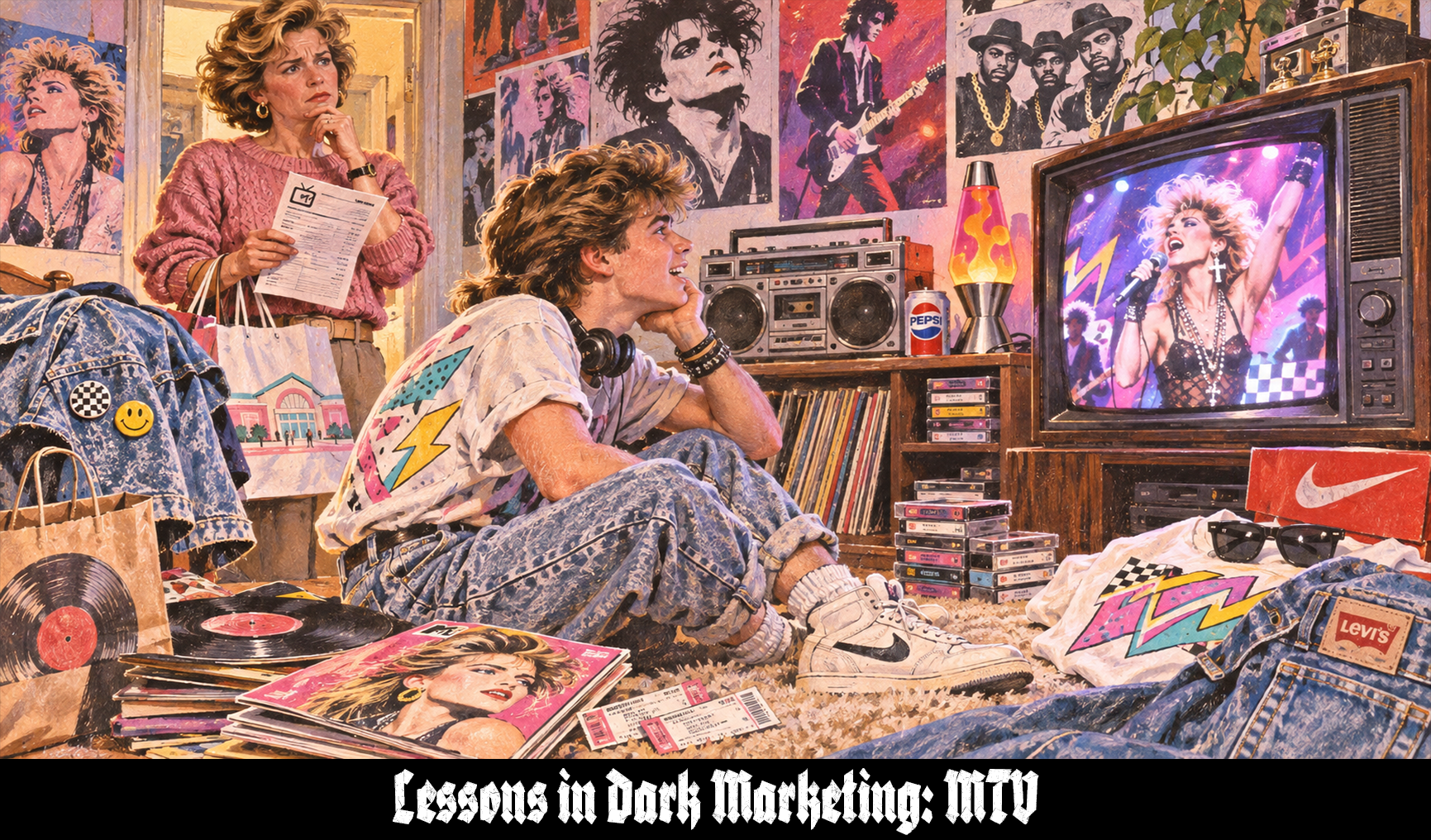
It is 1988, and a Generation X teenager is sitting on the bedroom floor with a television remote, an increasingly expensive opinion about music, and a level of contempt for mainstream culture that has been carefully encouraged by a cable network owned by a corporation. A music video begins. The singer looks like somebody who has never had to ask permission to stay out late, the band is dressed for a night that appears much more interesting than anything scheduled in this house, and the camera cuts fast enough to suggest that every adult on the planet has already lost the argument. Three minutes later, the teenager has acquired a favorite song, an opinion about the band’s authenticity, and a sudden conviction that the jeans in the dresser are a personal disgrace.
Across the hall, a parent sees a cable bill, an adolescent who now insists that ordinary radio is embarrassing, and a request to visit the record store. The teenager sees a private cultural homeland, populated by musicians, video jockeys, haircuts, leather jackets, sneakers, beautiful strangers, and people who seem to understand the sacred importance of being different from everybody else. The parent is being asked to finance this new individuality, which is an impressive outcome for a television program nobody in the house had actually purchased for the purpose of buying clothes.
The network sees a much larger set of transactions. Record companies can use videos to sell albums and singles. Artists can use national exposure to develop a visual identity. Advertisers can place products in front of an audience that traditional television has difficulty reaching without also paying to entertain its parents. Cable operators can use the channel as a reason to keep a household subscribed. MTV can stand in the middle of those relationships, sell access to youth attention, and collect the cultural prestige of appearing to be the one organization in the arrangement that isn’t trying to sell anything.
The extraordinary part is that the entertainment was often magnificent. MTV gave artists a national visual stage, accelerated the careers of performers who understood the camera, made experimental animation and graphic design part of everyday television, created shared generational moments, and eventually offered influential space to hip-hop, alternative music, news, and young voters. It also made terrible decisions, excluded artists, turned a few corporate assumptions into supposedly objective cultural taste, and discovered that rebellion could be packaged more efficiently once it had a familiar logo on the corner of the screen.
The historical mechanism is worth following carefully because the story didn’t begin with a music industry cleverly inventing a new advertisement. MTV launched amid uncertainty about whether anybody would sit through music videos all day or whether cable systems would even carry such a channel. Its creators found an inexpensive source of programming, gave it a revolutionary visual identity, and then taught advertisers, record labels, artists, and viewers to treat access to the channel as a measure of cultural importance. As the Smithsonian’s National Museum of American History explains in its history of targeted advertising, MTV helped define a narrow youth market through a seamless mixture of performance, celebrity promotion, visual design, and commercials. It could be a cultural force and a brilliantly designed commercial machine at the same time.
Generation X was particularly susceptible to the sales pitch because its fashionable posture was skepticism. The channel offered a complete wardrobe of skeptical gestures, a soundtrack for every rejection of adult taste, and a way to signal that the person watching was several steps ahead of the mainstream. MTV’s most consequential lesson for marketers was that the customer who prides himself on refusing to be sold can still become a magnificent buyer, especially when the sale arrives disguised as evidence of his independence.
The Cable Operator Was the First Customer MTV Had to Persuade
MTV began broadcasting on August 1, 1981, as part of the Warner-Amex cable enterprise, at a time when a 24-hour music-video channel sounded less like an inevitable revolution and more like a difficult conversation with the people who controlled cable distribution. It needed carriage before it could attract viewers, and it needed viewers before it could command attractive advertising revenue. That created a less romantic initial business problem than any history written entirely around famous musicians would suggest: the network couldn’t sell youth culture from a television set the household couldn’t receive.
The launch also occurred when the cable industry was learning how individual channels might distinguish its service from broadcast television. An all-music channel offered a new reason to subscribe, but operators had limited capacity and competing priorities. MTV could explain its concept, present a demographic forecast, and make an industry argument, but a skeptical distributor was still deciding whether teenagers would justify the space on the dial. The oral history of MTV executive Tom Freston at the Syndeo Institute remembers the early struggle as a distribution problem that eventually inspired a very unusual consumer campaign.
That problem established the defining asymmetry of MTV’s marketing. The viewer was the emotional customer, the cable operator controlled access, and advertisers would eventually pay for exposure once the audience could be assembled. The network needed consumers to pressure somebody else into buying or carrying the product. Generation X would later encounter this arrangement in video games, mobile apps, subscription platforms, and products whose most devoted users were not always the people with final purchasing authority.
This is dark marketing principle number one: When gatekeepers control distribution, recruit the eventual audience to make denying access commercially uncomfortable.
MTV’s first obstacle was an adult with a business plan and a channel lineup. Its solution was to find young people who could make that adult’s telephone ring.
Rock Stars Became the Cable Company’s Customer-Service Problem
The famous I Want My MTV campaign turned a distribution strategy into a demand from the audience itself. George Lois helped develop spots featuring performers such as Mick Jagger urging viewers to call their cable operators and ask for MTV. The advertisements were unusual because the requested immediate action wasn’t buying a record or subscribing through an 800 number. Viewers were instructed to contact the person who had the power to supply the channel, making their private enthusiasm a public source of business pressure.
The slogan worked because it sounded like a spontaneous statement of ownership. A teenager watching Mick Jagger shout about wanting his MTV was receiving both a celebrity endorsement and instructions for lobbying the local cable company. The word my made access seem like something already deserved, rather than a new entertainment service that could be evaluated among dozens of competing programming proposals. Lois describes the strategy on his own campaign archive, while Freston’s oral history explains why bypassing the cable-company decision makers was attractive in the first place.
This is one of the great tricks of consumer marketing: transform the inconvenience of a distribution system into evidence that the customer is being unfairly denied something important. The performer looked like an advocate for the fan, while the network received a volunteer pressure campaign with its own celebrity soundtrack. The cable operator got complaints from people who had never asked for an additional channel before, and the network got to describe the resulting pressure as proof that it belonged on the system.
This is dark marketing principle number two: Give consumers an emotionally satisfying demand to repeat, and they may campaign for your distribution without seeing themselves as your sales force.
The genius of the campaign was making a teenager feel like a revolutionary for calling customer service. Very few revolutions have been so concerned with adding a channel to the monthly cable package.
The First Video Announced the Product and Its Ambition
The Buggles’ Video Killed the Radio Star was the first music video MTV aired, following its August 1 launch announcement. As History’s account of the debut records, the choice became the network’s foundational joke, a declaration that the new medium had arrived to challenge an older one. That claim was theatrically oversized. Radio was already an established promotional system for popular music and didn’t disappear because a cable channel began playing video clips, but the declaration explained MTV’s desired position in the cultural hierarchy.
The song was an unusually efficient opening statement because the network’s technological novelty became the message. MTV wanted viewers, musicians, labels, and advertisers to believe the future had moved to a new screen. If somebody were still promoting records in an old-fashioned way, the implied question was whether they had failed to notice the change. In retrospect the first video can look like a cute archival coincidence, but as branding it supplied the new network with an origin myth that people could remember and repeat long after they had forgotten most of its actual programming schedule.
The economic truth was more complicated. Video added a powerful promotional channel, but it didn’t abolish older channels. A 1989 Los Angeles Times examination of music-video economics found that industry executives still regarded radio as crucial to record sales, even while video was increasingly influential. MTV’s promise was persuasive because it exaggerated a real shift rather than inventing one from nothing.
This is dark marketing principle number three: Announce a genuine change as an unavoidable replacement, and customers may hurry toward the future before the old system has actually disappeared.
The first video promised the death of radio, which continued operating with irritating determination. MTV got a terrific opening joke, and the music business acquired another expensive promotional obligation.
Record Labels Supplied the Programming That Promoted Their Own Merchandise
At launch, the network’s foundational programming consisted of music videos introduced by VJs, with many clips supplied by record companies at no programming acquisition cost to MTV. The label wanted record sales and artist exposure; the cable channel wanted compelling material that would draw and retain an audience. This exchange was a tremendous structural advantage for a young broadcaster. MTV could fill hours with content designed and financed in part to increase the commercial value of somebody else’s product.
The videos were also genuinely creative works, and treating every clip as an empty advertisement would miss why audiences watched. Artists, directors, editors, choreographers, and designers developed a visual language that could be funny, frightening, sensual, inventive, and occasionally more interesting than the songs being promoted. The promotional function did not cancel the artistic function. In fact, the overlap was precisely what gave the arrangement its strength: the audience could enjoy a work for reasons unrelated to the record company’s quarterly sales, while the same attention created value for the label.
The arrangement offered MTV a remarkable cost structure but also a fundamental dependency. Record companies were supplying the material on which the channel built much of its appeal, while MTV’s increasingly powerful rotation decisions could determine which promotional investments received a national audience. The Vanity Fair oral history of MTV’s beginnings describes the record-label and programming relationship that helped make the concept possible. Everyone was promoting everyone else, which can feel very democratic until one organization acquires the power to decide whose work is visible.
This is dark marketing principle number four: Build entertainment from content other businesses already need to promote, and the audience can become the shared asset of an entire commercial ecosystem.
The label paid to make the artist look irresistible, and MTV obtained a reason for viewers to remain near the television. The record store would handle one portion of the transaction while the network handled the advertising invoice.
Turning Music Into Pictures Added a Second Set of Things to Desire
Radio sold a sound. Music television sold a sound accompanied by a body, a haircut, a jacket, a room, a car, a set of dance moves, and an entire theory of what a desirable life might look like. The recording could be identical, but the visual channel dramatically expanded the number of associations and objects available for a viewer to want. An artist could sell a record while also encouraging a particular way of dressing, decorating, moving, or presenting oneself to the world.
This mattered enormously for an audience still assembling its identity. A teenager might not know what genre should define the next three years of adolescence until a music video offered an unusually persuasive answer. Once the answer arrived, ordinary consumer goods could become symbols of belonging. The leather jacket was no longer a jacket; it was evidence of musical seriousness. The hairstyle was no longer a haircut; it was a declaration that the family had failed to produce a conventional child. MTV did not manufacture every one of these associations, but it provided a national visual mechanism for circulating them rapidly.
The result was an expanded promotional canvas. Record companies could invest in image-making, fashion brands benefited from its spillover, and advertisers watched a generation learn to identify music with a coherent visual lifestyle. The viewer wasn’t just choosing a song. The viewer was discovering a ready-made vocabulary for turning taste into visible identity, often using objects that required spending money.
This is dark marketing principle number five: Add a compelling visual identity to an existing product, and the audience may begin purchasing the world surrounding the product as well.
A teenager could hear a song for free on the radio without finding fault with his own wardrobe. Three minutes of MTV could make the same teenager decide that the entire closet had betrayed him.
Heavy Rotation Made Familiarity Look Like Cultural Consensus
A record played repeatedly on radio could become a hit partly because listeners grew familiar with it. MTV added visual repetition to that mechanism. When a clip returned again and again, its hook, choreography, clothes, and images became recognizable to viewers who might not have deliberately chosen the artist in the first place. The repetition signaled that the song mattered, and the fact that it mattered seemed to justify showing it again. Programming selection and perceived popularity could reinforce each other until the difference between the two became difficult to identify.
For an artist or label, a spot in heavier rotation could have enormous promotional value because the network served as both exposure and implicit endorsement. The viewer saw the clip in a context framed by the channel’s broader cultural authority, not in the neutral circumstances of a stranger handing over an unsolicited cassette. MTV’s presentation could make the song seem like part of the national conversation. That mattered at record stores, in school hallways, at dances, and in the bedrooms where teenagers made their next purchase decisions.
This mechanism had a natural limit: repeated exposure can’t permanently make an audience love material it rejects, and MTV’s playlists didn’t determine the entire country’s music tastes. But rotation influenced the opportunities artists had to be judged in the first place. The most important power in a marketplace sometimes belongs to the person deciding which products consumers will have enough exposure to recognize.
This is dark marketing principle number six: Control repeated exposure and you can help shape which products the audience experiences as already important.
The teenager called it knowing what was popular. The programming department called it filling the schedule, and the record label hoped it would become an excellent month at the cash register.
The Video Jockey Made the Promotional Channel Feel Personal
The original MTV VJs, including Martha Quinn, Nina Blackwood, Mark Goodman, Alan Hunter, and J.J. Jackson, gave a potentially mechanical parade of clips a conversational personality. Their job wasn’t simply to pronounce song titles. They supplied a social atmosphere, making artists and videos feel like part of an ongoing relationship between the channel and the people watching at home. The Television Academy’s interview with Martha Quinn recounts the early culture of a network whose presenters were inventing the expectations of a new television format as they went.
The VJ was a crucial bridge between the recording industry and the viewer. A video might already be a promotional vehicle, but a likable presenter could wrap that vehicle in enthusiasm, humor, gossip, and the appearance of shared taste. If a VJ seemed like an older friend who understood music, the introduction arrived with a layer of credibility the artist’s own advertisement might lack. That credibility was genuinely earned through some personalities and some moments, but it also had economic value. The network could transform the professional work of recommending and presenting songs into a relationship that viewers experienced as social.
This is a familiar marketing technique now, even if the word influencer had not yet colonized every respectable conversation. The host feels like a participant in the audience’s culture while helping select, explain, and promote the products that culture consumes. The arrangement works best when the presenter is genuinely enjoyable, because audiences resist sales pitches more than they resist people they like.
This is dark marketing principle number seven: Put a trusted personality between the audience and the product, and promotion can arrive as cultural conversation.
A VJ could make a record-company priority sound like an exciting discovery from someone with excellent taste. The listener might not recognize the marketing structure, but the label certainly hoped the conversation would end at the record store.
MTV’s Logo Was Designed to Change Its Clothes Constantly
Most established television brands treated their logos like sacred corporate property: set the colors, protect the proportions, and forbid anybody from doing anything interesting. MTV’s original logo was almost provocatively flexible. Created by Manhattan Design’s Frank Olinsky, Pat Gorman, and Patti Rogoff, with creative direction associated with Fred Seibert, the blocky M and expressive TV could adopt wildly different textures, settings, colors, and treatments. The People’s Graphic Design Archive documents the design’s origin, and the visual history published by Artsy explains how that adaptability became part of the identity.
That decision made the logo a cultural participant rather than a static stamp. It could behave like graffiti, animation, collage, punk artwork, or an elaborate visual joke without surrendering its fundamental recognizability. For Generation X, the logo’s refusal to settle down mirrored the channel’s promise that conventional authority was boring and the next new style deserved immediate attention. For advertisers, the effect was a continuously refreshed environment whose identity remained unmistakable even when the decoration changed.
The financial implication was elegant. MTV could update its look without abandoning the brand equity accumulated in earlier versions, and artists or designers could contribute new visual treatments while strengthening the shared symbol. Flexibility became a way of owning change itself. A company that can plausibly claim to be constantly transforming has an easier time selling the idea that its audience is always ahead of everybody else.
This is dark marketing principle number eight: Build a recognizable identity that permits visible reinvention, and consumers can experience brand consistency as continual rebellion.
MTV could make its logo look like someone had vandalized it and still collect the full benefit of brand recognition. The corporate identity manual had apparently developed a healthy respect for creative misconduct.
Even the Breaks Between Programs Were Selling the Network
MTV’s animated idents, experimental transitions, sonic signatures, and rapid visual interruptions made the space between music videos part of the entertainment. Instead of apologizing for channel identification, MTV treated the exercise as an opportunity to demonstrate that the network had a stronger sense of style than conventional television. Animation and graphic design became performances that viewers might remember as vividly as the clips themselves, even when the formal job of the material was announcing where the viewer already was.
This was an important improvement on the ordinary broadcaster’s problem of keeping attention between attractions. Every transition risked becoming a cue to look away, change channels, or leave the room. MTV responded by making many of those transitions deliberately strange and visually rewarding. The channel was selling the experience of remaining on MTV, with brief house advertisements that could feel like miniature creative works. The Animation World Network’s account of the channel’s early graphic identity details how animation and promotional design were central to the network’s presence.
The brand didn’t rely on a single slogan repeated until it lost all meaning. It could repeatedly surprise the viewer while maintaining a coherent attitude, and that attitude distinguished the surrounding commercial inventory from the conventional television viewers were being encouraged to reject. Advertisers benefited from a network capable of making even its packaging feel like an event.
This is dark marketing principle number nine: Make the packaging of your media experience entertaining, and the audience may stay through transitions it would normally use as exits.
A normal network reminded you what channel you were watching. MTV appeared determined to prove it could produce an entire aesthetic crisis before the next chorus began.
Annoying Your Parents Was Part of the Audience Targeting
MTV’s fast editing, unconventional hosts, loud presentation, irreverent graphics, and fixation on contemporary music were obstacles for some adults and appealing signals for teenagers. A parent who found the channel incomprehensible was unintentionally performing one of its branding functions: confirming that the child’s entertainment belonged to a different cultural world. For Generation X, whose commercial identity would become deeply associated with the right to be skeptical, sarcastic, and unenthusiastic about authority, adult irritation could help certify the product as something worth defending.
This wasn’t a universal rule. Many adults liked MTV, and many teenagers disliked what it played. But a channel that defined itself around youth culture could gain meaning from the absence of older viewers. The Smithsonian describes MTV’s frenetic programming and advertising as intentionally attractive to younger audiences and off-putting to older ones, a strategy that produced a more precisely targeted group of consumers. Narrowing the audience could actually strengthen the channel’s proposition to advertisers seeking young viewers whose tastes were still forming.
The commercial beauty of this arrangement was that the network could convert a parent’s negative reaction into evidence of the brand’s relevance. Conventional entertainment tried to appeal to the whole family. MTV learned that attracting the wrong people could be less valuable than intensifying the loyalty of the right ones, even if the parents still had to pay for the cable package.
This is dark marketing principle number ten: When identity matters more than universal approval, rejection by outsiders can become a valuable endorsement to the intended audience.
The parent complained that MTV was loud, irritating, and unlike real television. The teenager was delighted to discover that the channel had apparently passed all three certification tests.
Advertisers Bought a Cultural Filter With the Audience Included
For major advertisers, MTV offered something ordinary prime-time television often could not provide: a concentrated audience oriented around youthful aspiration, music, style, and social influence. A commercial for clothes, soft drinks, or consumer electronics could appear in an environment where the surrounding programming had already trained viewers to think about image and identity. The buyer of advertising wasn’t simply purchasing a count of eyeballs. The buyer was purchasing a context in which certain products might seem naturally relevant.
That context carried its own irony. MTV’s style encouraged viewers to see themselves as resistant to mainstream commercial culture, even as the network helped advertisers speak more effectively to them. Viewers might mock a conventional cereal commercial and still pay attention to a beautifully cut fashion advertisement or a soft-drink campaign featuring their favorite performer. The line between a video and a brand commercial could be aesthetically thin enough that the same creative sensibility crossed it without much trouble. Advertising adapted to the language of its audience rather than demanding that the audience adopt the language of the advertiser.
The result anticipated the modern practice of building advertising environments around communities and interests rather than broadcasting a generic message to everyone. MTV helped advertisers learn how to address youthful identity directly while avoiding the tone of an adult telling teenagers what to purchase. The commercial message got more persuasive as it sounded less like a lecture.
This is dark marketing principle number eleven: Build a media environment around a specific audience identity, and advertisers can borrow that identity’s credibility rather than introducing themselves cold.
The viewer was proud of refusing to listen to ordinary television commercials. The advertiser just needed to make its commercial look like it belonged between two excellent music videos.
British Bands Had Already Made the Kind of Pictures MTV Needed
Early MTV inherited a supply problem that helped shape its cultural taste. Many American acts had not yet committed to producing music videos in the volume a round-the-clock channel demanded, while British artists and labels had more experience with television-oriented promotional clips. The network’s dependence on those available videos gave certain British new-wave performers a valuable American exposure advantage. The resulting cultural wave could feel like the channel’s independent discovery, even when part of its cause was a practical inventory shortage.
The relationship is a reminder that what a platform promotes is influenced by what it can acquire, format, and distribute. A distinctive music scene benefited from a distinctive broadcasting opportunity, and viewers encountered artists who might otherwise have struggled for comparable attention in the United States. The musicians still had to make interesting music, and no programming shortage could create durable affection from nothing. But the media’s need for a particular kind of content changed who could compete for national attention.
An EBSCO overview of MTV’s early years identifies the heavy presence of British, Irish, and Australian clips in the network’s early rotation and explains how that exposure affected American popular taste. What looked like a generational aesthetic preference was partly shaped by the supply chain for promotional video.
This is dark marketing principle number twelve: When a medium rewards a particular content format, suppliers already fluent in that format can gain cultural authority beyond their original market.
The audience thought a new wave had arrived by destiny. Some of the wave arrived because the network needed another four-minute video before the next commercial break.
The Music Video Became Another Expensive Professional Requirement
Before the music-video boom, a band could cultivate an audience with a recording, live performances, publicity, touring, and the often miserable labor of persuading radio programmers to play a single. MTV didn’t eliminate those obligations. It added a visual assignment that could be decisive for certain kinds of exposure. Suddenly, a musician could write an extraordinary song and still face a practical question about whether the label was prepared to finance an appealing three- or four-minute film to accompany it.
That increased the importance of directors, stylists, designers, choreographers, production crews, and label executives who could turn a musical identity into television. It also increased the cost of competing for certain kinds of attention. Artists with substantial video budgets could present grander fantasies, better effects, elaborate sets, or polished narratives, while acts with fewer resources had to depend on originality or the generosity of a cheaper aesthetic. The Los Angeles Times reported in 1989 that videos had become important promotional tools even as rising production budgets complicated the economics for record companies.
The new creative possibilities were considerable, and audiences benefited from many of them. But the system also gave financial strength another route into cultural visibility. A record company could offer the song and a film built to help sell the song, with access to MTV’s rotation serving as the hoped-for payoff. The channel made an additional form of marketing expense look like the normal price of entry for a serious commercial artist.
This is dark marketing principle number thirteen: Establish a new presentation standard for competing products, and suppliers may spend heavily just to qualify for attention.
A guitarist could spend years learning to play and still discover that the label wanted a wind machine, a director, and two trucks of lighting equipment. Apparently the solo also needed a cinematic budget.
The Video Taught Viewers How the Artist Was Supposed to Look
A recording leaves some imaginative work to the listener. A video can settle the matter with extraordinary confidence, deciding the color of the room, the look of the singer, the choreography, the surrounding fantasy, and which visual details will be remembered whenever the song plays again. MTV made that visual identity repeatable. Once a clip became ubiquitous, viewers could experience the singer’s image as inseparable from the music, even if the album itself contained none of those visual instructions.
This gave the recording industry additional tools for positioning artists. Someone could be sold as dangerous, eccentric, glamorous, vulnerable, futuristic, authentic, or aggressively ordinary through choices made in photography, costuming, setting, and editing. That wasn’t necessarily dishonest. Musicians have always crafted stage identities, and performers are entitled to build theatrical worlds around their songs. The commercial danger arrives when the public starts treating the crafted image as transparent evidence of the person’s character or artistic independence.
For the audience, the screen could transform style into a powerful purchase cue. An item worn in a video gained meaning because it belonged to the same imagined world as the music. A haircut or jacket wasn’t formally included with the record, but it could become part of how fans reproduced the sensation of belonging to that world. The media product taught consumers the visual grammar for spending beyond the music itself.
This is dark marketing principle number fourteen: Repeat a carefully constructed visual identity until consumers experience the presentation as part of the product’s essential truth.
The singer could spend a single afternoon wearing the jacket on camera. A teenager might spend the next six months explaining to a parent why owning something similar had become a question of personal integrity.
The Pepsi Generation Knew the Value of a Musical Superstar
The music-video era helped make celebrity advertising feel less awkwardly separate from popular culture. Pepsi’s 1984 Choice of a New Generation campaign, featuring Michael Jackson, built commercials around imagery and musical associations familiar to the audience. It did not invent celebrity endorsements, but it demonstrated how effectively advertising could borrow the excitement, movement, and symbolic vocabulary of music television. A scholarly study of the campaign published through Cambridge University Press examines how Jackson’s visual and musical signatures were repurposed to make a soft-drink advertisement feel like an extension of a major pop-cultural event.
The commercial logic was direct: a consumer attached emotionally to the performer might extend part of that attachment to the advertiser’s product. The brand wasn’t asking the audience to evaluate a beverage as a chemist would evaluate a formula. It was inviting the audience to connect a can of soda with the most desirable version of youth, energy, and celebrity excitement available on television. The music-video vocabulary made the transition between performance and selling feel natural, and the corporation was prepared to invest heavily to keep those associations circulating.
The broader business was substantial. Reporting in the Los Angeles Times on Jackson’s renewed Pepsi arrangement in 1986 documented the scale of the partnership. MTV didn’t own every advertisement or celebrity arrangement in the system, but the network helped normalize an audience expectation that music, fashion, brand presentation, and spectacular moving images belonged in the same place. A generation could cheer the performer and absorb the sponsor’s message within the same cultural moment.
This is dark marketing principle number fifteen: Borrow the emotional language of entertainment so that the commercial message feels like another scene in a story the audience already loves.
The consumer was buying a carbonated drink, not admission to Michael Jackson’s personal universe. The beverage industry did a wonderful job making that distinction seem unnecessarily technical.
Cultural Gatekeeping Was Hidden Inside the Playlist
Every music channel presents a selection of artists, and no channel can play everything. MTV’s early selection decisions were especially consequential because the network was making claims about what modern youth culture looked and sounded like. Its original rock-centered programming excluded many Black artists or gave them drastically less exposure, even when those artists were producing popular and innovative work. A choice explained internally as programming format or demographic fit could function publicly as a statement that certain performers were outside the central story of music television.
This is where the cultural authority of a media business becomes particularly dangerous. Viewers who hadn’t seen the excluded artists might assume their absence reflected the music scene itself, rather than the network’s decisions about what counted as appropriate programming. The apparent consensus could then reinforce the initial exclusion. Labels might hesitate to invest in videos without a strong distribution path, and programmers might point to the resulting shortage of suitable material to defend the continued absence. Whatever the individual motives or local decisions, the commercial system was capable of reproducing inequality while describing its output as taste.
The Smithsonian’s retrospective on MTV at forty details the network’s early problems with racial representation and the later breakthroughs that challenged it. The important dark marketing lesson extends beyond this one channel. When a platform decides who belongs in a category, it may affect not only which products succeed but which creators consumers learn to imagine as legitimate members of the culture.
This is dark marketing principle number sixteen: Control the definition of a cultural category and you can make exclusion appear to be an ordinary reflection of audience preference.
A young person could watch MTV to discover what music mattered without realizing how much of the discovery had been decided in advance. The artists left outside the frame were expected to compete with a television screen that rarely showed them.
David Bowie Asked About the Artists Missing From the Picture
In a 1983 MTV interview, David Bowie challenged VJ Mark Goodman about the channel’s lack of Black performers. The exchange matters because it exposed the difference between MTV’s broad cultural promise and the narrower assumptions guiding some of its programming. Goodman defended the network by talking about its audience and the kinds of music that might be accepted in different American markets. The Los Angeles Times published a transcript of the exchange, preserving a rare instance of an artist confronting the channel’s gatekeeping directly within its own promotional environment.
The commercial rationale was revealing even where it was contested. A network trying to attract a particular youth audience might treat existing prejudices or conservative market assumptions as evidence of what could safely be programmed. That meant the company could present its choices as an attempt to meet demand while avoiding the question of how those choices shaped demand in the first place. A viewer in a town supposedly uncomfortable with certain Black performers might never receive the exposure necessary to demonstrate interest. The programming decision protected the assumption by limiting opportunities to disprove it.
Bowie’s questioning didn’t single-handedly repair MTV’s problems, and the network’s evolution involved many artists, executives, labels, viewers, and cultural changes. But the interview is an unusually clear historical example of a brand’s supposedly rebellious identity being questioned by someone who noticed that its rebellion had inherited familiar exclusions. It is difficult to sell yourself as the future of music while asking some musicians to wait outside until the market feels comfortable.
This is dark marketing principle number seventeen: When a brand claims to represent cultural progress, its exclusions become more consequential because the audience may mistake its boundaries for the future itself.
Bowie asked why the channel’s vision of modern music had so few Black faces. MTV was discovering that explaining a conservative programming decision in the language of youth revolution could be a very uncomfortable interview.
Michael Jackson Exposed the Cost of Saying No to the Wrong Artist
Michael Jackson’s Billie Jean video became a turning point in the relationship between MTV and Black performers. The precise sequence of negotiations has been recounted differently by participants, so the caution is important: the video’s success and MTV’s earlier programming imbalance are well documented, while the strongest stories about a single executive’s ultimatum depend heavily on recollections. Accounts gathered by the Smithsonian describe CBS Records executive Walter Yetnikoff pressuring MTV over Jackson’s access, alongside the wider cultural and commercial forces that made continued exclusion increasingly indefensible.
The moment showed how market power can shift when the excluded product becomes impossible to ignore. Jackson had an extraordinary recording, an unmistakable visual performance, and massive public demand. MTV stood to benefit from showing him, while resisting such exposure risked making the channel look less like a leader and more like a narrow gatekeeper missing a major cultural event. In commercial terms, the artist had developed enough leverage to challenge the network’s authority to define who belonged in the format.
That doesn’t mean the system suddenly became fair or that every barrier disappeared when one superstar broke through. The breakthrough itself reveals how high a standard some performers had to clear before receiving attention that others could obtain more easily. Yet it also demonstrates an uncomfortable truth for gatekeepers: the market sometimes changes more quickly than the assumptions used to police it. A network built on discovering the future can lose credibility when the future starts happening somewhere else.
This is dark marketing principle number eighteen: A powerful gatekeeper can maintain exclusion until the commercial cost of denying demand exceeds the value of defending its old assumptions.
MTV wanted to be the place where America discovered the next giant thing. Michael Jackson became so enormous that pretending he wasn’t suitable for the channel required an increasingly heroic act of selective vision.
Thriller Made the Promotional Film Into an Event of Its Own
The Thriller short film elevated the ambition of the music video by giving the audience a reason to watch the visual production as an entertainment event in itself. Directed by John Landis, the elaborate production blended music, horror, choreography, effects, and narrative spectacle in a form closer to a short movie than a conventional performance clip. Its financing and release strategy involved Showtime as well as MTV exposure, a reminder that the film’s promotional value was significant enough to attract multiple media partners. The Smithsonian’s account of the production outlines the arrangements and the work’s place in music-video history.
The importance wasn’t confined to a particularly famous dance routine. The film expanded what labels and artists might consider worth creating to promote a record, while giving television channels a new kind of premiere, replay, and conversation-generating asset. Fans could wait for the clip, discuss its production, imitate its choreography, and treat another broadcast as a meaningful event. What began as a promotional format could itself attract attention usually reserved for original entertainment releases, increasing the return on every surrounding commercial association.
The marketing lesson is subtle. A great promotional work can become valuable enough to circulate independently of the product it supports, and that independence can strengthen the original product even more. It can also raise expectations and budgets for everyone else trying to compete. The remarkable creativity was genuine, but the commercial consequences were real enough to change the industry’s investment calculations.
This is dark marketing principle number nineteen: Make promotional content rewarding enough to become an event, and the audience may voluntarily redistribute the advertising argument as culture.
The viewers remembered the zombies, the choreography, and the cinematic audacity. The record industry remembered that the next single might now require a director, a monster budget, and several very patient accountants.
Yo! MTV Raps Turned an Overlooked Culture Into a Profitable Centerpiece
When Yo! MTV Raps debuted in 1988, it helped introduce hip-hop performers and their music to audiences who were not yet receiving comparable exposure through MTV’s regular rock-centered programming. The show drew upon an already vibrant and commercially significant culture, with hosts and performers giving the music a platform that mixed videos, conversation, humor, and scene credibility. NPR’s retrospective on the program describes how its creators pushed against skepticism within the network and helped make hip-hop more visible to a national television audience.
The achievement was meaningful for artists and fans, and it should not be flattened into a story about a corporation cynically inventing a new customer segment. Hip-hop existed, innovated, and attracted audiences without MTV’s permission. The channel’s contribution was distribution and amplification, and those activities had real value. The dark marketing question concerns who had been overlooked, how long the network took to acknowledge the demand, and what happened once that demand could be gathered into a commercially legible programming category.
A dedicated show also contained a tension. It gave music a recognizable home while maintaining a distinction between the general channel experience and programming classified as a specialized interest. That can be a practical step toward inclusion and a way to keep certain cultures in their designated television neighborhoods. As hip-hop’s commercial force expanded, MTV’s role evolved from reluctant gatekeeper to important participant in a larger ecosystem of record sales, sponsorship, and youth identity.
This is dark marketing principle number twenty: A platform can turn a culture it once marginalized into a valuable audience segment when the commercial case becomes too strong to disregard.
The artists were already making the music and the audiences were already listening. MTV arrived with cameras, distribution, and the very confident manner of a corporation discovering something that had been happening without it.
Specialized Programs Sold the Feeling of Belonging to a Smaller Club
MTV also learned that the main playlist couldn’t satisfy everyone who wanted to experience the channel as a cultural home. 120 Minutes, launched in 1986, gave alternative and less heavily rotated music a late-night setting; Headbangers Ball gave hard rock and metal fans a more recognizable destination. The programming created useful opportunities for artists who might otherwise receive limited exposure, while also allowing the channel to organize different tastes into distinct audience appointments. An archival history of 120 Minutes describes its original role in featuring clips outside regular rotation.
There was a satisfying contradiction here. A fan could feel superior to mainstream culture by watching a niche show on a channel whose commercial success depended on identifying exactly which niche groups could be assembled and sold to advertisers. Alternative viewers might celebrate obscure artists, metal fans might defend their scene against popular taste, and both groups could still become measurable audiences with predictable preferences. The passion was real, and often the programming was excellent. The business value came from converting highly specific passions into organized groups with recognizable purchase behavior.
Subcultural identity can be especially commercially potent because its participants often work hard to demonstrate belonging. An obscure album, a concert shirt, or a specific hairstyle can function as a badge of credibility. A media company that controls a gathering place for those signals can help decide which signals are recognized, even when the surrounding culture prides itself on resisting centralized authority.
This is dark marketing principle number twenty-one: Give a subculture a recognizable media home and its desire to remain distinct can become a dependable audience business.
One teenager was watching the mainstream lineup to discover what everyone liked. Another watched late at night to prove that everyone else had terrible taste, and MTV had found a useful place on the schedule for both.
Nirvana Showed How an Underground Sound Could Be Scaled Into a Mass Market
The trajectory of Nirvana’s Smells Like Teen Spirit on MTV is one of the great case studies in the commercialization of anti-commercial aesthetics. The video entered through alternative programming in 1991, then moved toward increasingly broad exposure as its cultural impact accelerated. The New Yorker’s account of the song and video’s rise describes the move from 120 Minutes to MTV’s Buzz Bin and then constant rotation, a sequence that made a band associated with underground rock visible to a much larger audience.
The music itself mattered. Nirvana’s appeal did not originate in a corporate meeting, and the song resonated with an audience ready for something different from the polished rock conventions preceding it. MTV’s role was to amplify that difference and package it within a system already capable of selling difference at scale. The awkward commercial brilliance was that the band’s apparent lack of interest in performing conventional rock stardom became part of its appeal. Anti-glamour acquired its own visual code, and the market quickly learned to recognize what authenticity was supposed to look like.
For Generation X, the moment is nearly impossible to separate from the broader tension between sincere cultural rebellion and commercial identity. Fans could care deeply about the music while resisting the ways corporations rushed to monetize the clothes, moods, and gestures surrounding it. MTV didn’t have to invent alienation or cynicism. It needed to recognize those feelings as commercially meaningful, then give advertisers and record labels a way to reach the people who expressed them.
This is dark marketing principle number twenty-two: When a rebellion gains mass appeal, the symbols of resisting commercial culture can themselves become valuable commercial assets.
The generation that wanted to avoid selling out had suddenly become the audience every marketing department wanted to court. Somewhere a very serious executive was learning how much money could be made from looking as though you didn’t care about money.
The Channel Sold Fashion Without Running a Fashion Show
A music video could supply consumers with a visual demonstration more persuasive than an explicit product advertisement. The jacket worn by a singer, the boots on a dancer, the fit of a pair of jeans, and the look of a nightclub all entered the viewer’s understanding of the artist’s world. Those details might be chosen for creative reasons rather than under a product placement contract, but their commercial effects could still be substantial. Brands benefited from cultural associations that circulated through entertainment long before a consumer visited a store.
This made MTV a kind of informal style authority. A teenager who rejected the advice of parents, teachers, and department-store catalogs might happily study a performer frame by frame for instructions on how to dress. The source of the recommendation mattered as much as the recommendation itself. Clothing presented through the artist’s charisma felt like an expression of personality, even when copying the look required a trip to the mall and the same basic purchasing behavior the teenager claimed to despise.
The network amplified style changes across regions and peer groups. A fashion cue that once might have spread through particular music scenes could appear simultaneously in suburban bedrooms across the country. Not every look became popular, and artists were often borrowing from communities with creative histories of their own. But MTV increased the speed with which those local visual ideas could be recognized, copied, and commercialized.
This is dark marketing principle number twenty-three: Place products and styles inside admired cultural performances, and consumer imitation can accomplish what explicit advertising would struggle to request.
The teenager hadn’t been persuaded by an apparel commercial. The teenager had simply concluded that looking vaguely like a music video was essential to becoming an authentic individual.
Rebellion Became a Product With a Reliable Visual Code
Leather jackets, ripped denim, black clothing, messy hair, confrontational camera work, graffiti, distorted graphics, and the carefully cultivated appearance of not giving a damn could all communicate outsider identity. Those signals had histories, meanings, and communities of their own. MTV helped bring many of them into a national commercial vocabulary, where the signals could be reproduced and rearranged to make new performers, advertisements, or products appear appropriately rebellious. The real creative challenge for marketers was keeping the rebellion recognizable enough to sell while making it look too spontaneous to have been planned.
This produced an unusually profitable tension for Generation X. A consumer who defined himself through contempt for conventional marketing could still buy products that demonstrated that contempt. The transaction was easier to justify when the object seemed to represent independence rather than status. An expensive piece of clothing could be defended as a refusal to participate in ordinary consumer culture, which is the kind of reasoning a finance department would preserve for future generations to admire.
The network didn’t force an entire generation into a single attitude, and plenty of viewers enjoyed music without attaching a philosophical manifesto to their sneakers. But MTV helped make certain gestures of alienation widely legible. Once those gestures were recognizable, any business with sufficient imagination could reproduce them in a sales campaign, often without reproducing the social or political causes that originally gave them meaning.
This is dark marketing principle number twenty-four: Standardize the symbols of nonconformity and consumers can purchase a recognizable identity while believing they are escaping conformity.
The kid in the ripped jeans insisted nobody could tell him what to wear. A national television channel had spent the afternoon offering several very attractive suggestions.
The Video Music Awards Made Promotion Into a Prize Worth Winning
The first MTV Video Music Awards were held in 1984, giving the channel a recurring live spectacle devoted to a form of entertainment it had helped elevate. The award show had an obvious benefit for performers and creators: music-video direction, design, performance, and experimentation deserved recognition as real work. The equally important commercial benefit was that MTV could stage an event about the cultural significance of the very media format on which its business depended. The network became host, distributor, promoter, and judge within a spectacle assembled from music-industry ambition.
Award ceremonies create valuable deadlines, public comparisons, appearances, and moments that can be replayed endlessly. Nominations make clips discussable; performances encourage coverage; controversy magnifies interest; and the channel’s own brand appears throughout the event. The record labels obtain exposure and the network obtains programming that people plan to watch, rather than a continuous flow of clips that might be sampled whenever convenient. The official MTV archival video of Madonna’s performance at the inaugural ceremony illustrates how quickly a single awards-night appearance could become a lasting piece of the institution’s mythology.
The marketing mechanism is especially strong when the organization bestowing prestige controls a major route to the public. Winning or appearing at the ceremony can increase the perceived importance of the artists, while the presence of important artists increases the perceived importance of the ceremony. Everyone can sincerely enjoy the performances, and the mutual promotional exchange still functions. Entertainment companies are very fond of giving awards to the products their distribution systems have already helped make famous.
This is dark marketing principle number twenty-five: Create an institution that rewards your industry’s products, and the prestige you distribute can return as audience attention for your own brand.
The musician received recognition, the label received publicity, and MTV received a televised event centered on why MTV mattered. It was a beautiful arrangement with a trophy at the center of the invoice.
Madonna Demonstrated That Controversy Was a Distribution Strategy
Madonna’s performance of Like a Virgin at the 1984 VMAs became one of those moments whose cultural afterlife exceeded the few minutes required to stage it. The staging, dress, choreography, and boundary-pushing presentation generated discussion beyond the television audience present for the broadcast. Madonna was an artist with agency and an unusually sharp understanding of performance as publicity; reducing her work to a network marketing trick would erase the creativity that made it effective. MTV nevertheless benefited from an event that converted cultural argument into distribution for both performer and network.
Controversy can move a performance into conversations among people who never watched the original broadcast. Parents complain, television critics debate, fans defend the artist, and the publicity encourages others to investigate what happened. An advertiser would ordinarily have to pay for that many additional exposures. MTV could produce or broadcast moments that created attention through the audience’s own arguments about propriety, authenticity, and cultural change. The network’s youthful identity grew more valuable when older authorities seemed unable to agree about whether the material was appropriate.
The line between risk and calculation should not be oversimplified. Not every controversy was staged, and audiences could respond in ways that harmed performers or brands. But MTV operated in a setting where an artist’s challenge to accepted norms could be simultaneously a sincere creative gesture and an effective promotional event. The network learned to benefit from that coexistence without needing to confess that rebellion had become part of its programming strategy.
This is dark marketing principle number twenty-six: When a brand owns the stage for cultural controversy, public arguments about the spectacle can extend its reach far beyond paid promotion.
The adults could argue about whether the performance was scandalous. MTV was happy to provide the venue where everybody could see exactly what they were arguing about.
Spring Break Turned a Beach Vacation Into an MTV Lifestyle Product
When MTV began bringing its cameras and music programming to spring-break destinations such as Daytona Beach in the 1980s, it expanded the channel’s cultural authority beyond the television studio and the music-video set. The audience could see its own age group, music, fashion, flirtation, and leisure presented as part of a national youth ritual. The beach was a real place with real students and real vacation economies, but the televised version offered a carefully selected image of what freedom and youth were supposed to look like. Vogue’s review of the history documented in Spring Broke places MTV’s arrival in Daytona in 1986, when the area was competing to become a major college spring-break destination.
The commercial advantage was that a network could turn an experience into a branded aspiration. Viewers did not have to buy a specific MTV product to internalize the idea that a particular kind of vacation, swimsuit, body, music, and social life represented the definitive young-adult experience. Sponsors, destinations, performers, and the network all benefited when the public imagined the spectacle as an important cultural appointment. The transmission made people elsewhere feel as though they were missing the party, which is an extremely effective way to advertise a destination without reducing the whole show to travel copy.
It also supplied MTV with a way to place itself at the center of adolescence beyond music preference. The brand was no longer confined to the act of watching videos. It stood for where young people might go, what a good time looked like, and which physical settings deserved to become stories. The network could translate a seasonal vacation into recurring programming and marketing inventory while presenting the entire enterprise as ordinary fun.
This is dark marketing principle number twenty-seven: Broadcast a desirable lifestyle as if it were a shared cultural ritual, and audiences may begin organizing real experiences around the version you’ve packaged.
Some students went to the beach to escape college. MTV showed the country what escaping college was supposed to look like, and a great many advertisers found the prospect delightful.
The Logo Escaped the Television and Became Something to Wear
MTV was especially well suited to merchandising because its brand identity had already become a visible sign of participating in a particular culture. A shirt bearing the network’s logo could function differently from a conventional corporate giveaway. To some viewers, it meant the wearer belonged to a younger, more current, more rebellious cultural world than ordinary television could provide. The brand accumulated a social meaning that could travel onto objects unrelated to broadcasting, and the person wearing those objects helped distribute that meaning in public.
This is one of the ways a media company can transform audience loyalty into a second advertising channel. The viewer pays, or persuades somebody else to pay, for an item carrying the company’s own logo. That item expresses taste, while also promoting the institution that helped define the taste. Nobody at the network has to hire a teenager to walk through the mall carrying the emblem. The teenager can volunteer, perhaps after saving allowance money or convincing a parent that a shirt with a television network’s name is somehow an expression of individuality.
There is a distinction between endorsing a creative work and wearing the logo of the business that distributes it. MTV’s strength was that the institution itself became part of what was loved. The channel’s graphic vocabulary, attitude, and cultural programming made its name an accessory with emotional value. When an audience begins to purchase the distributor’s identity, the intermediary has developed a relationship that can survive changes in the artists or programs moving through it.
This is dark marketing principle number twenty-eight: Turn the distribution brand into a desirable identity symbol and consumers may pay for the privilege of advertising the intermediary itself.
A teenager could wear an MTV shirt to announce that corporate culture had no power over him. The network probably appreciated the gesture more than the teenager appreciated the irony.
MTV News Made the Channel Sound Like an Authority on Reality
Music television began with entertainment and celebrity presentation, but its expansion into news gave the channel a different kind of public credibility. MTV’s news efforts grew in the late 1980s, including The Week in Rock, and eventually addressed politics, social issues, and cultural events alongside music. Young viewers who regarded conventional television news as distant or tedious could receive information from people speaking in a familiar style within a familiar media environment. The University of Colorado Boulder’s history of MTV traces the development of MTV News and the network’s wider evolution.
This could provide a legitimate public benefit. Information presented accessibly may reach audiences that other outlets fail to engage, and young people deserve journalism that takes their interests and questions seriously. The commercial structure was still important. News made MTV’s relationship with viewers broader and more habitual: they could turn to the channel for a cultural explanation, not only a new song or a fashionable performer. That enlarged the brand’s perceived authority and gave viewers more reasons to believe MTV understood their world.
The danger was the possibility of confusing tone with trustworthiness. A source that sounds like a peer can feel credible before the viewer has evaluated its reporting, sourcing, or editorial judgment. MTV’s best journalism had to earn authority through its work, while the business benefited from the credibility that journalism could create. A network could become more valuable to advertisers when it was part of an audience’s understanding of real life rather than simply an entertaining accompaniment to it.
This is dark marketing principle number twenty-nine: Extend a trusted entertainment relationship into information and news, and the brand can gain authority over how its audience interprets the wider world.
The teenager trusted MTV about which records were worth hearing. The network was now offering opinions and reporting about matters that couldn’t be settled by whether the music video had a good chorus.
Choose or Lose Turned Civic Participation Into a Youth-Media Event
MTV’s Choose or Lose initiative in 1992 encouraged young people to pay attention to the presidential election and participate in voting, while making politics fit the language and concerns of the channel’s audience. Bill Clinton appeared in a youth forum, and MTV developed reporting designed to address an audience often neglected by conventional political television. The Peabody Awards’ account of the campaign recognizes the work’s contribution to youth civic engagement, while contemporary Los Angeles Times reporting documents how striking the appearance of a presidential candidate on MTV seemed at the time.
The political initiative should not be confused with the separate nonprofit Rock the Vote, which collaborated in the wider youth-mobilization environment. Nor should the fact that a media company benefited from public-service programming be used to pretend that voter education and participation were worthless. Helping young people engage with an election was a real benefit. The dark marketing mechanism lies in the additional brand equity acquired when a network becomes the organization that appears to take its audience seriously enough to bring politicians into its world.
Generation X was being told, often with some justification, that traditional institutions didn’t understand or respect it. MTV could present itself as the exception, the outlet prepared to translate the adult political system into the language of its viewers. The result strengthened the channel’s claim to represent an entire generation, even though no commercial network could genuinely speak for every person in a demographic category. Public service and corporate legitimacy could grow together without being identical motives.
This is dark marketing principle number thirty: Deliver genuine civic or educational value to an underserved audience, and the resulting legitimacy can strengthen a commercial brand far beyond the original service.
Getting younger Americans engaged in politics was a worthwhile accomplishment. It also gave MTV an unusually convincing answer whenever somebody asked why a music-video channel deserved to be treated as a cultural institution.
The Network Started Selling Generation X Back to Itself
By the early 1990s, the phrase MTV generation had become a convenient way to describe young people’s supposed sensibilities: visual, impatient, skeptical, media-saturated, ironic, and skeptical again for good measure. No generation is uniform enough to fit neatly inside a marketing brief, but that didn’t stop marketers and journalists from using the shorthand. The network benefited because its name had become attached to a whole cohort’s identity rather than to a single entertainment service. A corporation had managed to stand beside the generation in the cultural vocabulary, as though it were an honorary classmate.
The commercial value was enormous. Selling advertising against a television program is a straightforward transaction. Selling access to an entire generation’s attitudes is a much more ambitious proposition, and it lets the intermediary claim expertise well beyond its programming. If a marketer believed MTV understood what young people wanted, the channel could sell itself as a guide to the culture, not simply a place to run a thirty-second spot. The audience meanwhile could identify with a generalized attitude that had been assembled through advertising, journalism, music, and repetition.
The cultural consequence is the illusion that a media product can serve as a demographic personality test. Millions of teenagers with different experiences, politics, tastes, classes, and circumstances could be reduced to a familiar set of expressive habits. The habits were useful for commercial storytelling because they were easy to recognize. They were less useful for understanding what actual young people believed or needed, but advertisers have always preferred a target market that can fit inside the presentation deck.
This is dark marketing principle number thirty-one: Become synonymous with a generation’s identity and the brand can sell cultural expertise alongside ordinary media access.
Generation X wanted to be understood on its own terms. MTV offered an explanation for who Gen X was, then made that explanation available to advertisers at very reasonable industry rates.
The Real World Moved the Camera From the Stage Into the Living Room
When The Real World premiered in 1992, MTV began a major shift toward original personality-driven programming. The show’s premise of young strangers living together invited audiences to watch relationships, arguments, aspirations, and differences unfold within a highly mediated setting. It created a different kind of connection from a music video. Instead of spending several minutes with an artist’s polished performance, viewers could follow recurring participants whose personalities and conflicts developed over a season.
The program had genuine cultural significance, including visibility for identities and experiences that mainstream television did not always present with comparable directness. It also assembled an unusually effective advertising product. Episodes gave viewers reasons to return, talk with friends, take sides, and anticipate the consequences of the previous week’s confrontation. A music video could be enjoyed in isolation; a continuing reality show encouraged appointment viewing and made the audience invested in characters whose lives felt available for inspection. The Los Angeles Times’ 1994 account of MTV’s shift toward a lifestyle network explained why that deeper engagement appealed to advertisers.
MTV had discovered an important new source of inventory: its audience’s interest in watching versions of people like themselves. A record label no longer needed to supply the central attraction. The network could develop, produce, schedule, and promote its own recurring cultural narratives. The stories were edited and shaped by production choices, but the promise of watching ordinary people encouraged viewers to think the resulting emotions were less manufactured than conventional entertainment.
This is dark marketing principle number thirty-two: Turn the audience’s own identities and social conflicts into continuing entertainment, and viewers may return for emotional developments that advertising can reliably surround.
The channel once depended on rock stars to provide captivating personalities. It had discovered that an apartment full of young strangers could produce a remarkable amount of programming without anybody recording an album.
Real People Became Characters Inside a Commercial Story
Reality programming offered a powerful feeling of intimacy because participants appeared to be revealing themselves rather than performing fictional roles. The camera captured ordinary domestic activities, uncomfortable conversations, unexpected friendships, and memorable arguments. But a filmed event always involves framing, selection, and editing, and a commercial television series must organize hours of human behavior into compelling episodes. Viewers saw people, while the network also needed recurring characters with motives, tensions, and recognizable story arcs.
That structure introduced another kind of dark marketing. The program could use the credibility of unscripted life while applying the suspense mechanisms of fictional drama. The audience might judge a participant’s personality based on scenes chosen to make a coherent television story, overlooking the difference between a human being and a highly edited public character. Such programming can illuminate important experiences, and its participants may share truths worth hearing. It can also make the complexity of real identity subordinate to the requirements of keeping an audience engaged.
The attraction for MTV was that young people could become the content themselves. A network that had previously mediated celebrity image now had a more direct role in creating celebrities, social archetypes, and public controversies. It could influence not only the music a generation recognized but the kinds of behavior and identities that became television-worthy. That expanded the channel’s cultural power and gave it a deeper stake in how the resulting stories were packaged.
This is dark marketing principle number thirty-three: Present edited human behavior as intimate access to real life, and viewers may mistake a commercially structured narrative for unfiltered authenticity.
The audience watched young people insist that they were being themselves. The production company still had to decide which parts of being themselves would make it into Thursday night’s episode.
Beavis and Butt-Head Turned Contempt for Television Into Television
Beavis and Butt-Head, which became a major MTV success in 1993, was a perfect expression of the channel’s relationship with Generation X cynicism. The animated pair watched music videos, reacted with aggressive stupidity, mocked performers, and turned a version of the audience’s own couch-bound commentary into entertainment. The show created a kind of permission structure for viewers who wanted to laugh at the medium while remaining inside it. The Los Angeles Times reported in 1993 on the program’s extraordinary popularity and the criticism it provoked.
The business mechanism was wonderful in its perversity. A network could air a show that ridiculed television, songs, celebrities, and popular taste while still accumulating the ratings and advertiser attention generated by people watching it. The apparent disrespect for the surrounding culture became a reason to remain engaged with that culture. Cynicism was no obstacle to monetization when the cynical act itself could be filmed, repeated, and sponsored. MTV had found a way to have its own audience insult the merchandise while keeping the audience in front of the merchandise.
The show also became its own licensed brand. Reporting on 1993 merchandising plans in the Los Angeles Times documents the difficulties and opportunities of putting the deliberately obnoxious characters on products. The rebellion was playful and occasionally genuinely subversive, but it was also available in forms a retailer could stock. Contempt had developed a surprisingly orderly distribution channel.
This is dark marketing principle number thirty-four: When the audience enjoys mocking the commercial culture, package the mockery as content and the act of resistance can become another saleable product.
The characters watched music videos and called many of them stupid. MTV collected audience attention while somebody else worked out how to print the two idiots on a shirt.
Original Programming Made Viewers More Predictable to Advertisers
The movement away from wall-to-wall videos was commercially rational even if it felt like cultural betrayal to viewers who had fallen in love with the original concept. Music videos were short, self-contained, and easy to watch casually. A viewer might enjoy one song, dislike the next, and switch channels without feeling any obligation to return at a particular time. A reality show, comedy, news program, or award spectacle offered different incentives: recognizable characters, scheduled episodes, developments to follow, and conversations people wanted to join before somebody spoiled the surprise.
The consequences were visible during MTV’s transformation. The 1994 Los Angeles Times investigation of the emerging lifestyle network reported advertisers paying premiums for strongly promoted programs such as The Real World and Beavis and Butt-Head because those shows attracted more engaged viewing than an endless rotation of clips. It was a turning point in the meaning of the brand. MTV could continue claiming a central place in youth culture while pursuing programming economics that drew it away from the feature that originally justified its name.
This pattern repeats throughout the media business. A platform may begin with a mission that attracts devoted early users, then discover that a different type of content generates more predictable attention, more profitable advertising, or better audience retention. Management has to decide whether the original promise is the core of the business or simply the method that first acquired the customers. The viewers who believe the promise can feel abandoned when the answer becomes apparent.
This is dark marketing principle number thirty-five: Once a platform owns an audience relationship, it may replace the original attraction with content that monetizes the same audience more efficiently.
The music fans wanted music television. The advertising department wanted viewers who would return at the same hour next week, which eventually proved to be a stronger argument in the conference room.
Corporate Ownership Had Always Been Part of the Rebellion
MTV’s image of youthful independence sometimes obscured the rather conventional reality of its ownership. The channel began within the Warner-Amex enterprise and became part of Viacom’s expanding media business after the ownership changes completed in the mid-1980s. The institution that sold irreverence and novelty was also part of the corporate television industry, dependent on distribution contracts, advertising revenue, budgets, executive decisions, and the familiar need to produce a return on investment. The University of Colorado’s history of the network covers its ownership transitions and broader development.
The irony did not require secret hypocrisy. A big media company can employ genuinely creative people, support valuable reporting, platform innovative music, and produce excellent television. It can also direct those creative efforts toward commercially attractive outcomes, apply demographic assumptions, and make compromises the audience dislikes. Both things can happen in the same organization on the same afternoon. The network’s brand benefited when viewers focused on its attitude rather than the structures responsible for setting its incentives.
This is why rebellion is such a tempting commercial identity. The company can sell the feeling of confronting established power while participating in established systems of ownership and profit. It may even be genuinely confrontational in certain cultural areas while remaining perfectly traditional in its business arrangements. The teenage viewer sees the leather jacket and the mocking slogan; the corporate parent sees the financial statements and hopes the leather jacket keeps performing.
This is dark marketing principle number thirty-six: A corporation can profit from an anti-establishment identity when consumers judge the brand by its cultural posture rather than its ownership or incentives.
MTV taught its audience to question authority while being managed by people with very ordinary ideas about quarterly performance. Even the revolution apparently had a finance committee.
Nostalgia Let MTV Sell the Generation Its Own Childhood Back
As the years passed, early MTV imagery acquired a different kind of value. The logo, launch clips, VJs, music-video aesthetics, and memorable programming became reminders of a time when viewers were forming their identities. A person who once watched the channel to discover the newest song could later encounter the same images as symbols of youth itself. The brand had accumulated emotional memory independent of whether its contemporary programming still resembled what the audience first loved.
Nostalgia is especially commercially useful because it does not require the original product to remain unchanged. A television network can transform, decline in relevance to its former audience, or shift into different programming while the artifacts associated with its early years remain culturally meaningful. Merchandising, archival programming, documentaries, anniversary retrospectives, and references to the familiar logo can reactivate those feelings. The viewer may return to the brand through a memory of belonging, even when the present-day product no longer offers the experience being remembered.
That creates a second commercial life for youth marketing. The teenager who once demanded MTV from the cable operator grows into an adult capable of purchasing nostalgia without asking a parent. A memory that originally helped sell music, clothes, and the attitude of rebellion can later sell a version of the past. Advertisers love an audience that has aged into more money while retaining emotional attachment to the symbols of its younger self.
This is dark marketing principle number thirty-seven: Build a brand into the formation of personal identity and its symbols may retain commercial value long after the original product experience has changed.
The teenager wanted MTV because it represented the future. The adult can be persuaded to buy something bearing the same logo because it reminds him of when the future still looked exciting.
The Music Disappeared While the MTV Identity Kept Working
MTV’s long transformation from music-video channel toward broader entertainment became a standing complaint among people who remembered the early schedule. The complaint was reasonable: the product evolved so dramatically that its original name became a reminder of the service that made viewers fall in love with it. Yet the brand’s survival also revealed a remarkable commercial achievement. MTV had built an identity broad enough to remain recognizable after much of the programming associated with that identity had been displaced.
The outcome followed incentives visible decades earlier. A channel that knows how to attract, classify, and entertain young audiences can change its programming mix when audience behavior and advertising economics change. The same business that once benefited from record companies providing promotional clips could benefit more from owning recurring shows and creating television celebrities. The network’s cultural language could shift while the logo, audience relationship, and commercial promise remained useful. The academic book Millennials Killed the Video Star examines the industrial and cultural forces behind the long transition to reality programming, including pressures that intensified as digital video consumption changed.
This was the final trick of the original marketing machine. MTV persuaded viewers that watching the channel was part of who they were, then discovered that the identity could outlive the specific reason they had started watching. One jagoff in a corporate meeting could look at the programming schedule and discover a higher-margin use for the audience without needing to erase the emotional value accumulated by thirty years of music. The viewer remembered the rebellion; the brand could continue collecting whatever the rebellion had made possible.
This is dark marketing principle number thirty-eight: If a platform makes its brand part of the audience’s identity, it can survive changing the very product that created the relationship.
The network began by announcing that video had killed radio. Decades later, people were asking where the music videos had gone, and the logo was still sitting there as though nothing especially unusual had happened.
The Case Study Breakdown
MTV’s marketing achievement was never confined to playing a new kind of advertisement for records. It built a distribution and identity system in which entertainment, artistic credibility, youthful rebellion, and corporate revenue repeatedly strengthened one another. The company could sell music, help artists develop public identities, persuade cable operators to carry the channel, create lucrative advertising inventory, and then sell the experience of being an MTV viewer as a culturally meaningful identity in its own right. The mechanisms can be separated for analysis, but their power came from working together.
- Audience-driven distribution: I Want My MTV encouraged consumers to pressure cable operators, turning teenagers into advocates for a service they could not directly authorize.
- Promotional content as entertainment: Record-company videos supplied creative programming while promoting the music and musicians audiences would later purchase.
- Visibility as gatekeeping: Rotation, playlist assumptions, and genre definitions shaped which artists seemed to belong in mainstream youth culture, including consequential early exclusions of Black performers.
- Personality-driven credibility: VJs and later news personalities made the network feel conversational, familiar, and culturally informed rather than simply commercially useful.
- Visual identity expansion: Artists’ clothing, choreography, hair, settings, and public personas supplied additional goods and symbolic behaviors for viewers to imitate.
- Adaptable corporate identity: The changing MTV logo made the network’s own brand an entertaining, fashionable symbol that could survive repeated reinvention.
- Subculture segmentation: Specialized music shows allowed alternative, metal, and hip-hop audiences to gather under the same umbrella while retaining recognizable identities.
- Rebellion as merchandise: MTV amplified skepticism and anti-establishment gestures, then demonstrated that those gestures could be used to sell fashion, records, television, and branded products.
- Institutional prestige and public service: Awards, journalism, and civic initiatives helped the channel become a cultural authority with a role beyond music promotion.
- Audience-ownership economics: Original shows such as The Real World and Beavis and Butt-Head made audience attention more predictable and commercially valuable than a continuous stream of self-contained videos.
- Nostalgia and brand durability: By attaching its name to the experience of being young, MTV developed an identity capable of continuing to generate value after the programming changed.
The important thing to remember is that these were not independent tricks performed by unrelated departments. Visual repetition gave the artists recognizable identities; those identities gave fans a reason to watch; that audience made the channel valuable to advertisers and cable operators; the resulting commercial power made MTV more important to artists seeking exposure. The system could then use the cultural authority it had accumulated to introduce new shows, host major events, create news coverage, and make the next generation of programming feel like a natural continuation of the earlier revolution.
There was genuine value moving through that system. Artists found audiences. Young viewers discovered music and forms of creative expression that ordinary radio and network television might have neglected. Programs helped bring underrepresented genres and personal experiences into mainstream view. News and civic initiatives gave some young people reasons to engage with public life. These benefits are important because the most durable dark marketing systems rarely survive on fraud alone. They provide something worthwhile, then use the resulting relationship to advance commercial objectives that the audience does not always recognize as clearly as the pleasure it receives.
This is dark marketing principle number thirty-nine: Build a mutually reinforcing culture of entertainment, promotion, identity, and distribution, and the brand can become the place where commercial influence looks like ordinary social life.
Generation X believed it had discovered a private station broadcasting the music and attitudes of its own generation. MTV had discovered a remarkably efficient way to make that cultural intimacy valuable to everybody from the record label to the cable operator to the advertiser selling the teenager another pair of jeans.
What Marketers Should Learn From MTV
The first lesson is that a clearly defined audience can be more commercially valuable than a vague promise to appeal to everybody.
MTV succeeded by understanding that younger viewers had tastes, visual languages, frustrations, and social aspirations that conventional television often treated as secondary. The network made those preferences central and developed an entertainment environment sufficiently distinctive that older viewers were not necessarily expected to approve. Advertisers could then buy access to a culturally specific audience rather than a broad household average. Modern marketers should resist the temptation to call every product a universal solution and every campaign a message for all people. A brand that understands exactly whom it serves, what those customers recognize, and why they would prefer a dedicated environment can create more meaningful attention than one that spends all its energy trying to avoid offending anyone. The warning is that narrow targeting must not turn into unjustified exclusion or the assumption that a demographic has only one taste, one identity, or one acceptable kind of representative.
The second lesson is that the most powerful promotional content often delivers enough genuine enjoyment that the audience chooses to consume it.
MTV’s earliest economic advantage came from entertaining viewers with music videos that also served the promotional interests of record labels and artists. The videos worked because their value exceeded the message that a record was available for purchase. They offered performances, stories, styles, art, and memorable moments, giving people reasons to return even when they weren’t planning to buy anything. This should be a corrective for marketers who confuse a steady publication schedule with a content strategy. A corporate video that repeats the product brochure is still a brochure, even if a handsome camera and a soundtrack have been employed to deliver it. The more useful question is whether the audience would seek out the material voluntarily, share it with somebody, or remember it after the selling opportunity has passed. Creative work that earns attention has a stronger chance of influencing behavior than an interruption the audience has already learned to ignore.
The third lesson is that distribution can be won by giving customers a reason to demand access on your behalf.
The I Want My MTV campaign understood that the network’s first major gatekeepers were cable operators rather than teenagers, and it turned that fact into an unusually effective call to action. Performers supplied cultural authority, the slogan gave viewers something simple to say, and the resulting requests reached the people who could make carriage decisions. A modern company facing retailers, platforms, employers, schools, or other intermediaries should study the difference between making a technical case for distribution and creating customer demand that is costly to disregard. That doesn’t mean manufacturing complaints or misrepresenting scarcity. It means understanding which person actually controls access, which person experiences the value, and whether the beneficiary can demonstrate enough interest to influence the intermediary. MTV didn’t build its channel by pretending the cable operator had no power. It found a way to give the operator a reason to care about the audience’s wishes.
The fourth lesson is that brands selling rebellion need to confront the contradiction between encouraging independence and prescribing what independence should look like.
MTV’s most impressive cultural feat was teaching Generation X an expansive visual language for being skeptical, fashionable, different, and above the ordinary sales pitch. Its commercial achievement was making that vocabulary attractive to advertisers and suppliers who could place products within it. The marketer should recognize both the creative opportunity and the ethical trap. People genuinely use clothing, music, symbols, and community membership to express themselves, and a brand can participate in those expressions in ways customers appreciate. But a company that sells an approved checklist for nonconformity eventually risks exposing the contradiction at the center of its promise. Sustainable cultural credibility requires giving audiences room to interpret, criticize, adapt, and sometimes reject the brand rather than insisting that authentic self-expression arrives in a standardized assortment. If the customers need corporate permission to look rebellious, the positioning has started arguing against itself.
The fifth lesson is that cultural gatekeeping should be recognized as power, especially when the platform claims to represent the future.
MTV’s early exclusion of many Black artists exposed the harm that can arise when editorial assumptions are mistaken for objective audience preference. The network’s rock-centered strategy had consequences for the visibility of performers and for viewers’ perceptions of what belonged in contemporary music. Artists such as Michael Jackson helped challenge the boundaries, and later programming gave hip-hop and alternative communities valuable platforms, but the history remains a warning. Any media platform, recommendation system, retailer, awards program, or discovery service that decides who receives attention can help shape the market it claims simply to measure. Marketers should examine the assumptions behind selection, seek evidence that isn’t confined to existing exposure, and create ways for overlooked creators or customers to challenge a narrow definition of relevance. A platform’s responsibility is larger when audiences treat its choices as a reliable picture of the cultural world.
The sixth lesson is that success can tempt a company to preserve its audience while abandoning the experience that earned the audience’s loyalty.
The expansion from music videos into original MTV programming brought real creative successes and strong commercial incentives. The Real World and Beavis and Butt-Head created recurring audience engagement that advertisers valued differently from individual music clips. Those programs were not accidents or proof that everyone involved had stopped caring about music. They reflected a media company responding to the incentives of scheduling, production, attention, and advertising. But the channel also demonstrated how a business can retain the emotional capital of an earlier product while gradually changing what customers actually receive. Modern platforms should be candid about such transitions, respect the communities built around the original promise, and understand that efficiency is not the same thing as loyalty. A change may be commercially rational and still represent a genuine loss to the people whose enthusiasm created the brand in the first place.
The seventh lesson is that cultural relevance is strongest when the brand contributes something real before attempting to monetize belonging.
MTV earned an extraordinary place in popular culture because it gave audiences access to music, visual creativity, performances, news, cultural conversations, and some genuinely memorable programming. Many of the network’s commercial opportunities developed from that authentic usefulness. The logo became desirable because people had experiences worth associating with it; the VJs mattered because they made the medium enjoyable; the awards mattered because music videos had become a significant creative field. Marketers should study this sequence rather than trying to manufacture a community through slogans and merchandise alone. People can’t be commanded to believe that a brand represents their generation, and a company that claims cultural authority without providing cultural value will usually expose itself quickly. The lasting opportunity is to contribute to the audience’s life in a way worth remembering, then build a commercially sustainable business that doesn’t confuse ownership of the platform with ownership of the people using it.
Those seven lessons share a common danger. The more successfully a brand becomes part of people’s identities, the easier it is for the organization to mistake that intimacy for permission to decide what those identities should become. MTV’s enduring achievement is inseparable from this tension: it helped viewers discover music, styles, ideas, and communities while also demonstrating how those discoveries could be organized into a marketplace. A useful marketer learns how to create cultural value and how to recognize the moment when cultural value is being treated as a license to manipulate the people who created it.
This is dark marketing principle number forty: Earn a place in the audience’s culture by providing real value, but never confuse the audience’s emotional attachment with permission to control its identity.
MTV’s finest moments gave young people more to listen to, watch, think about, and argue over. Its commercial genius was making all that activity feel like belonging to something bigger, then discovering just how many products could be sold near the entrance.
The Final Diagnosis
In the Lessons in Dark Marketing museum, MTV deserves a special room with a television that never stops changing channels, a wall of animated logos, a row of record-store posters, an enormous cable bill, and a mannequin wearing a jacket that was guaranteed to make somebody’s father complain. On one screen is a music video that changed a young person’s life. On another is a commercial borrowing the same visual language to sell a soft drink. Somewhere between them sits a corporate executive reviewing whether the audience can be retained more efficiently with a reality show.
The museum placard would record a complicated verdict. MTV accelerated artistic experimentation, exposed millions to new performers, helped popularize musical styles, created lasting television moments, and became a major participant in youth journalism and civic engagement. The same network exercised consequential control over exposure, carried assumptions that excluded important artists, transformed anti-establishment imagery into a commercial style, and eventually moved away from the core programming that had first given its name meaning. The record requires both halves. Praising the art while ignoring the business misses the system; condemning the business while denying the art misses why the system was powerful. The essential evidence belongs on the wall for anybody to examine:
- Product: A cable music channel whose original attraction was a continuous stream of music videos, personalities, and unconventional visual branding.
- Buyer and user: Cable operators and households made distribution and subscription decisions, while young viewers supplied the passion that made those decisions valuable.
- Core desire: Access to new music, cultural belonging, youthful identity, and the feeling of being ahead of ordinary adult taste.
- Commercial mechanism: Promotional videos, targeted advertising, celebrity credibility, playlist authority, visual identity, live events, and later original programming reinforced the network’s position.
- Cultural vulnerability: The desire to appear independent could make viewers receptive to prepackaged forms of rebellion, authenticity, and nonconformity.
- Documented harm: Early racial exclusions and gatekeeping limited which performers received visibility from a platform claiming to represent contemporary music.
- Legitimate benefit: Valuable creative exposure, memorable entertainment, new media forms, genre amplification, youth news, and opportunities for civic participation.
- Long-term consequence: MTV became a symbol of Generation X even as its original music-video mission gave way to different programming and commercial incentives.
The decisive insight is that MTV didn’t need to brainwash an entire generation or secretly invent its tastes. There were already young people eager for music, impatient with conventional television, curious about identity, and interested in cultural worlds their parents didn’t fully understand. The network assembled those impulses, gave them a logo and a schedule, and created a system in which attention, taste, and social belonging could be exchanged for commercial value. In many ways the audience benefited, which is why the experience remains worth remembering. The problem was the amount of authority the network accumulated while presenting its decisions as a simple reflection of what young people already wanted.
Return to the teenager on the bedroom floor in 1988. The song still sounds fantastic, the images still seem cooler than anything in the house, and the parent still doesn’t understand why a new pair of jeans has become an emergency. None of those feelings need to be fake for the marketing to work. The teenager can genuinely love the band, genuinely resent convention, and genuinely believe that following the music is an act of independence. MTV’s achievement was standing close enough to that experience to influence what independence looked like, and commercializing nearly everything that followed.
Generation X grew up insisting it wouldn’t buy whatever the establishment was selling. MTV helped teach it how to look convincingly rebellious while buying the records, clothes, drinks, television access, and lifestyle symbols associated with that rebellion. Years later, even the memory of refusing to be sold became valuable merchandise. The network had sold a generation a picture of freedom, and the picture was available on cable, subject to the usual subscription charges.
Leave a Reply
You must be logged in to post a comment.