
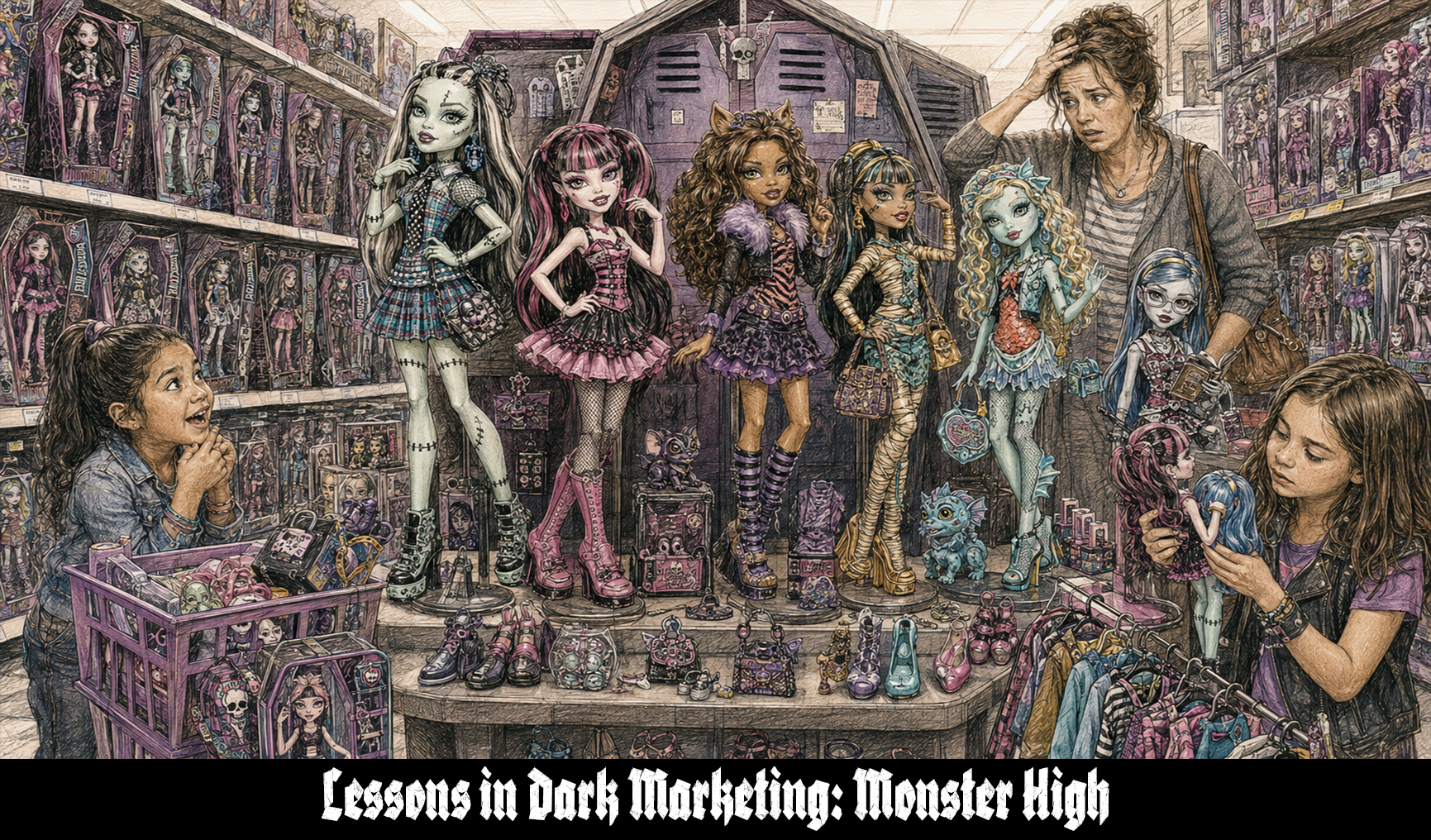
A child walks into the doll aisle and finds a teenage vampire wearing platform heels, a werewolf dressed for a fashion shoot, a stitched-together corpse carrying a purse, and the daughter of a mummy who appears to have spent the morning coordinating her bandages with her jewelry.
Every doll is different. Every doll is misunderstood. Every doll is learning to accept the strange feature that makes her unique. Every doll also needs a second outfit, a pet, a diary, a bedroom set, a vehicle, a locker, a dance costume, a beach costume, a birthday costume, and several equally misunderstood friends who happen to be sold separately. That was the elegant little crime scene inside Monster High.
Mattel introduced Monster High in 2010 after toy designer Garrett Sander pitched a fashion-doll line built around the teenage children of famous monsters. Executives were initially skeptical, and the concept went through audience testing before receiving approval. Within two years of launch, the brand was generating more than $500 million in annual sales. (St Pete Catalyst)
The original cast included Frankie Stein, Clawdeen Wolf, Draculaura, Lagoona Blue, Cleo de Nile, Ghoulia Yelps, and Deuce Gorgon, descendants of Frankenstein’s monster, the werewolf, Dracula, sea creatures, the mummy, zombies, and Medusa. The dolls arrived inside a larger franchise system that included online animation, books, apparel, Halloween costumes, music, games, and planned entertainment partnerships. Contemporary coverage described the rollout as one of Mattel’s largest brand launches and noted that the company was preparing content and merchandise across several platforms from the beginning.
Monster High had genuine value. The brand gave children characters who were strange, flawed, socially awkward, visibly different, and still allowed to occupy the center of the story. It treated adolescence as an experience filled with embarrassment, insecurity, changing bodies, difficult friendships, family expectations, and the exhausting pressure to fit into a social environment built by people pretending they had never felt weird themselves.
The dolls also broke visually from the polished suburban perfection associated with traditional fashion dolls. They had fangs, stitches, fins, fur, bolts, scars, unusual skin colors, asymmetrical features, and complicated family histories. Children who found ordinary princess fantasy too polished could enter a world where the princess might be undead, the prom queen might be wrapped in burial cloth, and the student council probably needed an emergency policy for shedding during a full moon.
Those benefits supplied the moral cover for an extraordinarily effective commercial machine. The product was a line of monster-themed fashion dolls. The machine was adolescent insecurity packaged as character choice, diversity turned into assortment, storytelling turned into product education, and self-acceptance translated into the belief that every form of difference deserved its own box.
We’re looking at outsider identity converted into a collectible retail system, not a rebellious uprising in the toy aisle.
That is the case study.
Mattel Turned Adolescent Alienation Into a Product Category
Monster High began with a powerful emotional truth: almost everyone feels strange during adolescence. The body changes. Social rules become more complicated. Clothing becomes political. Friendship groups acquire internal governments. A minor embarrassment can feel like a public trial conducted before an audience of people who also forgot their gym clothes last week.
Monster High took that universal discomfort and gave it a literal body. Frankie Stein had visible stitches and was still figuring out how the world worked. Clawdeen Wolf dealt with hair, transformation, confidence, and family identity. Draculaura came from a famous vampire lineage while developing her own personality and preferences. Lagoona Blue carried the signs of an aquatic heritage into a school filled with creatures from different backgrounds.
The characters didn’t need a metaphor for feeling monstrous. They were monsters. Mattel’s marketing described the brand as being built around the idea that everyone experiences moments of feeling like a monster. The company connected the characters’ “freaky flaws” to self-awareness and self-acceptance, turning emotional discomfort into the franchise’s central promise.
That promise gave the customer immediate emotional entry. A child didn’t need to identify with every detail of a vampire’s biography. They needed to understand what it felt like to possess a trait that attracted attention.
The monster concept universalized embarrassment while keeping the visual experience exciting. A child’s insecurity might involve braces, glasses, body shape, hair texture, social awkwardness, a disability, family background, or simply the conviction that everybody else had received a secret manual for being normal.
Monster High offered a cleaner diagnosis: everybody is strange, and the strange part might be the interesting part. That message was warm, useful, and commercially expandable. Human insecurity comes in countless forms. A brand built around difference could keep introducing another character, another body detail, another family history, and another variation of the same promise.
This is dark marketing principle number one: When a brand attaches itself to a universal emotional wound, every variation of that wound becomes a potential product extension.
Monster High didn’t need to invent adolescent alienation; it needed to give alienation excellent hair and a barcode.
Monsters Made Rebellion Safe Enough for the Toy Aisle
Monster High looked rebellious without requiring children to rebel against anything that might frighten a retailer. The dolls borrowed from goth fashion, horror movies, punk styling, tattoo imagery, platform shoes, skulls, chains, fishnets, dramatic makeup, and the long cultural history of parents wondering whether black clothing indicated demonic possession or an ordinary trip to the mall.
The brand took those signals and cleaned them for mass retail. The monsters were edgy, but approachable. The skull logo wore a bow. The vampire was cute. The zombie was studious. The werewolf was fashionable. The daughter of Frankenstein’s monster had stitching, bolts, and the posture of somebody who still understood the importance of accessorizing.
This balance was central to the original pitch. Sander later explained that Mattel needed to find the correct line between “monster” and “doll,” using highly recognizable creatures so the audience understood the characters immediately.The result gave children access to the performance of rebellion without demanding the consequences of rebellion.
A Monster High doll could signal that the child had moved beyond traditional princesses. The parent could still purchase it at Target, place it inside a gift bag, and feel reasonably confident that the doll wouldn’t introduce the household to actual occult practice.
The darkness was decorative. That made Monster High commercially useful to adults and children for different reasons. Children received something that felt older, stranger, and less obedient than conventional fashion dolls. Parents received a toy produced by one of the world’s largest toy companies, supported by carefully controlled stories and a message about acceptance. The brand sold safe danger.
This is dark marketing principle number two: Give customers the visual language of rebellion while removing the social risk, and mass-market conformity can feel subversive.
Monster High let children join the underground through the same checkout lane selling paper towels and breakfast cereal.
“Freaky Just Got Fabulous” Turned Difference Into Fashion
“Freaky just got fabulous” was an excellent slogan because it performed several jobs at once. It named the problem. It transformed the problem. It explained the product. It gave the customer a compliment.
The word “freaky” acknowledged social difference without softening it into bland corporate language. The word “fabulous” promised that the difference could become an advantage after styling, confidence, friendship, and the correct pair of shoes had been applied.
The slogan didn’t ask the child to become normal. It asked the child to become attractive enough that abnormality would receive applause. That distinction contains the commercial tension at the heart of Monster High. The brand encouraged self-acceptance while surrounding that acceptance with fashion, grooming, accessories, popularity, and carefully designed visual performance.
Difference was acceptable after it had been merchandised. A scar could be beautiful. A fang could be stylish. Fur could become a fashion feature. Stitches could coordinate with clothing. The monster didn’t need to hide the body. The monster needed to decorate it correctly.
The slogan made insecurity aspirational because it promised a conversion. The child could move from freaky to fabulous through confidence, friendship, self-expression, and an expanding wardrobe sold in themed assortments. Monster High didn’t erase the social category of the freak. It upgraded the category’s branding.
This is dark marketing principle number three: Reframe the customer’s insecurity as an aesthetic advantage, and the solution can be sold as self-expression rather than correction.
Monster High didn’t cure the freak; it sent the freak through hair, makeup, wardrobe, and public relations.
Each Character Sold a Different Version of Belonging
A single central doll asks the customer to identify with one personality. An ensemble gives the customer options. Monster High offered characters with different monster lineages, temperaments, interests, flaws, visual designs, friendships, romantic complications, and social positions.
The customer could choose the character who felt most familiar, most aspirational, or most visually impressive. Frankie could appeal to the newcomer learning social rules. Draculaura offered sweetness wrapped in vampire aesthetics. Clawdeen projected confidence and fashion authority. Lagoona carried a relaxed aquatic identity. Cleo delivered royalty, status, and controlled arrogance. Ghoulia represented intelligence through zombie behavior and glasses.
Each character offered a doorway. This made the line more inclusive and more collectible at the same time. Representation allowed more customers to find an emotional match. Assortment allowed Mattel to sell more dolls to the same customer.
The child could identify with one character and still want the others because the friendship group mattered. Frankie made more sense beside Draculaura. Clawdeen needed Cleo. Ghoulia’s personality became richer inside the group. The cast functioned as a social ecosystem.
The customer could begin with self-recognition and expand into completion. That’s stronger than selling six unrelated dolls. The characters occupied one shared world, carried connected stories, and appeared together across media. Buying another doll could feel like adding a relationship rather than adding inventory. Monster High turned personality typing into shelf space.
This is dark marketing principle number four: Create characters around distinct emotional identities and customers will mistake assortment for personal recognition.
The child found the doll who understood her, then purchased five of the doll’s friends so nobody had to understand her alone.
The Dolls Came With Personalities Already Installed
Traditional doll play allows the child to invent almost everything. Monster High arrived with extensive character information. The dolls included names, parentage, ages, pets, interests, dislikes, friendships, romantic relationships, “freaky flaws,” diary material, and visual cues tied to established personalities. The brand’s stories expanded those identities through books, webisodes, television specials, games, and other media. By 2014, the franchise had already generated dozens of doll series, hundreds of individual dolls, multiple playsets, books, web episodes, television specials, films, games, clothing, costumes, and additional merchandise.
This narrative depth increased emotional attachment. The customer didn’t own an unnamed vampire doll. The customer owned Draculaura, who arrived with relationships, anxieties, preferences, and a place inside the group.
That specificity made the doll easier to love and harder to substitute. A generic competitor could reproduce black clothing, fangs, pale skin, or a coffin-shaped accessory. Reproducing the emotional familiarity of a named character required years of storytelling and audience attention.
The diaries and profiles also provided product education. They told children how to interpret the design. A scar became character history. A pet became a relationship. Clothing became personality. An accessory became evidence from the story.
The brand reduced ambiguity. That can support imaginative play because the child receives a rich starting point. It can also guide play toward the company’s preferred meanings. The character arrives pre-written, and each official story reinforces which friendships, conflicts, outfits, and objects belong to that character. The customer still creates. The corporation has already furnished the stage.
This is dark marketing principle number five: Give a product a detailed personality and customers will attach to the character rather than evaluating the plastic.
Monster High placed biographies inside the box so a retail transaction could feel like meeting somebody.
Monster High Was a School Because Schools Never Run Out of Drama
The high-school setting was a commercial masterstroke. A school contains classrooms, lockers, cafeterias, dances, sports, clubs, teachers, rivalries, friendships, romances, uniforms, field trips, exchange students, assemblies, elections, performances, detention, and enough social humiliation to sustain a television franchise until graduation.
The environment generated stories automatically. A new character could transfer into the school. A new play-set could represent a classroom. A new fashion line could connect with a dance, beach trip, sporting event, holiday, school picture day, musical performance, or invented celebration containing the word “boo.”
The setting gave every product a reason to exist. A bedroom set might have felt disconnected from a monster doll. A dorm room, locker, school café, laboratory, dance floor, or vehicle tied directly into the world.
The school also allowed children to map the fantasy onto daily life. They understood cliques, new students, teachers, difficult friendships, embarrassment, and the effort required to survive a cafeteria without publicly dropping an entire lunch tray.
Monster High exaggerated the environment while preserving the emotional structure. A human teenager might fear arriving with the wrong clothing. A vampire teenager feared arriving with the wrong clothing and possibly being exposed to direct sunlight. The fantasy raised the visual stakes while keeping the emotional stakes familiar.
This is dark marketing principle number six: Place characters inside an environment that naturally generates endless social occasions, and every occasion can support another product line.
Monster High built a school where the academic curriculum consisted mainly of retail opportunities.
The Franchise Launched Before the Audience Had Time to Get Bored
Monster High wasn’t introduced as a lonely toy line waiting to see whether anybody cared. Mattel prepared a coordinated franchise. At launch, the company had publishing, online video, apparel, costume, entertainment, and retail relationships connected to the property. Early coverage noted YouTube content, Justice clothing, Party City costumes, books by Lisi Harrison, music, animation, and plans involving Universal Pictures.
This was a major change from the older sequence where a successful entertainment property generated toys afterward. Monster High used media and merchandise together.
The doll introduced the character. The webisode deepened the character. The book expanded the world. The costume allowed the child to become the character. The clothing carried the brand into daily life. The next doll assortment responded to another story or theme.
Each piece promoted the others. The child could encounter Monster High on a store shelf, then search for the characters online, then request a book, then watch a special, then recognize another doll, then wear a costume, then return to the shelf with a stronger relationship than the original purchase created.
The product line didn’t depend on one medium delivering the entire audience. It created a network of reminders.
This is dark marketing principle number seven: Launch a product inside a coordinated story system and each medium will return customers to the others.
Monster High didn’t release dolls and hope for attention; it surrounded the child before the first coffin-shaped package had finished opening.
The Webisodes Were Commercials With Character Development
Children voluntarily watched Monster High stories online. That mattered because voluntary viewing creates a different relationship from exposure to a conventional advertisement. The webisode could entertain, develop friendships, establish conflicts, introduce locations, reveal new personalities, and demonstrate how the dolls looked inside a larger world. The story gave the characters emotional life while keeping their visual designs in front of the audience.
Every appearance refreshed product recognition. A new character entering the story could become a future doll. A special outfit could become a fashion release. A location could become a playset. A celebration could become an assortment.
The entertainment didn’t need to announce a sales pitch. The merchandise potential sat inside the narrative. This is where children’s branded storytelling becomes particularly efficient. The audience wants to know what happens next. The company wants the audience to become familiar with what can be purchased next. Both goals fit inside the same episode.
The child experiences a story. The brand conducts inventory orientation. That doesn’t make every episode empty. Children can form genuine attachments to commercial characters. Stories can communicate friendship, courage, empathy, and self-acceptance even when the company hopes those feelings will survive long enough to reach the toy aisle. The manipulation lives in the fusion.
This is dark marketing principle number eight: When entertainment introduces products through story, the audience can absorb the catalog without experiencing a commercial interruption.
Monster High replaced “buy this doll” with twenty minutes of reasons the doll had feelings.
The First Doll Was the Beginning of a Friend Group
Monster High’s ensemble structure made a single purchase feel incomplete. The core characters were designed to interact. Their personalities contrasted, their relationships created stories, and their visual differences became stronger when displayed together.
One doll could participate in imaginative play. Several dolls created Monster High. This is the collection pressure hidden inside friendship-based franchises. The customer doesn’t need another figure because the first figure lacks physical function. The customer needs another figure because stories require relationships.
Frankie alone can attend school. Frankie with Draculaura can have a conversation. Add Clawdeen and a friendship group appears. Add Cleo and conflict becomes possible. Add Ghoulia and the social structure deepens. Add Deuce and the hallway acquires romantic complications that no household requested from molded plastic.
The brand could sell social completeness one character at a time. That structure also protected less central characters. A customer might prefer one doll visually and still purchase another because the character occupied an important role in the group. The collection became a cast.
This is dark marketing principle number nine: Design products as members of a relationship system and customers will experience additional purchases as narrative completion.
Monster High sold dolls individually and made loneliness the penalty for stopping at one.
Pets, Diaries, Stands, Shoes, and Bags Made Plastic Feel Like a Life
The original dolls often arrived with accessories such as pets, diaries, brushes, stands, handbags, jewelry, and elaborate footwear. Each piece expanded the impression that the character possessed a complete life.
The pet gave the doll something to care for. The diary supplied interior thought. The stand turned the doll into a display object. The bag suggested school and travel. The shoes reinforced fashion identity. The brush invited grooming and maintenance.
Accessories made the doll feel richer. They also trained the customer to notice missing accessories. Once one release included a pet, a later release without one could feel reduced. Once a character had a bedroom, locker, vehicle, café, or elaborate outfit, the basic doll could appear incomplete beside the expanded version.
The accessory system allowed Mattel to create price and value tiers without changing the emotional core. A child might already own the character and still want the version with a more elaborate environment.
The doll remained familiar. The package became larger. This is the quiet work of product-line expansion. The company doesn’t need a new hero every time. It can attach new objects to the existing emotional relationship. The plastic jagoff behind the merchandising plan understood that character loyalty could carry an extraordinary amount of luggage.
This is dark marketing principle number ten: Once customers believe a character has a complete life, every ordinary possession becomes an accessory opportunity.
Monster High gave the undead handbags because even immortality apparently requires somewhere to keep lip gloss.
The Same Character Could Be Sold Again After Changing Clothes
Fashion dolls possess one commercial advantage that many toy categories can’t match. The character can be repurchased without becoming a different character. Monster High released characters across themed assortments, events, settings, and fashion concepts. A customer who already owned Draculaura could encounter another Draculaura in a dance outfit, beach outfit, party outfit, school outfit, costume, collector design, or story-specific package.
The emotional relationship remained stable while the visual product changed. This reduced the burden of creating new attachment. Mattel didn’t need to convince the child to love a stranger. The child already loved the character. The company needed to make the new version visually distinct enough that ownership of the earlier version didn’t end desire.
Fashion supplied the reason. The theme supplied the urgency. The group structure multiplied the effect because each assortment could include several familiar characters wearing coordinated looks. One new doll might appear optional. The full themed group looked intentional.
The customer could purchase the same friendship circle repeatedly under different dress codes. The strategy helped create a large volume of releases. Academic research examining the brand’s early years documented dozens of doll series and roughly two hundred individual dolls by mid-2014, alongside play-sets, books, video content, movies, and games.
This is dark marketing principle number eleven: Repackage a beloved character around occasions and customers can repeat the emotional purchase while believing they’re buying visual variety.
Monster High discovered that resurrection becomes much easier when the corpse returns in a new outfit.
Difference Became an Assortment Strategy
Monster High’s diversity was meaningful because the characters looked and behaved differently from one another. The brand included monsters with different skin tones, bodies, features, abilities, family backgrounds, cultural inspirations, interests, and social personalities. The school’s central idea was that creatures from different lineages could belong in the same community.
That offered children a broader visual and emotional field than many traditional doll lines. The dark marketing problem appears when representation and assortment become indistinguishable.
Every newly represented difference could become another SKU. The vampire had one design language. The werewolf had another. The sea creature justified fins, scales, ocean colors, and water-themed accessories. The mummy opened Egyptian visual references. The zombie invited glasses, pale coloring, and cerebral personality traits. Later additions could draw from ghosts, gargoyles, skeletons, insects, folklore, mythology, and nearly any creature that could be given hair and footwear.
Inclusion created genuine recognition. Inclusion also created commercial range. That duality doesn’t make the representation false. A child can feel sincerely seen by a product designed to make money. The company’s commercial motive doesn’t erase the emotional response.
The important question is how the response gets used. Monster High connected recognition to collection. The brand could celebrate difference while encouraging customers to acquire difference in packages.
This is dark marketing principle number twelve: Representation becomes commercially expandable when every identity can be embodied as another product.
Monster High built a diverse student body and charged admission by the doll.
Acceptance Gave the Consumption a Moral Halo
Parents could defend a Monster High purchase through the brand’s message. The dolls encouraged children to embrace their flaws, accept their differences, support their friends, and resist the pressure to become identical. Mattel has continued to describe the franchise around individuality, authenticity, inclusion, community, and belonging. (Mattel Corporate)
Those values matter. Children benefit from stories that make visible difference ordinary. A doll with stitches, fangs, unusual skin, a physical feature, or a complicated family history can create room for conversations about identity and acceptance.
The message also made the merchandise feel socially constructive. The parent wasn’t purchasing another fashion doll. The parent was supporting self-esteem. The child wasn’t collecting plastic. The child was celebrating diversity. The company wasn’t expanding a profitable franchise. The company was helping everyone belong. All three interpretations could coexist, which is exactly why the machine worked.
A product attached to a moral value gains protection from ordinary commercial criticism. Question the volume of merchandise and somebody can respond as though you have objected to inclusion itself. The distinction matters. Acceptance can be valuable. Turning acceptance into a purchase requirement deserves examination.
This is dark marketing principle number thirteen: Attach a product to a moral good and consumption can feel like participation in the good.
Monster High sold self-acceptance with enough accessories to make the acceptance eligible for free shipping.
The Monsters Escaped Normal Beauty and Rebuilt It in Platform Heels
Monster High challenged traditional doll beauty while preserving many traditional beauty disciplines. The characters could be green, blue, gray, stitched, fanged, furry, scaled, or undead. That visual freedom was real.
The core girl dolls still leaned heavily on narrow waists, long hair, dramatic makeup, styled clothing, high heels, and fashion-centered presentation. Contemporary feminist criticism of the original line noted that the main characters entered the market with highly feminized bodies, long hair, and platform shoes even while the brand claimed to celebrate difference. (Ms. Magazine)
The message became complicated. You could be strange. You should still be fabulous. You could possess fangs. The fangs needed to coordinate with the outfit.
You could reject ordinary beauty. The replacement beauty standard remained demanding enough to require a hairbrush, handbag, makeup, shoes, and a body manufactured from the same fashion-doll tradition the monsters were supposedly disrupting.
This doesn’t erase the brand’s originality. Monster High widened the visual category of the fashion doll. It introduced children to characters who would have looked impossible beside older toy-aisle expectations. The line also demonstrated how quickly rebellion can build another uniform. The monsters escaped normality and arrived at a different dress code.
This is dark marketing principle number fourteen: A brand can challenge one beauty standard while installing another that requires the same level of consumption.
Monster High liberated the monster from hiding and immediately scheduled her for a makeover.
Horror Gave Adults Nostalgia and Children Novelty
Monster High used creatures adults already recognized. Dracula, Frankenstein’s monster, werewolves, mummies, zombies, gorgons, sea creatures, ghosts, and other supernatural figures carried decades of cultural familiarity.
Parents and grandparents knew the source material. Children received younger, fashionable descendants. This bridged generations without requiring Mattel to explain every concept from the beginning. A parent could understand the joke inside Frankie Stein’s name. A child could enjoy Frankie without seeing an old Universal horror film.
The recognizable monsters reduced commercial uncertainty. A completely original creature requires education. Dracula arrives with centuries of public relations already completed. The franchise borrowed cultural equity from monsters that existed long before Mattel and converted that familiarity into proprietary teenage characters.
This is a common licensing-style advantage even when the specific character is newly created. The audience recognizes the category, understands the powers, anticipates the visual cues, and experiences the product as both familiar and new. Monster High sold inherited mythology with contemporary wardrobe.
This is dark marketing principle number fifteen: Rebuild familiar cultural figures for a younger audience and borrowed recognition will reduce the cost of creating attachment.
Mattel didn’t invent the vampire; it gave the vampire a daughter and opened a school store.
The Brand Proved Outsider Money Could Rival Barbie Money
Monster High became a major commercial success quickly. In the second quarter of 2012, Mattel reported that worldwide gross sales for its Other Girls Brands category rose 96 percent, driven primarily by Monster High. (SEC) By the first quarter of 2013, Mattel’s profit had risen from $7.8 million to $38.5 million year over year, while sales in the Other Girl line led by Monster High rose 56 percent. The brand had become the company’s second-largest doll line behind Barbie.
The financial performance proved that unconventional appearance could produce conventional corporate success. Mattel didn’t need every customer to aspire toward Barbie’s traditional perfection. A large audience wanted characters whose appeal came from visible flaws, dark styling, humor, and social difference.
That was a valuable market discovery. The outsider could become mainstream without abandoning the visual signals of being outside. Once the brand succeeded, the industry received a clear lesson: alienation sells when the alienation is recognizable, fashionable, and organized into assortments.
The success also placed Monster High in competition with Mattel’s own portfolio. Reporting in 2013 described Monster High’s rapid growth alongside falling Barbie sales, with executives acknowledging that the newer line was drawing customers from the older brand. (Business Insider) The corporation could survive that conflict because it owned both versions of girlhood.
This is dark marketing principle number sixteen: When one cultural ideal loses power, the company that owns the opposite ideal can keep the customer.
Mattel could sell perfection through Barbie and profitable imperfection through the locker down the hall.
The Brand Expanded Because “Different” Has No Natural Endpoint
Monster High could always introduce another form of difference. A new monster lineage created a new character. A new character created a new silhouette, color palette, personality, pet, diary, friendship, conflict, outfit, and reason to return to the aisle.
The premise resisted completion. A school filled with monsters should contain more than six students. A world built around inclusion becomes conceptually stronger when new creatures keep arriving. The narrative value and commercial value point in the same direction.
That alignment is dangerous because expansion can always be defended as richer representation. Another character broadens the world. Another character also broadens the invoice.
The line generated spin-offs, competing supernatural doll concepts, and a large volume of branded material. Research on Monster High’s early franchise system described a cross-platform network of dolls, books, video, games, clothing, costumes, and fan activity that made the characters accessible through multiple forms of consumption.
The brand could grow horizontally across media and vertically through new product tiers. There was no final class roster.
This is dark marketing principle number seventeen: Build a brand around infinite difference and completion becomes impossible without contradicting the brand’s values.
Monster High could always welcome one more student, provided somebody’s parent welcomed one more charge.
Nostalgia Turned Childhood Acceptance Into Adult Scarcity
Generation Z grew up. Monster High followed them. Mattel has since developed premium collector products, limited releases, horror collaborations, member access programs, and exclusive drops through Mattel Creations. The company currently describes Skullector dolls as a premium line that reimagines Monster High characters, horror legends, and pop-culture figures, with some products offered through limited releases or Fang Club access. (Mattel Creations)
The emotional machine changed shape. A child once purchased a doll because the character represented belonging. An adult collector can purchase a premium doll because the character represents childhood.
Nostalgia restores emotional value to objects that may have been lost, damaged, donated, or dismissed when the original craze faded. Limited availability adds urgency. Premium packaging transforms play into display. Membership access turns fandom into a tier.
The message about uniqueness survives. The price architecture matures with the customer. This afterlife shows the long-term value of character attachment. Mattel didn’t simply sell dolls to children in 2010. It helped create a generation of adults who can recognize a silhouette, name a character, remember a webisode, and feel the sudden financial recklessness that arrives when a childhood object returns wearing collector packaging. The brand that once sold acceptance can later sell recovery.
This is dark marketing principle number eighteen: Build emotional identity into a childhood product and nostalgia can reopen the market after the original customer gains adult income.
Monster High waited for the children to grow credit scores.
The Case Study Breakdown
Here is the Monster High machine in plain English:
- The brand transformed adolescent insecurity into a literal monster metaphor.
- Recognizable flaws gave children immediate emotional entry points.
- Horror styling made mainstream dolls feel rebellious.
- Mass retail removed the real risk from that rebellion.
- “Freaky just got fabulous” turned difference into an aspirational transformation.
- Each character represented a distinct personality and visual identity.
- Character assortment allowed recognition and collecting to reinforce one another.
- Diaries, profiles, and stories made the dolls feel like established people.
- The school setting created endless social occasions and product environments.
- Books, webisodes, clothing, costumes, games, and entertainment promoted one another.
- Branded stories introduced characters and products without resembling ordinary ads.
- Friendship-group storytelling made one doll feel narratively incomplete.
- Pets, stands, diaries, shoes, bags, and playsets expanded the character’s commercial life.
- Themed assortments allowed the same characters to be purchased repeatedly.
- Diversity offered meaningful representation while expanding the product catalog.
- Acceptance and anti-bullying values gave purchases a moral halo.
- The dolls challenged conventional beauty while preserving strict fashion expectations.
- Familiar monsters supplied cultural recognition across generations.
- Rapid sales growth proved that outsider identity could become a mainstream business.
- New monster lineages gave the franchise no natural completion point.
- Adult collector products converted childhood attachment into premium scarcity.
- The customer could purchase difference, belonging, nostalgia, and identity through the same franchise.
Monster High worked because the emotional message and commercial structure strengthened each other. Children wanted characters who understood difference. Difference required visual variety. Visual variety created assortment. Assortment created collecting. Storytelling deepened attachment. Attachment increased demand for more characters, more outfits, more accessories, and more media.
The brand didn’t interrupt self-acceptance with a sales pitch. It built the sales pitch into the form self-acceptance took.
This is dark marketing principle number nineteen: The strongest identity brands make personal recognition, community membership, and product expansion feel like the same experience.
Monster High welcomed every kind of monster, then handed each one a separate receipt.
What Marketers Should Learn From Monster High
The first lesson is that emotional truth can carry an unconventional product.
Monster High’s visual design looked risky beside traditional fashion dolls, but the underlying feeling was familiar. Most children understand discomfort, difference, and the desire to belong. The monsters succeeded because the emotional problem required no explanation.
The second lesson is that rebellion becomes commercially scalable after risk has been controlled.
Monster High used skulls, fangs, scars, dark fashion, and horror references while remaining safe for mass retail, family gifting, books, costumes, and children’s media. The brand gave customers the sensation of crossing a boundary while keeping the checkout process ordinary.
The third lesson is that ensembles create stronger commercial worlds than isolated characters.
Each Monster High student offered a separate point of identification, while the friendship group encouraged customers to assemble the cast. The emotional benefit came from choosing a favorite. The financial benefit came from wanting the favorite’s social world.
The fourth lesson is that character depth can protect products from substitution.
A competing doll might reproduce the fashion or monster concept, but copying Frankie Stein’s specific history, relationships, personality, and accumulated audience recognition required more than changing a face mold.
The fifth lesson is that trans-media storytelling can turn entertainment into continuous product education.
Books, animation, music, games, and online content gave customers reasons to spend time with the characters between purchases. Each story strengthened recognition while introducing new environments, outfits, and relationships.
The sixth lesson is that inclusion can create both cultural value and commercial expansion.
A broader range of characters helps more customers find recognition. Marketers should acknowledge that value honestly while avoiding the cynical assumption that representation becomes meaningful only after it produces another product line.
The seventh lesson is that a strong slogan should contain the transformation the customer wants.
“Freaky just got fabulous” acknowledged the insecurity and promised a new interpretation. The customer didn’t need to remove the difference. The customer needed to see it as power.
The eighth lesson is that products become repeatable when familiar characters can be reorganized around occasions.
Monster High reused emotional attachment across dances, vacations, parties, school events, collector concepts, and other themes. The customer could repurchase the character through a new visual story.
The ninth lesson is that moral positioning strengthens commercial resilience.
Self-acceptance, belonging, friendship, and anti-bullying messages made the brand easier for parents to support and harder for critics to reduce to fashion-doll consumption.
The tenth lesson is that childhood identity can mature into adult collector demand.
A brand that becomes part of the customer’s personal history can later sell nostalgia, rarity, premium design, membership access, and the opportunity to recover a version of the past.
This is dark marketing principle number twenty: A durable character franchise sells the child a way to understand themselves and later sells the adult proof that the child still exists.
Monster High began in the toy aisle and waited patiently for the mortgage-paying collector.
Final Diagnosis
Monster High belongs in the Lessons in Dark Marketing museum because it transformed the emotional experience of feeling different into one of the most expandable doll franchises of its generation.
The final diagnosis is waiting beside a coffin-shaped locker:
- Monster High made adolescent alienation visually exciting.
- It turned classic monsters into relatable teenagers.
- It offered children meaningful characters built around difference and insecurity.
- It converted those differences into product assortment.
- It made dark styling safe for mainstream retail.
- It sold rebellion without requiring dangerous behavior.
- It used a slogan that transformed social discomfort into fashion confidence.
- It created multiple characters so more customers could find emotional recognition.
- It connected those characters through friendship, rivalry, romance, and school life.
- It used diaries and profiles to make molded plastic feel personal.
- It placed the characters in a school capable of producing endless stories and settings.
- It launched media, clothing, publishing, costumes, and merchandise as one coordinated machine.
- It allowed entertainment to perform the work of advertising.
- It made additional dolls feel like members of a social group.
- It expanded familiar characters through new outfits, themes, and occasions.
- It used pets and accessories to turn characters into complete lifestyles.
- It gave children broader visual representation than many traditional doll lines.
- It used acceptance and belonging as a moral justification for consumption.
- It challenged traditional beauty while preserving fashion-centered expectations.
- It borrowed recognition from classic horror and mythology.
- It proved that outsider identity could produce mainstream corporate revenue.
- It created a premise with no natural limit on characters or merchandise.
- It followed children into adulthood through premium collector releases and scarcity.
- It converted uniqueness into a repeatable sales architecture.
Monster High deserves credit for seeing children who felt ignored by more traditional fantasies. The dolls told them that the scar, fang, fin, stitch, family, awkwardness, or unusual feature didn’t disqualify them from friendship, style, or attention. That message landed because many children needed it.
The machine worked because the message was real enough to matter. Mattel didn’t have to manufacture every insecurity. School, adolescence, culture, beauty standards, cliques, and ordinary cruelty had already handled production. The company arrived with characters who translated those feelings into something colorful, funny, stylish, and purchasable.
Return to the doll aisle. Frankie Stein stands inside the box with stitches visible. Draculaura smiles beside her. Clawdeen wears an outfit that appears to have survived a fashion show and a wolf attack in the same afternoon. Cleo carries royal confidence. Ghoulia has her glasses. Lagoona has her fins.
Every character is different. Every difference is celebrated. Every celebration has another accessory pack. That was Monster High’s real achievement. It convinced children that nobody should be excluded for being unusual, then built a retail system where every unusual trait could support another character, another story, another outfit, and another reason the shelf remained incomplete.
The monsters were allowed to belong. The feeling of belonging was sold separately.
Leave a Reply