
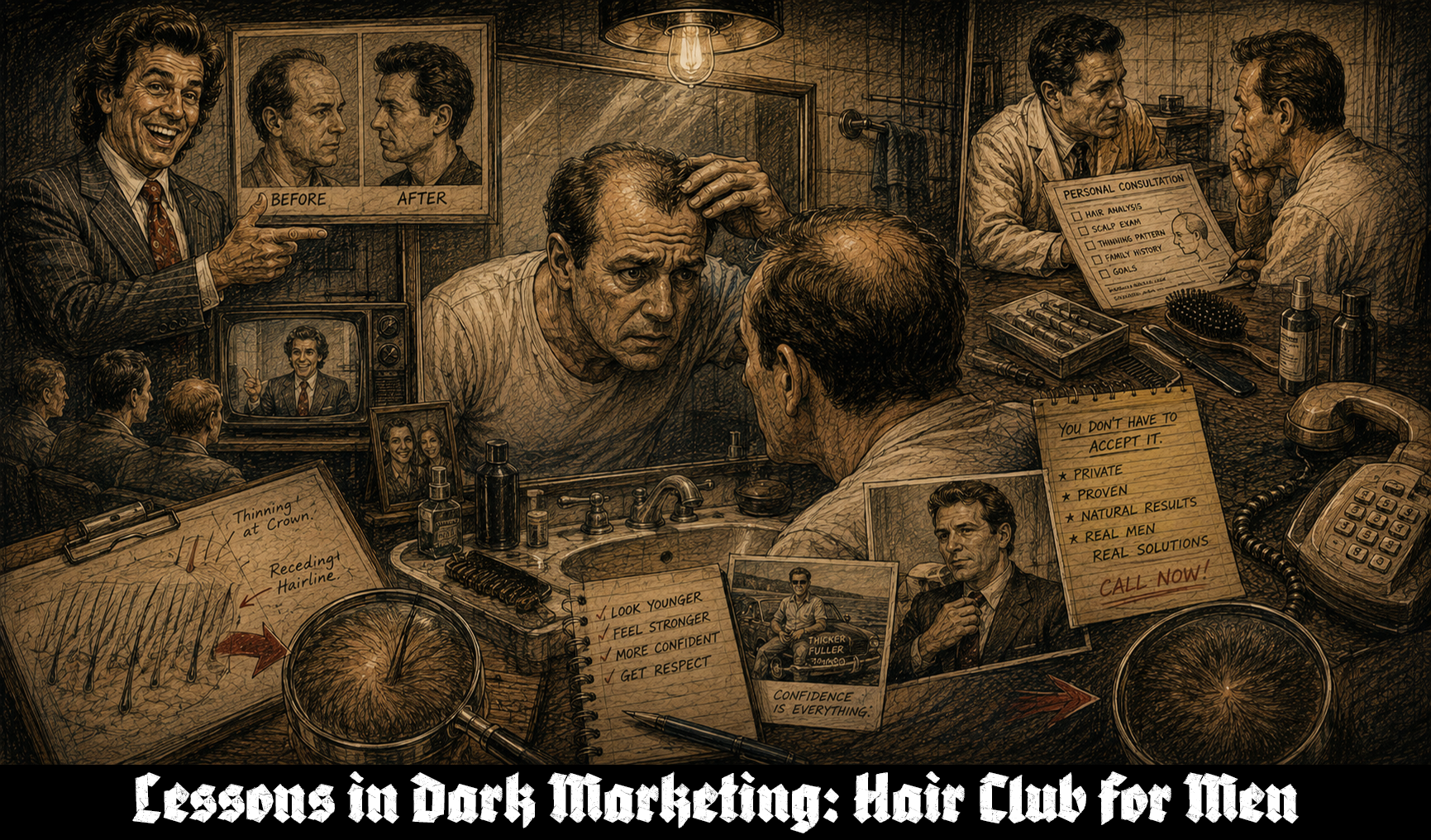
Hair Club for Men understood that the most dangerous room in male marketing was the bathroom mirror. That’s where the sales pitch began.
A man leans forward. He studies the hairline. He checks the crown under stronger light. He turns his head. He wets the hair, dries it, combs it forward, combs it sideways, and performs a little private act of forensic denial before work.
Maybe it’s the lighting. Maybe it’s the haircut. Maybe the forehead has always been that large. Maybe the hairline is merely reorganizing.
Sure, professor. There’s no fooling you.
The mirror has already delivered the bad news. The advertisement arrives to explain what the bad news supposedly means. You’re getting older. You’re losing youth. You’re losing attractiveness. You’re losing authority. You’re losing sexual relevance. Everyone sees it.
Hair Club for Men was founded by Sy Sperling in 1976 after his own hair loss left him deeply unhappy with his appearance and damaged his confidence. HairClub’s corporate history says Sperling had lost most of his hair by 25 and started the business from a Manhattan salon purchased with roughly $5,000 and credit cards.
That personal origin became the marketing machine.
Sperling didn’t hide behind a model, a physician in a white coat, or some handsome actor pretending to have experienced hair loss. He showed the before-and-after photographs, appeared in the advertising himself, and delivered the line that collapsed company president, product demonstration, customer testimonial, and proof of concept into one sentence:
“I’m not only the Hair Club president, but I’m also a client.”
The line was created by an advertising professional and used across Hair Club’s television, print, and radio campaigns. Sperling later described the strategy plainly: use real people, explain the service clearly, replace bad perceptions of old-fashioned toupees, and show customers someone like themselves.
That was the genius. Hair Club didn’t need to prove that hair loss existed. The customer had already completed that research at six in the morning with a wet comb and a look of spiritual defeat. The advertising only needed to turn the observation into an emergency. We’re looking at male shame converted into a rescue operation, not a simple cosmetic service.
The product was hair replacement. The machine was the fear of visible decline. That is the case study.
The Mirror Became the First Sales Representative
Hair Club’s most effective salesperson was never Sy Sperling. It was the mirror. The mirror worked before the commercial, after the commercial, and every morning between appointments. It did not need a salary, a script, or a motivational seminar. It simply reflected the hairline and allowed the customer’s insecurity to complete the pitch. That is a beautiful little system.
Most advertising must interrupt the customer’s life and introduce a concern. Hair-loss advertising could attach itself to a ritual the customer already performed. Shaving, showering, combing, dressing, and checking one’s appearance created daily opportunities for renewed anxiety.
The product category lived inside repetition.
A television commercial might air once that evening, but the mirror replayed the problem every morning. The customer could ignore the phone number. He could change the channel. He could laugh at Sy Sperling’s hair.
Then he had to look at himself again.
This is dark marketing principle number one: The strongest insecurity products attach themselves to a ritual the customer cannot avoid.
Hair Club didn’t need to create a new behavior. It colonized an existing one. Every glance at the hairline became another unpaid impression.
Baldness Was Re-framed as a Sales Emergency
Hair loss is gradual. That’s inconvenient for marketers.
Gradual change gives people time to adjust. A man may notice thinning, resist it, accept it, cut his hair differently, shave his head, or simply continue living because civilization has managed to survive the exposed male scalp.
Hair Club needed urgency.
The advertising transformed a slow biological change into a present-tense identity crisis. The viewer wasn’t merely losing hair over time. He was losing something socially valuable right now.
That framing changed the emotional temperature.
A few missing hairs became visible decline. A receding hairline became the start of a larger collapse. The customer was encouraged to see the scalp as evidence that youth, confidence, romance, and professional presence were quietly leaving the building.
Let’s get real, its not like follicles were unionizing against him. But fear rarely needs proportion. It needs meaning. Hair Club made hair loss signify more than hair loss. Once the customer accepted that expanded meaning, intervention felt urgent.
This is dark marketing principle number two: Turn a gradual change into an immediate identity threat and the customer begins shopping before acceptance can arrive.
The product category competed directly with peace of mind. Every month the customer waited, the advertisement suggested he was allowing the problem to become more visible.
The Founder Became the Proof
Sy Sperling’s famous line worked because it removed distance between seller and customer. He was the president. He was also the client.
The man presenting the solution had experienced the problem, purchased the solution, worn the solution, and built the company around the solution. That made the advertising feel unusually complete.
A conventional spokesperson could be dismissed as hired talent. A model could be dismissed as genetically lucky. A technician could explain the process but could not embody the transformation.
Sperling did all of it at once. He was authority and evidence.
He could speak as the businessman who understood the service and as the insecure man who understood the customer. That dual position gave the pitch emotional credibility without requiring institutional credibility.
The line also acknowledged the customer’s skepticism before the customer voiced it.
- Does this actually work? Look at the president.
- Would the company’s own founder use it? He says he already does.
The advertisement closed the loop.
A 1982 infomercial featuring Sperling’s before-and-after images and the famous client line reportedly generated more than 10,000 calls during its first month. The campaign also turned Sperling into a widely recognized figure and a frequent target of parody.
This is dark marketing principle number three: When the seller visibly uses the product, the testimonial becomes harder to separate from the authority.
Sperling wasn’t endorsing Hair Club from outside the experience. He made himself the living display model.
The Before-and-After Photograph Became the Courtroom Exhibit
Hair Club understood the power of two photographs placed beside each other.
Before. After.
That structure is one of the most aggressive shortcuts in marketing because it creates a complete argument without explaining the messy space between the images. The before photograph represents the problem. The after photograph represents the life after intervention.
The viewer supplies the emotional story.
- Before, the man looks older.
- After, he looks younger.
- Before, he appears defeated.
- After, he appears confident.
- Before, he is worried about his scalp.
- After, the problem seems to have vanished beneath a carefully arranged forest of renewed possibility.
The viewer may know the lighting changed, the styling changed, the expression changed, the wardrobe changed, and the entire photograph was designed to favor the result. It still works.
The human brain likes visible contrast. The transformation feels self-evident because both versions occupy the same frame. The advertisement does not have to argue that hair affects confidence. It shows a man smiling more after he has it.
That is enough for the emotional verdict.
This is dark marketing principle number four: Before-and-after advertising compresses uncertainty into a visual conviction.
The photographs did not merely show a cosmetic difference. They encouraged the viewer to assign personality, confidence, age, and social value to each side.
Male Shame Was the Targeting System
Men are often trained to treat appearance anxiety as weakness. That made the anxiety more profitable.
A man worried about his hair might avoid discussing it with friends, coworkers, relatives, or a partner because admitting the concern could feel vain, insecure, or unmanly. He might joke about baldness while privately rearranging the six remaining hairs like a failed municipal redevelopment project.
That silence isolates the customer.
Isolation helps the marketer because private shame reduces outside interference. There are fewer people offering perspective, challenging the fear, recommending acceptance, or pointing out that the man’s life has not actually collapsed because a little more forehead entered the marketplace.
The advertisement becomes the conversation he is not having elsewhere.
Hair Club could speak directly into the private concern and offer a confidential path out. The company did not need the customer to become publicly comfortable discussing hair loss. It needed him uncomfortable enough to seek a private consultation.
That’s one hell of a funnel.
This is dark marketing principle number five: Private shame creates a high-intent customer because embarrassment prevents the insecurity from being socially corrected.
The man may laugh at the commercial in front of other people, then write down the phone number when nobody is watching.
Hair Became Youth You Could Purchase
Hair Club sold hair replacement systems, but the emotional product was youth.
Hair is one of the visible markers people use when reading age. When it begins disappearing, the customer may feel older before anything else about his life has changed. The scalp becomes a calendar nobody asked to hang on the wall.
Hair Club offered a way to interfere with that calendar. The promise was not biological youth. The promise was visual negotiation. A man could not stop aging, but perhaps he could stop looking like aging had already started winning. That distinction carried enormous emotional value.
The service gave the customer a way to reclaim an earlier image of himself. The hairline was attached to photographs, dating memories, younger adulthood, professional ambition, and the period before every mirror began delivering quarterly earnings reports on follicular decline.
This is dark marketing principle number six: When customers cannot reverse time, sell them control over one visible sign of it.
Hair Club made youth feel available through appearance management. The service could not make a man younger. It could help him perform a younger version of himself.
Sexual Relevance Was the Hidden Promise
Hair-loss advertising rarely needs to say the ugliest fear directly.
Will people still find me attractive?
That question sits underneath the category.
Sperling openly connected his own early hair-loss concerns with dating and intimacy, describing the awkwardness and embarrassment surrounding removable hairpieces in romantic situations. Hair Club’s marketing offered a more secure fantasy. The hair would remain in place.
The customer could swim, shower, exercise, move, sleep, date, and participate in life without fearing that the illusion would detach itself at the worst possible moment. Sperling described his positioning as replacing the old image of the obvious, unstable toupee with a system that could remain in place through normal daily activities.
That physical promise carried sexual meaning. The customer wasn’t only afraid of being bald. He was afraid of being exposed as a man trying not to look bald. The second fear can be stronger than the first.
A failed concealment creates two humiliations at once: the insecurity and the evidence of the attempt to hide it. Hair Club sold relief from both.
This is dark marketing principle number seven: Concealment becomes more valuable when the customer fears being caught concealing.
The service offered hair and the possibility that nobody would know how the hair arrived.
“Natural” Became the Most Important Word
The old toupee had a marketing problem. People could see the damn thing.
It sat on the head like a nervous woodland creature hoping nobody would ask for identification. The hairline looked suspicious. The texture failed to match. The color was wrong. A strong breeze became an investigative journalist. Hair Club had to attack that image.
Sperling described his goal as changing the perception of old-fashioned toupees and answering the complaints of men who had experienced poor-quality products. His advertising emphasized clear explanation, relatable people, and the replacement of bad industry images with better ones.
That meant the real selling word was natural. Natural-looking. Natural-feeling. Undetectable. Secure.
The customer was not seeking visible transformation alone. He was seeking invisible intervention. The best result would attract attention to the improved appearance without attracting attention to the method. That is a strange marketing challenge. The product succeeds by disappearing.
This is dark marketing principle number eight: When customers are ashamed of needing the product, the highest benefit is that nobody can detect the purchase.
Hair Club was selling hair, but invisibility protected the transaction.
The Word “Club” Softened the Clinic
“Hair Club for Men” is a brilliant name because it avoids sounding like a medical office, wig shop, cosmetic procedure center, or emergency bunker for frightened foreheads.
It sounds social.
A club suggests membership, belonging, fraternity, exclusivity, and shared experience. Men join golf clubs, athletic clubs, private clubs, and professional associations. A club feels respectable. It implies other men are already inside. That matters when the underlying service carries embarrassment.
The name re-framed intervention as membership. The customer wasn’t being treated for an insecurity. He was joining a group of men who had made a decision.
The words “for Men” sharpened that reassurance. This was a male space built around a male concern. The customer did not have to wander into a beauty salon and explain why the crown of his head had become a source of national emergency. The category had been given a masculine door.
This is dark marketing principle number nine: When the service carries shame, rename the destination so entering feels like belonging.
Hair Club took a cosmetic concern and wrapped it in the language of membership. The shame remained, but the sign on the building looked more respectable.
The Consultation Became a Confession
A hair consultation begins with observation.
- Where is the thinning?
- When did it begin?
- What has changed?
- How does the customer feel about it?
- What does he want to look like?
Those questions may be practical, but they also invite confession. The customer must describe the fear out loud. He must acknowledge that the hair loss matters. He must allow another person to inspect the scalp, discuss the progression, and explain possible solutions.
That creates commitment.
Before the consultation, the concern remains private and somewhat abstract. During the consultation, the concern becomes documented, discussed, measured, and attached to a proposed path forward. The customer crosses an emotional threshold simply by showing up.
That is why free consultations are so useful in insecurity-based categories. The consultation lowers the financial barrier while increasing psychological involvement. The customer may arrive believing he is gathering information and leave having narrated the entire case against his own appearance.
This is dark marketing principle number ten: A free consultation can convert private discomfort into an officially recognized problem.
Once the insecurity has been named in a professional setting, doing nothing may begin to feel like an active decision.
Confidence Became the Respectable Sales Language
Hair Club could not build the entire pitch around vanity. Men are often willing to spend enormous amounts of time and money on appearance as long as nobody calls it appearance.
So the category used confidence.
- Confidence sounds practical.
- Confidence helps at work.
- Confidence helps in relationships.
- Confidence helps socially.
- Confidence sounds like character development rather than grooming.
That word gave the customer moral permission. He was not chasing youth. He was rebuilding confidence. He was not afraid of looking older. He was improving self-esteem. He was not buying hair. He was changing his life.
HairClub’s own history places confidence at the center of its origin story and current purpose, describing Sperling’s hair loss as destructive to his self-confidence and presenting hair restoration as a way to help clients regain it. That framing may reflect a real emotional benefit. It is also excellent positioning.
This is dark marketing principle number eleven: Vanity becomes easier to purchase when the brand translates it into personal development.
Confidence gave the customer a reason he could defend to himself and to anyone who asked.
The Service Sold Authority Back to Men
Male appearance marketing often connects hair with authority. A full head of hair can be framed as vitality, strength, experience without decline, and leadership without age showing too aggressively. The thinning crown, by contrast, becomes a symbol the customer fears others are reading.
Hair Club could exploit that concern without announcing it directly.
The after image usually did the work. Better posture. Better suit. Better expression. Better lighting. More hair. The transformed man appeared ready to reenter the office, the dating world, or the social environment with renewed command.
The hair became part of the uniform.
That is especially powerful for men whose identity is tied to professional competence. They may believe they are being judged in rooms where youth and energy carry economic value. The hairline becomes one more variable to manage.
The service offers a visible correction.
This is dark marketing principle number twelve: Attach appearance to authority and cosmetic intervention begins to feel professionally responsible.
Hair Club could sell the fear that the scalp was speaking before the man entered the conversation.
The Advertisement Used Real Men as Permission
Sperling believed real people were more believable than perfect professional models, and his advertising strategy relied heavily on relatability and visible transformations.
That choice mattered.
A beautiful model with perfect hair might attract attention, but he could not relieve the customer’s skepticism. The viewer needed to see another ordinary man with a familiar problem.
- The before photograph said, he was like you.
- The after photograph said, he did something about it.
- The testimonial added the final pressure: he feels better now.
That structure creates permission. The customer is no longer considering an unusual cosmetic intervention in isolation. He is following a path another man has already taken. The testimonial makes the behavior seem common, reasonable, and socially survivable.
The customer does not need to become the first man to admit that hair loss bothers him. The advertisement presents an entire line of volunteers.
This is dark marketing principle number thirteen: Relatable transformations make private insecurity feel like a normal consumer category.
Hair Club turned individual embarrassment into group evidence.
The Catchphrase Made Skepticism Memorable
“I’m not only the Hair Club president, but I’m also a client.”
The line survives because the structure is perfect. It begins with authority. Then it reveals vulnerability. The president is not above the customer. He is one of the customers. That reversal creates surprise, and surprise creates memory.
“I’m not only the Hair Club president, but I’m also a client.” also anticipates the suspicion that executives sell products they would never use themselves. Sperling’s reveal neutralized that concern with one sentence.
He had placed his own head inside the guarantee. That was powerful even when people mocked it. In fact, mockery helped. Every parody repeated the brand, the founder, the client relationship, and the basic product claim.
A person joking about Hair Club still had to explain why the line was funny. The president uses the service. The joke carries the proof.
This is dark marketing principle number fourteen: The strongest catchphrases survive parody because the joke repeats the selling proposition.
Hair Club became part of popular culture without losing the commercial mechanism underneath the reference.
Ridicule Became Free Distribution
Hair Club was easy to parody. The dramatic before-and-after. The serious music. The confident founder. The reveal. The hair itself.
American comedy did what American comedy always does when advertising becomes too recognizable: it dragged the campaign into the street and started beating it with impressions.
That could have destroyed a fragile brand.
Hair Club benefited because ridicule required familiarity. The audience already knew the phrase. The parody refreshed the memory. Even people who had never considered hair replacement understood the company’s promise.
The brand became shorthand for visible male insecurity and dramatic cosmetic intervention. That sounds cruel because it was cruel. It was also distribution.
The company did not need to purchase every repetition. Comedians, television shows, radio hosts, coworkers, and schoolchildren handled the unpaid media schedule.
This is dark marketing principle number fifteen: When ridicule repeats the brand promise accurately, embarrassment becomes reach.
Hair Club did not need cultural dignity. It needed the next frightened man to remember the name when his bathroom light hit the crown at the wrong angle.
The Product Offered Secrecy and Visibility at the Same Time
Hair Club sold a strange combination. The customer wanted the result to be visible. He wanted the method to remain invisible. People should notice that he looked younger, better, sharper, healthier, or more confident. They should not notice why.
That tension created the ideal cosmetic promise. The change should generate positive attention without generating investigation.
This is why hair replacement occupies such a psychologically charged space. The product is worn publicly while the purchasing decision remains private. It lives on top of the customer’s head, directly inside other people’s field of vision, while trying to avoid becoming a topic.
The service therefore had to sell control over attention. Look at me, buto not look too closely. That contradiction keeps the customer emotionally invested in quality, maintenance, discretion, and consistency.
This is dark marketing principle number sixteen: The most powerful appearance products promise visible improvement and invisible intervention.
Hair Club sold the customer a transformation that was supposed to be noticed without being detected.
Maintenance Extended the Emotional Relationship
Hair replacement is not emotionally complete at the moment of purchase. The customer must continue believing in the result.
He must live with it, style it, protect it, and trust that it remains convincing under changing conditions. Every new haircut, photograph, social event, romantic encounter, windy day, bright room, and curious glance can reactivate concern.
That continuing concern creates an ongoing relationship with the provider. The customer is not simply purchasing an object and walking away. He is entering a system built around preserving the appearance and the confidence attached to it.
That is commercially powerful.
The original insecurity keeps returning because the customer knows what sits underneath the solution. Even after the transformation, the fear of exposure can remain. The product manages the insecurity without necessarily erasing it.
This is dark marketing principle number seventeen: A solution becomes recurring revenue when the customer must continually protect the result from exposure.
The hair may be restored visually, but the anxiety still knows the original address.
The Brand Sold Control Over Other People’s Perception
Hair Club could never guarantee what other people thought. It could sell the feeling of control.
That is what appearance marketing offers at its deepest level. The customer cannot control aging, genetics, time, attraction, office politics, romantic chemistry, or the private judgments of strangers.
He can control the presentation. Hair becomes a manageable variable inside a much larger field of uncertainty. That small control can feel enormous.
The customer may believe that replacing the hair will change how others read him. Maybe it will. Maybe it will primarily change how he reads himself. The brand benefits either way because perception is difficult to measure and easy to hope about.
This is dark marketing principle number eighteen: Sell control over appearance when the customer feels powerless over interpretation.
Hair Club did not need to promise that every room would respond differently. It needed the customer to imagine entering the room differently.
Acceptance Was the Real Competitor
Hair Club’s greatest competitor was not another hair company. It was acceptance. A man who decides that baldness is ordinary, manageable, attractive, irrelevant, or simply part of his appearance becomes much harder to sell.
That is why insecurity categories must keep acceptance from arriving too early. The customer must continue believing the visible change is a problem, the problem carries social consequences, and the consequences can be reduced through purchase.
Acceptance interrupts the entire machine. It lowers urgency. It weakens shame. It destroys the imagined audience of critics. It turns the bathroom mirror back into a mirror. The hair restoration industry therefore benefits from a culture that treats baldness as decline rather than variation. The more relaxed the customer becomes about his scalp, the less emotionally available he is to the pitch.
Sperling himself later complained that the popularity of shaved heads among movie stars harmed the industry by making baldness appear attractive and socially acceptable. There’s the whole business model standing naked under fluorescent lighting.
This is dark marketing principle number nineteen: Insecurity brands lose power when the customer discovers acceptance before checkout.
The product must feel necessary before the customer realizes he may survive without it.
The Company Turned One Man’s Shame Into a Category
Sy Sperling experienced hair loss, felt bad about himself, found an alternative to the hairpieces available to him, and built a business around the solution. HairClub now describes that origin as a mission to reduce the stigma and shame surrounding hair loss while helping clients regain control and confidence.
That origin contains both sides of the case. The service may provide genuine emotional relief to people who want it. The marketing also depends on the fear that relief is needed. That is the tension inside nearly every appearance business. The company helps people manage pain while the category benefits from keeping the pain culturally active.
Hair Club did not invent male insecurity about aging.
- It organized the insecurity.
- It named it.
- It photographed it.
- It placed the before beside the after.
- It created the consultation.
- It provided the president as evidence.
Then it gave the whole thing a phone number.
This is dark marketing principle number twenty: The most durable insecurity businesses turn a private fear into a standardized customer journey.
Hair Club took a man staring at his reflection and built an entire commercial system between that reflection and the phone.
The Case Study Breakdown
Here is the Hair Club for Men machine in plain English:
- The bathroom mirror renewed the sales problem every morning.
- Gradual hair loss was re-framed as an immediate identity emergency.
- Baldness became a symbol of lost youth, attractiveness, authority, and sexual relevance.
- Sy Sperling served as president, spokesperson, testimonial, and visible proof.
- The famous client line compressed authority and vulnerability into one sentence.
- Before-and-after photographs turned emotional interpretation into apparent evidence.
- Male embarrassment isolated customers from outside perspective.
- Hair replacement was positioned as confidence and self-improvement rather than vanity.
- The word “club” made cosmetic intervention feel like respectable membership.
- Natural appearance and undetectability became central benefits.
- Real customers made the intervention look normal and socially survivable.
- The consultation converted private concern into a formally recognized problem.
- Romantic and professional fears expanded the meaning of the hairline.
- Parody repeated the company’s entire selling proposition.
- Ridicule provided unpaid cultural distribution.
- The customer wanted the result noticed while keeping the method invisible.
- Continuing concern about detection supported an ongoing service relationship.
- The product offered control over presentation when the customer feared other people’s judgment.
- Social acceptance of baldness threatened the entire urgency system.
- One man’s insecurity became a standardized national marketing category.
That is why Hair Club for Men worked. It found a visible change that many men experienced privately, attached the change to larger fears about aging and relevance, then gave the customer a believable guide who had already crossed the bridge.
This is dark marketing principle number twenty-one: The most persuasive insecurity campaigns show the customer a future self and place a relatable survivor between him and the purchase.
Sy Sperling’s head became the bridge.
What Marketers Should Learn From Hair Club for Men
The first lesson is that a founder can become the strongest testimonial when the origin story and the customer problem are the same.
Sperling’s personal use of the service made the sales claim feel embodied rather than borrowed.
The second lesson is that a great slogan can contain the entire credibility argument.
The president-client line answered the customer’s central question before the pitch continued.
The third lesson is that before-and-after imagery invites the audience to create emotional conclusions the advertiser never has to state directly.
The viewer assigns confidence, youth, attractiveness, and success to the transformation.
The fourth lesson is that private shame creates unusually focused demand.
A customer who cannot comfortably discuss the problem may become more receptive to the one brand speaking directly to it.
The fifth lesson is that language can sanitize vanity.
Hair Club used confidence, self-esteem, youthfulness, and personal improvement to give cosmetic intervention a respectable emotional frame.
The sixth lesson is that the destination matters.
Calling the business a club created belonging around a service many customers might otherwise have found embarrassing.
The seventh lesson is that parody can reinforce a brand when the famous joke preserves the core message.
Hair Club became mockable because the campaign was memorable, and the mockery kept it memorable.
The eighth lesson is that acceptance is the enemy of insecurity marketing.
The customer who stops treating the trait as a problem exits the funnel before the consultation.
This is dark marketing principle number twenty-two: When your product sells relief from shame, the entire system depends on the customer continuing to believe the shame deserves treatment.
Hair Club offered a real service. The marketing machine made sure the hairline felt like more than hair.
Final Diagnosis
Hair Club for Men belongs in the Lessons in Dark Marketing museum because it transformed a receding hairline into a full-scale referendum on masculinity, youth, authority, attractiveness, and personal relevance.
The final diagnosis is standing beneath the bathroom light with a hand mirror:
- Hair Club turned the mirror into a daily advertising channel.
- It made gradual hair loss feel like an immediate social emergency.
- It sold youth through visual restoration.
- It attached hair to confidence, romance, authority, and professional presence.
- It used male silence and embarrassment as targeting advantages.
- It transformed the founder into the company’s strongest proof.
- It made the president’s own insecurity the credibility engine.
- It used before-and-after photographs as emotional courtroom exhibits.
- It turned cosmetic intervention into respectable self-improvement.
- It made “natural” and “undetectable” more important than the product itself.
- It used the language of membership to soften the shame of seeking help.
- It converted the consultation into an admission that the problem mattered.
- It made real customers into permission structures for other men.
- It allowed parody to spread the slogan for free.
- It sold visible improvement alongside invisible intervention.
- It created an ongoing relationship by keeping the fear of exposure alive.
- It offered men control over presentation when they feared losing control over age.
- It treated acceptance as the one solution the company could not monetize.
- It proved that a single testimonial line could build an entire national credibility machine.
That is why Hair Club for Men belongs beside Ronco, The Clapper, Life Alert, Avon, Virginia Slims, Tupperware, Tang, TV dinners, Reader’s Digest, Jell-O molds, Chia Pets, and every modern brand that finds a private insecurity, adds studio lighting, and gives the fear a toll-free number.
Hair Club sold men the temporary right to believe nobody could see them getting older.
- The hairline.
- The bathroom light.
- The before photograph.
- The after photograph.
- The private shame.
- The free consultation.
- The fear that women noticed.
- The fear that coworkers noticed.
The larger fear that everyone noticed and was simply too polite to mention the widening patch of exposed scalp conducting its own hostile takeover.
Then Sy Sperling appeared. He showed the pictures. He showed the hair. He looked directly into the camera and delivered the only testimonial the campaign ever truly needed.
Sy wasn’t only selling the fear. He had lived inside it. And he was also a client.
Leave a Reply