
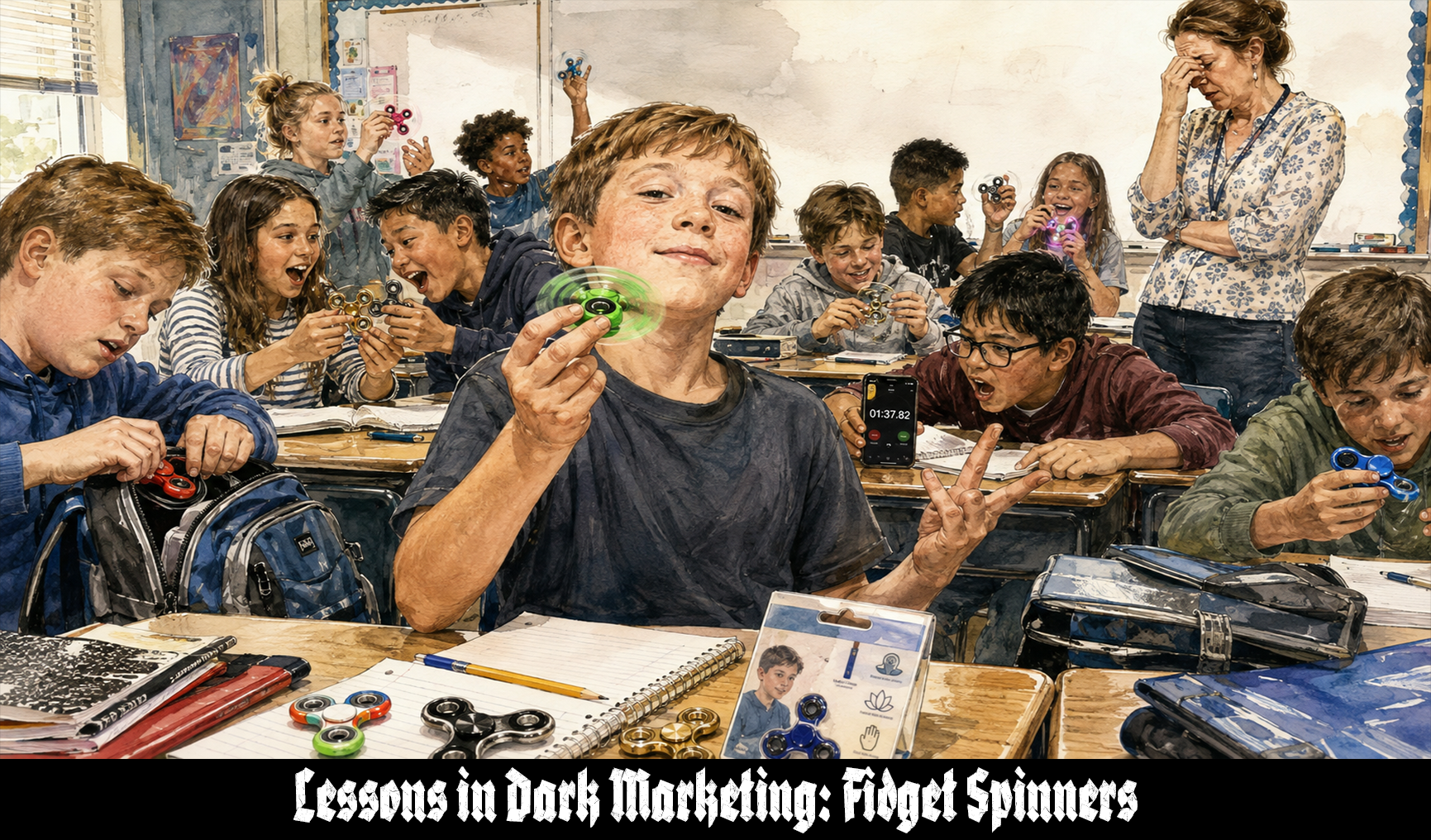
Somewhere in America during the spring of 2017, a teacher looked across a classroom and realized that half the children were holding tiny plastic propellers between their fingers. One student was staring at theirs. Another was timing how long theirs could rotate. Two were comparing bearings. Someone was attempting to balance one on a pencil, another had dropped one onto a desk with the acoustic subtlety of a socket wrench hitting a bathtub, and a child near the back was prepared to explain that confiscating the whole damn collection might interfere with everybody’s ability to concentrate.
That last part made the fidget spinner craze different from the average schoolyard infestation. Children have dragged yo-yos, trading cards, slap bracelets, Tamagotchis, Pokémon cards, Silly Bandz, and enough other distracting objects into classrooms to keep teachers professionally suspicious of anything that fits inside a backpack. The fidget spinner arrived with a better defense because this particular distraction had somehow acquired the vocabulary of attention, anxiety, sensory regulation, autism, ADHD, stress relief, and therapeutic support.
The object responsible for all this was almost insultingly simple. Most mass-market fidget spinners consisted of a central ball bearing surrounded by two or three weighted lobes. A person pinched the middle between a thumb and finger, flicked the outside, and watched the body rotate around the bearing. That was the product. There was no screen, no software, no account, no subscription, and usually no meaningful objective beyond keeping the thing moving until somebody nearby became annoyed.
The modern spinner’s origin was considerably messier than the neat inventor mythology that accompanied the craze. Catherine Hettinger was widely presented in 2017 as the forgotten inventor whose patent had expired before the phenomenon made other people money, but Bloomberg and later reporting challenged that story because her patented 1990s spinning toy differed substantially from the familiar bearing-centered spinner. Scott McCoskery, meanwhile, developed the metal Torqbar in 2015 after wanting something quieter than clicking a pen during meetings, while teenage entrepreneurs Allan Maman and Cooper Weiss began producing and promoting their Fidget360 spinners in 2016 after experimenting with 3-D printing at school.
By the spring of 2017, ownership history barely mattered because the market had become a manufacturing free-for-all. Major toy companies didn’t control the category, and consumers could find cheap versions through online marketplaces, convenience stores, gas stations, mall kiosks, toy stores, promotional suppliers, and countless importers. In May, eighteen of Amazon’s twenty bestselling toys and games were fidget spinners, while Toys “R” Us was flying inventory from China rather than waiting for slower ocean freight because the craze was moving faster than ordinary retail logistics could tolerate.
There was a legitimate human behavior underneath the madness. People fidget. Some children and adults genuinely benefit from appropriate sensory tools, movement, or tactile objects in particular circumstances, and occupational therapists had used other forms of fidget and sensory tools long before 2017. The problem began when a nuanced idea about individualized support was flattened into a mass-market implication that this extremely visible spinning toy could broadly improve concentration, anxiety, ADHD symptoms, autism-related needs, or classroom performance.
A 2017 review in Current Opinion in Pediatrics found that the benefits being attributed to fidget spinners lacked scientific support and specifically warned that marketers were promoting them for ADHD, autism, anxiety, and sensory issues despite the absence of rigorous evidence. Later research made the problem harder to ignore: a classroom study involving young children with ADHD found spinner use associated with poorer attention, while a 2023 study of 233 elementary-school children found an overall negative effect on academic performance regardless of ADHD symptom levels.
That gap between legitimate sensory needs and unsupported product-specific promises is where the fidget spinner earns its place in Lessons in Dark Marketing. The product was a bearing attached to plastic, while the machine was a playground fad wearing therapeutic vocabulary, social proof spinning in full view of every classmate, and a cheap toy that gained adult permission by suggesting it might also be an intervention. We’re looking at youth culture borrowing authority from special education and mental-health language while peer pressure, social media, school bans, and an uncontrolled supply chain handled the actual distribution.
Fidgeting Was Free Until Somebody Gave It Equipment
People have always occupied their hands while thinking. They click pens, bounce knees, twist rings, doodle, tap fingers, fold paper, squeeze stress balls, roll coins across their knuckles, chew gum, dismantle paper clips, and quietly abuse office supplies whenever the meeting refuses to end. None of those behaviors required a new consumer category because the human body arrived from the factory with several built-in methods of being restless.
The fidget spinner’s first marketing achievement was converting that ordinary behavior into something that appeared to deserve specialized equipment. Pen clicking looked annoying, while using a purpose-built fidget device could look intentional. Foot tapping suggested restlessness, while a product sold specifically for fidgeting suggested that the same impulse might represent an identifiable need with an identifiable solution.
That transformation matters because commerce becomes much easier after an informal behavior receives a name, a category, and a dedicated object. Walking becomes quantified steps, drinking water becomes hydration optimization, sitting quietly becomes mindfulness, and restless hands become a consumer market. The underlying human behavior can remain almost unchanged while the commercial meaning surrounding it becomes completely different.
This is dark marketing principle number one: Turn an ordinary behavior into a specialized category and consumers may begin treating something they already do naturally as an unmet product need.
Humanity managed nervous hands with pens for generations before somebody discovered the bearing was apparently the missing medical infrastructure.
“Fidget Spinner” Sounded Like Both the Diagnosis and the Prescription
The name was unusually efficient because each half performed a different job. “Spinner” explained the mechanism, while “fidget” explained why the buyer might supposedly need one. The product description and the problem statement had been compressed into two words.
That matters because “fidget” already carried cultural baggage. Children hear instructions to stop fidgeting, sit still, quit tapping, leave the pencil alone, stop rocking the chair, keep their hands to themselves, and generally reduce all physical evidence that they’re trapped inside a room discussing fractions. A product named for the unwanted behavior could reframe that behavior as something requiring support instead of correction.
That reframing can be useful when it helps adults understand legitimate sensory or attentional differences. The commercial shortcut appeared when the category name encouraged consumers to assume that anything labeled a “fidget” product automatically possessed therapeutic value. A mass-produced spinner didn’t need to demonstrate that it improved attention before its name positioned it beside products intended to address attention and regulation.
This is dark marketing principle number two: Name the product after the problem and the language itself can begin suggesting effectiveness before the evidence does.
“Three-Pronged Bearing Toy” would’ve forced the little bastard to survive on charm.
Therapeutic Language Gave the Toy Authority It Hadn’t Earned
The spinner could’ve succeeded as a toy without ever mentioning ADHD, anxiety, autism, sensory needs, or concentration. Spinning was satisfying, the objects were inexpensive, tricks were easy to demonstrate, and children could compare them publicly. That was already enough raw material for a schoolyard craze.
Therapeutic language made the product stronger because it added an adult justification. The 2017 pediatric review noted that sellers were advertising fidget spinners as beneficial for children with ADHD and other conditions even though those claims lacked scientific support. The authors also distinguished the spinner craze from the broader history of occupational-therapy tools, where sensory objects had been used for related purposes but the evidence base was still limited and highly dependent on individual circumstances.
That nuance was commercially inconvenient. “A particular child may benefit from a carefully selected tool used appropriately under specific conditions” takes too long to fit on packaging, and it doesn’t produce the satisfying certainty of “helps focus.” The market collapsed a complicated therapeutic conversation into a product attribute because simple claims convert better than professional judgment.
The result was a medical halo. The spinner could borrow credibility from legitimate special-education and therapeutic practices without carrying the evidentiary burden expected from an actual treatment. Parents weren’t always buying a toy because their child wanted a toy; some were also buying the possibility that a cheap object might make homework, classroom behavior, anxiety, or concentration slightly easier.
This is dark marketing principle number three: Borrow language from legitimate therapeutic practices and an ordinary consumer product can acquire authority far beyond what the product itself has established.
The spinner left a factory full of injection molding equipment and somehow arrived at retail wearing a lab coat.
The Child Wanted a Toy While the Parent Could Buy a Solution
Products become easier to sell when the user and the buyer can want them for different reasons. Fidget spinners had this advantage built directly into the craze because the child could want the same object for social and recreational reasons while the parent could justify paying for it through a completely different story.
The child saw classmates spinning them, trading them, timing them, performing tricks, and comparing colors. The parent might hear that the object could help with focus, stress, nervous energy, or attention. Nobody inside the household needed to agree on what the product actually was because one purchase could satisfy both narratives at once.
That arrangement weakens the normal parental veto. “You don’t need another toy” is a straightforward objection, while “maybe this will help you concentrate” transforms refusal into a more complicated decision. The low price made the proposition even easier because the adult didn’t need certainty; they needed enough hope to justify five or ten dollars.
The therapeutic possibility also gave parents a comfortable explanation for a purchase the child had already socially demanded. The family could walk away from the register with everybody receiving the story they preferred: the child got the thing everyone else had, and the adult got the possibility that this particular fad might be useful.
This is dark marketing principle number four: When the user wants entertainment and the buyer wants improvement, one product can monetize two motivations without proving that either story describes the average purchase.
The kid got a toy, the parent got “maybe this will help,” and the cash register didn’t have to resolve the disagreement.
The Research Clock Couldn’t Keep Up With the Retail Clock
Scientific evidence develops slowly because credible research requires design, recruitment, measurement, analysis, review, and enough methodological discipline to avoid declaring a revolution because twelve children enjoyed something for twenty minutes. Retail claims operate on a different calendar because a seller can update an online listing before lunch.
Fidget spinners exploded inside that timing gap. The 2017 pediatric review appeared while the craze was already in full swing and concluded that the alleged benefits remained scientifically unfounded. The stronger classroom evidence arrived later, including the 2018 study finding poorer attention among young children with ADHD while using spinners and the 2023 study finding reduced academic performance across a broader elementary-school sample.
By the time more evidence existed, the enormous 2017 market had already happened. The customers had bought the devices, schools had banned them, retailers had flooded shelves, manufacturers had rushed production, and the cultural spotlight was moving toward something else.
That timing advantage appears repeatedly in fast-moving wellness-adjacent markets. A product can benefit from plausible language, testimonials, anecdotes, and unanswered questions during the period when product-specific research remains scarce. Scientific uncertainty doesn’t automatically support the marketing claim, but commercially it can leave enough empty space for hope to start furnishing the room.
This is dark marketing principle number five: When cultural adoption moves faster than scientific verification, the research gap itself can become commercially useful.
The spinner completed the exciting part of its product life cycle while academia was still deciding what should be measured.
Anecdotes Had Better Marketing Than Data Because Anecdotes Had Children in Them
A parent doesn’t experience evidence as an abstract average. A parent experiences their child, which means one good afternoon can feel more persuasive than a study involving hundreds of children the parent has never met.
If a child appeared calmer while holding a spinner, that observation could be sincere and meaningful. If a teacher found that one student worked more effectively with a particular sensory tool, that experience could also be legitimate. The problem began when an individual success story became general proof that the same product should improve attention across large groups of children.
The testimonial has an enormous commercial advantage because it contains a narrative. A worried parent can hear about another child with similar difficulties, recognize their own household in the story, and feel an immediate emotional connection. Research about sample sizes, comparison conditions, statistical significance, and task performance has a harder time competing with “this worked for my son.”
Nobody needs to be lying for the claim to spread beyond its evidence. A sincere anecdote can be repeated by another parent, summarized by a retailer, shortened by a social post, copied into product language, and eventually transformed into cultural common knowledge. Before long, people remember that fidget spinners “help ADHD” without remembering where the statement came from or what anyone originally meant by “help.”
This is dark marketing principle number six: A sincere individual experience becomes commercially dangerous when consumers mistake it for evidence that a product produces the same result generally.
One kid successfully using a sensory tool can become unpaid advertising copy for ten thousand unrelated pieces of plastic.
The Spinner Was Visually Designed to Defeat Its Own Focus Pitch
A useful classroom fidget should generally avoid becoming the most interesting object in the room. It needs to occupy enough physical energy to help the user without repeatedly demanding visual attention from the user, the teacher, and everybody sitting within line of sight.
The classic fidget spinner had trouble with that assignment because its defining feature was visible rotation. The motion was satisfying precisely because people wanted to watch it. Children could spin the device for long periods, balance it on fingers or other objects, compare speeds, and create tricks around the movement, all of which increased entertainment value while creating a fairly obvious conflict with the idea that the object would quietly redirect attention toward algebra.
Research later documented that tension. In the 2018 classroom study of young children with ADHD, spinner use was associated with reduced activity during one phase of treatment but poorer attention across both phases. The 2023 classroom study found an overall detrimental effect on academic performance among 233 children regardless of ADHD symptom levels.
The product could survive that contradiction because it had two identities available at all times. When adults defended the spinner, it could be described as a focus or sensory tool. When the therapeutic argument became inconvenient, the spinner could retreat safely into being an entertaining toy that nobody should have taken so seriously.
This is dark marketing principle number seven: A product with two useful identities can dodge criticism by switching categories whenever one promise becomes uncomfortable.
Teachers called it a toy, sellers called it a tool, researchers questioned the tool, and children continued trying to balance the thing on their noses.
The Classroom Became the Greatest Showroom the Spinner Never Paid For
Schools concentrated the target audience inside one building for most of the day and made ownership visible. Children could see who had a spinner, who had multiple spinners, who had a metal one, who had a light-up one, whose spun longest, who knew tricks, who was willing to trade, and who had somehow survived until lunch without participating in the largest rotating-plastic emergency of the semester.
That environment produced repeated exposure conventional advertising would struggle to match. A television commercial lasts seconds, while a classmate with a new spinner sits three desks away until June. The product could be demonstrated repeatedly without anyone calling it advertising because every owner became a live display.
The Associated Press documented how quickly that social transmission appeared inside schools. A sixth-grade special-education teacher said that after a one-week break in late April 2017, more than half of her twenty-five students suddenly had spinners. Retailers were simultaneously reporting constant calls, frequent sellouts, and daily sales that could reach into the hundreds at individual stores.
The commercial message required almost no language. Children could observe the product, understand the action, compare possession, and decide whether they wanted to join. The classroom transformed the spinner into social information, and social information is especially powerful when the person receiving it has to sit beside the evidence for seven hours.
This is dark marketing principle number eight: A visible product inside a closed peer environment can turn ordinary ownership into continuous social proof.
The classroom became a six-hour commercial with occasional interruptions for American history.
School Bans Gave the Alleged Focus Tool the Prestige of Contraband
Teachers eventually responded exactly as teachers have responded to disruptive schoolyard crazes for decades: they started taking the damn things away. The reasons were predictable because students weren’t using every spinner quietly beneath a desk according to some individualized sensory plan. They were spinning, trading, throwing, comparing, balancing, dropping, showing off, and discovering that a rotating object could become dramatically more interesting whenever an adult was trying to explain something.
The bans created a complicated problem because legitimate fidget-tool use existed beneath the mass-market fad. A blanket rule intended to stop twenty children from performing tricks could affect a student who had an actual individualized reason for using an appropriate sensory object. The craze blurred an important distinction between accommodation and entertainment until teachers had to untangle it under classroom conditions.
That was one of the uglier consequences of borrowing therapeutic credibility for mass adoption. The fad used legitimate sensory needs to help normalize the product, then mass recreational use made the entire category look less credible. Children who genuinely benefited from appropriate tools could end up facing more skepticism because everybody else had turned “fidgeting” into recess with bearings.
The bans also created another commercial gift because prohibition increases status among children. A product important enough for teachers to confiscate acquires a degree of forbidden significance that an ordinary desk toy can’t manufacture on its own.
This is dark marketing principle number nine: When a youth fad becomes disruptive enough to ban, authority can increase its social value while simultaneously making life harder for the legitimate users whose needs helped give the category credibility.
The focus aid entered school as accommodation-adjacent merchandise and left the building in a teacher’s desk drawer.
Tricks Gave a One-Action Toy an Entire Skill System
A basic spinner performs one action, and the action doesn’t naturally deepen. Flick it, watch it rotate, wait, repeat. That should have placed a severe limit on how long the novelty could survive.
Children solved the problem for manufacturers by inventing more things to do. They balanced spinners on fingers, transferred them between hands, stacked them, caught them while rotating, spun them on pencils, compared durations, created trick videos, and discovered increasingly elaborate ways to make a bearing seem like athletic equipment.
YouTube and social media helped those behaviors spread. The product became demonstrable, repeatable content because every new trick gave viewers another reason to look at the same mechanical action. The audience could also imitate what it saw, which converted content consumption directly into product use.
That user-created skill system gave the spinner cultural depth the manufacturer hadn’t needed to engineer. A simple object became a platform for performance because the users supplied the rules, challenges, status markers, and competitive behavior.
This is dark marketing principle number ten: If a simple product allows visible skill, customers can create the complexity required to keep it interesting after the original novelty should have expired.
The factory shipped one feature and middle-school children wrote the expansion pack.
Spin Time Turned Pointless Duration Into a Performance Metric
A spinner rotating for five minutes accomplishes approximately the same practical objective as one rotating for thirty seconds, which is to say the nearby table remains heroically untransformed. That didn’t stop spin duration from becoming a meaningful point of comparison.
Longer spin times suggested better bearings, better balance, better construction, better materials, and eventually better ownership. Sellers could advertise precision bearings while users timed their devices and reviewers compared performance.
Numbers are useful in commodity markets because they give consumers a hierarchy. Two products that look nearly identical become easier to distinguish after somebody puts a measurable statistic between them. The statistic doesn’t need to matter much to actual utility because the comparison itself creates perceived superiority.
This is common across consumer categories. Products acquire specifications far beyond the circumstances most owners will ever encounter because measurable excess feels like quality. Fidget spinners reduced that logic to its funniest form by creating performance anxiety around an object whose entire assignment was continuing to rotate.
This is dark marketing principle number eleven: Give consumers a measurable performance metric and they can build status around differences that contribute almost nothing to practical usefulness.
The bearing spun for four minutes, which was excellent news for anybody trapped in a competitive waiting contest.
Premium Metal Turned Restlessness Into Connoisseurship
Before cheap plastic triangles conquered elementary schools, a smaller enthusiast market had already demonstrated that fidgeting could support luxury pricing. Scott McCoskery’s Torqbar was created in 2015 and sold in materials including brass, titanium, stainless steel, and other premium finishes. Inc. reported that the product retailed around the high end of the category and that scarce examples had commanded hundreds of dollars on secondary markets.
The expensive versions changed the emotional meaning of the object. Plastic looked like a toy, while machined metal looked like engineering. Weight could become refinement, bearing smoothness could become craftsmanship, and the customer could interpret restless hand movement as an enthusiast hobby requiring knowledge and taste.
There’s nothing inherently deceptive about appreciating a well-machined object. Better materials can feel better, last longer, and provide genuine satisfaction. The marketing mechanism appears when improvements in material and finish allow an ordinary behavior to support an identity system, because the customer starts buying membership in the group that understands why one version costs twenty times more than another.
This is dark marketing principle number twelve: Upgrade the materials around a simple behavior and consumption can begin presenting itself as connoisseurship.
The nervous habit stayed exactly where it was; somebody just machined it from titanium.
Cheap Manufacturing Made the Craze Almost Impossible to Own
Then the inexpensive versions arrived, and the category stopped behaving like a normal branded toy.
Fidget spinners were mechanically simple enough for enormous numbers of manufacturers to produce variations quickly. Sellers could change colors, shapes, bearings, packaging, materials, lights, patterns, and prices without requiring consumers to learn an entirely new product. The generic form itself had become recognizable.
This meant there was no single company responsible for forecasting national demand. Thousands of independent sellers, factories, importers, online merchants, promotional suppliers, and retailers could respond separately to the same visible craze. If one company underestimated the market, another supplier could attempt to fill the gap.
Inc. reported thousands of sellers across Amazon, eBay, and Alibaba during the peak, while the Associated Press described a market dominated by manufacturers rushing products into stores rather than one major toy company orchestrating a national launch.
That fragmentation accelerated supply and destroyed brand ownership at the same time. Consumers usually wanted a fidget spinner rather than the fidget spinner, which meant the winner was often whoever could place inventory in front of the buyer fastest.
This is dark marketing principle number thirteen: When viral demand attaches to a generic product form instead of a protected brand, speed and availability can become more valuable than ownership of the idea.
Nobody in the checkout line cared who invented rotational boredom; they wanted the blue one before the store ran out.
Teenage Entrepreneurs Demonstrated the New Advertising Model
Allan Maman and Cooper Weiss provided one of the cleanest examples of how quickly youth culture, social media, manufacturing, and commerce could collapse into the same system. The two teenagers started making spinners after Maman used a school 3-D printer, sold early versions to classmates, bought their own printer after the school objected, and eventually launched Fidget360 through Instagram.
The astonishing part was how little paid promotion could be required. Inc. reported that a $15 Instagram influencer shout-out generated roughly $2,000 in sales within days. The company eventually built a following of more than 160,000 and expanded production while the broader craze accelerated.
The spinner was ideal for this model because a short visual demonstration explained everything. The audience didn’t need an instructional commercial, a detailed review, or a trusted television personality. Somebody could hold the product, flick it, perform a trick, and create desire in a few seconds.
The recommendation also felt culturally closer to the target consumer. A polished national toy commercial announces that adults are selling something to children. Another teenager using the object on Instagram can feel like discovery, even when money has changed hands somewhere in the distribution chain.
This is dark marketing principle number fourteen: When a product can explain itself visually in seconds, social media can collapse advertising, demonstration, recommendation, and purchase into a single impulse.
Fifteen dollars could rent somebody else’s audience while Madison Avenue was still scheduling the pitch meeting.
The Market Became a Feedback Loop With Bearings
The fidget spinner craze didn’t need one mastermind because every participant reacted to evidence created by everybody else. Children saw classmates with spinners and wanted them. Retailers heard customers asking and ordered more. News outlets saw stores selling out and wrote stories. Parents read the stories and realized the product had become important. More children acquired spinners, schools reacted to the growing distraction, and the bans generated another round of coverage.
The Associated Press captured the speed of this feedback loop through individual retailers. One store owner went from receiving an unfamiliar inquiry about the product to taking twenty or thirty calls a day and selling as many as 150 spinners daily, while Toys “R” Us accelerated shipments by air because conventional restocking couldn’t keep pace.
Amazon rankings then supplied additional proof. When eighteen of the top twenty toys and games were fidget spinners, the marketplace itself became an advertisement for the scale of the craze. A parent searching for an unrelated toy could encounter a wall of evidence suggesting that something unusual was happening.
Nobody had to manufacture a coherent national narrative because demand created the narrative automatically. Each participant interpreted everybody else’s behavior as confirmation that the product mattered.
This is dark marketing principle number fifteen: Viral markets accelerate when every participant treats other people’s reactions as evidence that the demand must be justified.
The spinner became popular because it was popular, which is one of commerce’s oldest explanations and still one of its most profitable.
School Controversy Gave a Cheap Toy National Importance
Fidget spinners became excellent news material because they sat at the intersection of several arguments adults already cared about. Do they help children focus? Are they distracting? Should schools ban them? Are therapeutic claims legitimate? Who invented them? Why are stores selling out? Are teachers overreacting? Are parents being gullible? Is this the next yo-yo, or has civilization finally reached the stage where ball bearings require think pieces?
Every disagreement expanded the audience. A news report explaining why schools were banning fidget spinners had to show the product, describe how it worked, discuss why children liked it, and often repeat the claims that supporters made about attention or anxiety. Criticism carried the demonstration inside it.
That matters because opposition doesn’t always reduce demand. If the criticism reinforces the product’s cultural importance, demonstrates the behavior, and introduces the object to people who hadn’t previously seen it, the negative coverage can become distribution.
The spinner was especially suited to this effect because the controversy made an absurdly simple object feel culturally consequential. A bearing suddenly occupied conversations about education, parenting, disability, entrepreneurship, retail logistics, social media, product safety, and youth culture.
This is dark marketing principle number sixteen: A product can benefit from controversy when explaining the complaint requires teaching the audience why the product is interesting.
Every angry adult asking why children wouldn’t stop spinning the thing provided another demonstration of the spinning thing.
Legitimate Accommodation Became Marketing Armor
The most uncomfortable part of the spinner craze was the way therapeutic credibility complicated ordinary criticism. A teacher saying “these toys are distracting my class” could encounter a reasonable response from a parent whose child genuinely benefited from an individualized sensory strategy, while another child could repeat similar language because they wanted permission to continue doing tricks during science.
Those situations aren’t equivalent, but the mass market had given them the same vocabulary. Once “fidget tool” became culturally associated with ADHD, autism, anxiety, and sensory regulation, criticism of the consumer fad could sound uncomfortably close to criticism of legitimate support needs.
That ambiguity worked in the product’s favor because it raised the social cost of skepticism. Sellers didn’t need every customer to have a documented need; the existence of customers with legitimate needs supplied credibility that could spill across the entire category.
The damage ran both directions. Recreational users gained a serious-sounding defense, while people who genuinely benefited from appropriate tools could face increased skepticism because their support needs had been culturally bundled with the year’s most obnoxious toy craze.
This is dark marketing principle number seventeen: A mass-market product can use its most legitimate users as moral protection for much broader consumption.
The therapy conversation became a shield large enough for half the fifth grade to hide behind.
The Safety Problems Revealed What Happens When Demand Outruns Discipline
A generic product manufactured at enormous speed through a fragmented supplier network eventually produces quality-control questions. Fidget spinners appeared too simple to inspire much concern because most versions looked like a few pieces of plastic surrounding a bearing, but simplicity doesn’t eliminate manufacturing risk when millions of units appear from suppliers consumers know almost nothing about.
The Consumer Product Safety Commission reported that the 2017 craze produced incidents involving children swallowing small parts and fires associated with some fidget spinners. The agency issued safety information, created business guidance, and discussed risks involving batteries in illuminated versions.
The problem wasn’t that every spinner was dangerous. The problem was that a market rewarding speed, low price, and immediate availability gave consumers little incentive to investigate manufacturing provenance while sellers had enormous incentive to reach shelves before the craze cooled.
That conflict appears in many viral consumer markets. Quality assurance rewards deliberation, while fad demand rewards whoever can ship Tuesday. Consumers usually discover the tradeoff after the product has already entered homes, schools, pockets, mouths, backpacks, and whatever other testing environment children accidentally invent.
This is dark marketing principle number eighteen: When viral demand rewards speed above almost everything else, quality control becomes an invisible cost consumers may discover only after the market is saturated.
The spinner looked too stupid to require a safety strategy until somebody added batteries and detachable parts.
Corporate America Eventually Printed Its Logo on the Craze
Once the fidget spinner became universally recognizable, promotional marketers did what promotional marketers have done to every writable surface since the invention of the logo: they branded it.
Sports teams, companies, camps, events, sponsors, and promotional distributors adopted spinners as giveaways. Advertising Specialty Institute reported that the product became so dominant within promotional merchandise that “fidget spinner” rose to the top of its industry search rankings in May 2017 and was later named its Product of the Year.
The attraction was obvious. Most promotional merchandise struggles to convince recipients to keep interacting with it. A spinner arrived during a period when people voluntarily picked the object up, manipulated it repeatedly, passed it around, displayed it on desks, and sometimes fought over who had stolen whose.
That made the product behavioral media. A logo printed on the center didn’t sit passively on a forgotten pen; it rotated through an activity people were already culturally conditioned to perform.
The corporate adoption also demonstrated how quickly marketers can rent existing desire. Brands didn’t create the spinner craze and didn’t need to. Once the behavior became popular enough, companies could purchase cheap access to the attention the fad had already accumulated.
This is dark marketing principle number nineteen: When an object becomes culturally irresistible to touch, brands can place themselves inside the behavior instead of trying to create the behavior from scratch.
Corporate America discovered that restless hands still had unused advertising inventory.
The Craze Collapsed Because Attention Was the Real Product
The fidget spinner’s rise was extraordinary, and its decline exposed the weakness hiding underneath that success. The product had almost no narrative world, no beloved characters, no meaningful content ecosystem, no subscription, no significant progression system, and no durable identity capable of surviving after collective fascination moved somewhere else.
Its value depended heavily on synchronized attention. Children wanted spinners while other children wanted spinners. Retailers wanted inventory while customers were asking for inventory. Media wanted stories while audiences still recognized the controversy. Once enough people stopped caring, every remaining participant received the same message at once.
Advertising Specialty Institute’s own search data captured the rapid rise and fall inside the promotional market. Spinners rose to the top of industry searches in 2017 and then dropped sharply later that year, while retrospective coverage described the craze as a classic short-lived fad despite the broader survival of fidget products.
That decline wasn’t a manufacturing failure because the bearings still worked. It was a social-value failure because possession stopped communicating participation in something current.
Peer pressure had accelerated adoption, and peer abandonment accelerated the exit.
This is dark marketing principle number twenty: When most of a product’s value comes from synchronized social attention, the market can collapse as soon as ownership stops signaling membership in the moment.
The spinner continued rotating perfectly after the culture had already walked away.
The Spinner Died, but the Fidget Market Didn’t
The disappearance of the 2017 craze could make the entire category look fraudulent, but that conclusion would miss the legitimate behavior that made the product plausible in the first place. People still fidget, some still benefit from appropriate sensory tools, and many others simply enjoy manipulating small objects while thinking, waiting, listening, working, or trying not to respond honestly during conference calls.
The broader market continued through putty, cubes, tactile toys, rings, desk objects, sensory products, stress balls, poppers, and other devices. Even the promotional-products industry has reported renewed interest in the broader “fidget” category years after the original spinner boom receded.
That distinction identifies the durable commercial opportunity hiding beneath the fad. “Every child needs a three-pronged spinner” was temporary cultural nonsense, while “human beings frequently want something to do with their hands” is an enduring behavioral truth.
Strong marketers need to distinguish the two. The fad tells you what people are buying right now, while the underlying behavior tells you whether there is still a category after everybody becomes embarrassed by the thing currently sitting in the junk drawer.
This is dark marketing principle number twenty-one: A fad can disappear while revealing a durable human behavior capable of supporting an entirely different long-term market.
The spinner lasted a season, while restless hands have been renewing the category since humanity invented meetings.
The Case Study Breakdown
Here is the fidget-spinner machine in plain English:
- Ordinary restlessness became a specialized consumer category. Humans already tapped, clicked, squeezed, twisted, and moved their hands while thinking. The spinner packaged that behavior as something deserving dedicated equipment.
- The name suggested usefulness before the evidence established it. Calling the object a “fidget” spinner connected it directly to the behavior it supposedly managed and made therapeutic interpretation feel intuitive.
- Therapeutic vocabulary created an adult permission structure. Associations with ADHD, autism, anxiety, sensory regulation, stress, and focus allowed a playground toy to borrow authority from legitimate clinical and educational practices.
- Parents and children could buy the same object for completely different reasons. Children wanted participation in a visible fad, while adults could tell themselves the purchase might also help with attention or nervous energy.
- The market moved faster than product-specific research. Claims circulated during a period of limited evidence, and stronger classroom studies arrived after the largest commercial moment had already passed.
- Anecdotes supplied emotionally persuasive proof. Individual success stories could be sincere while still becoming generalized far beyond what those experiences actually demonstrated.
- The product’s visual appeal conflicted with its concentration story. Watching something spin was part of the entertainment, which made the object inherently capable of competing for attention.
- Schools became unpaid showrooms. Children spent hours observing one another’s colors, tricks, materials, spin times, and ownership, giving the product extraordinary peer exposure.
- Bans turned disruption into cultural prestige. Confiscation made the craze more visible while creating collateral problems for students who genuinely used appropriate sensory supports.
- Users created the product’s skill system. Tricks, balancing, transfers, challenges, and social videos gave a mechanically simple toy more depth than its original design provided.
- Spin time created a hierarchy from a largely useless metric. Better bearings and longer duration gave consumers quantitative reasons to compare products even when the improvement solved no additional problem.
- Premium materials created an enthusiast tier. Titanium, brass, steel, and precision manufacturing transformed restless movement into collector taste and craftsmanship.
- Cheap manufacturing destroyed the need for one dominant brand. Thousands of sellers could participate because customers wanted the category more than they wanted a particular company’s version.
- Social media compressed demonstration and advertising into seconds. The spinner’s movement communicated the product instantly, allowing teenage entrepreneurs and influencers to promote it with almost no explanation.
- Demand became self-reinforcing. Children, parents, retailers, schools, news outlets, and online rankings each reacted to activity created by the others until popularity became its own evidence.
- Controversy distributed the product. School bans, therapeutic debates, origin stories, safety questions, and adult irritation all gave media outlets reasons to keep demonstrating the spinner.
- Legitimate users supplied moral cover for casual consumption. Genuine sensory needs gave the category credibility that could be stretched far beyond individualized therapeutic use.
- Uncontrolled manufacturing velocity produced safety concerns. Small parts, batteries in some versions, and inconsistent quality entered the market alongside the flood of generic inventory.
- Promotional marketers rented the fad’s existing attention. Companies printed logos on an object recipients already wanted to handle, converting repetitive motion into branded exposure.
- Peer attention created both the rise and the collapse. The same social visibility that made ownership desirable quickly made the object irrelevant once the crowd moved on.
- The broader behavioral category survived. The spinner disappeared from cultural dominance, but the market for tactile and sensory objects remained because the underlying human behavior was never temporary.
Fidget spinners worked because the machine had no single engine. Therapeutic language created adult permission, schools created visibility, social media created speed, cheap manufacturing created ubiquity, tricks created performance, bans created controversy, news coverage created legitimacy, and children supplied the peer pressure. The culture assembled the sales funnel by accident, which made the absence of a dominant manufacturer almost irrelevant.
This is dark marketing principle number twenty-two: A product becomes exceptionally difficult to resist when different audiences supply different justifications for the same transaction and every justification increases visibility.
Fidget spinners were toys to children, possible tools to parents, classroom problems to teachers, content to creators, inventory to retailers, promotional merchandise to corporations, and therapeutic keywords to whatever jagoff was stuffing unsupported promises into an online product listing.
What Marketers Should Learn From Fidget Spinners
The first lesson is that naming can perform positioning before an advertisement ever appears.
“Fidget spinner” told consumers what the object did and connected that action to a familiar behavioral problem. Marketers should use names that help customers understand where products belong in their lives, but they should resist allowing category language to imply health or performance benefits that the product hasn’t established.
The second lesson is that legitimate adjacent use can generate enormous credibility.
Some people genuinely benefit from appropriate fidget and sensory tools, and that truth made the broader category easier to take seriously. Responsible marketing requires distinguishing between learning from those legitimate users and treating their existence as blanket proof that every mass-market version works for everyone.
The third lesson is that peer environments can outperform expensive media.
Schools gave spinners repeated exposure, public comparison, borrowing, demonstrations, competition, trading, and social pressure every day. Products that are naturally visible can make customer ownership function like advertising without anyone formally joining an ambassador program.
The fourth lesson is that the product experience should support the promise.
A visually captivating spinning object contains an obvious tension when positioned as a universal concentration tool. Marketing can temporarily overpower that contradiction, but durable credibility requires the thing being sold to behave consistently with the reason customers are told to buy it.
The fifth lesson is that users can create product depth.
Tricks, performance challenges, videos, spin-time comparisons, customized designs, and material hierarchies extended a simple mechanical object far beyond its original function. Good products often leave enough open space for customers to invent behaviors the manufacturer never had to program.
The sixth lesson is that social platforms reward products that demonstrate themselves instantly.
Fidget spinners required almost no explanation because movement communicated the idea in seconds. That made them unusually compatible with an emerging commercial environment where a recommendation, demonstration, advertisement, and buying impulse could occupy the same feed.
The seventh lesson is that operational speed becomes critical during a category explosion.
Traditional toy planning struggled with a product that could appear everywhere before large companies finished deciding whether it deserved shelf space. Fast sellers captured demand, although the safety problems also demonstrated why speed without quality discipline can become expensive.
The eighth lesson is that controversy can extend distribution without improving a product.
Teachers complaining, schools banning, journalists investigating, and parents debating the therapeutic claims all helped keep the spinner culturally visible. Marketers shouldn’t manufacture harmful conflict, but they should understand that criticism can still spread the product when the complaint itself demonstrates why people are interested.
The ninth lesson is that measurable performance creates hierarchy even inside commodity markets.
Spin duration, bearing quality, material, weight, finish, and balance gave consumers reasons to distinguish otherwise similar devices. A metric doesn’t need to change real-world usefulness dramatically before customers start using it to define what counts as better.
The tenth lesson is that fad demand and durable demand are different assets.
Fidget spinners depended heavily on synchronized cultural attention, while the broader market for tactile and sensory objects rested on a much older human behavior. Businesses need to know whether customers love the product or love being present during the product’s moment because those are completely different foundations for long-term investment.
This is dark marketing principle number twenty-three: The most durable opportunity is often hiding underneath the fad rather than inside the specific object everybody is currently chasing.
The spinner lasted a cultural minute, while the human need to occupy restless hands continues showing up for work every morning.
Final Diagnosis
Fidget spinners belong in the Lessons in Dark Marketing museum because they transformed an ancient human habit into a therapeutic-looking retail craze so culturally efficient that schools eventually had to ban the alleged concentration aid for distracting everybody. The object itself was simple, but the machine surrounding it combined medical suggestion, peer pressure, social-media demonstration, generic manufacturing, school conflict, retail frenzy, performance culture, and corporate opportunism into one of the purest short-lived consumer explosions of the 2010s.
- They turned natural restlessness into a product category. People had always fidgeted, but the spinner made an existing behavior look like something that required dedicated consumer equipment.
- They let the product name imply purpose. “Fidget” linked the toy directly to the behavior it supposedly managed and made usefulness feel embedded in the category.
- They borrowed authority from legitimate therapeutic practices. Real sensory and attention-support needs supplied credibility that mass-market sellers could stretch into broader claims.
- They gave children and parents different reasons to say yes. The child could buy social participation while the adult bought the possibility of improved focus or calmer behavior.
- They benefited from the gap between cultural velocity and scientific research. Broad claims circulated before rigorous spinner-specific evidence had time to catch the fad.
- They turned anecdote into informal product validation. Real individual experiences could become generalized into claims that the underlying evidence didn’t justify.
- They made the entertainment feature compete with the therapeutic promise. The visually satisfying motion that made spinning fun could also become a distraction.
- They converted classrooms into high-density peer advertising environments. Every child carrying one became a demonstration for every nearby child who didn’t.
- They transformed school bans into additional status. Confiscation gave the object the cultural energy of contraband while blurring perceptions of legitimate sensory tools.
- They allowed users to build an entire performance culture. Tricks, challenges, balancing, timing, and videos made one mechanical action feel deeper than it was.
- They created measurable hierarchy through spin duration. Better bearings gave consumers a reason to rank objects whose practical usefulness remained essentially identical.
- They supported a luxury market through premium materials. Machined metals and precision manufacturing converted a simple hand habit into enthusiast identity.
- They became a generic category faster than any one brand could dominate it. Manufacturing simplicity allowed suppliers everywhere to chase the same demand simultaneously.
- They demonstrated the power of social-first product marketing. A few seconds of video could explain the product, demonstrate the appeal, and generate desire without traditional advertising infrastructure.
- They turned popularity into evidence of further popularity. Retailers, parents, children, media outlets, schools, and online marketplaces constantly reinforced one another’s perception that the object mattered.
- They benefited from criticism because the criticism kept showing the toy. Every debate about bans, therapy, safety, and distraction introduced more people to the same highly demonstrable product.
- They complicated the conversation around legitimate accommodations. Mass recreational use borrowed credibility from genuine support needs and then made those needs harder for outsiders to distinguish from the fad.
- They exposed the risks of viral manufacturing speed. The flood of generic products brought inconsistent quality, small-part hazards, and battery concerns into an already chaotic marketplace.
- They became promotional merchandise while the craze was still hot. Corporate logos occupied the center of an object consumers voluntarily handled again and again.
- They collapsed when social attention disappeared. The bearings continued working, but ownership stopped communicating cultural participation.
- They revealed a larger market that outlived them. The spinner faded, while the broader demand for tactile, sensory, and desk-based fidget products continued because restless hands were never a 2017 invention.
The fidget spinner itself wasn’t some sinister technological assault on childhood. It was cheap, tactile, occasionally satisfying, and for some people genuinely calming. Some children and adults benefit from appropriate sensory tools, and the absurdity of the 2017 craze shouldn’t be used to dismiss individualized supports that have legitimate value.
The darker story concerns what commerce did with that possibility. A nuanced idea about movement and sensory regulation was widened into retail language broad enough to cover millions of ordinary toy purchases. The child’s social desire, the parent’s hope, the teacher’s frustration, the influencer’s video, the retailer’s inventory problem, and the seller’s therapeutic keywords all became compatible parts of the same machine.
Return to the classroom where the whole thing became impossible to ignore. The teacher is explaining something that will presumably matter later in life when a student pinches the center bearing and flicks the outside edge. The spinner rotates, the child watches, the desk partner notices, another student reaches into a backpack, and somebody immediately asks how long that model can keep going.
Within seconds, several people are paying attention to the product that arrived carrying a reputation for helping people pay attention elsewhere. The contradiction doesn’t need a punch line because the entire room has already supplied one.
That was the fidget spinner’s real achievement. It took restless attention, packaged it as equipment, wrapped it in therapeutic possibility, placed it in the most socially concentrated environment children inhabit, and spun until the entire country got bored.
Leave a Reply