
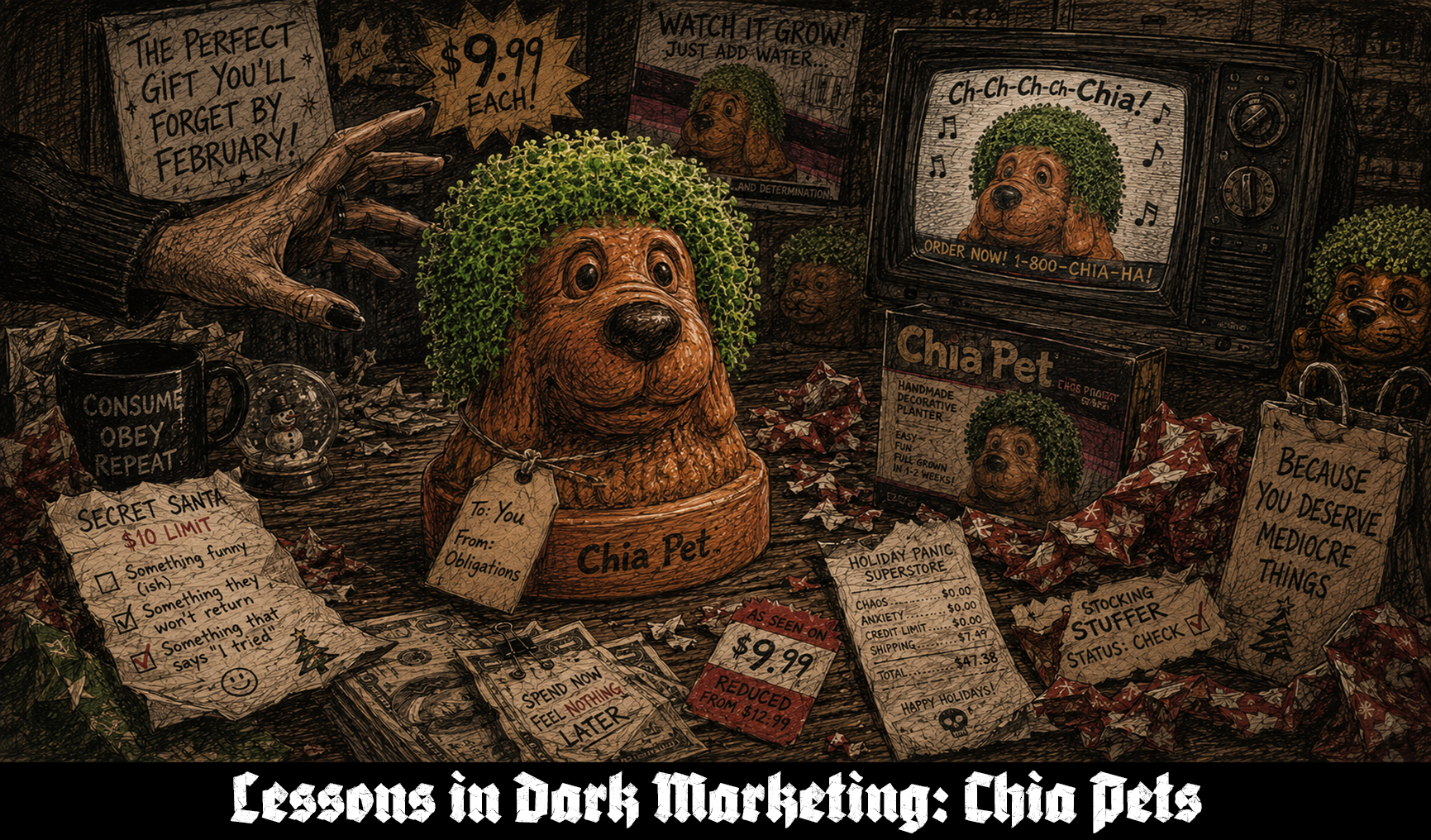
A terracotta animal with wet seeds smeared across its back should have died in one commercial break. That should have been the whole story.
A clay sheep. A clay ram. A clay head. A little packet of seeds. Add water, wait a few days, and suddenly your countertop has been blessed with the saddest little patch of botanical mange ever sold on television.
Yet Chia Pets survived.
They survived because Chia Pets were never really about plants. They were never really about decoration. They were never really about gardening, nature, creativity, or any of the wholesome nonsense people use when they try to make a useless product sound like a Montessori activity.
We’re looking at a perfect pre-internet dark marketing object, not a meaningful household product.
Chia Pets became famous because they understood something most modern marketers still pretend not to understand. A product does not need to be useful when it is memorable enough to become cultural litter. It does not need to solve a problem when it can become the answer to one of the most profitable problems in American consumer life.
What the hell do I buy someone when I do not know what to buy them? That is the Chia Pet business model.
- Not gardening.
- Not home décor.
- Not childhood wonder.
Gift panic. That is the machine.
The Product Is Almost Insultingly Simple
The basic Chia Pet formula is so stupid it becomes impressive.
Take a terracotta figurine. Cover it in wet chia seeds. Let the seeds sprout. The sprouts become “hair” or “fur.” Then the buyer gets to enjoy the miracle of watching a clay animal slowly turn into something that looks like it was found behind a neglected middle school science classroom.
That is the whole product, and that is why it worked.
Chia Pets were demonstration-proof. You did not need a celebrity explaining them. You did not need a long sales pitch. You did not need a white paper, a retail strategy deck, or some dead-eyed brand consultant saying the product sat at the intersection of nostalgia and wellness.
- You showed the thing.
- You said the name.
- You played the jingle.
People understood it instantly and that matters. A lot.
Most products require explanation. Chia Pets required exposure. The consumer saw the clay figure. The consumer saw green sprouts growing out of it. The consumer heard the sound.
Ch-ch-ch-chia.
That was it. A normal person might look at that and say, “This is ridiculous.” A marketer should look at it and say, “That is the entire point.”
Ridiculous gets remembered. Ridiculous gets repeated. Ridiculous enters the house during Christmas because the buyer is tired, lazy, desperate, and standing in a store trying to find a gift for an aunt, coworker, teacher, neighbor, mailman, secret Santa victim, or some distant relative they only see when folding chairs appear in a living room.
Chia Pets did not have to be wanted. They only had to be acceptable enough to buy when the buyer had no better idea. That is a very powerful place for a product to live.
This is dark marketing principle number one: The easier a stupid product is to understand, the faster it can spread.
- The consumer does not need to study it.
- The consumer does not need to believe in it.
- The consumer does not need to respect it.
The consumer only needs to recognize it fast enough to remember it later.
That is the beauty of a low-intelligence product with high visual clarity. It bypasses judgment. It does not ask the buyer to think. It asks the buyer to notice. In mass-market novelty, noticing comes before wanting. Sometimes noticing replaces wanting entirely.
The Jingle Was the Real Product
Nobody remembers Chia Pets because the product changed their life. They remember the sound.
Ch-ch-ch-chia.
That stupid little chant did more work than the clay animal, the seeds, the packaging, the commercial, and the entire shelf display combined. It was a memory parasite. It crawled into the brain and stayed there because it was simple, repetitive, and annoying in exactly the right way.
This is where Chia Pets become more than a novelty item. They become a lesson in audio branding.
A jingle does not need to be beautiful. It needs to be inescapable. It needs to be easy enough for a child to repeat, irritating enough for an adult to remember, and strange enough to detach itself from the product and become a standalone cultural reflex. That is what happened here.
The jingle turned the product into a call-and-response joke. Say “Chia” around enough people from a certain generation and someone will mentally hear the stuttered chant before they think about the actual planter.
That is dark marketing because the product no longer pays rent inside the consumer’s home. It pays rent inside the consumer’s head. The clay thing can break. The sprouts can die. The box can end up in a closet next to old wrapping paper and a flashlight with leaking batteries. The jingle stays.
That is the evil genius of the Chia Pet. It turned a disposable novelty product into a permanent soundbite. Before TikTok audio loops, before viral sounds, before brands tried to make every intern dance in front of a ring light, Chia Pets had already figured out the core principle.
Own a sound and you own recall.
This is dark marketing principle number two: Own the sound and you own the memory.
- The product can be cheap.
- The product can be ugly.
- The product can be useless.
But if the sound survives, the brand survives. That is why the Chia Pet jingle mattered more than the actual planter. The clay animal was the thing being sold, but the chant was the thing being installed. The buyer did not just remember the product. The buyer carried the ad around inside their own head for free.
Holiday Panic Made the Product Make Sense
Chia Pets became a holiday product because the holidays are when bad gifts are allowed to live.
Most of the year, people pretend gifts need thought. By December, everyone gives up. The shopping list gets too long. The budget gets weird. The social obligations multiply. People start buying candles for women they barely know and novelty mugs for men whose entire personality is “office.” This is where Chia Pets walk in wearing a little green clown wig.
The product is cheap enough to justify. Weird enough to feel like a joke. Harmless enough to avoid consequences. Familiar enough to feel safe. Packaged enough to look like a real gift. Dumb enough to say, “I did not forget you, but let’s not pretend this relationship needed jewelry.”
That is the sweet spot. Chia Pets are not bought with deep desire. They are bought with resignation. They are the retail version of a shrug, and that shrug is profitable.
Every holiday season creates millions of low-emotion buying decisions. People need objects to fill obligations. Stocking stuffers. Desk gifts. Family exchange gifts. Something for the person who already has everything because nobody wants to admit the real problem is that they do not know this person well enough to buy something meaningful.
Chia Pets fit that emotional dead zone perfectly.
- They give the buyer plausible deniability.
- It is funny.
- It is cute.
- It grows.
- It is a conversation piece.
That last phrase is one of the great scam phrases of American retail. “Conversation piece” usually means “object that has no actual function but might make someone briefly comment before never caring again.”
Chia Pets mastered that category. They did not need to become treasured possessions. They just needed to make the buyer feel like the gift had enough personality to survive the exchange. That is dark marketing at its most beautifully pathetic.
This is dark marketing principle number three: The best gag gifts do not sell desire. They sell relief from obligation.
- The buyer is tired.
- The buyer is rushed.
- The buyer needs something wrapped.
That is enough to get the job done well. Holiday panic creates a temporary collapse in taste. People buy things in December that would embarrass them in April. Chia Pets understood that collapse and built a product perfectly shaped for it. The gift did not need to be meaningful. It only needed to rescue the buyer from showing up empty-handed.
Uselessness Became the Charm
The mistake people make with novelty products is assuming usefulness is the standard. It is not. For novelty products, usefulness can actually be a liability. Usefulness invites comparison. Usefulness makes people ask if the product works well. Usefulness creates expectations.
Chia Pets avoided all of that by being proudly stupid.
There was no serious performance claim. Nobody expected a Chia Pet to transform the home. Nobody expected luxury. Nobody expected elegance. Nobody expected a tasteful object that would impress guests and elevate the room.
The product escaped judgment by lowering the bar to the floor. That is a classic dark marketing maneuver. When a product presents itself as serious, it can fail seriously.
When a product presents itself as a joke, every flaw becomes part of the act.
- If the sprouts grow unevenly, it is funny.
- If the thing looks ugly, it is funny.
- If the recipient never uses it, still funny.
- If it ends up in a closet, that was probably always the plan.
Chia Pets turned low expectations into armor. The buyer was not buying quality. The buyer was buying permission to give something dumb. That is a stronger business model than people want to admit.
Because America and the entire world loves dumb products when the dumbness is packaged correctly. The dumbness has to feel safe. It has to feel intentional. It has to feel like shared cultural stupidity rather than personal failure. Chia Pets gave people a way to participate in stupidity without feeling stupid. That is the whole trick.
This is dark marketing principle number four: When a product announces itself as a joke, failure becomes part of the experience.
- If it looks stupid, that is the joke.
- If it grows badly, that is the joke.
- If nobody uses it after Christmas, that is still the joke.
The product lowers expectations so far that disappointment cannot land. That is a powerful trick. Serious products can fail. Joke products can shrug. The stupidity becomes insulation. The buyer and the recipient both get to pretend the badness was intentional.
The Commercial Did Not Sell Desire. It Sold Recognition.
Chia Pet advertising worked because it was built for recognition, not persuasion. The commercial did not need to convince you that your life lacked a sprouting clay animal. Nobody’s life lacks a sprouting clay animal. There is no hole in the human soul shaped like a terracotta ram with seed fuzz.
The commercial had a different job.
- Make you recognize it.
- Make you remember it.
- Make you laugh at it.
- Make you see it in a store and feel the little electric shock of familiarity.
That is why the repeated jingle mattered. That is why the visual mattered. That is why the product demonstration mattered. The commercial built a mental shelf before the product ever sat on the physical one.
Then, during holiday shopping, the buyer sees the box and thinks, “Oh, yeah. That thing.” That is enough. A lot of marketing is not about creating love. It is about creating enough familiarity to beat the blankness around every other product.
Chia Pets did not need to be the best gift. They needed to be the gift the buyer recognized while panicking under fluorescent lights. That is how television turned into shelf velocity. The ad planted the sound. The store harvested the panic.
This is dark marketing principle number five: Recognition beats persuasion when the purchase is low stakes.
- The ad does not need to make the consumer passionate.
- The ad does not need to make the consumer loyal.
- The ad only needs to make the consumer remember the box.
That is why Chia Pets worked at retail. The commercial built the mental shelf before the product appeared on the physical shelf. By the time the buyer saw it in the store, the sale had already been softened by repetition. Familiarity did the dirty work.
Pre-Internet Virality Was Repetition With a Media Budget
People talk about virality now like it was invented by teenagers filming themselves in parking lots. Wrong. Virality existed before the internet. It just moved slower and cost more.
Chia Pets were pre-internet viral objects because they had all the ingredients modern viral products chase:
- They were visually absurd.
- They were easy to imitate.
- They had a repeatable sound.
- They were cheap enough to spread.
- They were funny enough to mention.
- They were giftable enough to move through social networks.
- They created recognition without requiring admiration.
The only difference is that the old machine used television instead of TikTok. The commercial was the feed. The jingle was the audio trend. The product demo was the short-form video. The holiday shelf was the checkout link.
Same disease. Different delivery system.
That is why Chia Pets are such a clean Dark Marketing case study. They prove that the internet did not make people stupid. The internet accelerated behaviors that were already sitting there in the culture, waiting for better distribution.
Chia Pets did not need likes, shares, stitches, duets, comments, or reaction videos.
- They had living rooms.
- They had Saturday morning television.
- They had holiday commercials.
- They had parents who needed gifts.
- They had children who repeated sounds.
- They had adults who bought things ironically before the word “ironically” became an excuse for having bad taste.
That was enough.
This is dark marketing principle number six: Virality existed before the internet. It just wore a television schedule.
- The commercial was the feed.
- The jingle was the viral audio.
- The product demo was the short-form clip.
- The holiday aisle was the buy button.
Chia Pets prove the disease is older than the platforms. The internet did not invent dumb consumer behavior. It removed the speed limit. Television already knew how to make people repeat nonsense, recognize nonsense, buy nonsense, and pass nonsense to someone else as a gift.
The Object Was Built for Display, Then Disposal
Chia Pets occupy a strange retail space because they are meant to be displayed but not cherished. A Chia Pet sits out for a little while. People look at it. Someone comments. The sprouts grow. The sprouts die. The novelty collapses. Then the object becomes clutter.
That should be a weakness. It is actually part of the model. A product that becomes clutter can still sell if the initial moment is strong enough. The buyer is not imagining the full ownership cycle. The buyer is imagining the first reaction.
That first reaction is the sale. This is one of the darkest truths in consumer marketing. Many products are not sold based on long-term value. They are sold based on the fantasy of the first five minutes.
- The first laugh.
- The first compliment.
- The first unboxing.
- The first photo.
- The first “you have to see this.”
After that, the product can rot in silence. Chia Pets understood this long before modern junk products flooded Amazon, TikTok Shop, Instagram ads, and every algorithmic bargain bin on earth. The object only had to be interesting at the point of purchase and mildly entertaining at the point of gifting. Everything after that was the consumer’s problem.
This is dark marketing principle number seven: Many products are sold for the first reaction, not the full ownership cycle.
- The first laugh sells it.
- The first comment justifies it.
- The first five minutes are the business model.
Everything after that is clutter.
That is the hidden economy behind novelty products. The buyer is not imagining the item six months later. The buyer is imagining the moment it gets opened. Chia Pets only needed that moment. The brand got paid before the product became landfill-adjacent cabinet junk.
Licensing Turned the Gimmick Into a Costume Rack
The original Chia Pet formula was simple. Animals, heads, little clay forms, little green sprouts. But the real expansion path was licensing.
Once the basic gimmick is established, anything can become a Chia Pet. Characters, celebrities, politicians, movie icons, cartoon figures, cultural artifacts. The clay body becomes a costume rack. The chia sprouts become a punchline applied to familiar faces.
This is how a novelty product stays alive. It borrows relevance.
When the original joke gets old, the brand dresses the joke in a new face. The core product barely changes. The seed packet does the same thing. The terracotta does the same thing. The sprouts do the same thing, but the cultural wrapper changes.
That is a very efficient form of marketing. You do not reinvent the product. You repaint the reason to notice it. A licensed Chia Pet does not ask the consumer to care about chia. It asks the consumer to care about the character or person being converted into a sprouting object. The joke transfers from the format to the face. That creates endless shelf refresh.
Same gimmick. New excuse.
This is how old novelty brands avoid dying. They attach themselves to whatever people already recognize and let borrowed attention do the heavy lifting. The Chia Pet becomes less of a product and more of a format. That is when a novelty item graduates into intellectual property.
This is dark marketing principle number eight: Once the gimmick is known, the brand can borrow relevance forever.
- Put a new face on it.
- Put a new character on it.
- Put a new cultural reference on it.
The same old trick suddenly looks alive again.
Licensing lets a novelty product pretend it has evolved without changing the actual machine. The seeds still sprout. The clay still sits there. The joke is still the joke. Only the costume changes. That is how dead formats keep getting dragged back into the aisle with a new excuse to exist.
The Real Audience Was the Buyer With No Taste and No Time
Chia Pets were never for the person with refined taste. That person was not the target.
The real target was the exhausted buyer trying to survive a shopping season. The aunt who needed a safe gag gift. The parent filling a cart. The office worker trapped in a Secret Santa exchange. The grandparent who thought it looked cute. The person who wanted to spend a little money and get a guaranteed reaction.
This is where the product becomes brilliant. It does not require the buyer to understand the recipient deeply. It does not require emotional intelligence. It does not require style. It does not require risk. It gives lazy gift-giving a costume.
You can hand someone a Chia Pet and pretend the joke was intentional. That is the key. The product protects the buyer from looking completely thoughtless because the product itself is already ridiculous. The stupidity becomes the alibi.
A bad sweater says, “I do not know you.”
A Chia Pet says, “I do not know you, but I found a socially acceptable way to make that funny.”
That is a market. A large one.
This is dark marketing principle number nine: Sell to the buyer’s anxiety, not the recipient’s desire.
- The recipient may not want it.
- The recipient may not need it.
- The recipient may never use it.
But the buyer needs a solution right now.
That is the gift-market loophole. The person spending the money is often not the person expected to enjoy the product. Chia Pets exploited that split perfectly. It solved the buyer’s problem of effort, time, and social obligation. Whether the recipient loved it was secondary.
The Product Sold Participation in a Shared Joke
Chia Pets became part of American pop culture because they were not just objects. They were references.
A reference is more powerful than a product because it lets people signal that they know the joke. Once a product reaches reference status, it enters conversation without needing active advertising every time.
That is what happened with Chia Pets. People could mock them, buy them, remember them, imitate the jingle, give them as gag gifts, or mention them as shorthand for cheesy television novelty culture.
All of that kept the brand alive. Mockery did not kill it. Mockery fed it.
This is one of the most important Dark Marketing lessons in the entire case. Products like this do not need respect. Respect might even ruin them. They need familiarity, repetition, and a little bit of collective embarrassment.
The consumer laughs at the product, but the laugh keeps the product culturally available. The laugh is distribution. The joke is the shelf space in the brain. The brand does not care whether the consumer thinks the product is stupid. The brand only cares that the consumer remembers the product when gift panic arrives.
This is dark marketing principle number ten: Mockery is still distribution when the product is built to survive humiliation.
- If people laugh at it, the brand circulates.
- If people quote it, the brand circulates.
- If people buy it as a joke, the brand still gets paid.
Chia Pets did not require dignity. That gave them power. A respectable product can be damaged by ridicule. A novelty product can feed on it. The public thinks it is making fun of the brand. The brand knows the joke is keeping it alive.
Chia Pets Were the Ancestor of TikTok Shop Slop
The modern internet is full of Chia Pet descendants.
- Little gadgets nobody needs.
- Cute desk objects.
- Novelty planters.
- Tiny appliances.
- Ugly plush toys.
- Reaction gifts.
- Weird holiday items.
Products that exist because they can be demonstrated in three seconds to someone who has no intention of thinking for a fourth. TikTok Shop did not invent this world. It industrialized it.
Chia Pets are the cleaner, older version of the same machine. The product was visual. The pitch was short. The sound was memorable. The use case was barely real. The purchase was emotionally low stakes. The object could travel as a gift, a joke, or a reference.
That is the whole modern novelty economy. Only now the jingle is a trending audio. The TV commercial is a short-form video. The holiday shelf is a buy button. The office gag gift is a link in the group chat. The old infomercial pitchman is now a creator pretending they just discovered something amazing in their kitchen.
The machine got faster, uglier, and more desperate. But the bones were already there. Chia Pets walked so TikTok garbage could sprint.
This is dark marketing principle number eleven: The platform changes, but the impulse stays the same.
- A dumb object.
- A fast demonstration.
- A repeatable sound.
- A low-risk purchase.
That was the Chia Pet formula before the internet, and it is still the formula behind half the garbage being shoved through modern feeds. TikTok Shop did not invent novelty slop. It inherited the Chia Pet playbook and replaced the jingle with a trending audio clip.
The Case Study Breakdown
Here is the Chia Pet machine in plain English.
- The product is cheap, weird, and visually simple.
- The jingle makes it impossible to forget.
- The demonstration explains the entire thing without effort.
- The holiday season gives buyers a reason to purchase without needing genuine desire.
- The low price lowers resistance.
- The joke protects the buyer from shame.
- The display moment creates enough social payoff to justify the purchase.
- The product’s uselessness becomes part of its charm.
- Licensing refreshes the gimmick without changing the core product.
- Mockery extends brand life instead of damaging it.
That is why Chia Pets endured. Not because the world needed sprouting clay animals. Because the product fit perfectly into the broken little spaces of American consumption where obligation, laziness, nostalgia, irony, and panic all meet in the same checkout line.
This is dark marketing principle number twelve: A product does not need deep value when it controls the moment of weak judgment.
- Weak judgment during holiday shopping.
- Weak judgment during television repetition.
- Weak judgment during gift exchanges.
- Weak judgment during cultural familiarity.
Chia Pets lived inside those weak spots. The product did not overpower the consumer with quality. It waited for the buyer to become tired, amused, obligated, nostalgic, or desperate. Then it offered the easiest possible answer.
What Marketers Should Learn From Chia Pets
The first lesson is that memorability can beat usefulness.
This is not an argument for making bad products. It is a warning that bad products with strong recall can outperform decent products nobody remembers. Chia Pets understood sound, shape, repetition, and timing better than many serious brands understand their own customers.
The second lesson is that giftability is a business model.
A product does not need daily use if it has strong gift logic. Gifts are weird because the buyer and user are often different people. That split creates opportunity. You can sell to the giver’s anxiety instead of the recipient’s desire.
The third lesson is that mockery can be profitable.
If the product is built to survive ridicule, ridicule becomes awareness. People making fun of a Chia Pet still spread the Chia Pet. That is the dark little miracle of novelty marketing. Contempt can become recall.
The fourth lesson is that a simple demonstration is worth more than a complicated pitch.
Show the object. Show the transformation. Play the sound. Repeat forever. That is more powerful than a thousand paragraphs of brand nonsense.
The fifth lesson is that seasonal pressure creates irrational purchases.
The holidays make people buy things they would ignore in March. A smart novelty product does not fight that pressure. It rides it.
This is dark marketing principle number thirteen: Memorability is not the same as greatness, but in consumer marketing it can be more profitable.
- Great products need proof.
- Useful products need comparison.
- Novelty products need recall.
That is the uncomfortable lesson. Chia Pets did not win by being better. They won by being stickier. The jingle stuck. The image stuck. The joke stuck. The holiday association stuck. In a crowded market, sticking around in the consumer’s brain can matter more than deserving to be there.
Final Diagnosis
Chia Pets are stupid. That is not an insult to the business model. That is the business model. A clay animal with sprouting seed fur should not be a case study in marketing power, but here we are, standing in the wreckage of consumer culture, forced to respect a terracotta gag gift because it did what so many brands still fail to do.
- It got remembered.
- It made a sound people could not forget.
- It turned uselessness into charm.
- It turned holiday panic into revenue.
- It turned mockery into distribution.
- It turned a cheap little object into a cultural reference.
The Chia Pet did not sell gardening. It sold relief from thinking. It sold an easy laugh. It sold a wrapped object for people who needed to show up with something and lacked the time, taste, or emotional investment to do better.
This is dark marketing principle number fourteen: The dumbest object in the room can still be the smartest marketing machine.
- The product was cheap.
- The pitch was simple.
- The sound was unforgettable.
- The timing was perfect.
That is the Chia Pet crime scene. A sprouting clay animal became a cultural reference because the marketing understood memory, panic, novelty, ridicule, and repetition better than thousands of respectable brands ever will. The consumer thought they were buying a joke. The brand was selling a system.
That is why it worked. That is why it lasted.
That is why the Chia Pet belongs in the Dark Marketing museum, somewhere between the Clapper, Beanie Babies, collector plates, and every modern TikTok product pretending it just changed someone’s life when all it really did was interrupt their attention long enough to steal twelve dollars.
Ch-ch-ch-chia.
The sound of a joke. The sound of a sale. The sound of someone buying something dumb because the commercial got there first.
Leave a Reply