
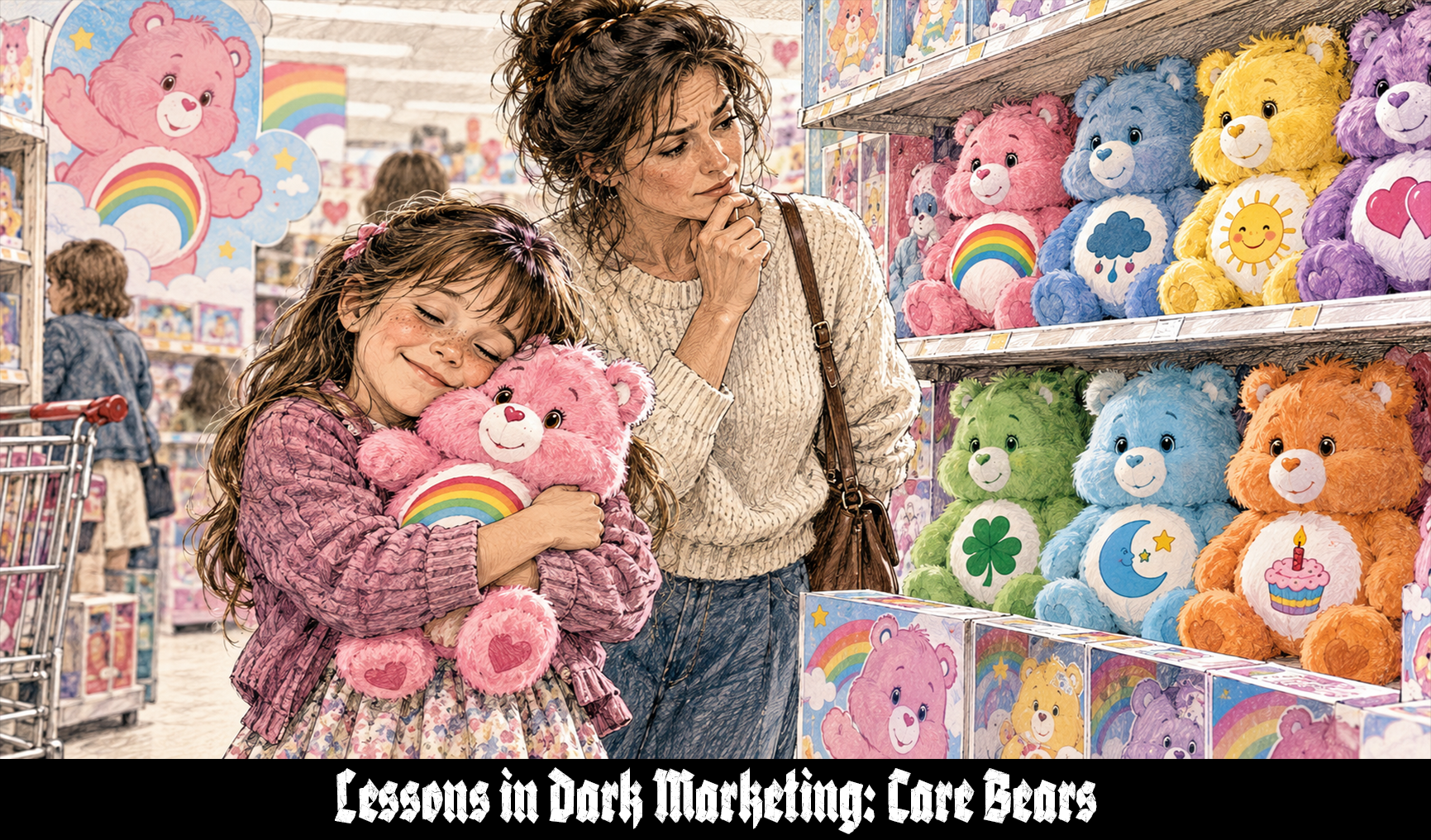
There’s a little girl standing in a toy aisle holding a pink stuffed bear against her chest while her mother studies a shelf full of what appears to be the same teddy bear in several different colors. There is already a teddy bear at home, which means Mom believes the household teddy-bear requirement has been satisfied unless the existing bear has resigned, died, or failed some previously undisclosed certification process.
Her daughter knows this is ridiculous. The bear at home is Tenderheart Bear, while the one in her arms is Cheer Bear, and confusing those two means Mom has somehow missed the entire emotional bureaucracy operating across the shelf. Tenderheart represents love and caring. Cheer represents cheer and hope. Grumpy Bear carries a rain cloud because having a bad day apparently requires dedicated plush representation. Bedtime Bear handles sleep. Birthday Bear has jurisdiction over cake. Good Luck Bear arrives with a four-leaf clover because American Greetings managed to turn random chance into something with a suggested retail price.
Mom sees teddy bears differentiated by color and stomach decoration. Her daughter sees personalities, emotions, virtues, occasions, relationships, and a community in which every bear has a specific emotional assignment. American Greetings and Kenner saw something even more valuable: one of childhood’s oldest comfort objects reorganized into a collectible classification system for human feelings.
That is the Care Bears crime scene. Nobody needed to invent childhood affection for teddy bears, explain why soft animals were comforting, or convince parents that caring was a socially acceptable value. The marketers only had to take those existing emotional assets, divide them into named characters, assign each character a symbol and color, build stories that made those differences meaningful, and then put the resulting emotional departments on separate shelves.
Care Bears were conceived in the first months of 1981 as American Greetings and its licensing operation looked for a property capable of following Strawberry Shortcake. Court records from the period describe the original goal explicitly: create and market bears differently from the way teddy bears had traditionally been sold, with pastel colors, distinctive shapes, and especially the prominent “tummy graphics” that communicated each character’s personality or emotional mission. (law.justia.com)
The commercial strategy was multicharacter from the beginning, not one successful bear followed later by opportunistic friends. American Greetings had already assembled a coordinated licensing apparatus before the public retail launch, and the federal record shows Care Bears entering stores in spring 1983 with plush toys, miniatures, poseables, accessories, greeting cards, national advertising, and television already working together. By then, the property had spent years being prepared as an ecosystem rather than waiting to discover whether one lonely teddy bear might catch on. (law.justia.com)
The physical product was a teddy bear, but that description is almost useless for explaining the business. The psychological sales machine was emotional segmentation, symbolic branding, collectible identity, moral reassurance, character storytelling, gift-message substitution, world-building, licensing saturation, media reinforcement, and the extraordinary commercial realization that ordinary childhood feelings could be assigned names, colors, logos, personalities, and inventory numbers.
The Teddy Bear Arrived With Generations of Free Emotional Advertising
Care Bears entered through one of the safest doors in the toy business. Teddy bears already meant comfort, childhood, bedtime, affection, security, sympathy, gift giving, and something soft to hold when the world was considerably less pleasant than the grown-ups kept promising.
That inherited meaning saved the brand an enormous amount of work. A completely unfamiliar creature has to establish what it is before the customer can decide whether it deserves affection, but Care Bears began with an object whose emotional function was already culturally understood. The company did not need to persuade children that teddy bears were lovable. It needed to persuade them that familiar teddy-bear love could be subdivided into distinct branded personalities.
The design wisely preserved everything that made the category safe. Care Bears remained round, soft, childlike, friendly, and built to be hugged, while the commercially important differences were layered onto the familiar body through color, names, facial expressions, and the stomach symbol.
This is dark marketing principle number one: When a category already carries emotional meaning customers trust, the smartest differentiation often preserves the familiar benefit and commercializes the distinctions around it.
Care Bears didn’t replace the teddy bear; they taught the customer that the teddy bear had been emotionally underclassified.
The Tummy Graphic Turned an Emotion Into a Logo
The most important piece of the Care Bear design sat directly on the stomach. Tenderheart carried a heart, Cheer a rainbow, Good Luck a four-leaf clover, Birthday a cake, Friend Bear flowers, Grumpy a rain cloud, Bedtime a crescent moon and star, and the rest of the original cast followed the same basic logic.
American Greetings was remarkably explicit about what those graphics were supposed to accomplish. Its licensing material described each tummy symbol as the graphic that best explained the bear’s chosen mission, while litigation over imitators treated the stomach designs as central to both character identity and the larger Care Bears family resemblance. (law.justia.com)
The graphic did several commercial jobs at once. It distinguished one bear from another, communicated personality to children who might not yet read fluently, supplied television and print advertising with instant visual shorthand, created a reproducible licensing mark, and attached something concrete to an otherwise abstract idea such as hope, love, friendship, or grumpiness.
Placement helped. The symbol was not buried on a tag or stitched discreetly into a paw. It occupied the front of the body, where it remained visible while the bear was displayed, advertised, held, photographed, or hugged.
This is dark marketing principle number two: Abstract ideas become easier to sell when customers can recognize them through a simple proprietary symbol before they can explain them in words.
American Greetings took feelings humanity had been experiencing forever and gave them stomach logos.
Human Emotion Became a Product Development Database
Once a company establishes that feelings and virtues can become characters, the assortment has room to grow almost indefinitely. Love, friendship, cheerfulness, luck, birthdays, sleep, wishing, fun, tenderness, grumpiness, encouragement, and later emotional variations all become potential character territories rather than qualities one generic teddy bear might possess simultaneously.
That distinction is commercially important because it makes variation feel conceptual instead of cosmetic. A blue bear and a pink bear can look like color choices, while Grumpy Bear and Cheer Bear appear to occupy different emotional jobs. The underlying manufacturing platform can stay relatively similar while the customer experiences a much larger psychological difference.
The court record shows exactly how deliberately this worked. The original characters were matched with specific symbols and stated messages, including Tenderheart for love and caring, Funshine for fun and laughter, Grumpy for the reassurance that being out of sorts was acceptable, and Cheer for cheer and hope. (law.justia.com)
This is dark marketing principle number three: When product variations correspond to recognizable human experiences, assortment expansion can feel like emotional completeness rather than manufacturing repetition.
The Care Bears product-development department had access to a raw material supply called being alive.
Grumpy Bear Made the Entire Emotional System More Credible
Grumpy Bear may be the most strategically important character in the original lineup because he prevented the brand from presenting childhood as compulsory happiness. His rain cloud and miserable expression acknowledged something obvious that a relentlessly cheerful marketing department could easily have missed: sometimes children feel lousy.
The original message associated with Grumpy Bear was not that grumpiness made somebody bad. Contemporary Care Bears material described his emotional territory as reassurance that it was acceptable to be out of sorts, which gave a negative feeling legitimate membership inside the same universe as love, friendship, birthdays, and hope. (law.justia.com)
That made the property more emotionally believable. If every character had represented a relentlessly positive trait, Care Bears could have become a soft-furred sermon about children smiling properly. Grumpy Bear gave kids who were angry, frustrated, disappointed, or simply sick of everybody’s nonsense a place inside the franchise.
The commercial benefit followed directly from the psychological benefit. A child could already own a cheerful character and still have a reason to want Grumpy because he did not duplicate the emotional role of the first bear.
This is dark marketing principle number four: Positive brands become more convincing when they acknowledge enough negative human experience to avoid sounding dishonest.
Grumpy Bear made the feelings department believable because somebody finally admitted that some days suck.
Color Coding Made the Collection Legible Before Literacy
Care Bears were built for instant recognition. Pastel pink, blue, yellow, green, orange, purple, and other colors worked with the tummy graphics so children could tell characters apart from across a bedroom before reading a package or remembering a biography.
That matters when the audience includes preschool and early elementary children. The product has to communicate quickly through shape, face, color, and symbol because written explanation cannot carry the entire sale.
Color also added another route into preference. A child could want Cheer Bear because of the rainbow, because of the personality, because she liked pink, or because all three signals worked together. Multiple cues make attachment easier because the brand does not depend on one feature landing with every customer.
This is dark marketing principle number five: Products aimed at young customers become more expandable when identity can be understood visually before language is required.
Care Bears turned feelings into something a child could read with a box of crayons.
Hugging the Product Performed the Brand Promise
Care Bears did not simply tell children that caring and comfort mattered. The physical product allowed them to perform the message by squeezing it.
That alignment between claim and behavior is unusually strong. A plush bear is warm, soft, portable, safe to take into bed, easy to hold during frightening or lonely moments, and physically suited to the emotional role the stories assigned to it. The brand promise and the product function were pointing in the same direction.
This is where legitimate product value becomes important to the case. Stuffed animals really can provide reassurance, imaginative companionship, familiarity, and comfort, especially for children dealing with bedtime fears, illness, unfamiliar places, family disruption, or ordinary bad days. Care Bears attached a proprietary character identity to a function teddy bears already performed exceptionally well.
The product did not need an advertising claim to make that benefit real. The darker commercial move was encouraging the customer to attribute the general comfort of plush companionship to specific named members of the Care Bears universe.
This is dark marketing principle number six: Emotional branding becomes strongest when physically using the product reenacts the emotional promise.
Care Bears sold caring in a form that could be hugged hard enough to flatten the marketing copy.
The Names Were Tiny Positioning Statements
“Cheer Bear” requires very little explanation. So do Grumpy Bear, Friend Bear, Birthday Bear, Bedtime Bear, Funshine Bear, Good Luck Bear, and Tenderheart Bear.
That naming architecture reduced customer education because the name simultaneously identified the product and described its emotional purpose. A parent standing in a store could understand the difference between two characters even without knowing the television stories, while a child could ask for a specific bear rather than requesting “the pink one with the rainbow thing.”
Names also made the products conversational. Children could talk about characters with friends, television could build stories around them, packaging could reinforce them, and relatives shopping for a birthday present had a much better chance of finding the correct requested bear.
This is dark marketing principle number seven: A strong product name should not simply label inventory; it should perform enough positioning work that customers understand why the product exists.
Care Bears turned character naming into shelf navigation.
The Collection Was Built Into the Concept Before the First Child Asked for Another Bear
One of the most important facts in the Care Bears history is that the property was conceived as a multicharacter line from the beginning. The assortment was not an afterthought created when one breakout bear unexpectedly sold well; multiple personalities were embedded into the core business plan. (law.justia.com)
That means collection pressure existed before consumer behavior could supposedly force the company to expand. Every child was introduced to a community, and every individual bear arrived with the knowledge that other equally legitimate emotional characters existed beside it.
This structure is commercially superior to a single hero character surrounded by obvious secondary merchandise. A child can have a favorite without believing the favorite makes everyone else unnecessary. Cheer can be “my Care Bear” while Grumpy, Tenderheart, Bedtime, and Good Luck still retain independent emotional roles.
The collection begins to resemble coverage. One bear represents one slice of the emotional world, while the group appears to represent a broader map of childhood.
This is dark marketing principle number eight: When collecting is designed into the mythology before launch, the first purchase can teach customers that the category extends beyond what they just bought.
One bear could comfort you, but apparently it took a committee to provide full emotional services.
Personality Literature Prevented Similar Plush Bodies From Looking Interchangeable
The physical bears were not expected to do all the differentiation alone. Packaging, catalogs, brochures, greeting cards, and later media gave the characters personalities and messages that expanded beyond color and tummy graphics.
That little layer of storytelling mattered because plush toys built from related proportions can easily look substitutable to an adult. A narrative turns “another colored bear” into “another person,” which dramatically changes how repetition is perceived.
The strategy also gave children a starting point for imaginative play. They could ignore the official personality whenever they wanted, but the company had already provided enough canonical identity to ensure the bear entered the toy box as somebody instead of something.
This is dark marketing principle number nine: Lightweight storytelling can create enormous perceived differentiation when products share similar physical forms.
The cheapest part of the bear may have been the story that convinced the household it was not the same bear.
The Shared Heart Mark Separated Character Identity From Family Identity
Care Bears carried common visual traits beyond their individual stomach symbols, including heart motifs that tied the characters back to the larger family. That distinction between individual identity and master-brand identity is crucial in any expandable character system.
The tummy graphic explains which Care Bear you are looking at. Shared design elements explain why that character belongs to Care Bears at all, which lets the company keep changing the individual symbol without weakening recognition of the larger property.
This architecture becomes more useful as the assortment grows. The customer can encounter a new color, new name, new emotion, or even a different species and still recognize the underlying commercial grammar.
This is dark marketing principle number ten: Scalable character families need one set of signals that creates individuality and another set that preserves common membership.
Care Bears could change the emotional employee while keeping the corporate uniform recognizable.
The Launch Was Organized Before Consumers Had a Chance to Make It Look Organic
Care Bears are often remembered as a toy craze that spread naturally because children loved the characters. The documented rollout looks much more industrial.
By June 1982, twenty-six licensees were already committed, and that August representatives were presenting the project to roughly fifty major retailers. Trade promotion preceded the public toy launch, while American Greetings prepared the property across greeting cards, licensed merchandise, character art, and retail relationships before the first major wave of children could supposedly demand an ecosystem into existence. (law.justia.com)
This is what coordinated saturation can accomplish. A customer encountering Care Bears in spring 1983 could see plush toys, cards, merchandise, advertising, and television appearing close together and reasonably conclude that the characters had become important very quickly.
The machinery had simply reached the consumer last. The cultural phenomenon looked spontaneous from the toy aisle because most of the commercial planning had already happened somewhere the child would never see.
This is dark marketing principle number eleven: A heavily coordinated launch can manufacture cultural momentum by arranging multiple forms of visibility before customers perceive the property as established.
Care Bears did not wander innocently into childhood and discover a licensing business waiting there; the licensing business was already setting the table.
Retailers Were Being Sold Care Bears Before Children Were
The prelaunch chronology also exposes how many different audiences a character property must persuade. Before the child saw a friend, retailers had to see shelf movement, licensees had to see transferable intellectual property, manufacturers had to see viable products, and American Greetings had to see enough consistency to keep the character recognizable across categories.
Those audiences were not buying the same thing psychologically. The child was being offered affection, the parent a wholesome gift, the retailer velocity, the licensee recognition, and the rights holder royalty potential.
A successful character property has to make those meanings coexist without allowing one to contaminate the others. Children do not need to know that Cheer Bear is a licensing asset, while licensing executives do not need to hug her during a difficult afternoon.
This is dark marketing principle number twelve: Strong brands allow different participants in the same commercial system to perceive completely different forms of value in the same object.
The bear could mean hope in a child’s bedroom and projected volume in a retailer meeting without changing its expression.
Advertising Surrounded Both the Child and the Person Holding the Wallet
The launch did not rely on children encountering Care Bears accidentally. The federal record documents a national television campaign beginning in April 1983 with seven different thirty-second commercials, including several devoted specifically to Kenner plush Care Bears, while print advertising appeared in magazines read by adults and families. (law.justia.com)
That split reflects one of the oldest truths in children’s marketing: the person who wants the product and the person who pays for it are frequently different customers. The child needs recognition, excitement, character attachment, and enough enthusiasm to initiate the request, while the adult needs familiarity, trust, giftability, and a reason not to veto the transaction.
Care Bears were unusually well suited to that two-sided persuasion. Children received colorful characters and emotional stories, while parents received a product associated with caring, friendship, empathy, and a category already considered safe.
This is dark marketing principle number thirteen: When desire and payment live in different people, the marketing system has to convert both.
The commercial got the child to ask, and the moral vocabulary made it easier for Mom to say yes.
Caring Was a Moral Message and a Sales Shield
Care Bears enjoyed one commercial advantage many toy properties would kill for: the central brand value was difficult to criticize without sounding like an asshole. Caring is good, friendship is good, comforting somebody is good, recognizing emotions is good, and allowing Grumpy Bear to acknowledge unpleasant feelings is arguably healthier than demanding permanent smiles.
That gave parents a legitimate reason to approve of the characters. Purchasing a Care Bear could feel aligned with the values adults wanted children to learn, which meant the brand was not simply asking families to tolerate commercial entertainment. It could present the merchandise as participating in an admirable moral lesson.
The important distinction is that the benefit and the merchandising requirement were never the same thing. A child does not need six stuffed animals to learn empathy, but once empathy has been distributed among six named characters, buying another stuffed animal can feel strangely adjacent to encouraging another good quality.
This is dark marketing principle number fourteen: Positive values become commercially potent when buying the product feels like endorsing the value itself.
Care Bears did not sell additional plush inventory; they sold another opportunity for the household to demonstrate that it supported caring.
Emotional Literacy Became Branded Vocabulary
There is real educational usefulness in giving children simple visual language for feelings. A rain cloud can represent a bad mood, a rainbow hope, flowers friendship, a heart affection, and a sleepy moon bedtime, allowing abstract ideas to become concrete enough for young children to discuss.
Care Bears attached those useful concepts to proprietary characters. The child learning to distinguish cheerfulness from grumpiness was simultaneously learning Cheer Bear and Grumpy Bear, which meant the brand could become part of the vocabulary through which ordinary emotions were understood.
That is not automatically sinister. Educational usefulness can coexist with authentic creativity, but the marketing advantage appears when a company becomes the memorable intermediary between a child and a concept the child would have needed to learn anyway.
This is dark marketing principle number fifteen: Brands become unusually durable when they attach themselves to universal concepts customers are already developing language to understand.
American Greetings did not invent feelings; it built a colorful filing system and placed trademarks on the folders.
Care-a-Lot Gave the Feelings Department Real Estate
A collection of emotional mascots can live anywhere until the story gives them an official home. Care-a-Lot transformed the bears into residents of a cloud-filled world, which immediately created commercial opportunities beyond plush companionship.
Kenner’s 1984 Care-a-Lot playset is preserved by The Strong National Museum of Play, whose description places it inside a larger system of bears, cousins, villains, cases, and playsets. The museum also characterizes the franchise as an example of the promotional and consumer machinery surrounding character toys. (artsandculture.google.com)
The psychological shift is familiar. Before an official environment exists, the child’s bed, sofa, cardboard box, or bedroom floor can become Care-a-Lot for free. Once the authorized place has a plastic version, imagination can begin to look like an incomplete substitute.
This is dark marketing principle number sixteen: Fictional geography turns characters into residents, and residents can be sold infrastructure.
Care-a-Lot took emotional wellness into cloud-based property development.
Plush Bears Opened the Door, but Miniatures and Poseables Expanded the Type of Play
Kenner did not limit Care Bears to plush. The 1983 product assortment included poseable figures, miniatures, accessories, and other toys, allowing the same characters to participate in forms of play that a large soft bear handled poorly. (law.justia.com)
That is a sophisticated expansion because one format does not necessarily replace the other. Plush provides comfort and physical affection, while smaller figures work better with vehicles, environments, carrying cases, and detailed character interactions.
The child who already owns Tenderheart in plush can still be given a reason to want Tenderheart in miniature form. The company is selling the same identity twice without requiring the second purchase to admit that it duplicates the first.
This is dark marketing principle number seventeen: Character licensing expands most efficiently when different physical formats create different modes of play rather than serving as obvious substitutes.
Tenderheart could work the night shift on the pillow and report for duty at the plastic playset the next morning.
The First Television Special Made Not Caring the Actual Villain
In April 1983, The Care Bears in the Land Without Feelings brought the characters into animation. The story opposed the Bears against Professor Coldheart and a world defined by emotional numbness, making the absence of caring the threat that the heroes existed to defeat. (law.justia.com)
That narrative choice validated the entire product premise. The tummy graphics were no longer cute decoration on stuffed animals. The characters’ emotions and caring missions became the organizing moral structure of the fictional universe.
This matters because branded storytelling works best when the product’s distinguishing feature becomes important to the plot. If caring saves people, the bears representing different forms of caring seem less like color variations and more like necessary specialists.
The story could genuinely teach children that emotions and relationships matter. It simultaneously taught them which copyrighted characters embodied those lessons.
This is dark marketing principle number eighteen: Branded entertainment becomes particularly effective when the feature that distinguishes the merchandise also becomes the moral law of the story.
Care Bears did not simply possess feelings; feelings became civilization.
The Care Bear Stare Turned Branding Into a Weapon System
The Care Bear Stare may be one of the most commercially elegant ideas in the entire franchise. The symbols identifying the characters could project their emotional power outward, combining into a beam that helped the Bears confront villains and restore emotional order.
That transformed the tummy graphic from static branding into functional mythology. Cheer Bear’s rainbow was not simply a way to distinguish pink plush from another bear, and Tenderheart’s heart was not just a decorative badge. The symbols did something inside the story.
That makes variation feel consequential. A child can understand that the symbols represent different identities and powers, while the toy on the shelf carries the same symbol that mattered during the adventure.
There is also something magnificently 1980s about resolving emotional dysfunction with a coordinated beam fired from everybody’s abdomen. The message was that caring was powerful, and the merchandising department somehow managed to make empathy look like artillery.
This is dark marketing principle number nineteen: When a visual branding feature becomes a functional power inside the story, the product difference stops feeling cosmetic and starts feeling narratively necessary.
Care Bears turned emotional communication into a group weapons platform.
The Villain Made the Bears’ Commercial Premise Look Like a Moral Necessity
Professor Coldheart’s importance goes beyond providing somebody for the Bears to defeat. His defining characteristic was opposition to emotion itself, which meant the franchise’s core commercial concept could present itself as the antidote to the story’s central evil.
That is exceptionally efficient ideological storytelling. Caring is not simply one admirable behavior among many. Inside the fictional world, losing the ability to care can destroy relationships, while the Care Bears are uniquely equipped to restore what has been lost.
The buyer does not consciously conclude that purchasing a toy is morally equivalent to resisting emotional numbness. The brand does not need that level of literal persuasion. It only needs the characters to accumulate enough moral authority that the products feel like embodiments of something worthwhile.
This is dark marketing principle number twenty: A branded virtue becomes stronger when stories repeatedly show the absence of that virtue producing danger, loneliness, or disorder.
Care Bears gave caring a villain so the merchandise could arrive wearing the moral high ground.
Television Turned Shelf Inventory Into People the Child Already Knew
A package can communicate a name, color, symbol, and short description. Television gives the character time to speak, disagree, worry, help, fail, joke, and demonstrate the personality that the package only promises.
That converts retail recognition into preexisting affection. The child standing in the store is no longer evaluating a row of unfamiliar plush bears. She may already know which character she likes because the television special performed the personality testing before the shopping trip.
The timing mattered. The first special aired as the toy line entered national retail and as the television advertising campaign began, creating a tight loop between entertainment, character recognition, and merchandise. (law.justia.com)
This is dark marketing principle number twenty-one: Entertainment can pre-select customer preference before the product encounter occurs.
The store did not have to introduce the cast because television had already handled auditions.
The Commercials Could Sell Products While the Special Sold Affection
Traditional advertising and character entertainment performed different jobs. The thirty-second commercial could show the toy, explain availability, reinforce the collection, and push purchase desire, while the longer story could make children care about the personalities without interrupting itself every few minutes to discuss inventory.
That division of labor is more persuasive than asking either format to accomplish everything. Advertising converts attention into purchase intent, while storytelling creates emotional equity that makes the later commercial message easier to accept.
This is one of the defining mechanisms of 1980s toy marketing. Children could genuinely love a character for reasons created by the story, while the company could genuinely profit because that character already existed in purchasable form.
The commercial arrangement does not make the affection fake. The authenticity of the affection is precisely why the arrangement works.
This is dark marketing principle number twenty-two: Branded entertainment is most powerful when storytelling creates the emotional asset and advertising handles the transaction.
Care Bears could let the cartoon make a friend and allow Kenner to sell the plush body afterward.
Assortment Expansion Became Story Development
The larger the product line became, the more useful television became as an explanation system. Court findings describe Kenner expanding its thirteen-inch plush assortment from six characters to thirteen in 1984, while the second television special helped expose audiences to a larger cast. (law.justia.com)
This turns ordinary line expansion into world-building. A company adding seven new pieces of inventory can look opportunistic, while a fictional universe introducing seven more characters appears to be developing.
Children do not experience a balance-sheet decision. They experience somebody new arriving in Care-a-Lot, and the difference matters because stories provide emotional reasons for inventory growth that manufacturing cannot provide by itself.
This is dark marketing principle number twenty-three: When assortment expansion risks looking repetitive, narrative can make additional products feel like natural developments inside the world.
The catalog got bigger, and the story department supplied everybody with citizenship papers.
The Sales Explosion Validated the Entire Emotional Architecture
Care Bears did not become a modest specialty line. The federal record places approximately $250 million in retail sales across Care Bears and licensed products in 1983 alone, including tens of millions in plush, miniatures, poseables, accessories, and greeting-card business. (law.justia.com)
The following year became even larger. The same court record reported approximately $500 million in total retail sales of licensed Care Bears products in 1984, including around six million plush Care Bears representing roughly $100 million in retail sales. (law.justia.com)
Those numbers matter because they reveal that the real commercial victory was broader than the plush bear. Cards, toys, figures, accessories, media, and licensed goods were all harvesting the same emotional identity through different transactions.
Success also creates internal momentum. Once a new character system produces numbers like those, every unused emotion, species, product category, and licensing surface begins looking less like creative restraint and more like revenue management failing to do its job.
This is dark marketing principle number twenty-four: Once an expandable concept demonstrates enormous demand, success itself becomes evidence used to justify further expansion.
Caring became a blockbuster, so somebody was eventually going to ask how many additional feelings were available for fiscal next year.
The Care Bear Cousins Proved the Bear Was Not the Real Product
The Care Bear Cousins were a critical expansion because they showed that the emotional architecture could survive without the original species. Lions, rabbits, lambs, elephants, and other animals could enter the system as long as the audience recognized the same general character grammar.
The Strong’s museum material identifies the Cousins as part of the broader original-era expansion, while contemporary litigation described them as tied to the Care Bears family through shared design features and the acquisition of tummy symbols. (artsandculture.google.com)
That revealed what the brand truly owned psychologically. The valuable structure was not bear plus color. It was character plus emotion plus symbol plus personality plus membership in an established moral community.
Once customers accept that grammar, the company can change the animal without breaking the franchise.
This is dark marketing principle number twenty-five: A character system becomes far more scalable when its defining logic survives beyond the original physical category.
Care Bears eventually discovered that being a bear was negotiable.
The Movie Turned the Merchandising System Into a Paid Theatrical Event
The Care Bears Movie opened on March 29, 1985, with a reported production cost of about $4 million. The American Film Institute records that the film grossed more than $9 million within ten days and roughly $14 million after seventeen days, while also noting contemporary complaints from critics and parents who regarded it as unusually close to a feature-length commercial for already merchandised characters. (catalog.afi.com)
That criticism gets to the central ambiguity of character-driven entertainment. The movie could be a legitimate animated story that children enjoyed and a commercially valuable extension of a merchandising property at exactly the same time.
The film did not need to flash prices on screen to provide marketing value. Seventy-five minutes of emotional exposure to characters already available in stores could deepen attachment far beyond what television spots could buy in equivalent advertising time.
This is dark marketing principle number twenty-six: Entertainment becomes difficult to separate from advertising when genuine storytelling value and merchandise value are carried by the same characters.
The parent bought a movie ticket, the child got an adventure, and the licensing system received a very long product demonstration without needing an announcer.
The Movie Also Reduced the Risk of Selling the Movie
Care Bears entered theaters with an audience already built through toys, greeting cards, television specials, advertising, and licensed merchandise. The film did not have to persuade families to care about an unknown world before it could begin telling the story.
That preexisting recognition lowers a form of entertainment risk. Retail products had already performed customer acquisition, while the movie could deepen the emotional relationship and return stronger character attachment to the retail system afterward.
It is a circular commercial structure. Toys help create an audience for media, media strengthens demand for toys, and both sides can point at the other as evidence that the property is culturally important.
This is dark marketing principle number twenty-seven: A successful merchandise ecosystem can become an audience-development system for entertainment, while the entertainment becomes renewed advertising for merchandise.
Care Bears arrived at the box office with millions of tiny plush advance men already working bedrooms across America.
Forty Million Plush Bears Demonstrated Industrialized Individuality
The Victoria and Albert Museum estimates that more than forty million Care Bears plush toys were sold during the franchise’s peak period from 1983 through 1987. It also notes the enormous range of associated merchandise, including clocks, toothbrushes, books, annuals, records, and tapes. (vam.ac.uk)
Forty million plush toys turn the case from a cute branding anecdote into industrial psychology. The manufacturer needs repeatable bodies, materials, production methods, and recognizable styling, while customers need every variation to feel sufficiently personal that another unit deserves to exist in the same household.
Care Bears solved both problems by manufacturing physical similarity and psychological difference simultaneously. The factory saw product families. The child saw Cheer, Grumpy, Tenderheart, Bedtime, and the rest of the neighborhood.
This is dark marketing principle number twenty-eight: Mass-produced individuality succeeds when manufacturers can repeat the platform while customers experience the variations as personally meaningful.
The feelings were intimate even when the production numbers required commas.
The Legal Battles Revealed Where American Greetings Believed the Money Lived
American Greetings aggressively challenged competing plush lines that used similar pastel animals and prominent stomach graphics. The federal litigation repeatedly focused on the tummy graphics, overall visual identity, consumer recognition, and whether competing products could create confusion with Care Bears. (law.justia.com)
That is revealing because companies show what they consider valuable when somebody else imitates it. American Greetings was not trying to own the ancient concept of teddy bears, but it clearly believed the combination of pastel plush, emotional symbolism, and the broader Care Bears appearance had acquired enormous commercial meaning.
The court even observed that the tummy graphics were functionally important because they communicated the characters’ emotional messages. That is a remarkable legal confirmation of the marketing mechanism: the symbol mattered because without it, something central to what made a Care Bear a Care Bear disappeared.
This is dark marketing principle number twenty-nine: Intellectual-property fights often expose the part of a product system that actually carries the customer’s recognition.
American Greetings knew the stomach was not decoration; it was valuable commercial territory.
Greeting-Card DNA Made Every Bear a Message From the Buyer
Care Bears never fully escaped their greeting-card ancestry, and commercially that was an advantage. Greeting cards help people outsource difficult emotional expression to a purchased object, allowing a printed message to carry some of what the buyer wants to say.
Care Bears could perform the same function in plush. Birthday Bear can mean happy birthday, Good Luck Bear can express encouragement, Cheer Bear can say somebody needs cheering up, Tenderheart can communicate affection, and Friend Bear can turn an ordinary gift into a declaration of friendship.
That increases giftability because the product serves the purchaser as well as the recipient. The buyer is not simply selecting a toy the child might enjoy; the buyer can feel that the object itself communicates why it was chosen.
American Greetings had effectively made the card furry. The emotional message survived, but the envelope became something the recipient could take to bed.
This is dark marketing principle number thirty: Gift products become more valuable when they help purchasers communicate feelings they already wanted to express.
Care Bears turned greeting-card sentiment into plush and found room for a much higher retail price.
Favorite Bear Selection Became a Tiny Personality Test
Care Bears also allowed children to identify with characters rather than simply like them. A child might prefer Cheer because she saw herself as cheerful, Grumpy because he made irritation feel acceptable, Bedtime because she loved the sleepy imagery, or Tenderheart because affection felt central to how she understood herself.
That turns product choice into self-description. The question quietly changes from “Which bear looks best?” to “Which bear is most like me?” or “Which one represents something important to me?”
Identity-based differentiation is much harder for generic competitors to replace. Another manufacturer can make a soft blue bear with excellent stitching, but if the child believes Grumpy Bear represents her particular emotional experience, objective plush quality becomes less important than symbolic ownership.
This is dark marketing principle number thirty-one: When customers use product variants to describe themselves, preference becomes part of identity rather than a simple feature comparison.
Care Bears managed to put a personality quiz in the plush aisle without requiring anybody to sharpen a pencil.
Collecting More Bears Could Look Suspiciously Like Collecting More Virtues
Care Bears had another advantage over collectible systems built around weapons, luxury, status, or competition. Most of the characters represented qualities parents already considered desirable.
Friendship is good. Caring is good. Cheerfulness is good. Hope is good. Love is good, and even Grumpy Bear’s emotional honesty is difficult to condemn without sounding like the sort of adult who tells children to smile when they are furious.
That makes excessive accumulation harder to criticize in moral terms. The parent may know the child already owns several stuffed animals, but each additional Care Bear arrives carrying a wholesome justification that does not resemble simple consumer excess.
The trick is subtle because nobody has to say buying Cheer Bear makes a child more hopeful. The brand only needs the emotional association to soften the distinction between appreciating the virtue and purchasing another object that represents it.
This is dark marketing principle number thirty-two: Collections become easier to justify when every new item represents a quality the buyer already admires.
Materialism becomes considerably harder to prosecute when the defendant is pink, furry, and represented by a rainbow.
Licensing Let the Bears Follow the Child Through the Entire Day
The V&A’s list of Care Bears merchandise includes objects as ordinary as toothbrushes, clocks, books, recordings, and other household goods. At that point, the brand is no longer restricted to playtime because the character can participate in routines that were going to happen with or without a Care Bear present. (vam.ac.uk)
A child can sleep with the plush bear, wake beneath licensed bedding, brush her teeth with a licensed toothbrush, wear branded clothing, read a Care Bears book, watch the characters on television, and return to the toys after school. Each contact reinforces familiarity created by the others.
This is licensing at its most effective because it redirects existing household expenditure. Parents already need toothbrushes, pajamas, books, bedding, clocks, and birthday gifts, so Care Bears do not always need to create a new spending category. They can compete for the version of something the family was going to purchase anyway.
The jagoff approving one more piece of licensed household clutter may see a small royalty. The child experiences the cumulative result as a world where the same characters have become fixtures in everyday life.
This is dark marketing principle number thirty-three: Licensing reaches maturity when affection for the original product starts influencing practical purchases outside the original category.
Care Bears stopped competing only for toy money and began competing for the rest of childhood.
The Simple Symbols Were Perfect Licensing Technology
Care Bears were especially portable because the fundamental visual language survived crude reproduction. A heart, rainbow, cloud, moon, sun, cake, flower, or clover can remain legible on a tiny sticker, cheap toothbrush, printed bedsheet, plastic cup, school folder, or television graphic.
That means the licensing system does not require every product manufacturer to reproduce an elaborate character illustration perfectly. Even stripped down, the symbols retain enough emotional and visual association to keep the brand recognizable.
Simple design therefore increased commercial mobility. The property could leave the plush aisle without abandoning its identity because the most important signs fit comfortably on almost any consumer surface.
This is dark marketing principle number thirty-four: Character properties become easier to license when their core identity survives translation onto cheap, small, and unrelated products.
Care Bears had portable emotions designed long before anybody needed a smartphone icon.
Real Emotional Value Gave the Machine Better Cover Than Cynical Manipulation Ever Could
The strongest argument in Care Bears’ defense is also central to understanding why the marketing worked. The property did offer children something worthwhile.
The characters normalized talking about feelings, acknowledged that negative moods happen, celebrated friendship and empathy, and offered comforting plush toys that children could genuinely love. A child frightened at night, unhappy about moving, lonely at school, or simply attached to a favorite stuffed animal was not pretending to experience comfort because American Greetings had a licensing contract.
Those authentic benefits made the larger commercial system easier to accept. Parents did not have to rationalize a worthless product, and children did not have to be tricked into caring about characters they disliked.
The dark machinery appears in the distance between the benefit and the amount of merchandise required to receive it. One bear can provide comfort, and no bear is necessary to understand empathy. The commercial system still discovered dozens of ways to imply that caring had additional members, accessories, formats, environments, and licensed surfaces worth acquiring.
This is dark marketing principle number thirty-five: Genuine psychological value can become moral cover for commercial expansion far beyond what is necessary to obtain the benefit.
Care Bears worked because the affection was real enough to support the inventory built around it.
The Brand Was Built Around Feelings That Do Not Become Obsolete
Many 1980s properties are trapped inside the technology, fashion, slang, or media habits of the decade that created them. Care Bears built itself around something far more durable: people continue having emotions.
Children still become angry, lonely, excited, sleepy, frightened, jealous, affectionate, hopeful, and sad. Friends still matter. Birthdays still happen, and parents still want products that make kindness easier to explain.
That permanence gives the franchise enormous flexibility. Art styles can change, animation can move between platforms, manufacturers can change, and new characters can be introduced while the underlying emotional grammar remains understandable to a child born decades after the original Kenner line disappeared.
This is dark marketing principle number thirty-six: brands anchored to permanent human needs age better than brands anchored to temporary novelty. Grumpy Bear does not need 1983 to remain relevant because somebody is going to have a terrible Tuesday forever.
Nostalgia Turned Comfort Objects Into Memory Objects
For the original Generation X audience, the bears eventually stopped being only characters and became evidence of a particular childhood. A worn Care Bear can carry memories of a bedroom, sibling, hospital visit, grandmother, Christmas morning, family move, television special, sleepover, or period when the bear was physically present during vulnerable moments.
That kind of memory can become more powerful than nostalgia for a purely visual toy. Stuffed animals often participate in routines and emotional moments, which gives the object a biography that extends beyond the entertainment property printed on it.
When the adult later sees the same character, the product can reactivate that biography. The buyer is no longer purchasing the original childhood function so much as purchasing continuity with the person who once needed it.
This is dark marketing principle number thirty-seven: Comfort objects become unusually durable nostalgia assets because memory attaches to how the product participated in life, not just how it looked on television.
The adult may no longer need a teddy bear to sleep, but she may still want five minutes with the child who did.
The Modern Franchise Shows That the Emotional Grammar Was the Real Asset
The Care Bears system proved durable enough to survive multiple generations of redesigns, entertainment versions, manufacturers, owners, and licensing strategies. In August 2026, Authentic Brands Group completed its acquisition of the property, and industry reporting said the franchise had generated more than $12 billion in lifetime retail sales. The modern universe was described as containing more than one hundred bears, reaching more than 190 countries in twenty-six languages and supported by more than five hundred licensing partners. (licenseglobal.com)
Those figures reveal what American Greetings actually created in 1981. It was not a fixed lineup of ten teddy bears. It was an expandable grammar for turning emotions, virtues, personality traits, social situations, and attitudes into recognizable characters.
The rules are simple enough to survive indefinitely. Choose an emotional territory, create a name, assign a color and symbol, establish a personality, place the character inside the community, and make sure the newcomer looks sufficiently familiar to belong while remaining sufficiently distinct to buy.
This is dark marketing principle number thirty-eight: The most valuable character franchises do not create a finite assortment; they create rules for manufacturing new identities without breaking the original idea.
Care Bears turned the emotional spectrum into a product-development system with no obvious final SKU.
The Case Study Breakdown
- Inherited comfort: Care Bears entered through the teddy bear, a category already associated with security, affection, childhood, and gift giving.
- Tummy-graphic branding: Simple stomach symbols converted emotions and virtues into instantly recognizable character identities.
- Emotional segmentation: Feelings, occasions, and personality traits created stronger reasons for variation than color alone.
- Negative-emotion legitimacy: Grumpy Bear made the emotional system more credible by allowing unpleasant feelings inside the brand.
- Pre-literacy recognition: Color and symbol allowed young children to understand character differences without relying on text.
- Performable positioning: Hugging the plush toy physically enacted the brand promise of care and comfort.
- Self-explanatory naming: Character names identified the product while simultaneously explaining its emotional role.
- Collection-by-design: The franchise was conceived as a multicharacter system before public retail success could supposedly demand expansion.
- Narrative differentiation: Packaging and stories prevented similar plush bodies from being perceived as interchangeable.
- Family architecture: Shared visual traits connected individually distinct characters to a recognizable master brand.
- Coordinated launch saturation: Licensees, retailers, trade promotion, merchandise, media, and toys were assembled before consumers encountered the full phenomenon.
- Multiple commercial audiences: Children, parents, retailers, licensees, and rights holders each saw different forms of value in the same property.
- Buyer-user persuasion: Television created childhood desire while wholesome positioning reduced resistance from adults controlling payment.
- Moral branding: Caring, friendship, hope, and emotional expression gave commercial expansion unusually respectable cover.
- Branded emotional literacy: Universal feelings were made easier to understand through proprietary characters and symbols.
- World construction: Care-a-Lot transformed individual bears into residents of an environment capable of supporting playsets and accessories.
- Format multiplication: Plush, miniatures, poseables, and other toys allowed the same identities to occupy different modes of play.
- Moralized storytelling: Emotional numbness became villainous, validating the importance of the brand’s central concept.
- Functional symbolism: The Care Bear Stare turned stomach graphics from branding into narrative powers.
- Television preselection: Animated stories allowed children to develop favorites before encountering the toys at retail.
- Advertising-story division of labor: Entertainment created attachment while commercials converted attachment into product desire.
- Narrative assortment expansion: New characters could arrive as story development rather than looking like additional inventory.
- Sales-driven momentum: Hundreds of millions in early retail sales provided overwhelming commercial justification for continued expansion.
- Species expansion: Care Bear Cousins demonstrated that the core identity system did not actually depend on bears.
- Theatrical merchandising: A feature film deepened emotional exposure to characters already available across retail.
- Installed media audience: Existing merchandise and television recognition reduced the amount of audience building the movie needed to perform.
- Industrialized individuality: Tens of millions of plush toys remained emotionally differentiated despite highly scalable production.
- IP enforcement: Legal battles over the stomach graphics exposed how commercially important the emotional-symbol system had become.
- Gift-message substitution: Care Bears preserved the emotional communication function of greeting cards inside a plush product.
- Personality identification: Selecting a favorite bear could function as a small form of self-description.
- Virtue collecting: Additional purchases looked especially benign because the characters represented values adults already admired.
- Household licensing: Care Bears expanded from toys into practical categories and daily routines.
- Portable iconography: Simple symbols allowed the brand to remain recognizable on almost any licensed surface.
- Legitimate emotional benefit: The toys provided genuine comfort, imaginative play, and accessible emotional language.
- Timeless positioning: The franchise relied on human feelings that remained understandable after 1980s culture changed.
- Nostalgia conversion: Childhood comfort later became adult memory and collectible value.
- Expandable emotional grammar: The character system could continue producing new identities without abandoning the original concept.
- Lifetime licensing: More than four decades of expansion eventually produced reported lifetime retail sales above $12 billion.
The individual mechanisms reinforced one another with unusual efficiency. Teddy bears supplied comfort before the brand arrived, tummy graphics gave comfort emotional categories, names explained those categories, colors reinforced the names, television demonstrated the personalities, the Care Bear Stare made the symbols functional, Care-a-Lot supplied geography, licensing moved the characters through the household, and moral messaging reassured the parent holding the wallet.
This is dark marketing principle number thirty-nine: The strongest character systems convert something universal into something proprietary without requiring customers to believe the universal experience belongs exclusively to the brand.
American Greetings did not own love, hope, frustration, sleep, friendship, birthdays, or caring, but it built one hell of a retail directory telling children where the branded versions lived.
What Marketers Should Learn From Care Bears
The first lesson is that differentiation does not always require inventing a new category.
Care Bears entered an extremely old category, preserved the fundamental reasons customers already loved teddy bears, and added a character architecture powerful enough to make individual versions feel proprietary. The useful question for marketers is not always “What completely new thing can we build?” Sometimes it is “What familiar thing already carries enormous emotional value, and what meaningful distinction can we add without damaging it?”
The second lesson is that abstract concepts become easier to market when customers can see them.
Care Bears translated feelings into symbols, colors, expressions, and names, which meant a young customer did not need sophisticated language to understand why the characters differed. Strong design reduces explanation because the object itself teaches the customer how to categorize the line.
The third lesson is that variation works better when the differences have conceptual meaning.
A pink product and a blue product can feel like options, while Cheer Bear and Grumpy Bear feel like different identities. Marketers trying to support repeat purchasing should ask whether a variation actually gives customers a new reason to care or simply gives manufacturing another color to ship.
The fourth lesson is that emotional honesty makes idealized brands more credible.
Grumpy Bear strengthened Care Bears because the franchise acknowledged that children do not spend every day cheerful, grateful, and ready to participate in whatever character-building exercise an adult has scheduled. A brand willing to represent imperfect emotional states can create deeper identification than one that requires customers to perform happiness.
The fifth lesson is that the physical product should support the emotional claim.
Care Bears promised comfort and arrived soft enough to hug, which made the positioning experiential instead of rhetorical. When the product itself performs the promise, advertising has less work to do.
The sixth lesson is that naming architecture can become product architecture.
“Grumpy Bear” explains character, emotion, visual direction, story possibilities, and consumer positioning before a designer starts discussing packaging. A strong naming system should help customers understand the current line while giving the company a coherent way to develop the next product.
The seventh lesson is that collection logic works best when it is structural rather than desperate.
Care Bears began as a family of characters, so the existence of multiple products felt natural from the first encounter. Brands that bolt collectibles onto a successful standalone product later often struggle because customers can see where the original experience ends and the cash grab begins.
The eighth lesson is that children’s marketing requires separate arguments for the user and purchaser.
The child needs desire, identity, story, and emotional attraction, while the parent needs permission to believe the purchase is worthwhile. Care Bears gave children recognizable friends and gave adults the comforting language of kindness, emotional expression, and harmless imaginative play.
The ninth lesson is that moral usefulness creates both opportunity and responsibility.
Care Bears really could help children discuss emotions, but marketers should not confuse a helpful concept with evidence that the customer needs an expanding commercial ecosystem to receive the benefit. The ethical line becomes especially important when a brand attaches itself to psychological development, education, health, or other valuable human needs.
The tenth lesson is that narrative should make product differences consequential.
The Care Bear Stare is a remarkably effective example because the same symbol distinguishing merchandise became a functional power inside the story. When design differences matter narratively, product variation feels more meaningful than a cosmetic repaint.
The eleventh lesson is that media and merchandise can form a circular acquisition system.
Toys create awareness for entertainment, entertainment creates attachment to the toys, and every successful part of the system lowers the burden on the others. Marketers should recognize how powerful that loop can become, especially when the target audience does not clearly distinguish commercial infrastructure from ordinary culture.
The twelfth lesson is that licensing works best when the brand has portable visual language. Hearts, rainbows, clouds, moons, flowers, suns, and clovers survive on everything from plush bodies to toothbrushes because the symbols remain legible even when production quality and available space change dramatically. Simplicity is not only an aesthetic advantage; it can be an industrial licensing advantage.
The thirteenth lesson is that gift products become more valuable when they communicate something for the purchaser.
American Greetings understood this from cards, and Care Bears translated the same mechanism into plush. The buyer could select a character partly because the product itself conveyed affection, encouragement, friendship, celebration, or sympathy.
The fourteenth lesson is that identity-based choice resists substitution.
A child who identifies with Grumpy Bear is not simply shopping for a blue stuffed animal, which makes price, stitching, and material comparisons less decisive than they would be in a generic plush category. Once the product becomes self-description, competitors have to replace meaning rather than features.
The fifteenth lesson is that positive values can become extremely effective commercial alibis.
Caring, empathy, emotional honesty, and friendship deserve encouragement, but those virtues can also make a sprawling merchandise system look more innocent than an equally aggressive franchise built around status or competition. Marketers should distinguish the value being represented from the volume of goods being sold in its name.
The sixteenth lesson is that enduring intellectual property usually attaches itself to something more permanent than fashion.
Care Bears can change illustration styles, animation partners, owners, manufacturers, and media platforms because the emotional concepts underneath the characters remain understandable. A brand built around something customers will still need in forty years has a structural advantage over one built around whatever is fashionable this quarter.
The seventeenth lesson is that childhood comfort can become extraordinarily durable nostalgia.
Products present during vulnerable, repetitive, intimate moments can accumulate memories that ordinary novelty merchandise never receives. When those children become adults, a company may discover that the most valuable feature of an old product is not what it did, but who the customer remembers being when it was there.
The eighteenth lesson is that the most scalable character systems establish a grammar rather than a fixed cast.
Care Bears can keep adding characters because consumers understand the construction rules immediately.Emotion, symbol, color, name, personality, community, and story provide enough consistency for recognition and enough variation for another product to feel legitimate.
This is dark marketing principle number forty: The deepest form of brand ownership occurs when a company creates a proprietary language for something customers would experience with or without the company.
Care Bears did not create caring, but they made caring available in multiple colors, gave each version a name, and trained generations of children to recognize the packaging.
Final Diagnosis
Care Bears belongs in the Lessons in Dark Marketing museum because American Greetings and Kenner took one of childhood’s oldest comfort objects, placed an emotional classification system on its stomach, and discovered that human feelings could support an industrial character franchise. The brilliance was not making teddy bears cute because teddy bears had already mastered that assignment. The brilliance was giving each bear a different emotional jurisdiction and then making the entire department collectible.
The case against the Care Bears machine is extensive:
- It inherited the teddy bear’s existing associations with comfort, affection, childhood, and security.
- It converted abstract emotions into proprietary visual symbols.
- It reinforced those emotions through names, colors, expressions, stories, and packaging.
- It used Grumpy Bear to make the emotional system more believable by legitimizing unpleasant moods.
- It made character differences readable to children before literacy.
- It designed the physical toy so hugging it performed the promise of care and comfort.
- It used names that functioned as positioning statements and purchase requests.
- It conceived the property as a collection before the first retail craze could justify one.
- It used narrative material to make related plush bodies feel like distinct personalities.
- It maintained shared family markers while allowing individual symbols to vary.
- It coordinated licensees, retailers, trade promotion, merchandise, media, and toys before the public launch.
- It presented different forms of value to children, parents, retailers, manufacturers, and licensees.
- It surrounded the user and purchaser with different kinds of persuasion.
- It wrapped commercial expansion in the legitimate language of caring, hope, friendship, and empathy.
- It attached proprietary characters to emotional concepts children genuinely needed to understand.
- It created Care-a-Lot so characters could acquire environments, playsets, and infrastructure.
- It expanded from plush into miniatures, poseables, accessories, and other forms of play.
- It made emotional numbness the central evil of its first animated story.
- It transformed stomach symbols into functional powers through the Care Bear Stare.
- It used television to build character preference before retail encounters.
- It divided persuasive labor between entertainment that created affection and advertising that sold products.
- It used stories to make assortment expansion look like natural world development.
- It generated roughly $250 million in retail sales across the system in 1983.
- It reportedly expanded to roughly $500 million in licensed retail sales in 1984.
- It proved through the Care Bear Cousins that the core system could survive without bears.
- It turned the property into a theatrical event through The Care Bears Movie.
- It used an existing merchandise audience to reduce the movie’s customer-acquisition burden.
- It sold tens of millions of plush toys during the original craze.
- It fought competitors over the design elements that carried emotional recognition.
- It converted greeting-card sentiment into plush gift communication.
- It turned favorite-character selection into a form of childhood self-description.
- It made collecting look unusually wholesome because the products represented admired values.
- It spread through practical household categories that families were already buying.
- It used simple symbols capable of surviving almost any licensing format.
- It delivered genuine emotional and imaginative value that made the larger commercial system easier to defend.
- It attached itself to human feelings that remained relevant after 1980s culture moved on.
- It converted childhood comfort into adult nostalgia.
- It created an expandable grammar capable of supporting more than one hundred characters.
- It ultimately became a global licensing property reported at more than $12 billion in lifetime retail sales. (licenseglobal.com)
The important diagnosis is not that Care Bears somehow fooled Generation X into believing caring mattered. Caring mattered before American Greetings arrived, stuffed animals really were comforting, children really did identify with Grumpy or Cheer, and parents had legitimate reasons to prefer a franchise about empathy over products organized around guns, conquest, or competitive status.
The commercial genius was dividing those universal experiences into purchasable identities. Love could become Tenderheart, hope could become Cheer, frustration could become Grumpy, friendship could become Friend Bear, luck could become Good Luck, bedtime could become Bedtime Bear, and every new emotional territory could potentially receive a color, symbol, personality, story appearance, licensed product line, and spot on the shelf.
Return to the toy aisle. Mom is still wondering what is wrong with the bear already sitting on the child’s bed, while her daughter can explain the difference immediately because the brand has given her every piece of vocabulary necessary to make the sales presentation: different color, different symbol, different personality, different feeling, different friend.
Mom is counting teddy bears while her daughter is counting emotional identities, and the commercial opportunity lives in the distance between those two definitions. American Greetings did not convince children that feelings mattered; it taught them that feelings could arrive individually named, color coded, trademarked, licensed, and ready to hug.
Once caring itself had a product architecture, the shelf could always make room for one more feeling.
Leave a Reply