
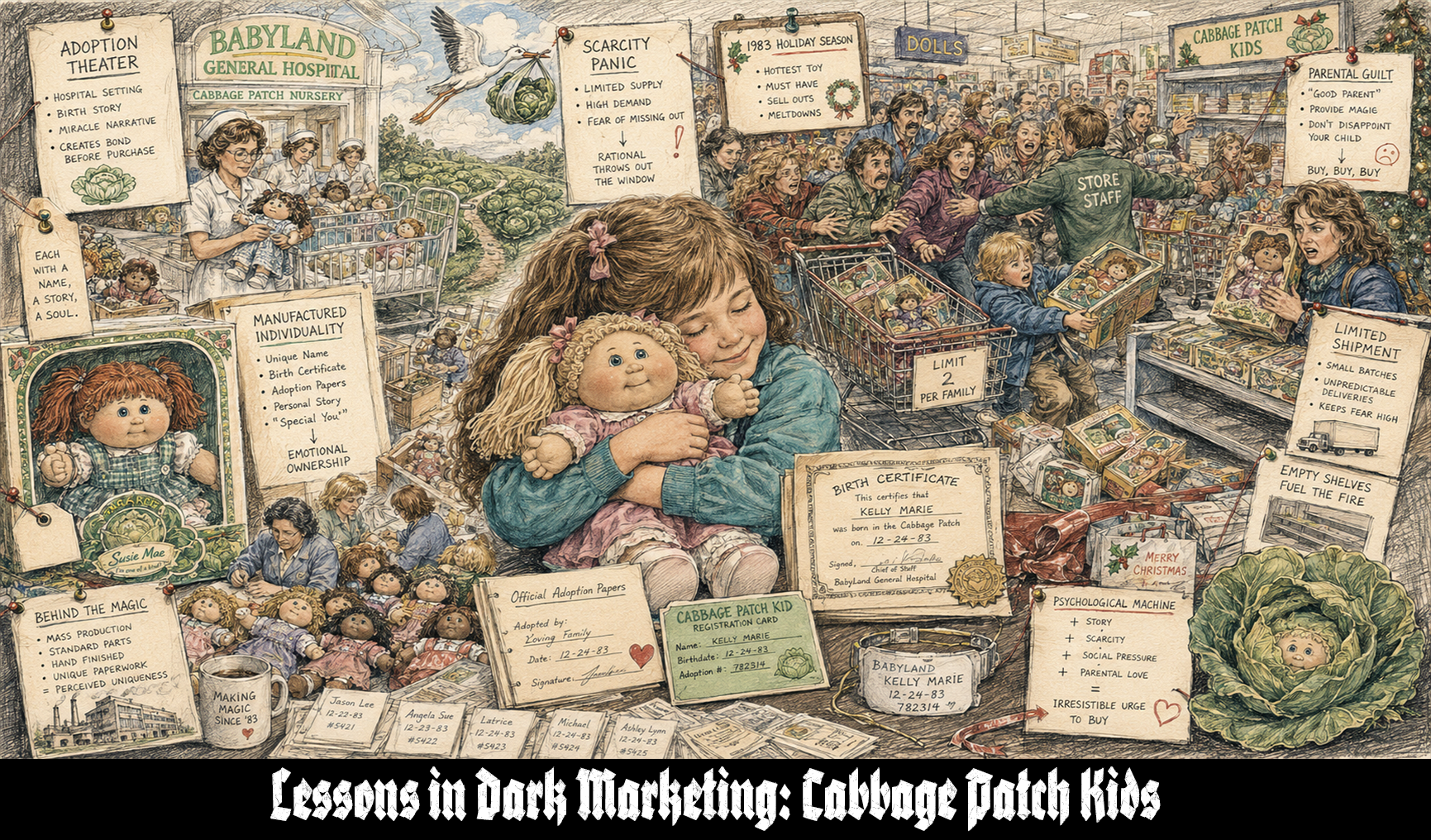
A department-store employee is standing on a counter with a baseball bat while hundreds of adults surge toward a shipment of soft-bodied dolls with yarn hair, plastic heads, and facial expressions suggesting they’ve already reviewed the family finances.
The customers push. They shout. They grab boxes from one another. Store managers issue numbered tickets as though they’re distributing emergency rations after a natural disaster. Somebody gets knocked down. Somebody else leaves with three cracked ribs and a broken leg. A parent who arrived to buy a Christmas present suddenly finds herself participating in a low-budget infantry assault beneath fluorescent lighting.
Inside each box sits a doll with a name, a birth certificate, an adoption record, and enough paperwork to suggest the child is about to assume legal custody rather than open a toy. That paperwork explains the entire crime scene.
The Cabbage Patch Kid wasn’t presented as a manufactured object waiting to be purchased. The transaction was called an adoption. The store became the final stop in a fictional journey from a magical cabbage patch to BabyLand General Hospital and into the arms of a child who had been informed that this specific doll needed a family.
A missing Christmas toy disappoints a child. A failed adoption leaves somebody behind. That emotional difference is where the money lived.
The dolls grew from soft-sculpture figures developed in Georgia by Xavier Roberts, whose Little People were influenced by artist Martha Nelson Thomas’s Doll Babies. Roberts offered the handmade figures for “adoption,” included names and official-looking documents, and built a hospital-themed retail experience in Cleveland, Georgia. Original Appalachian Artworks later licensed the concept to Coleco, which introduced mass-market Cabbage Patch Kids in 1983 with vinyl heads, cloth bodies, computer-generated names, birth certificates, and adoption papers. (The Strong National Museum of Play)
The launch collided with Christmas demand, production limits, saturated advertising, and national media attention. Dolls disappeared from shelves. Parents stood in long lines and fought over limited shipments. At a Zayre store in Wilkes-Barre, Pennsylvania, an estimated thousand shoppers rushed a delivery of 240 dolls, which sold out within thirty minutes as several people were injured. (History)
The physical product was a sixteen-inch doll with a cloth body, molded head, yarn hair, clothes, and individual documents. The machine was adoption language, bureaucratic theater, parental guilt, manufactured individuality, scarcity panic, public spectacle, and the suggestion that leaving the store empty-handed meant failing a child who already had a name.
We’re looking at mass production disguised as family formation, not an ordinary doll craze.
The Doll Was Adopted Before It Was Owned
Most dolls are purchased and then loved. Cabbage Patch Kids reversed the emotional order. The customer was told that the relationship already existed. The doll had a name. It had a birthday. It had come from somewhere. It possessed a personal history before the child entered the room. The purchase didn’t create the character. The purchase rescued the character from institutional limbo.
That changed the buyer’s role. A shopper evaluates products. An adoptive parent accepts responsibility. A shopper can compare prices, walk away, reconsider, or choose another category. A parent is expected to provide a home.
The word “adoption” converted a commercial choice into an ethical performance. The customer wasn’t deciding whether the doll offered good value. The customer was deciding whether this child-shaped object should remain in the box.
The language also made price discussion feel indecent. Nobody wants to sound like they’re negotiating over a baby. Calling the price an adoption fee helped move the transaction away from ordinary retail judgment and toward emotional commitment.
Roberts had used adoption language with the handmade Little People before Coleco entered the picture. Buyers received birth certificates and adoption papers, and BabyLand General Hospital extended the fiction through staff uniforms, bassinets, medical rooms, and a formal adoption process.
This is dark marketing principle number one: Rename the transaction so refusing the product feels like refusing the relationship attached to it.
Cabbage Patch Kids didn’t ask whether you wanted a doll. They asked why little Marcella Beth still didn’t have a mother.
The Paperwork Turned Pretend Affection Into an Official Obligation
Children had loved dolls for generations without completing forms. A child could pick up a doll, assign it a name, invent a birthday, declare it a princess, forget that declaration by lunch, and rename it after the family dog. The emotional relationship belonged to the child because the child created it.
Cabbage Patch Kids arrived with documentation. The birth certificate established identity. The adoption paper established custody. Personality information explained the doll. Registration allowed the relationship to continue through the company. The product entered the home carrying credentials that made ordinary imaginative attachment look under-regulated.
That paperwork gave pretend play bureaucratic weight. A signature transforms an idea. The child didn’t just say the doll belonged to her. She completed an official process confirming the obligation. The document made the fantasy feel recognized by an institution outside the bedroom.
The New Yorker reported that children signed promises to act as responsible adoptive parents and mailed the documents back to the company. Registered dolls could receive birthday correspondence from BabyLand General Hospital, extending the fiction beyond the purchase. (The New Yorker)
The documents also protected the brand from generic substitution. Another soft doll could be hugged, dressed, carried, and placed in a toy crib. It couldn’t produce the same stack of official identity papers.
The paperwork became part of the product’s perceived value, even though the customer had supplied most of the emotional labor before the envelope reached the mailbox.
This is dark marketing principle number two: Documentation can make an ordinary experience feel formal, exclusive, and institutionally validated.
Coleco sold cardboard proof that a child had completed a legally meaningless act with enormous emotional consequences.
The Name Arrived Before the Child Could Choose It
Traditional doll play gives the child naming power. That power matters because naming creates ownership, personality, and intimacy. Cabbage Patch Kids arrived with names already assigned.
The original Little People received names drawn from Georgia birth records. When Coleco mass-produced the dolls, computer-generated combinations allowed the company to preserve the appearance that each doll had entered the world with an individual identity. Some names sounded charming. Others sounded like rural insurance adjusters, retired church secretaries, assistant principals, or people who had been asked to bring a casserole after a funeral.
That awkwardness helped. A perfectly market-tested name would have exposed the product as a product. An odd combination such as Della Gayle or Eldon Clark sounded discovered rather than created. The name implied that the child had encountered an existing person instead of selecting a manufactured character from inventory.
The company had removed one of the child’s creative choices and presented the removal as greater authenticity. That’s the trick. The child might have preferred to name the doll herself, but the assigned name arrived as evidence of individuality. Accepting it became part of accepting the doll. The customer received less control while feeling that the product contained more personality.
This is dark marketing principle number three: Preassign identity when doing so makes mass-produced variation feel discovered instead of manufactured.
The computer printed two names, and the box acted like destiny had completed the paperwork.
Imperfection Became the Product’s Most Perfect Feature
Cabbage Patch Kids didn’t resemble the polished fashion dolls that had dominated shelves. Their faces were wide and pudgy. Their eyes sat close together. Their noses were small. Their mouths looked pursed, uncertain, or mildly offended by the adoption process. Yarn hair and soft bodies gave them a homemade quality that mass production usually scrubs away.
Coleco’s leadership openly contrasted them with Barbie’s glamorous perfection. Company president Arnold Greenberg described the Kids as different, imperfect, and representative of ordinary people “with all our warts.” By 1985, the New Yorker observed that the unconventional dolls had become a dominant toy phenomenon despite lacking the beauty standards traditionally associated with successful dolls. (The New Yorker)
The supposed ugliness created identification. A doll that looks perfect can become an object of admiration. A doll that looks vulnerable becomes an object of care. Cabbage Patch Kids didn’t ask children to become them. They asked children to protect them.
That shifted the emotional center of doll marketing away from aspiration and toward nurture. The face suggested need. The body felt soft. The clothes looked ordinary. The name sounded personal. The child wasn’t staring at an impossible adult fantasy with a sports car and a dream house. She was looking at a round-cheeked dependent who appeared to have arrived without parents or competent hairstyling.
Imperfection also widened recognition. Children who didn’t see themselves in glamorous dolls could find something familiar in varied skin tones, hair, freckles, facial molds, and body styles. The legitimate benefit was real: the brand made room for unconventional beauty and belonging in a category often built around narrow ideals. The commercial machine used that benefit beautifully. Every variation became proof that the doll wasn’t interchangeable.
This is dark marketing principle number four: When perfection creates distance, sell imperfection as intimacy.
Barbie invited the child to imagine becoming extraordinary. Cabbage Patch Kids arrived looking like they needed a ride home from daycare.
BabyLand General Hospital Turned Retail Into Medical Theater
A store displays merchandise. BabyLand General Hospital displayed patients. Roberts had purchased a former medical clinic in Cleveland, Georgia and converted it into a headquarters where employees wore doctors’ and nurses’ clothing, dolls rested in bassinets, and visitors moved through a hospital-themed adoption experience.
The setting transferred emotional authority from medicine to retail. Hospitals are associated with birth, care, vulnerability, expertise, records, urgency, and family transformation. Those associations entered the transaction without the company needing to explain them.
A doll shop says, “Choose what you like.” A nursery says, “Meet your child.” BabyLand placed the customer inside a story before money changed hands. Reception areas, medical uniforms, maternity wards, incubators, nurseries, and the Magic Crystal Tree made the commercial process feel ceremonial.
The environment also protected the absurdity through commitment. Once employees are wearing scrubs and conducting cabbage-based deliveries, ordinary retail language would break the spell. Everyone agrees to call the employees nurses, the inventory babies, the shoppers parents, and the price a fee. The customer participates because participation is more enjoyable than pointing out that the hospital’s patients were produced through manufacturing contracts.
This is dark marketing principle number five: Build a physical environment that forces customers to speak the brand’s language before they can question the premise.
BabyLand didn’t decorate a store. It staged a maternity ward with a cash register hiding near the discharge desk.
The Origin Myth Sanitized Birth and Strengthened the Fantasy
The Cabbage Patch mythology required an explanation for where these children came from. Actual reproduction was unlikely to help sell dolls to young children, so the brand developed a story involving cabbage patches, Bunnybees, magic crystal dust, and fantastical births beneath a tree.
Licensing executive Roger Schlaifer developed the Cabbage Patch Kids name, packaging, and larger mythology after Original Appalachian Artworks reached its agreement with Coleco. The mythology expanded the older folk idea that babies could be found in cabbage patches and created a sanitized origin story suitable for children’s marketing.
The explanation performed several jobs at once. It connected the dolls to the brand name. It avoided uncomfortable biological detail. It gave BabyLand a reason to exist. It supplied material for stories, packaging, television, attractions, and licensed products. Most important, it placed the dolls outside ordinary manufacturing.
A doll created in a factory can be replaced by another doll from the same factory. A child born through magical cabbage agriculture has a destiny. The myth also gave adults permission to participate in nonsense without discussing the commercial mechanics. Parents could repeat the story. Children could describe it to friends. Employees could conduct deliveries. Every retelling refreshed the brand.
This is dark marketing principle number six: A useful origin myth should explain the product while concealing the machinery that produced it.
Cabbage Patch Kids came from magical vegetables because “assembled through a Hong Kong production agreement” lacked bedtime charm.
Mass Production Preserved the Illusion of One-of-a-Kind Children
The handmade Little People could plausibly feel unique because they were produced in small numbers with visible variation. Coleco faced a more profitable problem: preserve that uniqueness while manufacturing millions.
The company used combinations of head molds, skin tones, hairstyles, hair colors, clothing, names, and personal information to create enough variation that shoppers could believe they were choosing individuals. Factories standardized the underlying production and changed the visible details.
That is mass customization before the phrase became a business-school sedative. The dolls were different, but they were different within a controlled menu. The company didn’t need to create millions of original designs. It needed enough combinations to make duplication feel unlikely during an ordinary shopping trip.
The customer supplied the rest of the distinction. Once a child adopted one doll, the freckles became special. The crooked yarn hair became recognizable. The unusual name became family history. The outfit became the outfit worn when they first met.
Manufacturing created variation. Attachment converted variation into uniqueness. This allowed Coleco to enjoy industrial scale while selling the emotional opposite of industrial scale. The company could produce millions of dolls while telling each customer that this particular face had been waiting for this particular family.
This is dark marketing principle number seven: Standardize what customers can’t see and vary what they use to establish identity.
Coleco mass-produced individuality with the efficiency of a factory printing personalized sympathy cards.
Scarcity Turned Interest Into Emergency
A child can want a doll for months. A parent can delay that purchase for months. Scarcity destroys delay. Once adults believed Cabbage Patch Kids might disappear before Christmas, the decision changed from “Should we buy one?” to “Can we find one before another parent does?”
Coleco produced millions of dolls, but demand overwhelmed supply during the 1983 holiday season. The Strong attributes the phenomenon to the new adoption concept, production shortages, and a saturated marketing campaign.
The shortage didn’t have to be intentional to become commercially useful. Empty shelves proved popularity. Long lines proved urgency. Purchase limits proved rarity. News reports proved national importance. Every visible sign of failure to supply the market increased the perceived need to join it.
Parents who had felt neutral began watching. Parents who had planned to wait began calling stores. Parents who had never heard of the dolls began wondering why everyone else considered them essential. Scarcity transformed the product from a preference into a deadline.
This is dark marketing principle number eight: Once availability becomes uncertain, customers stop evaluating the product and start competing for permission to buy it.
The jagoffs running the wider scarcity machine didn’t need to convince anyone the doll was excellent once the empty shelf started doing public relations.
The Store Became a Battlefield Because the Parent Arrived Already Guilty
The famous Cabbage Patch disturbances weren’t caused by the physical attractiveness of the dolls. They were caused by what failure supposedly meant. Christmas had concentrated parental love, social comparison, childhood expectation, and household performance into one morning. The parent understood that other children might receive the year’s most desirable toy. The parent imagined her own child asking why Santa had missed the house.
That fear carried the customer into the store. Once several hundred adults had converted the doll into evidence of good parenting, ordinary civility became negotiable. Shoving another adult could be reframed as fighting for one’s child.
The Wilkes-Barre incident became one of the best-known examples. A store employee reportedly stood above the crowd with a baseball bat while shoppers rushed the limited supply, and five people required hospital care. The absurdity becomes visible only after removing the moral costume.
These weren’t parents securing food, medicine, shelter, or evacuation supplies. They were assaulting one another for dolls whose central message involved care and responsible parenthood. The product didn’t create parental love. The frenzy weaponized it.
This is dark marketing principle number nine: Attach a limited product to a customer’s fear of failing somebody they love and competition can feel like duty.
Adults celebrated adoption by trampling one another beneath a SALE sign.
News Coverage Became a National Commercial Coleco Didn’t Have to Buy
A toy riot is excellent television. The footage contains crowds, shouting, police, empty shelves, emotional parents, frightened employees, and boxes moving through the frame like evidence in a public corruption investigation.
Every report repeated the product name. The audience learned that Cabbage Patch Kids were scarce, desirable, emotionally important, and capable of causing adults to abandon the standards they regularly imposed on children.
The news didn’t need to praise the dolls. It only needed to display the demand. Coverage of fights and shortages could look negative while performing the most valuable advertising task: proving that other people cared desperately.
Social proof becomes especially powerful when the behavior appears costly. A person who waits six hours, drives across state lines, pays a markup, or fights another shopper must believe the product matters. Viewers infer value from sacrifice even when the sacrifice is ridiculous.
The disturbance became part of the mythology. The toy was no longer one product among many. It was the doll people fought over.
This is dark marketing principle number ten: When public disorder demonstrates demand, negative coverage can become premium social proof.
Every news anchor describing the insanity also announced which box America had agreed to want.
The Assigned Child Made Substitution Feel Emotionally Wrong
Retailers often solve shortages by offering alternatives. Cabbage Patch Kids resisted substitution because the product wasn’t framed as a category. It was framed as an individual. A parent might find another baby doll with a cloth body, cute clothes, and a lower price. That alternative still lacked the specific name, face, papers, and mythology the child had been promised.
The company had turned replaceable functions into irreplaceable identity. This is why individual variation mattered so much. If every Cabbage Patch Kid looked identical, another doll could compete on features. Once each one had visible differences, the child could reject alternatives as the wrong child.
The problem became even sharper when shoppers encountered a doll but disliked its combination of hair, skin tone, expression, outfit, or name. Scarcity said, “Take whatever you can find.” Individuality said, “Choose the one that belongs with you.”
Those pressures fought each other and increased engagement. The customer searched longer because any doll could satisfy the category while only the right doll could satisfy the story.
This is dark marketing principle number eleven: Make individual variation central to the purchase and customers will resist functionally equivalent substitutes.
A competing doll could wear the same dress and still fail the background check.
The Adoption Oath Recruited the Child Into Product Maintenance
The adoption process didn’t end when the box opened. The child promised to care for the doll. That promise turned maintenance into morality. Keeping the doll clean, dressed, safe, and included wasn’t simple product care. It was responsible parenting.
This altered how children interpreted wear, loss, and neglect. A missing shoe became more than a lost accessory. A stained outfit suggested poor care. Leaving the doll beneath the bed could create guilt because the product had been framed as dependent.
The company had transferred responsibility to the customer and made that responsibility part of the fun. That’s powerful because customer labor increases attachment. The more time children spent dressing, feeding, carrying, registering, naming, and protecting the doll, the more personal value accumulated around it.
The oath also distinguished the product from fashion dolls whose primary appeal involved outfits, glamour, and adult aspiration. Cabbage Patch Kids centered nurture. The child wasn’t managing a lifestyle. She was managing a dependent.
This is dark marketing principle number twelve: Give customers a duty toward the product and maintenance can feel like proof of love.
Coleco didn’t include a warranty against neglect because the child had already sworn an oath.
The Birthday Card Turned a One-Time Purchase Into a Relationship Calendar
A birthday is a recurring marketing opportunity disguised as affection. Once the adoption papers were registered, the company possessed information connecting a child, a doll, and a date. Birthday correspondence from BabyLand General Hospital allowed the brand to reenter the household after the original excitement had faded.
The card validated the fiction. An outside institution remembered the doll’s birthday. The product’s identity appeared to exist beyond the child’s imagination. BabyLand knew the doll and recognized the family.
That small gesture strengthened retention. The child might celebrate the birthday, dress the doll, request accessories, involve siblings, or remember the broader product line. One piece of mail could restore emotional attention to inventory already sold.
This is an early form of customer relationship management conducted through envelopes, certificates, and the postal service. The company didn’t need an app notification, loyalty dashboard, or automated email sequence. It had an adoptive family and a birthday.
This is dark marketing principle number thirteen: Collect information during an emotional ritual and future marketing can arrive looking like personal recognition.
The birthday card was a retention campaign wearing a party hat.
The Soft Body Made the Doll Easier to Love and Harder to Dismiss
Cabbage Patch Kids had a physical advantage over many hard-bodied dolls. They could be hugged. The cloth torso and limbs created softness, weight, and warmth. The molded vinyl head preserved recognizable facial features and allowed mass production. The design balanced industrial efficiency with tactile intimacy.
That mattered because nurturing play depends heavily on touch. A child could hold the doll against her chest, carry it comfortably, put it to bed, wrap it in blankets, and treat it like a baby without embracing a rigid piece of plastic shaped like a miniature department-store mannequin.
The soft body gave the product legitimacy. The doll wasn’t just a paperwork gimmick. It was physically suited to the emotional experience being sold. That genuine benefit strengthened the darker machinery. Adoption language would have felt hollow if the product were unpleasant to hold. The cuddle value made the narrative believable.
Coleco retained the cloth body while changing the handmade soft-sculpture head into vinyl for mass production, preserving the basic emotional appeal while increasing scale.
This is dark marketing principle number fourteen: Build the product so its physical experience confirms the emotional promise made by the advertising.
Cabbage Patch Kids felt like dependents because they collapsed against the shoulder like sleepy toddlers with unusual tax documents.
Diversity Expanded the Number of Children Who Could Find a Match
Cabbage Patch Kids appeared as boys and girls, with different skin tones, hairstyles, facial details, clothing, and later a growing range of identities and conditions. By 1985, tens of millions had been sold across boy and girl dolls and black and white dolls, while Coleco emphasized that no two were supposed to be exactly alike.
The representation offered real value. Children could find dolls that resembled themselves, their siblings, their friends, or the kind of child they wanted to care for. The brand’s emphasis on unconventional appearance allowed difference to become desirable within a category that often rewarded sameness and idealized beauty.
That widened the emotional market. A company selling one narrow image depends on customers aspiring toward it. A company selling variation can invite customers to search for recognition.
The matching process became part of the purchase. Parents and children could examine faces, hair, clothes, and names until one combination seemed right. The more possibilities Coleco offered, the more plausible destiny became.
This is dark marketing principle number fifteen: Widen representation when the product’s central promise depends on customers finding themselves or somebody they love inside it.
Coleco industrialized belonging and placed it in boxes by the doll aisle.
The Preemie Line Converted Vulnerability Into a Product Category
The brand’s nurturing logic made smaller or more vulnerable dolls commercially powerful. A “preemie” doll didn’t need glamour, adventure, or elaborate technology. The doll needed care.
BabyLand General Hospital incorporated a preemie nursery motif, complete with hospital imagery and incubator-like displays. The Strong’s senior curator has written about owning a bald Cabbage Patch doll marketed as a preemie and later questioning the commercialization of premature babies and adoption within the product line. (The Strong National Museum of Play)
Vulnerability intensified responsibility. The customer wasn’t choosing the strongest, prettiest, or most fashionable doll. She was choosing the one who appeared to need her most.
That emotional structure can be deeply positive in play. Children practice empathy, care, patience, and inclusion. It can also become commercially aggressive when marketers keep discovering new forms of vulnerability that can be packaged into separate lines. The product’s weakness becomes its selling point.
This is dark marketing principle number sixteen: When care drives demand, greater vulnerability can increase perceived emotional value.
The smaller baby required a larger portion of the household’s protective instinct.
Accessories Turned Adoption Into an Ongoing Household Expense
A newly adopted child needs things. Clothes. Shoes. Furniture. Carriers. Bedding. Feeding accessories. Diapers. Furniture. Vehicles. School items. Seasonal outfits. Somewhere in the licensing department, a person realizes parenthood is the finest cross-selling framework ever invented.
Once the doll was framed as a family member, accessories stopped looking like optional decorations. The child needed proper clothing. The baby needed a crib. The family needed supplies. Every new object could be justified as care.
The original doll had opened an expense category. The Strong reports that the brand spread across clothing, dinnerware, accessories, and numerous licensed products, while its senior curator notes that more than two thousand products eventually carried the Cabbage Patch Kids name at the height of the phenomenon. (The Strong National Museum of Play)
Licensing also allowed the adopted child to spread across the real child’s life. Cabbage Patch Kids could appear on clothing, bedding, school supplies, dishes, books, and household goods. The brand no longer occupied the toy box. It occupied the family.
This is dark marketing principle number seventeen: Frame accessories as responsibilities created by the initial purchase and cross-selling begins to feel like proper care.
The adoption fee covered the child. Nobody said anything about the wardrobe, nursery, dinnerware, and licensed bedroom occupation.
The Gift Buyer Could Purchase Emotional Importance Without Knowing the Child
Cabbage Patch Kids were designed for gift pressure. A grandparent, aunt, uncle, family friend, or exhausted parent didn’t need to understand an elaborate rule system. The doll’s importance had already been established through national coverage.
The buyer knew the name. The buyer knew children wanted one. The buyer knew they were difficult to find. Scarcity reduced the need for taste.
Finding any available doll could feel like an achievement. The gift buyer didn’t need to compare quality, features, or educational value. The box carried its own story of demand.
That made the purchase socially efficient. A person could give the child the year’s most visible toy and receive credit for having overcome the shortage.
The doll conferred status on the giver. The adult wasn’t only saying, “I bought you something.” The adult was saying, “I found the thing everyone else couldn’t find.”
This is dark marketing principle number eighteen: When acquisition becomes difficult, the gift communicates the giver’s effort and status alongside the product.
The box contained a doll, an adoption, and proof that Grandma had better retail intelligence than the other side of the family.
Retail Purchase Limits Made Scarcity Look Official
Stores attempted to control demand through tickets, purchase limits, controlled distribution, and crowd management. Those measures were reasonable responses to disorder. They also strengthened the product’s aura.
A purchase limit acts like an official declaration of value. The store is effectively telling the customer that ordinary access has been suspended because the item has become too important.
The limit encourages people to recruit others. Family members visit separate stores. Friends call one another. Shoppers monitor delivery schedules. Employees become sources of intelligence. The product generates a small gray market of favors, tips, and whispered shipment times.
Availability becomes information worth possessing. The customer who knows when the truck arrives has an advantage. The customer who knows a manager has access. The customer who has already secured one doll possesses social leverage.
This is dark marketing principle number nineteen: Restrictions can intensify demand by converting access into privileged information.
Cabbage Patch Kids turned the receiving dock into a classified intelligence station staffed by teenagers wearing store smocks.
The Secondary Market Made Retail Price Look Almost Responsible
When stores ran out, unofficial sellers stepped in. Scarcity created markups, private resale, theft, and stories of people paying far above retail. A doll that had cost an ordinary store price could acquire a much higher emotional value once Christmas approached and supply disappeared.
The secondary market helped the original brand even when Coleco didn’t receive the markup. Inflated resale prices made retail pricing look attractive. If someone else wanted double or triple the amount, finding the doll at a normal store felt like winning.
The New Yorker later reported armed thieves stealing two Cabbage Patch Kids from a Long Island drugstore and described the absurd seriousness with which the dolls’ identities and papers were treated. (The New Yorker) The theft proved symbolic value. Nobody stages a dramatic getaway with a product the public considers interchangeable and abundant.
The resale market also transformed ownership into status. A family with the doll had secured something other families couldn’t. The product could remain soft and nurturing while operating as a trophy.
This is dark marketing principle number twenty: When unofficial prices rise, the authorized price begins to feel like access to hidden value.
The doll entered the store as a toy and left through the secondary market like contraband with dimples.
The Craze Saved Coleco From Its Own Technology Problems
Cabbage Patch Kids didn’t only reshape doll marketing. They helped reshape Coleco.
The company had invested heavily in the Adam home computer, which became a major financial problem. The New Yorker reported that Cabbage Patch Kids brought in roughly $540 million during 1984, helping Coleco absorb losses connected with Adam before the company abandoned the computer and concentrated more heavily on toys. (The New Yorker)
That contrast is magnificent. Coleco had pursued the sophisticated future through computing and found rescue in a cloth-bodied doll whose most advanced feature was documentation.
The doll didn’t speak, compute, move, blink, record, or require batteries. It arrived during a decade fascinated with electronics and defeated technological novelty through emotional paperwork.
That success taught the toy industry something dangerous. A product doesn’t need advanced functionality when the story surrounding ownership is strong enough. Emotional complexity can outperform technical complexity. The certificate beat the circuit board.
This is dark marketing principle number twenty-one: Customers will reward emotional innovation even when the physical product remains technologically simple.
Coleco tried to sell the future through a computer and found salvation in a baby whose operating system was guilt.
The Success Taught the Toy Industry to Attach Credentials to Everything
Cabbage Patch Kids made paperwork fashionable. Birth certificates, adoption papers, personality profiles, ownership records, registration numbers, passports, membership cards, and official documents began appearing across other toys.
The New Yorker’s 1985 survey of the toy market described a growing industry obsession with credentials and explicitly connected the trend to the success of Cabbage Patch Kids. Pound Puppies, dolls, trains, and other products arrived with certificates, clubs, papers, and ownership rituals designed to make ordinary possession feel recognized by an institution. (The New Yorker)
The lesson was easy to copy. Paper is cheap. Identity is valuable. A company could add a document costing pennies and increase the product’s emotional seriousness. The customer might save the paper, mail it back, display it, discuss it, or worry when it went missing.
Documentation also gave companies customer data and future contact opportunities. The credential looked like value to the child and infrastructure to the marketer.
This is dark marketing principle number twenty-two: Once customers accept official paperwork as part of play, inexpensive documents can create identity, retention, and data collection at the same time.
Cabbage Patch Kids didn’t just receive birth certificates. They gave the entire toy industry a minor in public administration.
Abundance Eventually Killed the Emergency
Scarcity created the craze. Production eventually caught up. By 1985, the New Yorker reported that at least thirty-five million Cabbage Patch Kids had been sold, including twenty million through the end of 1984. The dolls remained major sellers, but the terrifying difficulty of finding one had eased. By 1990, about sixty-five million had reportedly been adopted.
The product became more accessible and less urgent. This is the contradiction at the center of mass-market scarcity. The company wants to satisfy demand because unsold demand produces no revenue. Every additional unit also weakens the visible shortage that helped create the demand.
The adoption story survived. The paperwork survived. The faces survived. The brand survived. The national emergency couldn’t survive full shelves.
Once a shopper could calmly compare several dolls, the product returned to ordinary retail judgment. Price mattered again. Taste mattered again. Competing toys mattered again. The fight ended when the inventory arrived.
This is dark marketing principle number twenty-three: Scarcity can create a phenomenon, but satisfying the phenomenon may destroy the conditions that made it irresistible.
America stopped rioting once every aisle had enough abandoned children.
The Doll Offered Genuine Nurturing Play
Cabbage Patch Kids earned affection for reasons beyond marketing. The soft bodies invited hugging and carrying. The varied faces encouraged identification. The adoption materials gave children story prompts. Dressing, caring for, naming, and protecting the dolls supported nurturing play.
Children could practice empathy and responsibility without needing electronic effects or rigid scripts. They could invent families, routines, illnesses, birthdays, schools, conflicts, and entire domestic worlds.
The dolls also challenged conventional beauty standards. Their distinctive faces, varied appearances, and vulnerable qualities allowed many children to find emotional value outside the polished glamour associated with other successful dolls.
Those benefits matter because a manipulative campaign works best when the product delivers something worth loving. The darker machinery didn’t manufacture every feeling. It organized, intensified, and monetized feelings children already possessed. The child’s affection could be sincere while the adult’s panic remained commercially useful.
This is dark marketing principle number twenty-four: Genuine emotional utility gives aggressive marketing the strongest possible defense.
The child learned care from the doll while the adults demonstrated crowd control problems in aisle seven.
Nostalgia Preserved the Adoption Long After the Shortage Ended
The original customer eventually grew up. The doll remained connected to Christmas mornings, parents, grandparents, childhood bedrooms, family photographs, handwritten certificates, and the strange national moment when adults fought over round-faced babies from Georgia.
That memory gave the brand a second life. An adult collector can describe the purchase as preservation, restoration, design history, or nostalgia. The commercial engine still benefits from the emotional relationship established before the customer controlled her own income.
BabyLand General Hospital preserved the retail theater as a destination, combining museum, nursery, adoption center, and gift shop. The hospital motif, staff uniforms, maternity spaces, Magic Crystal Tree, and formal adoption process allowed visitors to reenter the story physically.
The adult no longer needs a parent to locate the doll. She can return to the institution, select one, complete the papers, and finish a childhood transaction on her own authority.
This is dark marketing principle number twenty-five: When the purchase ritual becomes part of childhood memory, the ritual can be sold again as heritage.
The child needed a parent to complete the adoption. The adult arrived with a credit card and unresolved custody issues.
The Case Study Breakdown
- Adoption language: The brand replaced ordinary purchasing vocabulary with a family-formation ritual.
- Official paperwork: Birth certificates and adoption records made pretend ownership feel institutionally recognized.
- Preassigned identity: Names and birthdays suggested that each doll existed before meeting the customer.
- Unconventional appearance: Imperfection encouraged nurture, identification, and emotional closeness.
- Medical retail theater: BabyLand General Hospital borrowed the authority and emotion of birth and care.
- Magical origin mythology: Bunnybees, cabbage patches, and crystal dust concealed manufacturing behind fantasy.
- Mass-produced individuality: Controlled combinations of visible features preserved the appearance of uniqueness.
- Shortage urgency: Limited supply converted preference into a Christmas deadline.
- Parental guilt: Failure to find the doll became evidence of disappointing one’s child.
- Retail disorder: Lines, tickets, injuries, and crowd control demonstrated demand publicly.
- Media amplification: News coverage repeated the product name and showed the scale of desire.
- Substitution resistance: Individual names and faces made competing dolls feel like the wrong child.
- Adoption oath: Children accepted a moral obligation to care for the product.
- Birthday retention: Registration allowed the company to reenter the household through personalized correspondence.
- Tactile intimacy: Cloth bodies made the emotional promise physically convincing.
- Representation: Varied appearances widened identification and belonging.
- Vulnerability marketing: Preemies and dependent-looking dolls intensified nurturing instincts.
- Accessory parenthood: Clothing, furniture, and licensed products extended the expense beyond the initial adoption.
- Gift status: Scarcity made the giver’s successful acquisition part of the present.
- Purchase restrictions: Limits turned shipment information and store access into strategic advantages.
- Secondary-market proof: Markups and theft demonstrated the product’s extraordinary symbolic value.
- Corporate rescue: Doll revenue helped Coleco survive losses connected with its failed computer ambitions.
- Industry imitation: Credentials, certificates, clubs, and registration systems spread across other toy categories.
- Scarcity collapse: Mass availability eventually weakened the emergency that had fueled the craze.
- Legitimate nurturing value: The dolls supported empathy, storytelling, responsibility, and affectionate play.
- Nostalgia renewal: Adult collectors could return to the adoption ritual with their own purchasing power.
These mechanisms worked because each one strengthened the next. The name supported the paperwork. The paperwork supported adoption. Adoption supported responsibility. Responsibility supported accessories. Variation supported individuality. Individuality resisted substitution. Scarcity intensified parental guilt. Crowds created news. News created social proof. Social proof attracted more crowds. The child supplied love. The parent supplied urgency. Coleco supplied enough dolls to build a fortune while remaining temporarily unable to supply enough dolls to stop the panic.
This is dark marketing principle number twenty-six: The strongest emotional products make identity, obligation, scarcity, and social proof reinforce one another until purchasing feels like the final step in a relationship that already exists.
Cabbage Patch Kids turned the toy aisle into family court and made Christmas the custody deadline.
What Marketers Should Learn From Cabbage Patch Kids
The first lesson is that language can transform the customer’s role before the product changes at all.
Calling the transaction an adoption moved buyers away from ordinary price comparison and toward responsibility. A powerful name doesn’t describe only what the product is. It tells the customer who they become after choosing it.
The second lesson is that inexpensive physical materials can carry enormous emotional value.
Birth certificates, adoption papers, personality profiles, and birthday cards cost little compared with the doll, yet they supplied identity, ritual, retention, and customer data. Marketers should stop treating packaging inserts as dead space when those materials can deepen the relationship.
The third lesson is that imperfection can create stronger attachment than polished aspiration.
Cabbage Patch Kids looked vulnerable, unusual, and recognizable. Customers didn’t need to admire them from a distance. They could protect them. Brands built around care should consider whether flawlessness is weakening emotional access.
The fourth lesson is that the environment surrounding a transaction can change what the transaction means.
BabyLand General Hospital used costumes, rooms, language, records, and ceremony to make shopping feel like participation in a living world. An experience becomes memorable when every detail repeats the same emotional premise.
The fifth lesson is that variation must remain visible.
Coleco standardized production while changing the details customers used to establish identity. Product differences become commercially valuable when customers can recognize, explain, and care about them.
The sixth lesson is that scarcity works fastest when attached to a meaningful deadline.
Christmas gave the shortage a fixed endpoint and parental consequences. Urgency becomes more powerful when waiting threatens a relationship, ritual, event, or public expectation.
The seventh lesson is that negative publicity can strengthen demand when it demonstrates sacrifice and popularity.
Store fights looked ugly, but every report proved that the product had become culturally important. Brands should understand that attention and approval aren’t the same asset.
The eighth lesson is that customers resist substitutes when the product has been individualized before selection.
The named doll with a particular face felt irreplaceable even when another doll performed the same functions. Personal identity protects products from category-level comparison.
The ninth lesson is that responsibility can become a retention mechanism.
The adoption oath, registration process, birthdays, clothes, and accessories kept the child involved after purchase. Customers remain engaged longer when they have an active role inside the product’s world.
The tenth lesson is that genuine benefit makes the machine durable.
Cabbage Patch Kids supported nurture, imagination, representation, and emotional play. Those strengths gave children real reasons to love them and gave adults credible reasons to approve them.
The eleventh lesson is that runaway demand creates a dangerous operational contradiction.
Shortages can produce urgency and national attention, but they also create disappointed customers, disorder, markups, and lost sales. The company must increase supply without making the product feel ordinary.
The twelfth lesson is that nostalgia begins accumulating during the original transaction.
The documents, names, rituals, shortages, and family stories became memory assets that could be monetized decades later. A brand that enters the family history doesn’t need to rebuild its emotional meaning from zero.
This is dark marketing principle number twenty-seven: Create a product customers can name, document, care for, search for, celebrate, and remember, and the commercial relationship can outlive the original shortage.
Coleco sold the doll once. The adoption story kept collecting emotional interest.
Final Diagnosis
Cabbage Patch Kids belongs in the Lessons in Dark Marketing museum because the brand turned a cloth-bodied doll into a dependent child, a department store into an adoption center, a production shortage into a national emergency, and parental love into crowd-control footage.
The case against the Cabbage Patch adoption machine is extensive:
- It replaced the word “purchase” with the emotionally loaded language of adoption.
- It turned ownership into a formal ritual through certificates, signatures, and records.
- It gave dolls assigned names and birthdays before the customer met them.
- It made mass-produced variation feel like individual destiny.
- It used unconventional appearance to encourage care and identification.
- It borrowed medical authority through BabyLand General Hospital.
- It created a magical birth mythology that concealed the industrial supply chain.
- It made the customer feel responsible for a product before leaving the store.
- It used Christmas to transform limited inventory into a moral deadline.
- It converted empty shelves into proof of cultural importance.
- It used purchase limits and tickets to formalize scarcity.
- It allowed news coverage of disorder to advertise demand nationally.
- It made substitutions feel emotionally inappropriate.
- It recruited children into maintenance through an adoption oath.
- It used registration and birthday mail to extend the relationship.
- It made softness and weight confirm the nurturing promise physically.
- It used visible diversity to widen recognition and belonging.
- It turned vulnerability into additional product categories.
- It framed accessories as supplies required by responsible parenthood.
- It made successful gift acquisition a status performance for adults.
- It allowed resale markups and theft to reinforce perceived value.
- It generated revenue powerful enough to help rescue Coleco from its computer losses.
- It taught competing toy companies to attach credentials and bureaucracy to play.
- It expanded into thousands of licensed products.
- It produced enough dolls to weaken the shortage that had created the frenzy.
- It delivered legitimate nurturing and imaginative value.
- It preserved the adoption ritual as nostalgia after the craze ended.
Return to the department store.
The doors open. The crowd moves. A shipment of dolls appears beneath the fluorescent lights. Each one has a name. Each one has papers. Each one has supposedly arrived from a magical hospital where employees in scrubs have been maintaining the fiction with admirable professional discipline.
The adults aren’t thinking about vinyl heads, cloth bodies, licensing agreements, computer-generated names, warehouse inventory, or Coleco’s quarterly revenue. They’re thinking about Christmas morning. They’re thinking about the child who asked for one. They’re thinking about another family reaching the shelf first. The brand has arranged the emotional evidence so completely that grabbing a box feels like love and leaving without one feels like failure.
A doll waited inside the package. The panic came from everything Coleco put around it.
Leave a Reply