
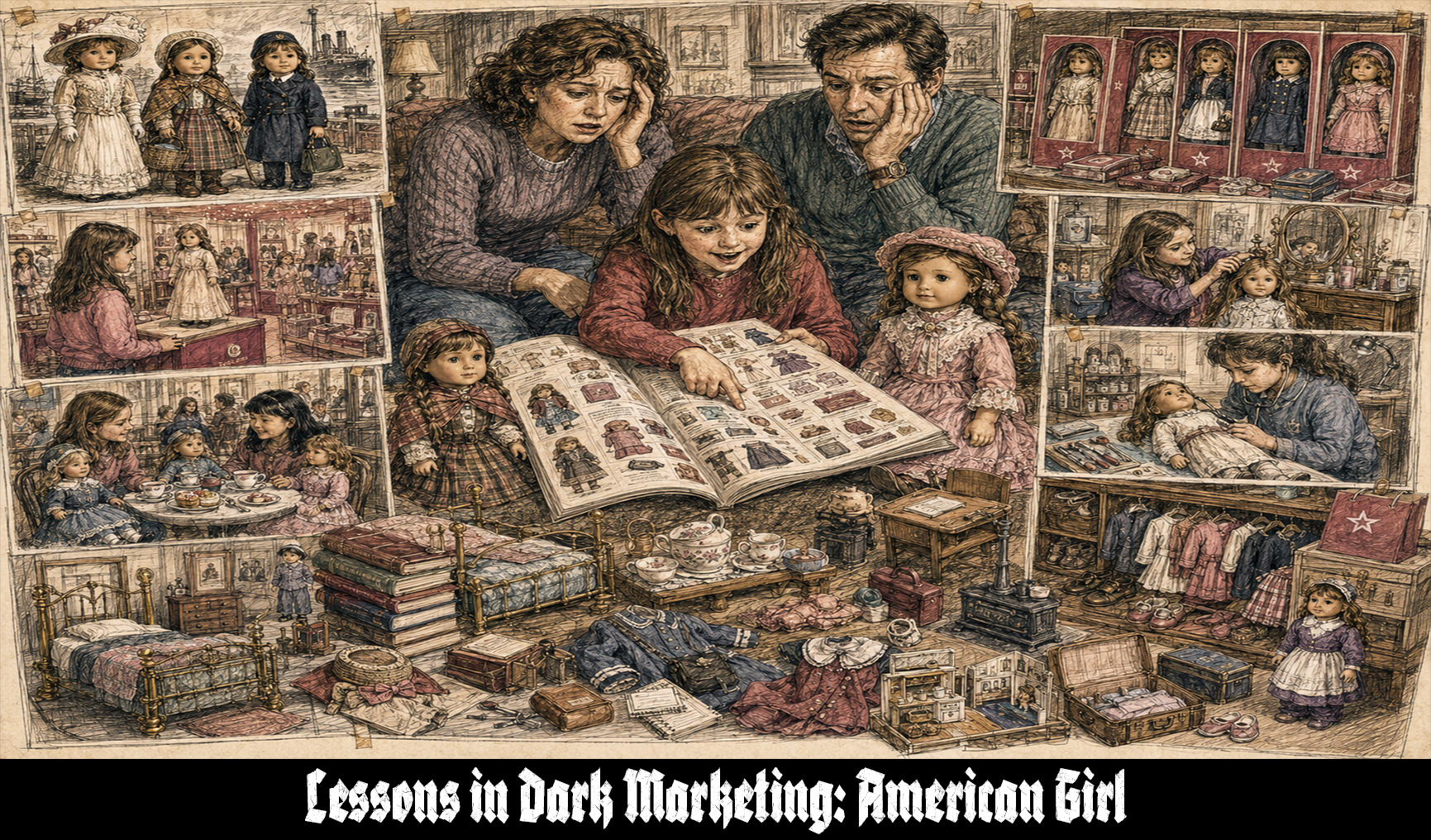
Somewhere in America during the early 1990s, a girl sat on the living-room carpet with an American Girl catalog spread open across both knees and attempted to explain to her parents that the eighty-dollar doll was only the beginning.
Samantha needed her hat. Samantha needed her school desk. Samantha needed her nightgown, tea set, bed, birthday dress, winter coat, books, tiny accessories, and several pieces of historically appropriate furniture apparently required for a nine-year-old plastic resident of 1904 to maintain basic dignity. Molly had her own wardrobe, bedroom equipment, school supplies, and wartime domestic infrastructure. Kirsten couldn’t simply arrive from 1854 and sit around in one dress like some neglected immigrant.
The parents saw a doll. The catalog showed an entire civilization sold separately. This was the beautiful trick at the center of American Girl. Pleasant Rowland didn’t build a toy company around one expensive object. She created characters with biographies, homes, historical periods, possessions, problems, traditions, personalities, and enough miniature household goods to make an adult furnishing an actual apartment begin questioning the economic priorities of the republic.
American Girl began in 1986 after educator and textbook author Pleasant Rowland developed an idea for teaching American history through nine-year-old fictional girls, books, dolls, historically inspired clothing, and accessories. Rowland later described the concept as a miniature version of Colonial Williamsburg brought into girls’ homes through books and playthings. Samantha Parkington represented 1904, Swedish immigrant Kirsten Larson lived in 1854, and Molly McIntire experienced the American home front during World War II in 1944. (USPTO)
The original dolls cost $80, a price high enough that Lands’ End staff reportedly warned Rowland that their customers wouldn’t pay more than $40 for a doll. Mainstream toy-industry assumptions also held that girls aged nine through twelve were already too old for dolls. Rowland ignored both objections and mailed 500,000 catalogs before Christmas 1986 despite being advised to send only 100,000. Pleasant Company sold $1.7 million in merchandise between September and December and reached $7.6 million in its second year. By 1991, annual sales had reached $50 million.
The physical product was an unusually well-made 18-inch doll accompanied by thoughtful historical fiction. The machine was much larger. American Girl sold education as moral permission for premium consumption. It turned historical detail into accessory demand, literary characters into identity categories, catalogs into private fantasy worlds, representation into emotional attachment, and a doll purchase into the opening payment on a miniature lifestyle.
The doll might cost eighty dollars. The childhood built around her had a furniture budget.
The Doll Was Expensive on Purpose
Pleasant Rowland never intended American Girl to compete with bargain-bin dolls. The original concept treated the dolls as heirloom-quality objects with prices to match. They would have sturdy childlike bodies rather than glamorous adult proportions, glossy hair designed for styling, detailed clothing, carefully developed stories, and entire collections of historically inspired accessories. Rowland deliberately rejected the assumption that a doll had to be cheap enough for casual toy-store purchasing.
That positioning changed what the price communicated. An inexpensive doll is easy to classify as a toy. An expensive doll requires an explanation. American Girl supplied several: craftsmanship, education, history, literature, collectibility, durability, and family tradition.
The price became part of the brand. Parents weren’t asked to compare Samantha with whatever doll happened to be hanging on a peg at the local discount store. Samantha existed in a different category, surrounded by books, period furniture, catalog photography, and a biography substantial enough to make the purchase look closer to educational enrichment.
An $80 price in 1986 also created a social signal. Owning an American Girl doll meant somebody in the household had authorized a significant expenditure. Children might not understand inflation-adjusted purchasing power, but they understood which classmates had American Girls and which classmates had dolls that arrived without six hardcover-adjacent chapters of historical context.
The premium price also made the object easier to protect. Expensive toys get special shelves, careful brushing, original boxes, warnings about younger siblings, and family speeches about what happens if somebody brings a permanent marker within twelve feet of Samantha Parkington. Every act of protection reinforced importance.
This is dark marketing principle number one: A high price can create its own evidence of value when the brand gives customers enough respectable language to defend the expense.
American Girl didn’t ask parents to spend eighty dollars on vinyl and cloth. It invited them to make an educational investment whose hair happened to require brushing.
The Books Sold the Doll Before the Catalog Asked for the Money
American Girl’s strongest defense against looking like an expensive toy company was sitting right beside the toy. The books mattered. Each historical character originally came with a six-book story structure that followed major events in her life and connected personal experiences with a broader historical period. The characters encountered war, immigration, child labor, poverty, social class, slavery, political change, and other subjects through narratives written for children. The USPTO’s history of American Girl notes that more than 160 million American Girl books have been sold since the brand’s creation, substantially outpacing doll sales. (USPTO)
That literary foundation altered parental judgment. A child asking for a doll can sound like a child asking for another toy. A child asking for Samantha after reading about child labor, or Molly after learning about the World War II home front, arrives with educational witnesses. The purchase becomes connected to reading.
That is extraordinary moral cover. Parents could see American Girl as an extension of a library rather than an expansion of the toy box. The stories offered legitimate educational value, and the doll transformed reading into tactile play.
Pleasant Rowland described the approach as “chocolate with vitamins.” That phrase captures the entire machine. History supplied the vitamins. The doll, clothing, miniature bed, birthday accessories, school supplies, and tiny tea cakes handled the chocolate. The brilliance was that the educational and commercial systems strengthened one another. The book made the doll meaningful. The doll made the book tangible. The story introduced an object. The catalog sold the object.
This is dark marketing principle number two: When the emotional product looks frivolous, attach it to genuine intellectual value so buying can feel like participation in learning.
Samantha discussed labor reform while her tiny brass bed waited patiently for a credit card.
The Story Turned Every Accessory Into Evidence
Most doll accessories are arbitrary. A doll can wear a blue dress or a red dress. The furniture can be pink, purple, white, or whichever color survived the focus group. American Girl made accessories feel necessary to the dolls history and life.
Kirsten’s clothing reflected her immigrant and frontier life. Molly’s school and household objects belonged to her 1944 world. Samantha’s dresses and furniture reflected her wealthy Edwardian environment. Felicity’s collection included historically inspired clothing and objects developed with input from Colonial Williamsburg staff.
The accessory had appeared in the story. That changed the transaction. A random doll table is extra merchandise. Samantha’s school desk is the desk from Samantha’s world. A generic dress is optional. The dress shown in the book is part of the character.
The story turned commercial expansion into narrative completion. A girl reading the books could recognize the objects in the catalog because the fiction had already supplied meaning. The customer didn’t need advertising to explain why the item mattered. The book had performed that work chapters earlier.
American Girl had effectively embedded product placement inside the imagination. This didn’t make the stories cynical. The historical storytelling was carefully developed, and many accessories genuinely strengthened educational play. That’s what made the system powerful. The fiction worked as fiction while simultaneously creating demand for physical recreations of its world.
This is dark marketing principle number three: Introduce the accessory inside a story before offering it for sale and optional merchandise begins to feel like a missing piece of the narrative.
The child wasn’t asking for another table. She was attempting to maintain historical continuity in the dining room.
Historical Accuracy Made Tiny Furniture Feel Educational
American Girl paid serious attention to research. Felicity’s world was developed with Colonial Williamsburg consultation. Addy Walker’s creation involved an advisory board of Black historians, educators, and museum professionals, including future Smithsonian leader Lonnie Bunch, along with novelist and professor Connie Porter. Clothing, illustrations, environments, and historical circumstances were treated as meaningful elements rather than generic costume decoration.
That rigor produced genuine educational value. It also upgraded the moral status of accessories. A miniature historically inspired tea chest no longer looked like toy clutter. It became material culture. A dress represented an era. A school slate demonstrated historical childhood. A bed, table, bonnet, trunk, or sewing accessory could be described as a way for children to understand everyday life.
The distinction is subtle and commercially enormous. Parents who might reject sixty dollars of random plastic could approve sixty dollars of historically researched miniature objects because the second purchase carried an educational explanation.
American Girl discovered that accuracy increases permission to spend. The more detailed the object became, the more respectable the purchase looked. Cheap simplicity might have weakened the entire premise. Expensive specificity made the world feel researched.
This is where American Girl became especially effective. The educational value wasn’t invented. The company actually did the research. That authentic work created a protective shell around an accessory economy capable of turning one doll into several Christmases of incremental acquisition.
This is dark marketing principle number four: Authentic detail can transform decorative merchandise into educational equipment in the customer’s mind.
The miniature tea service still ended up on the bedroom floor, but it arrived with the moral authority of a museum docent.
The Catalog Was a Toy Store With No Cheap Aisle
Pleasant Company initially bypassed conventional toy retailers. The company sold through mail-order catalogs. Rowland mailed half a million catalogs for the 1986 launch even after the list-management company recommended one-fifth that number. That decision gave American Girl unusual control. A toy store places expensive products beside cheaper alternatives. A customer can compare prices, inspect competing brands, become distracted by another aisle, or decide that a twenty-dollar substitute looks perfectly adequate.
The American Girl catalog contained American Girl. There was no generic doll four inches away costing half as much. The brand controlled the photography, sequence, context, language, and entire visual environment. The catalog could introduce Samantha on one page, show her furniture on another, display her books, present matching clothing, and continue expanding the world until the customer forgot that the original question had been whether the household needed another doll.
The catalog also entered the home. It sat on kitchen tables, bedroom floors, coffee tables, and nightstands. Children circled items, folded corners, made Christmas lists, compared characters, and revisited pages repeatedly without another advertising purchase from Pleasant Company.
The customer preserved the advertisement. That is a spectacular direct-marketing arrangement. The company mailed one piece of media, and children treated it like literature.
This is dark marketing principle number five: Remove competing products from the sales environment and your own merchandise becomes the entire universe of reasonable choices.
The catalog had no bargain aisle because Pleasant Company had thoughtfully removed the concept of financial dissent.
The Catalog Turned Wanting Into a Hobby
Children didn’t only order from American Girl catalogs. They studied them. The catalog offered enough detail to reward repeated reading: character scenes, outfits, furniture, books, accessories, child-sized clothing, room settings, gift ideas, and new releases. A girl could spend hours with the catalog without spending money that afternoon.
This created a strange category of pre-purchase entertainment. Wanting became recreational. A child could imagine which doll she would choose, which bedroom set belonged in the fantasy, which outfit should come next, which accessories would complete the collection, and which relatives might be persuaded to finance each stage.
The catalog gave desire architecture. An ordinary television commercial creates a momentary urge. A catalog gives the customer pages on which to organize the urge.
Wish lists transformed the merchandise into future events. The doll might be Christmas. The bed could be a birthday. The winter outfit could come from Grandma. The tea set might be assigned to an aunt who had made the mistake of asking what the child wanted. American Girl didn’t need one adult to purchase the entire collection. It could distribute the expense across a family calendar.
This is dark marketing principle number six: Give customers enough product detail to plan future consumption and anticipation becomes part of the entertainment.
The girl wasn’t browsing a catalog anymore. She was drafting a five-year capital-improvement plan for Molly McIntire.
The Collection Had No Natural Stopping Point
Buying the doll solved one problem. It created twenty others. A historical character required clothing. Clothing required occasions. Occasions required accessories. Accessories implied furniture. Furniture implied environments. The books introduced additional scenes. Seasonal catalogs introduced additional possibilities.
The collection could expand vertically and horizontally. A customer could go deeper into Samantha’s world or add another character entirely. Once Samantha was adequately furnished, perhaps Molly deserved representation. Once Molly arrived, she brought her own book series, wardrobe, furniture, and historical economy.
This was commercial multiplication disguised as imaginative expansion. There was no natural definition of enough because every object generated context for another object.
A doll with no bed could sleep in the child’s bed. The catalog suggested a better arrangement. A doll with one dress remained functional. The stories established birthdays, school, Christmas, winter, summer, parties, travel, and bedtime. The product line created occasions faster than parents could declare the collection complete.
Modern American Girl still operates through that world-building structure. Historical dolls are currently sold alongside outfits, accessories, playsets, journals or books, and broader collections, with a standard 18-inch historical doll priced around $135 in 2026. (americangirl.com)
This is dark marketing principle number seven: Build the core product so every completed purchase reveals another category of incompleteness.
The doll came home fully dressed and somehow developed a housing crisis before bedtime.
The Doll’s Biography Made Ownership Feel Like Friendship
Samantha wasn’t a blank doll. She had parents, grandparents, friends, fears, beliefs, conflicts, clothes, school experiences, historical circumstances, and opinions. Kirsten had another personality. Molly had another. Addy had another. That characterization gave children more than products to choose from. It gave them relationships to select.
A child might identify with Molly’s glasses, Samantha’s personality, Kirsten’s family story, Addy’s courage, or Felicity’s love of horses. American Girl described its characters as both “windows and mirrors”: a girl might see herself reflected in one story or use another to encounter an unfamiliar life.
This was one of the brand’s most meaningful achievements. It was also superb identity marketing. Choosing an American Girl could become a statement about the customer. The doll said something about who you were, what you valued, which history interested you, and what personality felt familiar.
Children began sorting one another through characters. Who was a Samantha? Who was a Molly? Who had Kirsten energy before anybody used the word “energy” that way? Which doll looked most like you? Which one represented the kind of girl you wanted to become? The merchandise had moved into identity.
This is dark marketing principle number eight: When customers see personality inside a product, choosing among products becomes a way of choosing who they are.
Samantha wasn’t sitting on the shelf waiting to be purchased. She was conducting nine-year-old personality testing in a velvet hat.
“She’s Just Like You” Turned Identity Into Inventory
In 1995, Pleasant Company introduced American Girl of Today, later renamed through several iterations and eventually becoming Truly Me. The sales proposition was explicit: a contemporary girl could choose a doll resembling herself. Customers could select combinations of hair, skin tone, and eye color, while the modern accessory universe expanded into school, hobbies, sports, health, activities, and contemporary childhood. The catalog told girls, “She’s just like you. You’re a part of history too!”
This was the commercial mirror becoming literal. Historical characters asked children to identify with somebody else. American Girl of Today sold the self. That opened a far larger inventory opportunity because personal identity has no fixed historical set. The contemporary doll could acquire whatever the child acquired: school supplies, sports equipment, braces, pets, hobbies, medical devices, furniture, pajamas, holiday outfits, and eventually an enormous range of customization.
In 2017, American Girl extended the concept with Create Your Own, allowing customers to design a doll and apparel through a deeper personalization system. The marketing shift was profound. The company no longer needed to convince the customer to enter Samantha’s life. It could sell the customer a miniature version of her own.
This is dark marketing principle number nine: When customers want products that express identity, make identity itself expandable inventory.
American Girl looked at the entire personality of a child and discovered several hundred potential accessories.
Representation Created Real Emotional Value
American Girl’s identity system can’t be reduced to cynical merchandising because representation genuinely mattered. Addy Walker’s 1993 introduction gave many Black girls a major historical doll who looked like them and whose story centered a Black family navigating slavery and freedom. Pleasant Company assembled a Black advisory board and worked with author Connie Porter to build the series. Porter said she wanted children to understand enslaved people as members of strong, loving families surviving an inhuman system rather than as anonymous historical figures.
Later characters expanded the range of ethnic, cultural, regional, and historical experiences represented by the brand. The contemporary lines also broadened physical representation. American Girl has offered dolls and accessories involving wheelchairs, service dogs, allergy bracelets, hearing-related and medical accessories, and other features intended to normalize differences within play.
That has genuine social value. A child seeing herself represented inside an aspirational toy universe can feel recognized rather than excluded. A child encountering another culture through a carefully researched character can develop empathy and curiosity.
The marketing lesson sits beside that benefit. Representation intensifies attachment because recognition is emotionally powerful. A doll that resembles the child, shares part of her heritage, lives with a familiar difference, or reflects a meaningful family story possesses value beyond the material object. Brands that understand identity can build powerful relationships. They can also sell into those relationships.
This is dark marketing principle number ten: Authentic representation creates emotional value, and emotional value inevitably creates commercial leverage when the representation is attached to a product ecosystem.
Seeing yourself on the shelf can be meaningful and expensive at the same time. Both things can be true.
Serious History Made the Shopping Feel Virtuous
American Girl stories addressed subjects many mainstream dolls never approached. Samantha encountered class inequality and child labor. Addy’s story began with enslavement and escape. Molly’s world dealt with war and family separation. Historical characters gave children routes into immigration, economic hardship, political change, discrimination, and social reform.
This differentiated American Girl from fashion-first doll brands. Parents weren’t simply buying beauty standards, fantasy careers, or miniature consumption. They could purchase a product connected to conversations about courage, injustice, empathy, family, and history.
That gave the brand unusual moral authority. The customer could spend heavily while feeling culturally responsible. Again, the education was real. That is exactly why the marketing worked so well.
A cheaper toy couldn’t necessarily compete by claiming equivalent depth. American Girl created a premium category where the expensive object arrived with enough intellectual seriousness to make ordinary price objections feel slightly vulgar.
The parent questioning the cost risked sounding as though they opposed reading, history, resilience, and girls learning about the world. That is a lovely position for a sales machine.
This is dark marketing principle number eleven: Attach consumption to a moral good and price resistance becomes psychologically harder because refusing the product can feel like refusing the value surrounding it.
Nobody wanted to be the parent standing between a child and American history because Samantha’s accessories looked excessive.
Matching Clothes Collapsed the Border Between Girl and Doll
American Girl didn’t stop at dressing the doll. The company sold clothing for girls inspired by or coordinated with the dolls’ outfits, a practice the brand continues today through matching doll-and-girl clothing sets. This turned ownership into performance. A girl could wear the same nightgown, dress, pajamas, or historically inspired style as her doll. The relationship moved from imagination into visual identification.
The customer didn’t simply possess Samantha. She could become part of Samantha’s world. Matching clothing also created another price tier outside the doll’s scale. A family that had completed the miniature outfit could now purchase a human-sized version.
The same aesthetic crossed from toy into apparel. This is how strong character brands expand: they erase the border between the customer and the object. The doll’s identity becomes wearable.
The child can display affiliation in public without carrying the doll everywhere. The clothes announce the relationship. Photographs make the system even stronger. A child and doll in matching outfits create a family image worth preserving, which converts commercial coordination into sentimental memory.
This is dark marketing principle number twelve: When customers identify strongly with a character, sell them the ability to visually merge with the character.
The doll already had the dress, and now the household discovered that historical accuracy came in children’s sizing.
The Brand Turned Childhood Into a Lifestyle Category
American Girl expanded beyond dolls and historical novels. Pleasant Company created American Girl magazine, advice books, contemporary books, Bitty Baby, American Girl of Today, and other products reaching different ages and interests. Rowland described the company’s ambition as something larger than a doll brand: a company concerned with what was good for girls.
That positioning widened the commercial territory. A doll company can sell dolls. A “girl company” can speak about friendship, confidence, growing up, health, school, hobbies, identity, history, birthdays, clothes, rooms, relationships, and practically anything else occupying childhood.
The brand gained permission to follow the customer through categories. This is a familiar expansion strategy in modern lifestyle marketing. The strongest brands don’t want one purchase. They want to become a trusted interpreter of the customer’s life.
American Girl did that unusually early. The same company selling a miniature school desk could publish advice about friendship and then invite the family into a branded restaurant. That sounds absurd when stated plainly because the integration was executed so smoothly that families rarely experienced it as one sales system.
This is dark marketing principle number thirteen: Stop defining the brand by the product and start defining it by the customer’s life stage.
Pleasant Company sold dolls until it realized girlhood contained considerably more square footage.
The Doll Hospital Made Damage Part of the Relationship
American Girl established its Doll Hospital in Wisconsin in 1988. By 2018, the company said its doll doctors had cared for more than 800,000 dolls. The service, now called the Doll Care Center, continues offering repairs, cleaning, hair care, and other treatments. (americangirl.com)
This was customer service with theatrical genius. A damaged doll wasn’t returned for repair. She went to the hospital. That language protected the illusion of personhood. Hair could be fixed. Skin could be cleaned. Parts could be repaired or replaced. The company communicated about admission, treatment, and a healthy homecoming. A maintenance department became pediatric medicine for vinyl.
Children could experience separation, concern, anticipation, and relief. Parents could justify repair expenses because the doll had acquired emotional history that a replacement might erase. The hospital also supported the premium positioning. An heirloom deserves maintenance. A disposable toy goes in the trash. The service told customers that the product was built for a long relationship and deserved professional care. This made accidental damage less likely to terminate the customer lifecycle.
This is dark marketing principle number fourteen: Turn repair into ritual and product longevity becomes another emotional service the brand can own.
The doll lost a limb, and American Girl responded with bedside manner instead of an RMA number.
“Heirloom” Positioning Made Replacement Feel Like Betrayal
American Girl’s original concept explicitly treated the dolls as heirloom-quality products. (USPTO) That word changed the expected lifespan. A normal toy belongs to childhood. An heirloom belongs to the family.
Parents could imagine storing the doll, preserving the books, protecting the accessories, and eventually passing the collection to another generation. This made the high price easier to defend because the cost could be mentally distributed across decades.
It also encouraged preservation behavior that increased attachment. Boxes were saved. Clothes were organized. Hair was protected. Accessories were cataloged. Missing shoes acquired the emotional significance of stolen museum artifacts.
The product became less disposable because customers were taught to treat it as less disposable. That belief now supports an adult collector market and strong millennial nostalgia. In 2021, a Samantha doll signed and numbered by Pleasant Rowland sold for $14,000 at auction, while early Pleasant Company dolls and complete collections continue attracting collector interest. Most childhood dolls will never command that kind of value, but exceptional examples strengthen the broader fantasy that careful preservation was financially wise.
This is dark marketing principle number fifteen: Describe the product as an heirloom and customers will perform the preservation work that makes the product feel worthy of becoming one.
Samantha spent childhood in a box because somebody’s mother was apparently running a private conservation department.
The Chicago Store Turned the Catalog Into a Pilgrimage
In 1998, American Girl opened its first physical store in Chicago. The brand describes the location as an environment that brought the characters and experiences to life, and later stores expanded dining, celebrations, salons, and interactive activities. This wasn’t ordinary retail. American Girl Place turned shopping into destination entertainment.
A family could travel to the store, browse the full product universe, dine with dolls, attend events, have doll hair styled, celebrate birthdays, take photographs, and convert acquisition into a family outing. The store solved one limitation of the catalog. The catalog allowed children to imagine the world. The store allowed them to enter it.
That experience made price comparison almost irrelevant. Nobody schedules a family weekend around comparing the unit economics of an 18-inch doll. The trip itself created sunk emotional value. Once the family had traveled downtown, made reservations, promised the child an American Girl day, and entered a building constructed around the brand, buying nothing would have required an act of parental discipline bordering on hostage negotiation. American Girl had transformed retail into pilgrimage.
This is dark marketing principle number sixteen: Make the store a destination and the customer begins spending against the value of the entire experience rather than the value of one product.
By the time the family reached the register, they weren’t buying a doll. They were completing the itinerary.
The Café Made the Doll a Paying Member of the Family
American Girl stores extended the fantasy into dining. Current stores still offer doll-friendly restaurant experiences, including special seating for dolls, while birthday packages can include doll-sized cups and saucers, meals, cake, gifts, salon services, and other activities. (americangirl.com)
This is wonderfully strange commerce. The doll doesn’t eat. The doll receives restaurant infrastructure anyway. That miniature chair or place setting tells the child that the doll belongs at the table as a participant.
The emotional fiction becomes spatially real. Families photograph the experience. Children remember taking Samantha to lunch. Parents remember the trip years later.
The transaction moves beyond merchandise into memory production. That is far more defensible than “we spent money inside a doll store.” The family created an experience.
Experiential retail works because memories are difficult to price rationally. A parent may resist a forty-dollar accessory and then spend considerably more on a meal, salon appointment, birthday package, hotel stay, and photograph because the entire day has become sentimental.
This is dark marketing principle number seventeen: When products become participants in family rituals, spending can migrate from object acquisition into memory acquisition.
The doll didn’t touch the macaroni, but apparently her reservation remained essential.
The Salon Turned Maintenance Into Status
American Girl stores also operate doll salons. Customers can pay for hairstyling and related care, and some current locations offer beauty experiences for children alongside their dolls. The company promotes salon services, doll hair care, events, and styling sessions as part of the store experience.
This monetized another part of ownership. Hair was already one of the doll’s defining physical features. Children brushed it, styled it, damaged it, and worried about preserving it. The salon elevated routine care into professional treatment.
A doll hairstyle now had service value. The store became more than the place where the product was purchased. It became the authorized location for maintaining, styling, celebrating, and upgrading the product.
This is ecosystem thinking before the word “ecosystem” infected every investor presentation in America. American Girl controlled the doll, clothing, books, furniture, repair, salon, restaurant, events, and increasingly the entire social ritual around ownership.
This is dark marketing principle number eighteen: Create paid services around product ownership and the transaction continues long after the customer leaves with the original object.
The little cloth-bodied jagoff had acquired a stylist before half the adults in the household did.
Birthdays Converted the Brand Into a Family Milestone
American Girl birthday experiences take the system even further. The company’s current stores offer party packages with meals, cake, goody bags, doll-sized tableware, activities, and higher-tier experiences. Chicago even advertises private events capable of including dedicated store access, doll hairstyles, a personal party coordinator, and other amenities. (americangirl.com)
This is what happens when a toy company becomes an event venue. The birthday gives spending a sacred deadline. Parents who might scrutinize an ordinary Saturday purchase become more flexible when the expense is attached to a once-a-year childhood memory.
The child can invite friends, and every guest enters the branded environment. That transforms one family’s celebration into customer acquisition. A guest who doesn’t own an American Girl doll sees the store, café, salon, outfits, and entire hierarchy of belonging. The birthday girl gets an experience. American Girl gets a room full of prospects.
This is dark marketing principle number nineteen: Attach the brand to milestones and customers will defend higher spending because the calendar has declared the occasion emotionally exceptional.
Nothing lowers price sensitivity like a cake, six children, and one parent who already promised this would be the best birthday ever.
Limited Characters Added Scarcity to an Already Expensive World
American Girl eventually layered limited availability onto the collection. The Girl of the Year line debuted in 2001 with Lindsey Bergman. American Girl describes each Girl of the Year character as available for a limited time, with a new contemporary story and collection taking the spotlight.
This introduced a clock. Historical characters could feel permanent even when collections changed. Girl of the Year announced that waiting could mean losing the opportunity.
A parent who found the doll expensive could postpone the purchase and risk discovering that the character had disappeared. A child who formed an attachment to the books or catalog had a reason to ask now rather than next birthday.
The limited window also made ownership more socially distinctive. Once the character left retail circulation, the child owned something newer customers couldn’t simply purchase. Scarcity joined identity. The character wasn’t only “the one I like.” She became “my year.”
This is dark marketing principle number twenty: Give an identity product an expiration date and emotional preference becomes urgency.
The doll had a biography, hobbies, a wardrobe, and apparently a retail lease expiring December 31.
Archiving Characters Made Corporate Inventory Feel Like Loss
American Girl has also periodically retired or “archived” historical characters and collections. Samantha’s original collection was archived in 2009, Kirsten followed, and Molly was later removed from regular circulation before later returns and anniversary rereleases. The 2026 fortieth-anniversary celebration has brought historical characters back again in special offerings, showing how retirement can later become revival. The language matters. An ordinary product is discontinued. An American Girl is archived.
The word respects the fiction. The character appears to be entering history rather than leaving the product line because management changed the assortment. That softens the commercial mechanics while intensifying emotional reaction. Fans aren’t watching inventory disappear. They’re saying goodbye to Samantha.
Retirement also creates a future nostalgia asset. A character can be withdrawn, missed, discussed, collected secondhand, and eventually returned for an anniversary with enough emotional momentum to make the revival feel important. The company gains scarcity on the way out and nostalgia on the way back.
This is dark marketing principle number twenty-one: Personify the product deeply enough and discontinuation becomes bereavement while rerelease becomes reunion.
American Girl discovered that inventory management works beautifully when customers think the warehouse is holding old friends.
Mattel Bought a Doll Company and Received a Consumption System
In 1998, Mattel purchased Pleasant Company for $700 million. By then Rowland had built American Girl into a business with roughly $300 million in annual sales, proving that the premium dolls, books, catalogs, accessories, and broader girl-focused publishing system had become far more valuable than a niche historical-toy experiment.
The acquisition price validated the machinery. American Girl had found customers outside the assumptions of the mainstream toy industry. It sold to older girls. It charged premium prices. It bypassed toy stores. It used books to create attachment. It turned history into a collection. It developed a trusted relationship with parents.
Mattel wasn’t purchasing one successful doll. It was purchasing a customer architecture. That architecture proved durable enough to survive changes in ownership, retail strategy, character lines, digital commerce, and generational turnover. The products evolved. The basic system remained recognizable.
This is dark marketing principle number twenty-two: The most valuable brands don’t own successful products alone; they own a repeatable structure for creating the next purchase.
Mattel paid seven hundred million dollars and received a toy company whose customers already knew that the bed, books, pajamas, dog, desk, and birthday outfit were sold separately.
Millennial Nostalgia Brought the Entire Catalog Back as Memory
The first major American Girl generation grew up. The dolls didn’t disappear. They moved into closets, attics, storage boxes, childhood bedrooms, resale marketplaces, collector groups, and adult memory. Now the brand can sell back into that nostalgia.
American Girl is celebrating its fortieth anniversary in 2026 with renewed emphasis on original historical characters, anniversary merchandise, and stories designed to reconnect longtime fans with the brand. The original characters have been rereleased in anniversary collections, while adult nostalgia has become a visible part of American Girl’s cultural life.
The adult customer has different purchasing power. The child who couldn’t afford Samantha’s furniture can now buy it. The parent who saved Molly can pass her to another generation. The collector can rebuild the collection that disappeared during a garage sale conducted by somebody who didn’t recognize the long-term strategic value of tiny pioneer accessories.
Nostalgia also changes the meaning of the price. A $135 doll bought for a child is a toy purchase. A $135 doll bought by an adult recovering a formative memory can be classified as collecting, preservation, self-gifting, décor, family heritage, or emotional reparations for Christmas 1994. Same doll. Better accounting terminology.
This is dark marketing principle number twenty-three: When childhood desire survives into adulthood, disposable income can finally complete the collection that allowance never could.
The catalog closed thirty years ago, but somewhere inside the millennial brain Samantha’s furniture order remained pending.
The Current Brand Still Sells the World, Not the Doll
American Girl’s modern store shows how little the underlying strategy has changed. An 18-inch historical doll currently sits around $135. Clothing and accessories expand around the character. The brand operates retail stores with shopping, cafés, parties, salons, events, care services, personalization, and associated travel experiences. Some hotel partners even advertise packages connected to American Girl visits. (americangirl.com)
The doll remains the entrance. The world remains the business. American Girl can sell books to readers, dolls to children, nostalgia to adults, outfits to collectors, salon appointments to owners, birthday experiences to families, meals to visitors, repair to longtime customers, and new characters to the next generation.
That is why the original $80 objection missed the point. The doll was expensive. The lifetime value of belonging to American Girl was much larger.
This is dark marketing principle number twenty-four: When the core product opens a world of identities, services, rituals, accessories, and memories, the first purchase should be understood as customer enrollment.
The doll was never the destination. It was the beautifully brushed admission ticket.
The Case Study Breakdown
- Premium pricing created prestige: The original $80 price separated American Girl from ordinary dolls and made quality part of the brand story.
- Books supplied intellectual legitimacy: Historical fiction made the purchase feel connected to reading and education.
- Stories pre-sold accessories: Objects appearing in the characters’ worlds became commercially meaningful before entering the catalog.
- Historical research justified detail: Carefully developed clothing and furniture could be framed as educational material culture.
- Mail order removed cheaper comparisons: The catalog placed customers inside an American Girl-only sales environment.
- Catalog browsing turned desire into recreation: Children studied products, planned collections, and maintained wish lists for months.
- The collection had no natural endpoint: Clothing, furniture, books, seasons, occasions, and additional characters continually reopened demand.
- Character personalities created identity categories: Choosing a doll could express the customer’s own personality and aspirations.
- American Girl of Today monetized self-recognition: Look-alike dolls transformed the child herself into the product theme.
- Representation created meaningful attachment: Cultural, racial, physical, and personal recognition made products emotionally significant.
- Serious history gave consumption moral authority: Parents could connect expensive purchases to education, empathy, and girls’ empowerment.
- Matching clothes merged girl and doll: The brand expanded from toy ownership into wearable identity.
- Publishing expanded the territory: American Girl positioned itself around girlhood rather than around one product category.
- The Doll Hospital extended product life: Repair became a ritual reinforcing personhood and long-term attachment.
- Heirloom positioning encouraged preservation: Families treated dolls and accessories as objects worth keeping for decades.
- American Girl Place turned shopping into pilgrimage: The retail environment made purchasing part of a destination experience.
- Dining placed dolls inside family rituals: The brand monetized participation rather than simple ownership.
- Salon services created recurring spending: Product care and styling became professional experiences.
- Birthday packages attached the brand to milestones: Emotional occasions reduced resistance to larger expenditures.
- Girl of the Year introduced scarcity: Limited availability turned character preference into urgency.
- Archiving turned discontinuation into emotional loss: Character retirement created nostalgia and later revival opportunities.
- Mattel purchased the whole customer system: The $700 million acquisition validated the commercial architecture.
- Millennial nostalgia recovered adult customers: Childhood desire returned with adult purchasing power.
- The modern brand remains an ecosystem: Dolls continue to lead into clothing, books, services, experiences, personalization, and events.
These mechanisms worked because American Girl almost never asked customers to defend consumption as consumption. There was always another explanation available. The doll encouraged reading. The dress taught history. The furniture recreated material culture. The expensive object was an heirloom. The matching clothes celebrated identity. The store visit created memories. The salon maintained the doll. The birthday package celebrated childhood. The limited character had to be purchased before she disappeared.
Every expenditure arrived with emotional paperwork. That didn’t make the benefits fake. American Girl genuinely created smart books, serious historical research, meaningful representation, durable toys, and memorable experiences.
The commercial brilliance came from making those genuine benefits inseparable from an endlessly expandable product world.
This is dark marketing principle number twenty-five: The strongest premium ecosystems give every additional purchase a reason more respectable than “we wanted more stuff.”
American Girl built a shopping empire inside history class and let the parents congratulate themselves on the curriculum.
What Marketers Should Learn From American Girl
The first lesson is that premium pricing works when the entire experience supports the price.
American Girl didn’t put an eighty-dollar doll inside cheap packaging and hope parents understood. The catalog photography, books, clothing, research, construction, language, and service system all reinforced the idea that this belonged in a different category.
The second lesson is that content can sell physical products without behaving like advertising.
American Girl’s stories created emotional relationships before many families purchased the doll. When customers know a character’s fears, friends, history, and personality, merchandise enters an existing relationship instead of starting from zero.
The third lesson is that accessories sell better when they carry narrative meaning. A chair can be optional.
A chair connected to a scene, historical period, or beloved character becomes part of the world. Context increases perceived necessity.
The fourth lesson is that direct marketing becomes powerful when customers keep the advertisement.
American Girl catalogs were browsed, reread, circled, shared, and turned into wish-list infrastructure. The catalog became entertainment instead of disposable media.
The fifth lesson is that identity is more expandable than function.
Once American Girl moved from historical characters to dolls resembling the customer, almost every part of childhood became potential merchandise. School, hobbies, health, clothes, pets, rooms, sports, and personality could all enter the collection.
The sixth lesson is that representation works best when it’s real.
Addy’s development involved serious consultation, authorship, research, and historical consideration. Customers can distinguish between superficial cosmetic diversity and representation that carries narrative depth. The emotional bond is stronger when the work behind it is credible.
The seventh lesson is that an ecosystem should solve problems created by ownership.
Dolls need clothing, care, repair, storage, styling, social experiences, and reasons to reappear in the customer’s life. American Girl built services around those needs instead of surrendering them to other businesses.
The eighth lesson is that physical retail can survive eCommerce when the store offers something a website can’t reproduce.
American Girl Place became a café, salon, event venue, party destination, photographic backdrop, and family ritual. The store justified travel because shopping was only one activity inside it.
The ninth lesson is that limited availability becomes especially powerful when attached to identity.
Girl of the Year works because the customer may identify with that specific character. Scarcity threatens a relationship rather than access to generic inventory.
The tenth lesson is that discontinuation can be managed as storytelling.
“Archiving” preserved the dignity of the characters and made future returns emotionally valuable. Brands with beloved legacy products should understand that removing and restoring a character can produce different forms of demand.
The eleventh lesson is that nostalgia rewards brands that preserve distinctive details.
The white catalog pages, historical outfits, books, character personalities, and miniature accessories remained vivid enough to reactivate adult customers decades later. Generic products rarely produce that kind of recall.
The twelfth lesson is that genuine value and manipulative marketing frequently occupy the same product.
American Girl could educate children, broaden representation, encourage reading, create meaningful memories, and run a highly sophisticated consumption machine simultaneously. Marketers should understand the power of that combination and the responsibility attached to it.
This is dark marketing principle number twenty-six: when every commercial mechanism is attached to something customers sincerely value, the sales machine becomes difficult to separate from the experience they love.
American Girl didn’t hide commerce behind history. It stitched the two together until pulling one thread threatened the whole dress.
Final Diagnosis
American Girl belongs in the Lessons in Dark Marketing museum because it transformed one of the easiest products to dismiss as frivolous—a doll—into an educational, literary, historical, emotional, experiential, collectible, and intergenerational consumption system.
The brand deserves credit for what it did well. It put girls at the center of history. It published books that introduced difficult subjects to young readers. It invested in historical research. It created characters children genuinely loved. It expanded representation. It gave girls intellectual worlds that didn’t revolve entirely around romance, beauty, or becoming attractive to somebody else.
That genuine achievement made the commercial machine stronger.
The final diagnosis is sitting inside the catalog:
- American Girl used premium pricing to create prestige.
- The books gave the dolls educational authority.
- Historical fiction introduced accessories before they were sold.
- Research turned miniature furniture into material culture.
- Mail order removed cheaper competitors from view.
- Catalogs became entertainment and long-term wish lists.
- Every accessory opened another category of need.
- Character personality turned purchase into identity.
- Look-alike dolls converted self-expression into merchandise.
- Representation produced meaningful emotional attachment.
- Serious historical themes made expensive consumption feel virtuous.
- Matching clothes allowed girls to wear the brand relationship.
- Publishing transformed a doll company into a girlhood lifestyle company.
- The Doll Hospital extended ownership through ritualized repair.
- Heirloom positioning taught families to preserve the product.
- Retail stores transformed purchasing into family pilgrimage.
- Cafés brought dolls into meals and memories.
- Salons turned maintenance into another transaction.
- Birthday packages attached American Girl to emotional milestones.
- Girl of the Year added limited-time urgency.
- Archiving transformed discontinued inventory into lost characters.
- Rereleases converted that loss into nostalgia-fueled return.
- Mattel’s $700 million purchase validated the ecosystem.
- Millennial adulthood reopened collections with greater disposable income.
- Today’s dolls still lead into clothing, books, playsets, salons, dining, events, repairs, customization, and travel.
- American Girl proved that one expensive doll could become the center of an entire miniature economy.
Return to the living-room floor. The catalog is still open. The girl has chosen Samantha. The parents have accepted the doll. That should settle the matter. Samantha possesses a body, hair, shoes, clothing, and enough fictional independence to survive child labor reform without additional household assistance.
Then the page turns. There is the bed. There is the desk. There is the nightgown. There is the birthday dress. There is the tea set. There are the books. There are the accessories from the books. There are clothes for the doll. There are matching clothes for the child.
There is another historical girl waiting fifty pages later with an entirely separate furniture problem. The parents wanted to buy their daughter something meaningful. American Girl understood that meaning could be expanded indefinitely.
That was the genius. The history was real. The books mattered. The characters mattered. The representation mattered. The memories mattered. And because all of it mattered, the furniture suddenly looked perfectly reasonable.
The doll was the evidence. The real product was the world she required.
Leave a Reply